

When you're sourcing broccoli seed extract powder for supplement capsules, functional foods, or nutraceutical blends, the format question comes up fast. Powder or liquid? Both carry glucoraphanin. Both can deliver sulforaphane to the body. But they behave very differently once they leave the supplier's warehouse - and those differences have real consequences for your shelf life, formulation process, regulatory documentation, and landed cost per kilogram.
This guide walks through every dimension that matters to B2B buyers: stability, bioavailability, processing compatibility, cost structure, and application fit. By the end, you'll know exactly which format belongs in your supply chain.
What "Format" Actually Means in Broccoli Seed Extract
Before comparing the two, it helps to understand what each format is - and what it isn't.
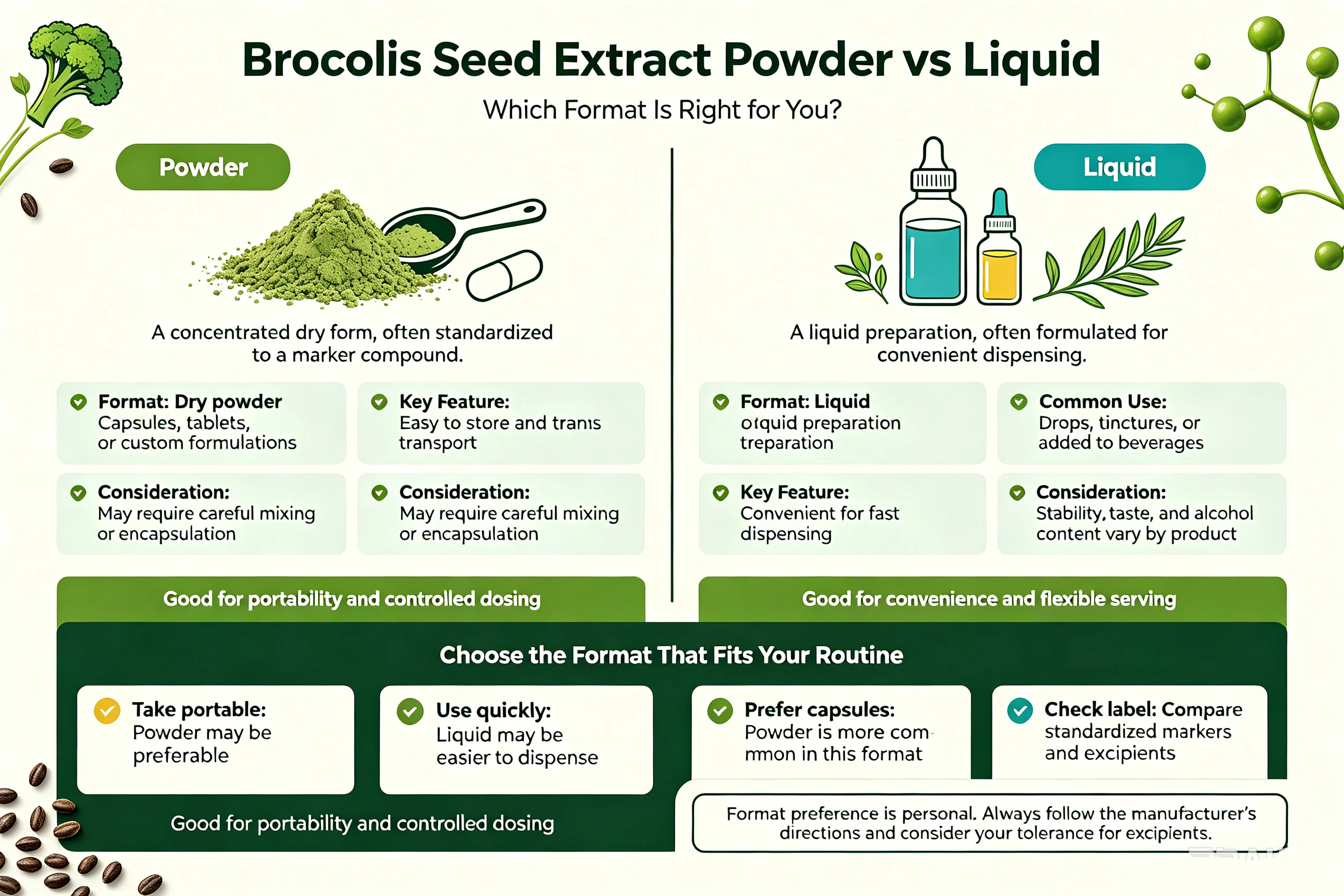
Broccoli seed extract powder is produced by extracting glucosinolates from broccoli seeds using water or hydroalcoholic solvent systems, then removing the solvent through spray drying or freeze drying. The result is a free-flowing, shelf-stable powder standardized to a declared glucoraphanin or sulforaphane percentage.
Liquid broccoli seed extract retains the solvent carrier - typically water, glycerin, or ethanol - and delivers the active compounds in solution. It skips the drying step entirely.
These are not just different physical states. They represent fundamentally different stability profiles, processing requirements, and end-use applications.
Stability: Where Powder Wins Decisively
Stability is the single most important factor for most B2B buyers - and this is where broccoli seed extract powder holds a clear structural advantage.
Powder Stability Profile
Glucoraphanin in dry powder form is chemically inert under standard storage conditions. Published research confirms that glucoraphanin-standardized powder retains over 95% potency after 24–36 months when stored at cool, dry conditions (below 25°C, relative humidity below 60%).
Key stability advantages of powder format:
- No aqueous degradation pathway - water activity is near zero, so hydrolysis cannot proceed
- No microbial growth risk - dry matrix does not support bacterial or mold proliferation without added preservatives
- Thermal resilience - glucoraphanin powder remains stable up to 100°C under neutral pH, surviving most encapsulation and blending processes
- Oxidative resistance - the glucosinolate backbone is not susceptible to lipid oxidation pathways
Liquid Stability Profile
Liquid extracts face a fundamentally different challenge. Once glucoraphanin enters an aqueous environment, several degradation pathways activate simultaneously:
- Enzymatic hydrolysis - residual myrosinase activity (if not fully heat-inactivated) converts glucoraphanin to sulforaphane prematurely, which then degrades
- Sulforaphane volatility - free sulforaphane in solution loses potency rapidly; research shows sulforaphane loses approximately 50% of its activity within 72 hours at ambient temperature in aqueous solution
- Microbial contamination risk - aqueous matrices require preservative systems (potassium sorbate, sodium benzoate) that may conflict with clean-label positioning
- pH sensitivity - glucosinolate stability in solution is highly pH-dependent, with accelerated degradation below pH 4 or above pH 8
The practical implication: A liquid broccoli extract shipped from a Chinese manufacturer to a European supplement brand faces a 4–6 week transit window. Without validated cold-chain documentation, the declared potency on arrival may differ significantly from the COA issued at the point of manufacture.

Bioavailability: More Nuanced Than You Think
The common assumption is that liquid extracts absorb faster and therefore deliver better bioavailability. For some botanical ingredients, that holds. For broccoli seed extract, the picture is more complex.
How Absorption Actually Works
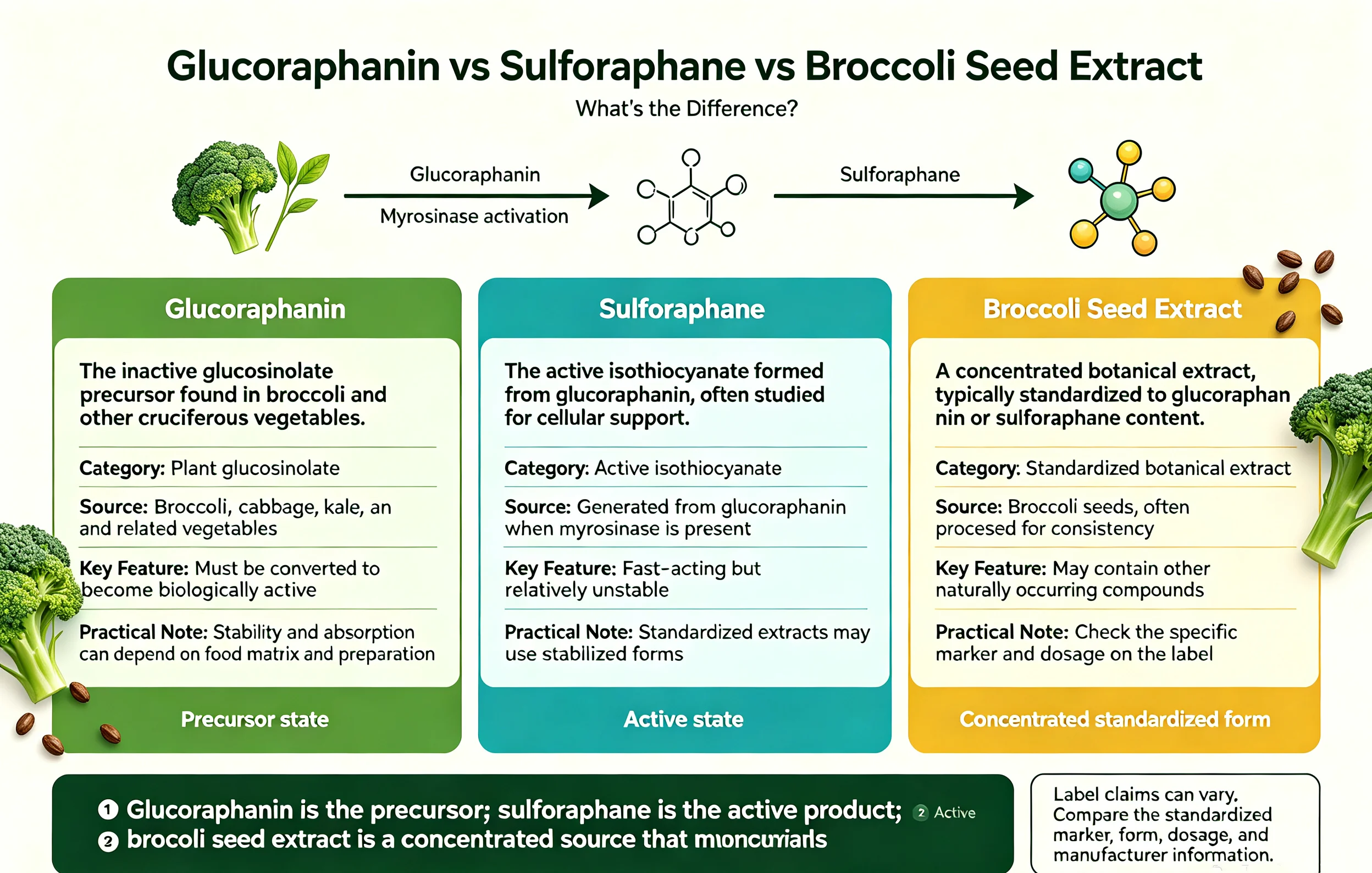
Broccoli seed extract's bioavailability depends on glucoraphanin-to-sulforaphane conversion, not on the physical format of the raw material. The conversion pathway is:
Glucoraphanin (stable precursor)
↓ [Myrosinase - gut microbiota]
Sulforaphane (active isothiocyanate)
↓ [Nrf2/Keap1 pathway activation]
Cytoprotective enzyme induction
Whether glucoraphanin enters the gut from a powder capsule or a liquid tincture, the conversion rate depends on gut microbiome composition - not on the delivery vehicle.
Format Impact on Bioavailability
|
Parameter |
Powder Format |
Liquid Format |
|
Dissolution speed |
Moderate (requires gastric fluid) |
Fast (already in solution) |
|
Glucoraphanin integrity at ingestion |
✅ High - no pre-conversion |
⚠️ Variable - depends on storage |
|
Sulforaphane pre-conversion risk |
✅ Low |
❌ Higher - especially in aged liquid |
|
Gut conversion rate |
Microbiome-dependent |
Microbiome-dependent |
|
Urinary dithiocarbamate recovery |
70–90% (validated) |
70–90% (if GR intact at ingestion) |
|
Myrosinase co-delivery option |
✅ Easy - blend with radish powder |
⚠️ Complex - enzyme stability in liquid |
The key insight: a powder capsule with intact glucoraphanin delivers equivalent or superior bioavailability compared to a liquid extract where glucoraphanin has partially pre-converted and sulforaphane has begun to degrade.
Processing & Formulation Compatibility
This dimension matters most to contract manufacturers and in-house formulation teams. The format you choose directly determines which dosage forms are available to you.
Powder Format - Formulation Versatility
Broccoli seed extract powder integrates cleanly into virtually every solid and semi-solid dosage form:
- Capsules (HPMC / gelatin) - direct fill, no compatibility issues
- Tablets - compatible with standard excipients; no compression instability
- Sachets & stick packs - free-flowing grades available for direct consumer use
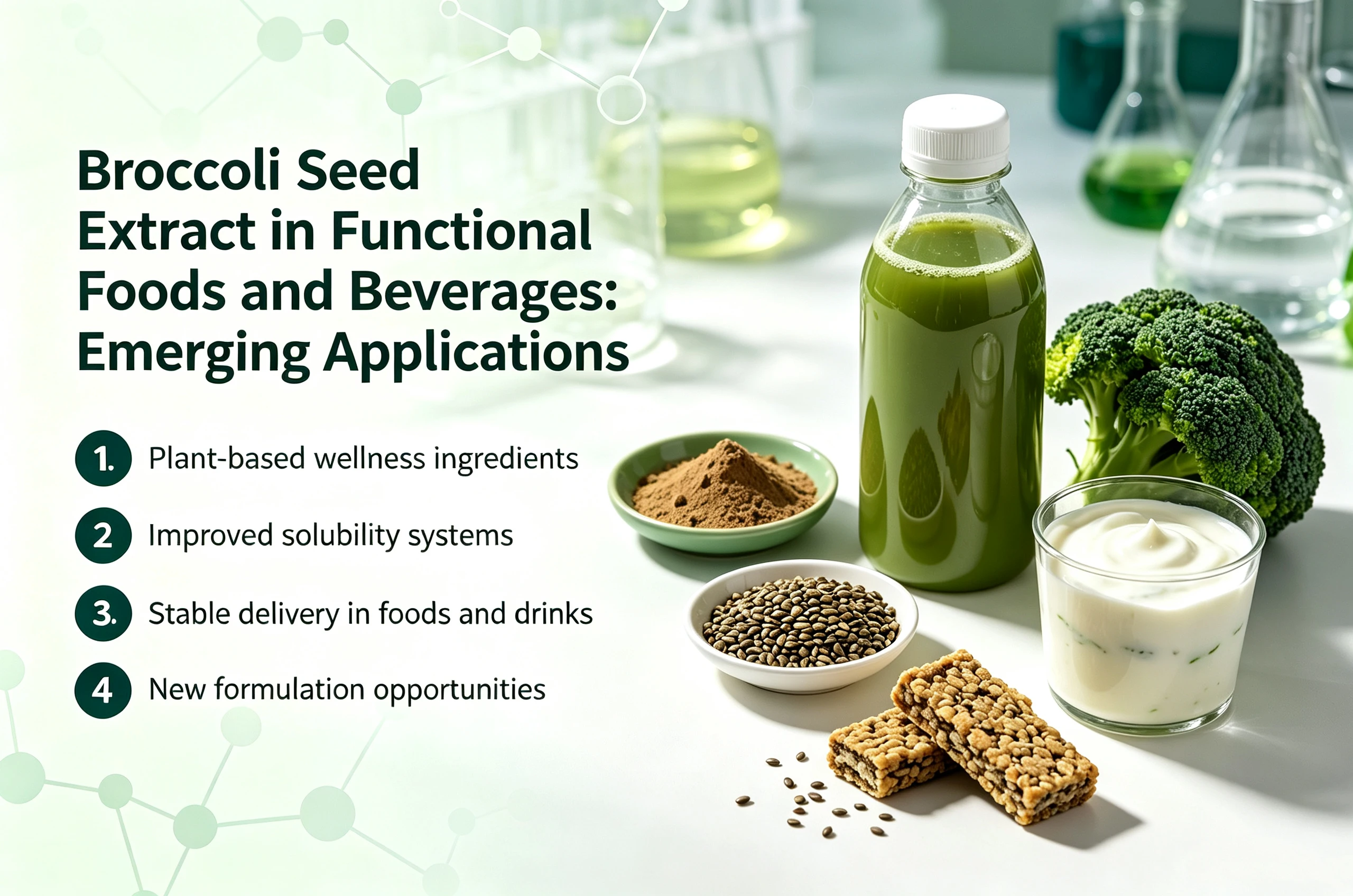
- Functional food blends - protein powders, greens blends, meal replacements
- Gummies - compatible with gelatin and pectin matrices at standard processing temperatures
- Spray-dried beverage premixes - water-soluble grades achieve ≥98% clarity in solution
- FSMPs and clinical nutrition - milligram-precise dosing with excellent batch-to-batch consistency
Powder also simplifies GMP manufacturing compliance. Dry blending operations carry lower cross-contamination risk, simpler cleaning validation requirements, and more straightforward environmental monitoring programs than liquid processing lines.
Liquid Format - Formulation Constraints
Liquid extracts fit a narrower set of applications:
- RTD beverages - viable if pH and preservative system are compatible
- Tinctures and drops - direct consumer use, typically glycerin or ethanol-based
- Soft-gel fill - oil-soluble liquid extracts can fill soft-gel capsules
- Topical formulations - aqueous or hydroalcoholic bases for cosmeceutical use
The constraints are real:
- Liquid lines require dedicated equipment, separate from dry processing
- Preservative requirements add label complexity and potential consumer objections
- Dose precision is harder to achieve - viscosity variation affects volumetric fill accuracy
- Regulatory documentation for liquid extracts often requires additional stability data submissions
Cost Structure: Total Landed Cost vs Unit Price
Purchase price per kilogram is rarely the right metric for format comparison. Total landed cost - including freight, cold-chain requirements, yield loss, and rework risk - tells a more accurate story.
|
Cost Factor |
Powder Format |
Liquid Format |
|
Unit price (per kg active) |
Moderate |
Lower (higher water content dilutes cost) |
|
Freight classification |
Dry goods - standard |
Liquid goods - higher freight class |
|
Cold-chain requirement |
❌ Not required |
✅ Often required - adds cost |
|
Shelf life at destination |
24+ months |
12–18 months (with preservatives) |
|
Yield loss in manufacturing |
Low - dry blending |
Higher - filling losses, viscosity variation |
|
Rework / retest cost |
Low |
Higher - potency drift requires retesting |
|
Storage infrastructure |
Standard warehouse |
Temperature-controlled storage |
|
Customs / import classification |
Standard botanical extract |
May require additional documentation |
When you account for cold-chain freight, shorter shelf life (meaning faster inventory turnover requirements), and higher rework risk, powder format typically delivers lower total landed cost for most B2B buyers - even when the liquid unit price appears lower.
Regulatory & Quality Documentation
For B2B buyers supplying regulated markets - EU, USA, China, Japan - documentation requirements are non-negotiable.
What to Require From Any Supplier
For powder format:
- HPLC-verified COA (assay, heavy metals, pesticides, residual solvents, microbiology)
- Accelerated stability data (37°C / 75% RH, 90-day minimum)
- Batch-to-batch consistency data across ≥3 production lots
- In vitro conversion rate documentation
For liquid format (additional requirements):
- Preservative system declaration and validated efficacy data
- pH stability data across the declared shelf life
- Cold-chain validation documentation
- Microbial challenge test results
Certifications to require from either format:
- ISO 9001 / ISO 22000 / FSSC 22000
- cGMP (FDA-inspected facility)
- USDA / EU NOP Organic (if applicable)
- Halal & Kosher
- HACCP
Which Format Is Right for Your Application?
Here's the practical decision matrix:
Choose broccoli seed extract powder when:
- You manufacture capsules, tablets, powders, gummies, or functional food blends
- Your supply chain spans international shipping without cold-chain infrastructure
- You need 24+ month shelf life for inventory flexibility
- You're targeting clean-label positioning without preservatives
- You need milligram-precise dosing for clinical or FSMP applications
- You're scaling production and need consistent batch-to-batch reproducibility
Choose liquid broccoli seed extract when:
- You produce RTD beverages, tinctures, or liquid drops for direct consumer use
- Your manufacturing facility already runs dedicated liquid processing lines
- You're developing topical or cosmeceutical formulations
- Your target market specifically demands liquid format (e.g., pediatric drops, elderly care)
- You have validated cold-chain logistics from supplier to finished product
The honest answer for most B2B buyers: Broccoli seed extract powder covers 85–90% of commercial supplement and functional food applications with better stability, lower total cost, and simpler regulatory documentation. Liquid format serves specific niches well - but it's the exception, not the rule.
References
- Fahey, J. W., Wehage, S. L., Holtzclaw, W. D., Kensler, T. W., Egner, P. A., Shapiro, T. A., & Talalay, P. (2015). Sulforaphane bioavailability from glucoraphanin-rich broccoli: Control by active endogenous myrosinase. PLOS ONE, 10(11), e0140963.
- Shapiro, T. A., Fahey, J. W., Dinkova-Kostova, A. T., Holtzclaw, W. D., Stephenson, K. K., Wade, K. L., Ye, L., & Talalay, P. (2006). Safety, tolerance, and metabolism of broccoli sprout glucosinolates and isothiocyanates: A clinical phase I study. Nutrition and Cancer, 55(1), 53–62.
- Vanduchova, A., Anzenbacher, P., & Anzenbacherova, E. (2019). Isothiocyanate from broccoli, sulforaphane, and its properties. Journal of Medicinal Food, 22(2), 121–126.
- Rein, M. J., Renouf, M., Cruz-Hernandez, C., Actis-Goretta, L., Thakkar, S. K., & da Silva Pinto, M. (2013). Bioavailability of bioactive food compounds: A challenging journey to bioefficacy. British Journal of Clinical Pharmacology, 75(3), 588–602.
- Dinkova-Kostova, A. T., & Talalay, P. (2008). Direct and indirect antioxidant properties of inducers of cytoprotective proteins. Molecular Nutrition & Food Research, 52(S1), S128–S138.
- Traka, M. H. (2016). Health benefits of glucosinolates. Advances in Botanical Research, 80, 247–279. Academic Press.
Source Verified Broccoli Seed Extract Powder From a Manufacturer You Can Trust
At Jiuyuan Biotech, our broccoli seed extract powder line is built for B2B buyers who need more than a price list. Every batch is HPLC-verified against certified reference standards - not colorimetric proxies - and ships with a full COA covering assay, heavy metals, pesticide residues, residual solvents, and microbiology.
Our available powder specifications include:
- GR-13 - Glucoraphanin ≥13% (New Food Raw Material compliant)
- GR-1 / GR-10 - Glucoraphanin 1% and 10%
- SFN-1 / SFN-5 / SFN-10 - Sulforaphane 0.1%–10%
- GR-13 + SFN-1 - Combined dual-marker grade
- Water-soluble grades - ≥98% clarity for beverage applications
- Ultra-high potency custom grades - available on request
Our facility holds 12 international certifications including FSSC 22000, ISO 9001, cGMP, USDA/EU Organic, Halal, and Kosher - covering every major market your products reach.
📩 Contact our technical team: info@jiuybiotech.com
🌐 View full broccoli seed extract powder specifications: jiuyuanbio.com/broccoli-seed-extract