

If you've ever sourced broccoli seed extract for a supplement formula, you already know the frustration. Two suppliers quote the same specification. The COAs look identical. But your finished product performs differently - batch to batch, supplier to supplier.
The answer almost always lives in the manufacturing process. And most suppliers won't walk you through it.
This guide does exactly that. We'll cover every stage of production - from raw seed selection through enzymatic conversion, purification, and final standardization - so you can ask better questions, qualify suppliers more rigorously, and build formulas that hold up under third-party scrutiny.
What Makes Broccoli Seed Extract Different From Regular Broccoli Powder
Before we get into the process, it's worth clarifying what you're actually buying.
Whole broccoli powder is exactly what it sounds like - dried, milled broccoli florets or whole plant material. It contains trace glucosinolates, fiber, vitamins, and chlorophyll. It's a food ingredient, not a standardized bioactive.
Broccoli seed extract is a different category entirely.
The seeds of Brassica oleracea var. italica accumulate glucoraphanin - the primary glucosinolate precursor to sulforaphane - at concentrations 10 to 100 times higher than mature florets . That density is what makes seeds the commercially viable source for standardized extract production.
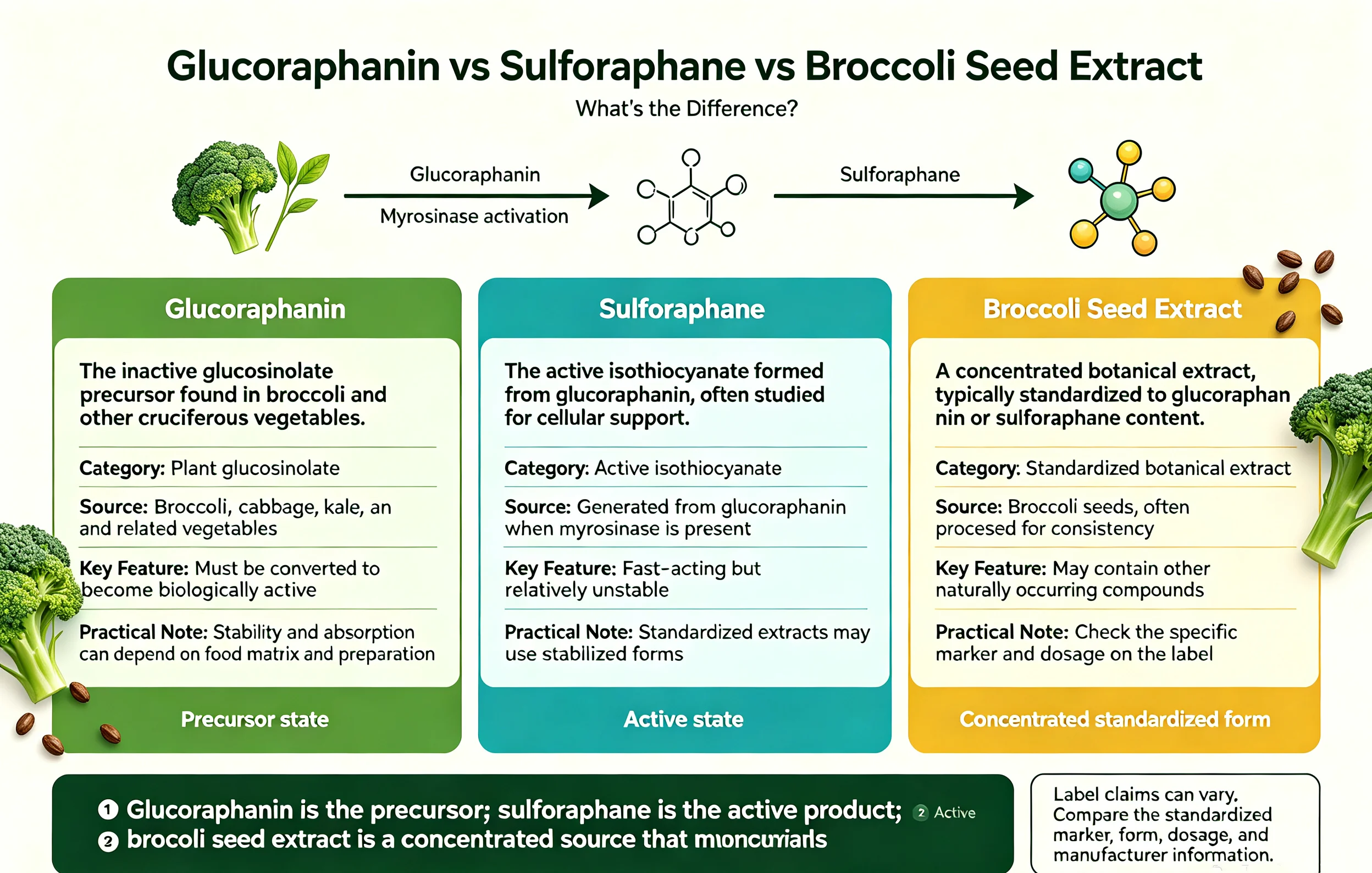
Here's the biochemical chain that matters to formulators:
- Glucoraphanin (stable precursor, survives processing and heat)
- → hydrolyzed by myrosinase (enzyme, either endogenous or gut-derived)
- → yields sulforaphane (the bioactive isothiocyanate)
- → sulforaphane activates Nrf2, triggering a cascade of cytoprotective enzymes including NQO1, HO-1, and GST
The global broccoli extract market reflects this growing clinical credibility. The market was valued at approximately $253.1 million in 2025 and is projected to reach $382.1 million by 2032, growing at a CAGR of 6.1% .
Understanding this chain is non-negotiable. It determines every decision in the manufacturing process - and every failure point where quality can be lost.
Stage 1: Seed Sourcing and Varietal Selection
The manufacturing process begins long before any extraction equipment is involved.
Glucoraphanin concentration varies significantly across broccoli cultivars, growing altitude, soil composition, and harvest timing. Not all seeds are equal starting material .
At Jiuyuan Biotech, our seed supply comes from the Qinling Mountain region of Shaanxi Province - an elevation range of 800–2,000 meters with distinct seasonal temperature gradients. This geography produces seeds with consistently elevated glucosinolate profiles compared to lowland cultivation.
What responsible seed sourcing looks like:
- Cultivar selection based on documented glucoraphanin yield data, not price
- Harvest timing calibrated to post-maturation glucosinolate peak
- Incoming lot testing for glucoraphanin baseline before any seed enters production
- Full field-to-COA traceability documentation per FSSC 22000 protocols
Lots that fall below our minimum glucoraphanin threshold are rejected. This step alone eliminates the most common source of batch-to-batch potency variance - and it's a step most commodity traders skip entirely because they don't control their raw material supply.

Stage 2: Pre-Treatment, Cleaning, and Milling
Raw seeds carry field contaminants - dust, stones, plant debris, and residual agricultural inputs. These need to be removed before extraction, not after.
Our pre-treatment sequence:
- Destoning and air classification - removes heavy and light foreign matter
- Magnetic separation - removes metallic particles
- Controlled drying - seeds dried to ≤8% moisture before milling
Milling is where many processors make a critical error. Standard ambient-temperature milling generates frictional heat that can degrade glucosinolate bonds before extraction even begins.
We use cryogenic milling - maintaining temperature below 40°C throughout the size-reduction process. This preserves cell wall integrity and maximizes glucoraphanin availability for solvent contact in the next stage.
Stage 3: Extraction - The Core Technical Decision
This is where the process diverges most sharply between precision manufacturers and commodity processors.
Broccoli seeds contain both glucoraphanin and myrosinase - the enzyme that converts glucoraphanin to sulforaphane. In an intact seed, these are physically separated by cellular compartmentalization. Once the cell wall is disrupted by milling, they come into contact.
This creates a critical control problem.
If extraction temperature is too low, myrosinase remains active and begins converting glucoraphanin to sulforaphane during the extraction itself. Sulforaphane is volatile and reactive - it degrades rapidly in aqueous solution, particularly at temperatures above 60°C or under alkaline conditions . Premature conversion leads to sulforaphane loss and inconsistent final potency.
Our extraction parameters are designed to prevent this:
- Solvent system: Aqueous or hydroalcoholic (water/ethanol), ratio optimized per incoming lot assay
- Temperature: 50–65°C - above myrosinase denaturation threshold, preserving glucoraphanin intact
- Duration: 2–4 hours with continuous agitation
- pH control: Maintained at 6.5–7.0 to stabilize glucosinolate structure
The goal at this stage is to extract glucoraphanin intact - not to convert it. Conversion is a separate, controlled step.
Stage 4: Filtration and Concentration
The crude extract undergoes sequential filtration:
- Coarse filtration - removes seed fiber and particulates
- Fine filtration - removes colloidal matter
- Membrane filtration - removes lipid-soluble impurities and residual cell debris
The clarified extract is then concentrated under vacuum evaporation at ≤60°C. Reduced pressure allows water removal at lower temperatures, minimizing thermal stress on the glucosinolate fraction.
This step is where solvent residuals are also driven off. Our finished extracts comply with ICH Q3C Class 3 solvent residual limits - verified by GC headspace analysis on every batch.
Stage 5: Enzymatic Hydrolysis (For Sulforaphane-Standardized Grades)
For specifications requiring standardized sulforaphane content - rather than glucoraphanin - a controlled enzymatic conversion step follows concentration.
This is the most technically demanding stage in the entire process.
How it works:
- Exogenous myrosinase is introduced under controlled conditions: pH 6.0–7.0, temperature 37–40°C
- Conversion efficiency is monitored via inline UV spectrophotometry
- The reaction is quenched at the target conversion rate
Why does quenching matter? Sulforaphane hydrolysis doesn't stop cleanly at sulforaphane. Over-hydrolysis produces nitrile byproducts - particularly erucin nitrile - which are biologically inactive and reduce the effective potency of the finished extract . Precise reaction termination is what separates a 1% sulforaphane specification you can defend in an audit from one that exists only on paper.
Research has shown that glucoraphanin-to-sulforaphane conversion efficiency can be doubled through optimized processing conditions - from approximately 19% to 40% bioavailability in human subjects .
Stage 6: Spray Drying and Powder Standardization
The concentrated extract is spray-dried using inlet temperatures calibrated to achieve target moisture content (≤5%) while preserving compound integrity.
After drying, the powder is blended to specification and tested against our release criteria before any batch is approved for shipment.
Release testing covers:
|
Test |
Method |
|
Glucoraphanin / Sulforaphane assay |
HPLC (primary) |
|
Heavy metals (Pb, As, Hg, Cd) |
ICP-MS / AAS |
|
Residual solvents |
GC headspace |
|
Total plate count |
USP <61> |
|
Yeast & mold |
USP <61> |
|
Salmonella / E. coli |
USP <62> |
|
Moisture |
Karl Fischer |
|
Particle size |
Laser diffraction |
A note on testing methods: HPLC is the only reliable method for accurate glucoraphanin and sulforaphane quantification. UV spectrophotometry - still used by many commodity suppliers - can overestimate glucosinolate content due to co-extracted chromophoric compounds. If your supplier's COA doesn't specify HPLC as the assay method, that's a red flag worth investigating .
Stage 7: Packaging Under Nitrogen
Sulforaphane and glucoraphanin are both sensitive to oxidation and humidity. Standard polyethylene packaging is not adequate for long-term stability.
Every batch ships in:
- Inner: Nitrogen-flushed, moisture-barrier aluminum foil bags
- Outer: Food-grade kraft paper drums or vacuum aluminum buckets (25 kg)
Under recommended storage conditions - ≤25°C, ≤60% RH, away from direct light - our extracts maintain specification for 24 months. Accelerated stability data (37°C/75% RH, 90 days) shows >95% glucoraphanin retention.
What This Means for Your Formulation
The manufacturing process directly determines which format your finished product can take.
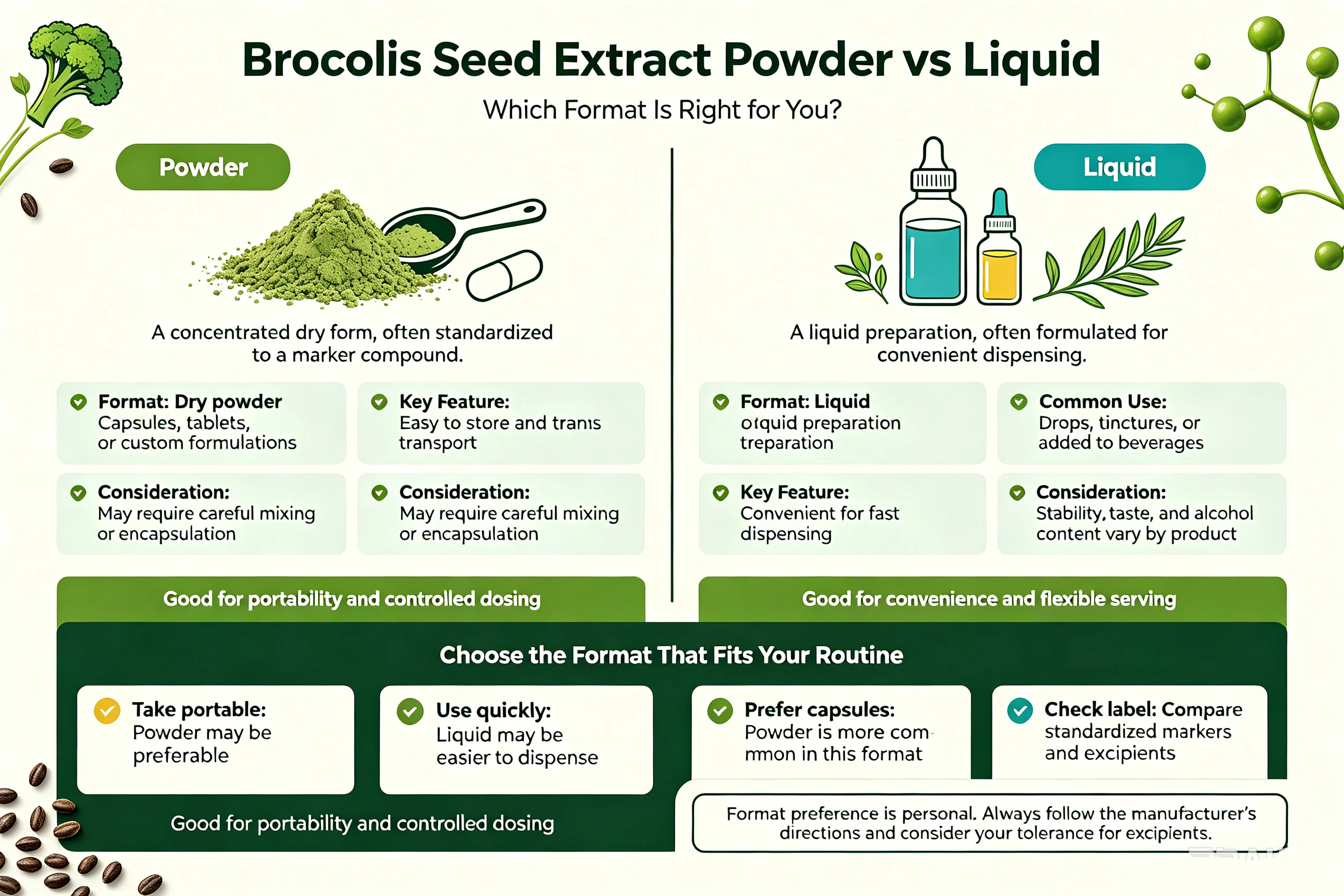
Glucoraphanin-standardized extract is thermally stable and survives tablet compression, baking, and heat-processed formats. Conversion to sulforaphane happens in the gut via microbiome-associated myrosinase activity. This is the preferred grade for most supplement formats.
Sulforaphane-standardized extract delivers the active compound directly but requires careful handling. Capsule and softgel formats are recommended. Avoid direct compression with high-heat excipients or extended exposure to moisture.
Co-formulation tip: Published research supports co-encapsulating glucoraphanin-standardized extract with a small amount of myrosinase-active material - such as mustard seed powder or fresh broccoli sprout powder - to enhance in-vivo conversion efficiency in individuals with lower gut microbiome myrosinase activity .
How to Qualify a Broccoli Seed Extract Supplier
You now know what the process should look like. Here's how to verify it:
- Ask for batch-specific COAs - not generic or undated certificates
- Confirm HPLC as the primary assay method - not UV or colorimetric
- Request retained sample availability - responsible manufacturers keep samples for 36 months
- Ask whether they manufacture or trade - traders cannot guarantee process consistency
- Request third-party heavy metal and pesticide residue reports - not just internal data
- Verify certifications are current - ISO 9001, FSSC 22000, cGMP, and organic certifications all have expiry dates
At Jiuyuan Biotech, we welcome factory audits - in person or via live video tour. Our in-house HPLC, GC, UV, AAS, and microbiology laboratory operates independently from production, with results reported directly to QA management. Every batch ships with its own COA covering assay, heavy metals, residual solvents, and microbiology. No generic certificates are issued.
Our broccoli seed extract is available in three HPLC-verified grades:
- SFN-1 - Sulforaphane ≥1%
- SFN-5 - Sulforaphane ≥5%
- GR-13 - Glucoraphanin ≥13%
Custom specifications above 10% sulforaphane are available on request. Organic-certified grades (USDA NOP and EU Organic) are also offered.
The Bottom Line
The phrase "seed to extract" describes a precise, multi-stage biochemical and engineering process - not a marketing claim. Every decision along that chain, from cultivar selection through enzymatic hydrolysis and nitrogen packaging, determines whether your finished product delivers the potency your label promises.
Most of the quality problems formulators encounter with broccoli seed extract - inconsistent potency, failed third-party audits, batch-to-batch variance - trace back to shortcuts taken somewhere in this process. Knowing the process gives you the tools to identify those shortcuts before they become your problem.
Ready to request a sample or discuss specifications? Reach out to our technical team directly at info@jiuybiotech.com or visit www.jiuyuanbio.com/standard-plant-extract-powder/broccoli-seed-extract.html to review full technical documentation and request a batch-specific COA.
References
- Fahey, J.W., Wehage, S.L., Holtzclaw, W.D., Kensler, T.W., Egner, P.A., Shapiro, T.A., & Talalay, P. (2012). Protection of humans by plant glucosinolates: Efficiency of conversion of glucosinolates to isothiocyanates by the gastrointestinal microflora. Cancer Prevention Research, 5(4), 603–611.
- Dinkova-Kostova, A.T., & Kostov, R.V. (2012). Glucosinolates and isothiocyanates in health and disease. Trends in Molecular Medicine, 18(6), 337–347.
- Persistence Market Research. (2025). Broccoli Extract Market: Global Industry Analysis and Forecast to 2032. Persistence Market Research Global Market Study.
- Cramer, J.M., Teran-Garcia, M., & Bhagwat, S. (2011). Enhancing sulforaphane absorption and excretion in healthy men through the combined consumption of fresh broccoli sprouts and a glucoraphanin-rich powder. British Journal of Nutrition, 107(9), 1333–1338.
- Shapiro, T.A., Fahey, J.W., Dinkova-Kostova, A.T., Holtzclaw, W.D., Kensler, T.W., Cole, R.N., Stephenson, K.K., & Talalay, P. (2006). Safety, tolerance, and metabolism of broccoli sprout glucosinolates and isothiocyanates: A clinical phase I study. Nutrition and Cancer, 55(1), 53–62.
- Vanduchova, A., Anzenbacher, P., & Anzenbacherova, E. (2019). Isothiocyanate from broccoli, sulforaphane, and its properties. Journal of Medicinal Food, 22(2), 121–126.