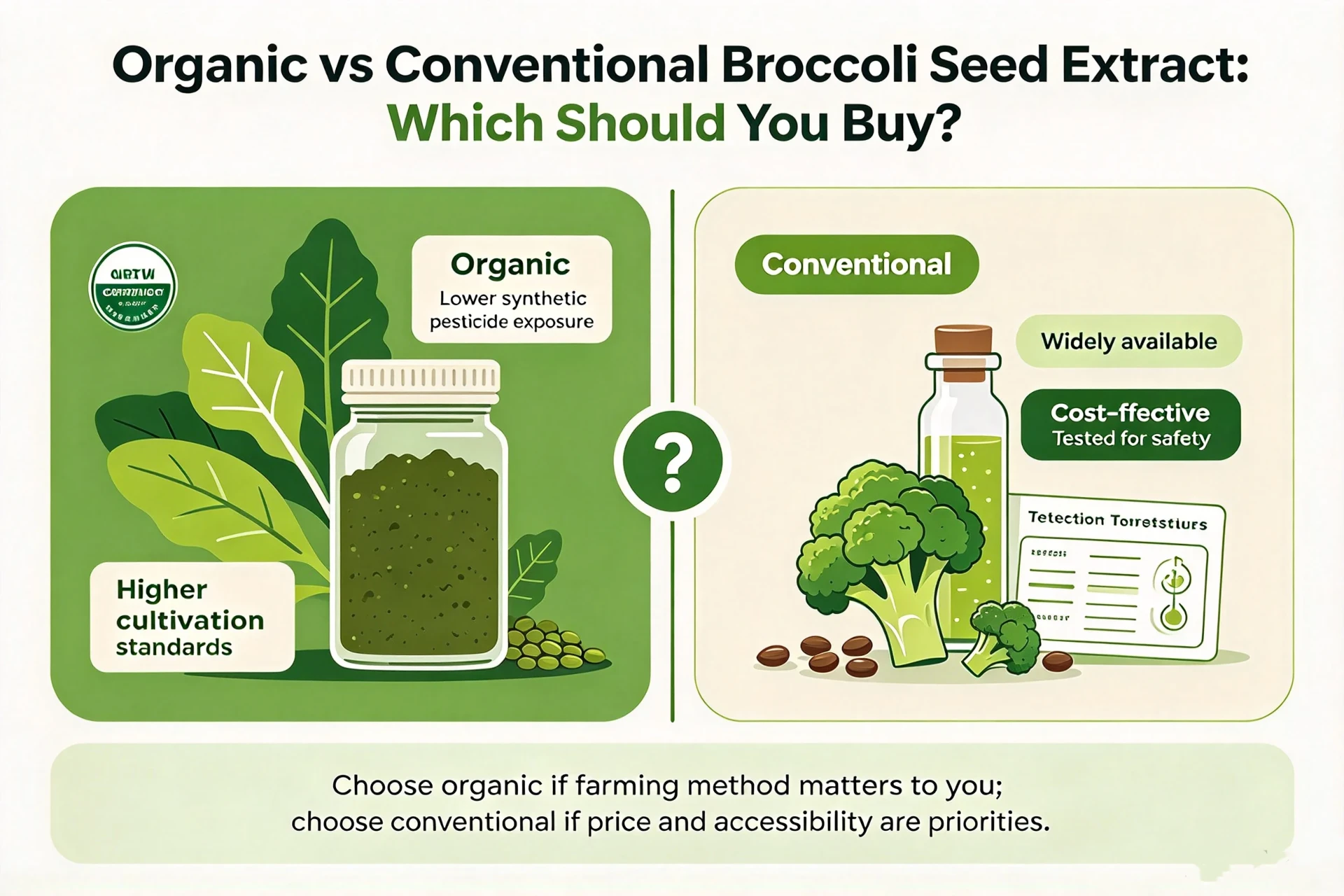
It sounds like a simple question. Organic or conventional - pick one and move on.
But when you are sourcing broccoli seed extract for a dietary supplement or functional food product, that choice carries more weight than it does at the grocery store. It affects your regulatory documentation, your label claims, your target consumer's trust, and - in some cases - the actual bioactive integrity of the ingredient you are paying for.
This article walks through the real differences between organic and conventional broccoli seed extract. Not the marketing version. The version that matters to a formulator, a procurement manager, or a brand owner who needs to make a defensible sourcing decision.
Why the Organic vs. Conventional Question Matters More for Extracts
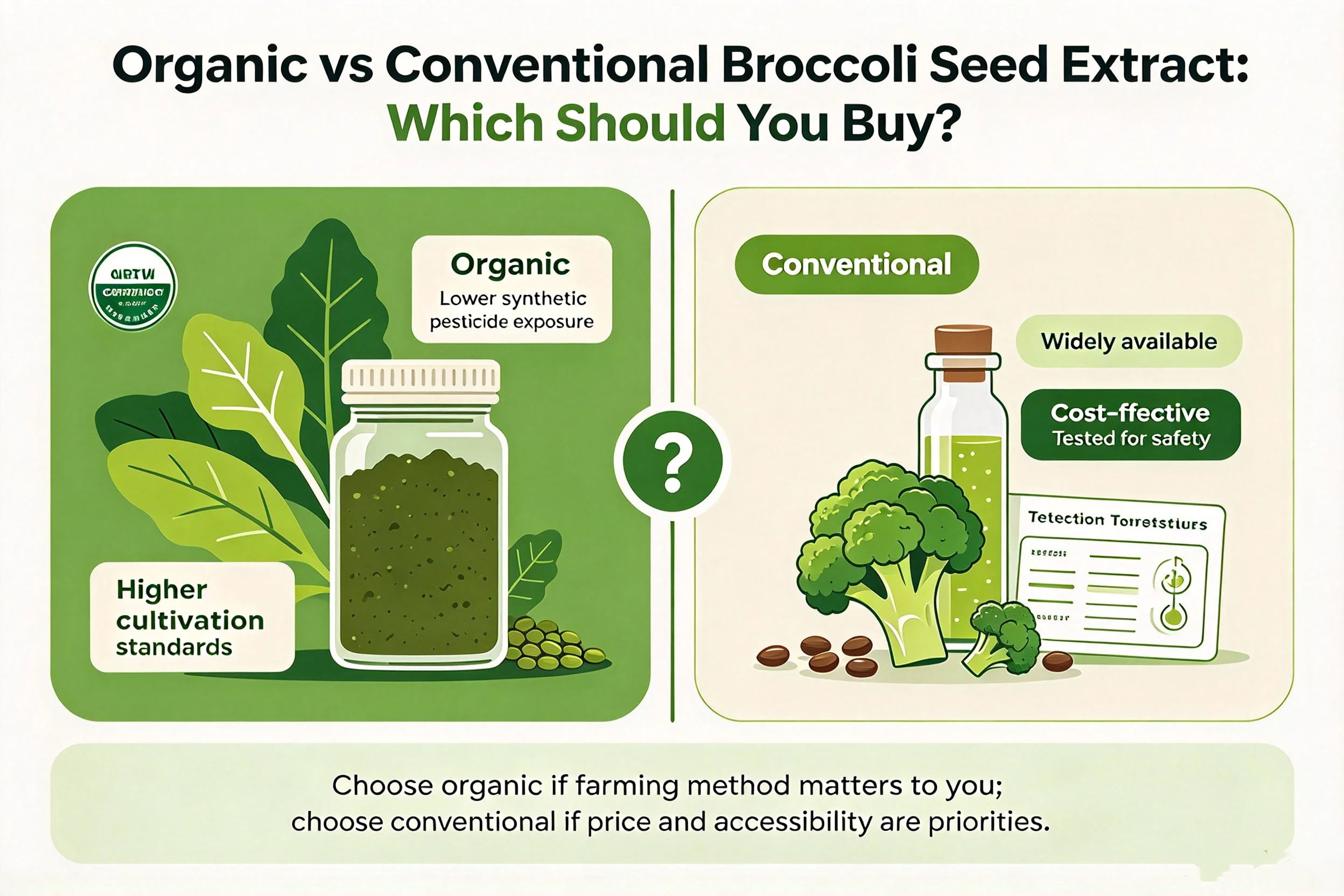
When you buy a head of broccoli at a farmers' market, the organic label is mostly about pesticide exposure and farming philosophy. The broccoli itself is still broccoli.
With a concentrated botanical extract, the stakes shift.
Concentration amplifies everything - including contaminants. A 10:1 extract compresses ten kilograms of raw plant material into one kilogram of finished powder. If that raw material carried pesticide residues, heavy metals, or solvent contamination, those compounds concentrate right alongside the glucoraphanin you are paying for.
This is the core reason why the organic vs. conventional distinction matters more in extract form than in whole-food form. You are not just buying a farming philosophy. You are buying a contamination risk profile - and that risk profile scales with concentration.
What "Organic" Actually Means for Broccoli Seed Extract
The word "organic" on a botanical extract is not self-certifying. It requires a documented chain of custody from farm to finished powder, verified by an accredited certification body.
For broccoli seed extract sold into the US market, USDA NOP (National Organic Program) certification is the governing standard. For EU-bound material, EU Organic Regulation (EC) No. 834/2007 applies. These are not interchangeable - a product certified under one framework requires separate verification for the other.
Here is what a legitimate organic certification chain covers:
- Farm level - no synthetic pesticides, herbicides, or chemical fertilizers for a minimum of three years prior to certification
- Handler/processor level - certified organic handling facilities, segregated processing lines, no co-mingling with conventional material
- Extract manufacturer level - certified organic processing, documented input materials, annual audit by accredited certifier
- Certificate traceability - every certificate carries a unique number verifiable directly with the issuing body (CCOF, ECOCERT, or equivalent)
If a supplier cannot produce this full chain - or provides a single certificate without farm-level documentation - the organic claim is incomplete.
The Pesticide Problem in Conventional Broccoli Crops
Brassica crops are among the most heavily treated vegetable crops in commercial agriculture. Broccoli in particular is susceptible to a range of insect pests - cabbage loopers, aphids, diamondback moths - that drive significant pesticide application in conventional growing systems.
The pesticides most commonly associated with conventional broccoli cultivation include:
- Organophosphates - chlorpyrifos and related compounds, with documented neurodevelopmental concerns
- Pyrethroids - permethrin and cypermethrin, persistent in fatty matrices
- Fungicides - azoxystrobin and propiconazole, used to manage downy mildew
In a whole broccoli floret, residue levels may fall within regulatory limits. In a concentrated seed extract, the math changes. A 10:1 concentration factor can push residues that were borderline-compliant in raw material to non-compliant levels in the finished extract - particularly under EU Regulation 396/2005, which sets maximum residue limits (MRLs) for food ingredients at stricter thresholds than many other markets.
This is not a theoretical risk. It is a documented failure mode that has caused product recalls and import rejections for botanical extracts in both the US and EU markets.
Does Organic Certification Affect Glucoraphanin Content?
This is a question worth addressing directly, because the answer is more nuanced than a simple yes or no.
Organic farming practices do not inherently increase glucoraphanin content. Glucoraphanin accumulation in broccoli seeds is primarily determined by:
- Variety selection - different Brassica oleracea cultivars have meaningfully different glucoraphanin profiles
- Harvest timing - seeds harvested at peak maturity contain higher glucoraphanin concentrations
- Post-harvest handling - rapid drying and temperature-controlled storage preserve glucosinolate integrity
- Processing temperature - low-temperature extraction (≤ 45°C) prevents glucosinolate degradation
Some research suggests that mild abiotic stress during cultivation - including the absence of synthetic nitrogen fertilizers common in organic systems - can upregulate glucosinolate biosynthesis as a plant defense response. But this effect is variable and cultivar-dependent. It is not a reliable basis for claiming that organic broccoli seed extract is categorically higher in glucoraphanin.
The honest answer: organic certification does not guarantee higher glucoraphanin content. Standardization by HPLC does. What organic certification does guarantee - when properly documented - is a cleaner contamination profile and a more defensible regulatory position.
Clean Label Value: What Your Customers Are Actually Buying
Beyond the regulatory dimension, there is a market reality that B2B buyers need to factor into their sourcing decisions.
Consumer demand for clean-label, certified organic supplement ingredients has grown consistently over the past decade. In the US natural products market, "USDA Organic" on a supplement label commands a measurable price premium and drives purchasing decisions among health-conscious consumers - particularly in the 25–45 age demographic that represents the core buyer for antioxidant and detox-positioned supplements.
For brands building premium positioning, organic certification is not just a farming standard. It is a marketing asset that:
- Differentiates your product on crowded retail shelves and e-commerce listings
- Supports higher retail price points without requiring additional justification
- Reduces consumer skepticism about ingredient sourcing and manufacturing practices
- Aligns with retailer requirements - many natural channel retailers (Whole Foods, iHerb, Thrive Market) actively prefer or require organic-certified ingredients in their supplier standards
If your target consumer reads labels carefully - and supplement consumers disproportionately do - the organic certification on your broccoli seed extract ingredient is visible, legible, and commercially meaningful.
Where Conventional Extract Still Makes Sense
Organic is not always the right answer. Here is when conventional broccoli seed extract is a defensible choice:
Price-sensitive formulations - organic certification adds a cost premium of typically 20–40% over comparable conventional material. For high-volume, value-tier supplement products where margin pressure is real, conventional extract with verified pesticide compliance can be appropriate.
Pharmaceutical excipient applications - where the regulatory framework focuses on pharmacopeial purity standards rather than agricultural certification, conventional extract with full analytical documentation may be the specified format.
Markets with limited organic regulatory infrastructure - in some emerging markets, organic certification carries less consumer recognition and commercial value, making the premium harder to justify.
Blended formulations with low broccoli extract inclusion rates - when broccoli seed extract represents a minor component (below 2% of formula weight) in a complex blend, the organic premium may not translate to meaningful label differentiation.
The key point: the choice between organic and conventional should be driven by your target market, your label strategy, and your regulatory requirements - not by a default assumption that one is always superior.
The Five Documents That Separate Legitimate Organic Suppliers from Label Traders
In the botanical extract market, "organic" is sometimes applied loosely. Here is the documentation checklist that separates a verifiable organic supply chain from a marketing claim:
1. Farm-level organic certificate Issued by an accredited certifier (CCOF, ECOCERT, CERES, or equivalent). Must include the farm name, location, certified crops, and certificate validity period. Verify the certificate number directly with the issuing body.
2. Transaction certificate (TC) For EU Organic-certified material, a transaction certificate is required for each shipment. It documents that the specific lot being shipped was produced and handled under certified organic conditions.
3. Batch-specific COA with HPLC glucoraphanin assay The COA must reference the specific batch lot number, testing date, and the name of the testing laboratory. Generic COA templates without batch-specific data are not acceptable.
4. Third-party pesticide residue panel From an ISO/IEC 17025-accredited laboratory, compliant with EU Reg. 396/2005 MRLs. This is the independent verification that the organic claim translates to actual residue-free material.
5. Processing facility organic certificate The extraction and spray-drying facility must hold its own organic processing certificate - separate from the farm certificate. Many suppliers hold farm-level certification but process on non-certified lines, which invalidates the organic status of the finished extract.
Organic vs. Conventional: Side-by-Side Summary
|
Factor |
Organic Broccoli Seed Extract |
Conventional Broccoli Seed Extract |
|
Pesticide residue risk |
✅ Minimal (certified) |
⚠️ Requires third-party verification |
|
Regulatory documentation |
✅ Full chain of custody |
⚠️ Analytical compliance only |
|
EU market entry |
✅ Straightforward |
⚠️ MRL compliance critical |
|
Clean label positioning |
✅ Strong consumer signal |
❌ Not applicable |
|
Glucoraphanin content |
Standardization-dependent |
Standardization-dependent |
|
Price tier |
Mid-High |
Mid |
|
Premium retail suitability |
✅ High |
⚠️ Limited |
|
Concentration risk (contaminants) |
✅ Managed at source |
⚠️ Amplified by extraction ratio |
|
Third-party audit support |
✅ Annual certifier audit |
Self-declared or spot-tested |
Making the Right Call for Your Formulation
The decision comes down to three questions:
Who is your end consumer? If they read labels, shop natural channels, and pay attention to certifications - organic is the commercially correct choice. If they are primarily motivated by price and the supplement is sold through mass-market channels - conventional with verified analytical compliance may be sufficient.
Which market are you selling into? EU market entry for botanical extracts is significantly smoother with organic certification and EU Organic documentation. US market entry is more flexible, but the USDA Organic label carries real retail value.
What is your brand's long-term positioning? If you are building a premium supplement brand, the organic certification on your ingredient supply chain is an asset that compounds over time. Switching from conventional to organic mid-product-lifecycle creates reformulation costs and label revision expenses. Getting it right at the sourcing stage is cheaper than fixing it later.
Source Your Broccoli Seed Extract With Confidence
At Jiuyuan Biotech, we supply certified organic Broccoli Seed Extract standardized to HPLC-verified glucoraphanin content - available in 10%, 13%, and 20% grades, with active-myrosinase and myrosinase-inactivated formats.
Our organic certification chain covers farm origin through finished extract, with full documentation available for every commercial shipment:
✅ USDA Organic & EU Organic certified
✅ ISO 9001:2015 & FSSC 22000 compliant
✅ Batch-specific COA with HPLC glucoraphanin assay
✅ Third-party pesticide residue panel (EU Reg. 396/2005)
✅ Heavy metal report from accredited laboratory
✅ Myrosinase activity data available on request
Whether you are building a premium antioxidant supplement, a detox formulation, or a clean-label functional food ingredient, we can support your sourcing with the documentation and technical depth your regulatory team needs.
📧 Contact our technical sales team at info@jiuybiotech.com
🌐 Visit us at www.jiuyuanbio.com
References
- Fahey, J. W., Zalcmann, A. T., & Talalay, P. (2001). The chemical diversity and distribution of glucosinolates and isothiocyanates among plants. Phytochemistry, 56(1), 5–51.
- Baenas, N., García-Viguera, C., & Moreno, D. A. (2014). Elicitation: A tool for enriching the bioactive composition of foods. Molecules, 19(9), 13541–13563.
- Vermeulen, M., Klöpping-Ketelaars, I. W., van den Berg, R., & Vaes, W. H. (2008). Bioavailability and kinetics of sulforaphane in humans after consumption of cooked versus raw broccoli. Journal of Agricultural and Food Chemistry, 56(22), 10505–10509.
- European Food Safety Authority (EFSA). (2012). Scientific opinion on the safety and efficacy of glucosinolates as feed additives for all animal species. EFSA Journal, 10(10), 2935.
- Jeffery, E. H., & Araya, M. (2009). Physiological effects of broccoli consumption. Phytochemistry Reviews, 8(1), 283–298.
- Dinkova-Kostova, A. T., & Talalay, P. (2008). Direct and indirect antioxidant properties of inducers of cytoprotective proteins. Molecular Nutrition & Food Research, 52(S1), S128–S138.