

If you source botanical ingredients for supplement brands, functional food developers, or contract manufacturers, you've seen all three terms on spec sheets: glucoraphanin, sulforaphane, and broccoli seed extract. Suppliers use them loosely. Labels blur the lines. And procurement teams often don't realize they're comparing fundamentally different things until a stability failure or a failed third-party audit forces the question.
This guide cuts through the confusion. We'll compare all three across chemistry, stability, bioavailability, mechanism of action, formulation suitability, and B2B sourcing criteria - so you can make the right call before you place your next order.
The Foundation: What Each Term Actually Means
Before comparing them, you need to understand what each term refers to at a molecular level. They are not interchangeable - they describe three different things operating at three different levels of the same biochemical system.
Broccoli Seed Extract - The Matrix
Broccoli seed extract is a standardized botanical concentrate derived from the seeds of Brassica oleracea var. italica. It is not a single compound. It is a complex phytochemical matrix.
Seeds are the preferred raw material because they contain 10–100× more glucosinolates than mature broccoli florets on a dry-weight basis. That density makes seeds the most commercially viable source for high-potency standardized extracts.
The full phytochemical profile of broccoli seed extract includes:
|
Compound Class |
Key Constituents |
Bioactivity |
|
Primary glucosinolate |
Glucoraphanin |
Sulforaphane precursor - the primary active driver |
|
Minor glucosinolates |
Glucoiberin, Glucoerucin, Glucobrassicin |
Secondary isothiocyanate precursors |
|
Flavonoids |
Kaempferol, Quercetin glycosides |
Antioxidant, anti-inflammatory synergy |
|
Phenolic acids |
Sinapic acid, Caffeic acid |
Antioxidant support |
|
Indole precursors |
Indole-3-carbinol precursors |
Estrogen metabolism modulation |
|
Carotenoids |
β-Carotene, Lutein (trace) |
Antioxidant |
The marker compound used for standardization determines the product's commercial identity. A broccoli seed extract standardized to glucoraphanin 13% is a fundamentally different product from one standardized to sulforaphane 1% - even if both come from the same raw material. Always specify which marker, at what percentage, verified by which analytical method.
Glucoraphanin - The Stable Precursor
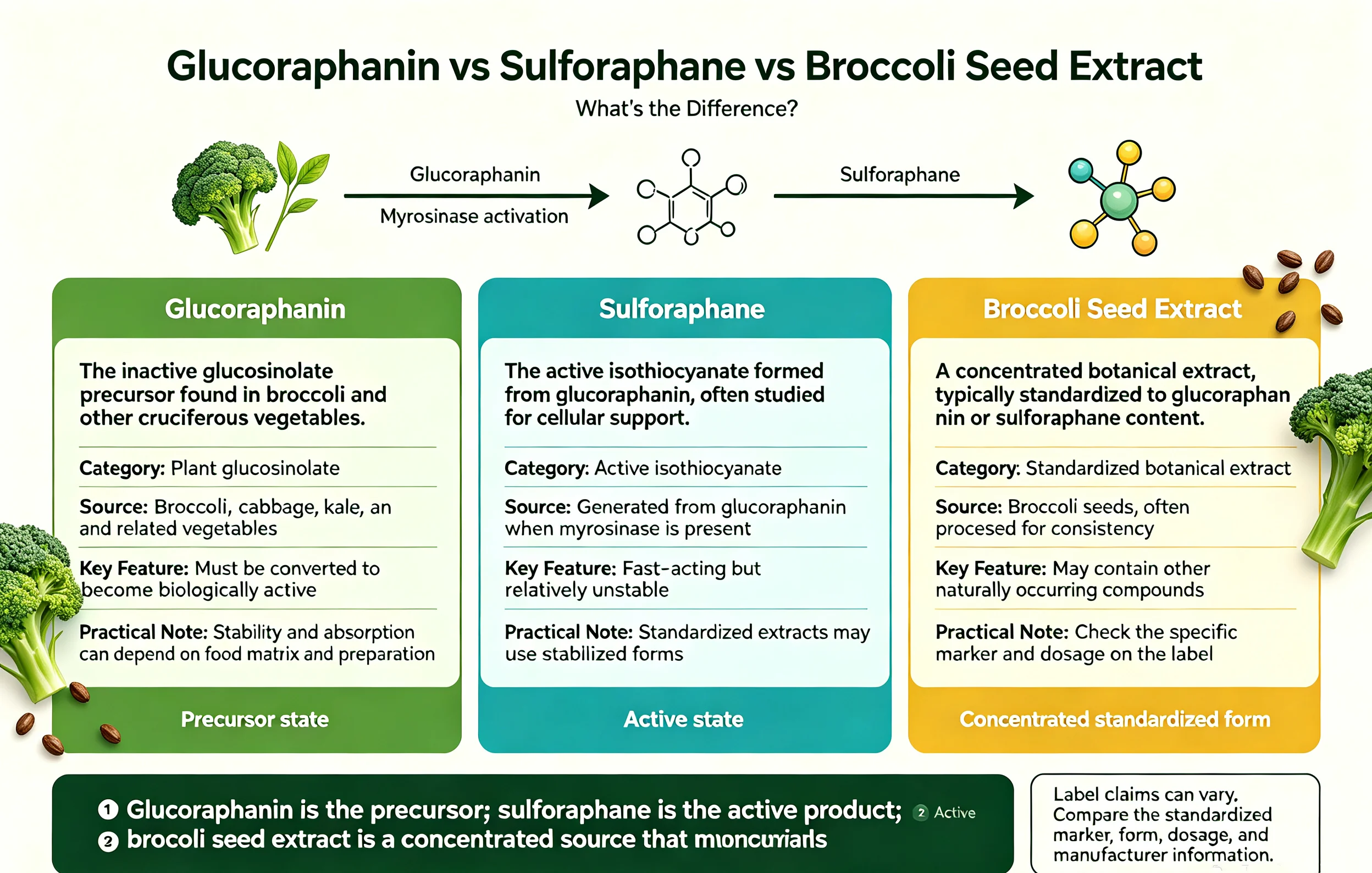
Glucoraphanin (chemical name: 4-methylsulfinylbutyl glucosinolate) is the primary glucosinolate in broccoli seeds and the direct biochemical precursor to sulforaphane. It is thermally stable, water-soluble, and survives standard manufacturing processes intact.
Key chemical characteristics:
- Molecular formula: C₁₂H₂₃NO₁₀S₃
- CAS No.: 21414-41-5
- Solubility: Freely water-soluble
- Thermal stability: Stable up to 100°C under neutral pH conditions
- Enzymatic cleavage: Requires myrosinase (thioglucosidase) to release sulforaphane
Sulforaphane - The Active Isothiocyanate
Sulforaphane (1-isothiocyanato-4-(methylsulfinyl)butane) is the biologically active end-product of glucoraphanin hydrolysis. It is produced when myrosinase - either from plant tissue or gut microbiota - cleaves the thioglucose bond of glucoraphanin.
Key chemical characteristics:
- Molecular formula: C₆H₁₁NOS₂
- CAS No.: 4478-93-7
- Boiling point: ~130°C (decomposes)
- State at room temperature: Oily liquid - volatile
- Stability: Highly reactive; degrades through oxidation, hydrolysis, and polymerization
Head-to-Head Comparison: 8 Dimensions That Matter to Formulators
This is where the real decision-making happens. Here's how all three compare across every dimension a formulation team or procurement manager needs to evaluate:
Dimension 1 - Chemical Stability
|
Parameter |
Glucoraphanin |
Sulforaphane |
Broccoli Seed Extract |
|
Thermal stability |
✅ High - stable to 100°C |
❌ Low - degrades above 40°C |
Depends on standardization |
|
Oxidative stability |
✅ Resistant |
❌ Rapidly oxidizes |
Depends on antioxidant co-matrix |
|
Hydrolytic stability |
✅ Stable in neutral pH |
❌ Hydrolyzes in aqueous media |
Variable |
|
Long-term shelf life |
✅ 24+ months |
⚠️ Short without stabilization |
✅ 24 months (GR-standardized) |
|
Accelerated stability |
>95% retention at 37°C/75% RH for 90 days |
Significant loss under same conditions |
>95% retention (GR-standardized) |
The bottom line: Sulforaphane in isolated form is a formulator's nightmare. It evaporates at room temperature, reacts with excipients, and loses potency during tablet compression and encapsulation. Glucoraphanin-standardized broccoli seed extract solves this entirely - the active compound generates in vivo, not in the bottle.
Dimension 2 - Bioavailability & Conversion
Bioavailability is the most misunderstood dimension in this ingredient category. Higher declared sulforaphane percentage does not automatically mean better bioavailability in humans.
|
Parameter |
Glucoraphanin |
Sulforaphane |
Broccoli Seed Extract (GR-standardized) |
|
Absorption site |
Colon (gut microbiome-mediated) |
Small intestine (direct) |
Colon-primary, SI-secondary |
|
Conversion dependency |
Gut myrosinase activity |
None - direct |
Gut microbiome + optional exogenous myrosinase |
|
Urinary recovery |
70–90% as dithiocarbamate metabolites |
High but formulation-dependent |
70–90% (validated) |
|
Inter-individual variability |
Moderate (microbiome-dependent) |
Low |
Moderate |
|
In vitro conversion rate |
Up to 55.8% in 120 min (gastric fluid) |
N/A |
Up to 55.8% with myrosinase co-delivery |
|
Enhancement strategy |
Co-formulate with myrosinase source |
Stabilization required |
Co-formulate with radish/sprout powder |
Research published in Frontiers in Physiology (2025) confirms that the gut microbiome plays a central, bidirectional role in glucoraphanin-to-sulforaphane conversion - with Bacteroides and Lactobacillus species being the primary microbial actors.
A study in Nutrients (2019) further demonstrated that co-delivering glucoraphanin with exogenous myrosinase sources significantly boosts conversion rates - a validated formulation strategy for maximizing bioavailability without using unstable free sulforaphane.
Dimension 3 - Mechanism of Action
All three ultimately drive the same core pathway - but through different entry points:
The Glucoraphanin → Sulforaphane → Nrf2 Cascade:
Glucoraphanin
↓ [Myrosinase - gut microbiota or plant enzyme]
Sulforaphane
↓ [Reacts with Cys residues on Keap1 repressor]
Nrf2 released → translocates to nucleus
↓ [Binds Antioxidant Response Element (ARE)]
Transcription of cytoprotective enzymes:
|
Induced Enzyme |
Primary Function |
Clinical Relevance |
|
NQO1 (NAD(P)H quinone oxidoreductase 1) |
Phase II detoxification, quinone reduction |
Carcinogen neutralization |
|
HO-1 (Heme oxygenase-1) |
Anti-inflammatory, cytoprotective |
Oxidative stress resolution |
|
GST (Glutathione S-transferases) |
Carcinogen conjugation |
Detoxification support |
|
GCL (Glutamate-cysteine ligase) |
Glutathione biosynthesis (rate-limiting) |
Master antioxidant replenishment |
|
Thioredoxin reductase |
Redox homeostasis |
Cellular protection |
|
Ferritin |
Iron sequestration |
Oxidative stress protection |
Sulforaphane is capable of upregulating over 200 cytoprotective genes through ARE binding - making it one of the most pleiotropic single phytochemicals known.
The Nrf2/Keap1 axis is now one of the most studied drug and nutraceutical targets in biomedical research, with sulforaphane remaining the best-characterized natural Nrf2 inducer in the published literature.
Dimension 4 - Formulation Suitability
|
Application |
Glucoraphanin |
Sulforaphane |
Broccoli Seed Extract |
|
Tablets & capsules |
✅ Excellent |
❌ Poor - volatile loss during compression |
✅ Excellent |
|
Powder blends |
✅ Excellent |
⚠️ Requires microencapsulation |
✅ Excellent |
|
RTD beverages |
✅ ≥98% clarity (water-soluble grade) |
❌ Unstable in aqueous solution |
✅ Water-soluble grade available |
|
Functional gummies |
✅ Compatible |
❌ Degrades in gelatin matrix |
✅ Compatible |
|
FSMPs & clinical nutrition |
✅ Milligram-precise dosing |
⚠️ Stability challenges |
✅ Preferred format |
|
Topical / cosmeceutical |
⚠️ Limited penetration |
✅ Direct Nrf2 activation in skin |
✅ Oil-soluble grade available |
|
Infant / maternal nutrition |
✅ Mild taste, low odor |
❌ Pungent, irritating |
✅ Mild taste, no cruciferous aftertaste |
|
Research substrates |
✅ Stable reference material |
✅ Direct activity measurement |
✅ Standardized research-grade available |
The 2023 Chinese Dietary Reference Intakes established the first official Tolerable Upper Intake Level (TUL) for sulforaphane at 30 mg/day - enabling milligram-level precision in clinical and functional food formulation for the first time.
Dimension 5 - Analytical Verification
This dimension separates defensible supply chains from liability risks.
|
Parameter |
Glucoraphanin |
Sulforaphane |
Broccoli Seed Extract |
|
Gold-standard method |
HPLC-UV / HPLC-MS |
HPLC-UV / HPLC-MS |
HPLC-UV (specify marker) |
|
Colorimetric assay risk |
⚠️ Can inflate readings |
⚠️ Non-specific |
⚠️ High risk of inflated claims |
|
Reference standard availability |
✅ Certified standards available |
✅ Certified standards available |
✅ Specify per marker compound |
|
COA parameters required |
Assay, heavy metals, pesticides, solvents, microbiology |
Assay, stability data, heavy metals |
Full panel + conversion rate data |
|
Conversion rate documentation |
Required - in vitro gastric fluid data |
N/A |
Required for GR-standardized grades |
Critical procurement rule: Never accept colorimetric glucosinolate assay data as the primary specification. Colorimetric methods measure total glucosinolates non-specifically and routinely overstate glucoraphanin content by 15–30%. Demand HPLC verification against certified reference standards - it's the only number you can defend in a third-party audit.
Dimension 6 - Regulatory & Market Access
|
Market |
Glucoraphanin |
Sulforaphane |
Broccoli Seed Extract |
|
USA (FDA) |
GRAS pathway available |
GRAS pathway available |
GRAS pathway available |
|
EU (Novel Food) |
Requires Novel Food authorization |
Requires Novel Food authorization |
Depends on extraction process |
|
China |
New Food Raw Material (13%–20% GR specification approved) |
Covered under New Food Raw Material |
New Food Raw Material approved |
|
Japan |
FOSHU-eligible |
Research use primary |
FOSHU-eligible |
|
Dosing reference |
TUL 30 mg SFN equivalent/day (China DRI 2023) |
TUL 30 mg/day (China DRI 2023) |
TUL 30 mg SFN equivalent/day |
Dimension 7 - Clinical Evidence Base
The clinical evidence behind this ingredient category is substantial and growing:
|
Region |
Published Clinical Trials |
Ongoing RCTs |
Representative Institutions |
|
North America |
48 trials / 1,100+ SCI papers |
3 (NCT03932136, NCT05145270, NCT05148169) |
Johns Hopkins, Mass General, UNC Chapel Hill |
|
European Union |
27 trials / 580+ SCI papers |
2 (EudraCT 2024-registered) |
Imperial College London, Karolinska Institutet |
|
Japan |
18 trials / 350+ SCI papers |
1 (UMIN-registered) |
University of Tokyo Institute of Medical Science |
|
China |
37 trials / 1,020+ SCI & core papers |
6 real-world studies (ChiCTR-registered) |
Shanghai Ruijin, Beijing Union Medical, Sichuan Huaxi, Sun Yat-sen |
Sulforaphane's Nrf2-activating mechanism has been validated across oncology, metabolic disease, neuroinflammation, and cardiovascular research - with over 3,000 global SCI publications citing glucoraphanin-derived sulforaphane as the intervention compound.
Dimension 8 - B2B Sourcing Checklist
When qualifying a broccoli seed extract supplier, these are the non-negotiable checkpoints:
Specification & Testing
- HPLC-verified assay (not colorimetric)
- Full COA: assay, heavy metals (Pb, As, Cd, Hg), residual solvents, microbiology, pesticide residues
- Batch-to-batch consistency data across ≥3 production lots
- In vitro conversion rate documentation (gastric fluid model)
- Accelerated stability data (37°C / 75% RH, 90-day minimum)
Certifications to require
- ISO 9001 / ISO 22000 / FSSC 22000
- cGMP (FDA-inspected facility)
- USDA / EU NOP Organic (if applicable)
- Halal & Kosher (for Middle East and specialty market access)
- HACCP
Technical Support Capabilities
- Custom specification development (e.g., GR 13% + SFN 1% combined grades)
- OEM/ODM in multiple dosage forms
- Regulatory documentation support (SDS, allergen declarations, country-of-origin)
- Formulation co-development and after-sales technical support
Which Form Should You Choose?
Here's the practical decision framework:
Choose glucoraphanin-standardized broccoli seed extract when:
- You need shelf-stable finished products (tablets, capsules, powders, gummies)
- Your manufacturing process involves heat, compression, or aqueous processing
- You need a clean label with a single, scientifically credible marker compound
- You're targeting functional food, FSMP, or infant/maternal nutrition categories
Choose sulforaphane-standardized extract when:
- You're producing research-grade materials or clinical trial substrates
- You're developing topical/cosmeceutical applications with direct skin delivery
- Your formulation includes microencapsulation technology that stabilizes the molecule
Choose a combined GR + SFN grade when:
- You want both immediate sulforaphane activity and sustained precursor conversion
- Your target consumer has known gut microbiome variability
- You're positioning a premium, high-potency product with dual-mechanism labeling
References
- Dinkova-Kostova, A. T., & Talalay, P. (2008). Direct and indirect antioxidant properties of inducers of cytoprotective proteins. Molecular Nutrition & Food Research, 52(S1), S128–S138.
- Shapiro, T. A., Fahey, J. W., Dinkova-Kostova, A. T., Holtzclaw, W. D., Stephenson, K. K., Wade, K. L., Ye, L., & Talalay, P. (2006). Safety, tolerance, and metabolism of broccoli sprout glucosinolates and isothiocyanates: A clinical phase I study. Nutrition and Cancer, 55(1), 53–62.
- Vanduchova, A., Anzenbacher, P., & Anzenbacherova, E. (2019). Isothiocyanate from broccoli, sulforaphane, and its properties. Journal of Medicinal Food, 22(2), 121–126.
- Fahey, J. W., Wehage, S. L., Holtzclaw, W. D., Kensler, T. W., Egner, P. A., Shapiro, T. A., & Talalay, P. (2012). Protection of humans by plant glucosinolates: Efficiency of conversion of glucosinolates to isothiocyanates by the gastrointestinal microflora. Cancer Prevention Research, 5(4), 603–611.
- Kensler, T. W., Egner, P. A., Agyeman, A. S., Visvanathan, K., Groopman, J. D., Chen, J. G., Chen, T. Y., Fahey, J. W., & Talalay, P. (2013). Keap1–Nrf2 signaling: A target for cancer prevention by sulforaphane. Topics in Current Chemistry, 329, 163–177.
- Traka, M. H. (2016). Health benefits of glucosinolates. Advances in Botanical Research, 80, 247–279. Academic Press.
Source Your Broccoli Seed Extract From a Supplier Who Knows the Difference
At Jiuyuan Biotech, we don't sell commodity broccoli powder. Our broccoli seed extract line is built on a dual-patent "Myrosinase + Stabilization" platform - delivering an in vitro conversion rate of 55.8% in 120 minutes of simulated gastric digestion, which is 5–8× higher than standard enzyme-free extracts on the market.
Our available specifications include:
- GR-13 - Glucoraphanin ≥13% (New Food Raw Material compliant)
- GR-1 / GR-10 - Glucoraphanin 1% and 10%
- SFN-1 / SFN-5 / SFN-10 - Sulforaphane 0.1%–10%
- GR-13 + SFN-1 - Combined dual-marker grade
- Ultra-high potency custom grades - available on request
- Every batch ships with HPLC-verified COA - not colorimetric proxies. Our facility holds 12 international certifications including FSSC 22000, ISO 9001, cGMP, USDA/EU Organic, Halal, and Kosher.
📩 Reach our technical team directly: info@jiuybiotech.com 🌐 View full specifications: jiuyuanbio.com/broccoli-seed-extract