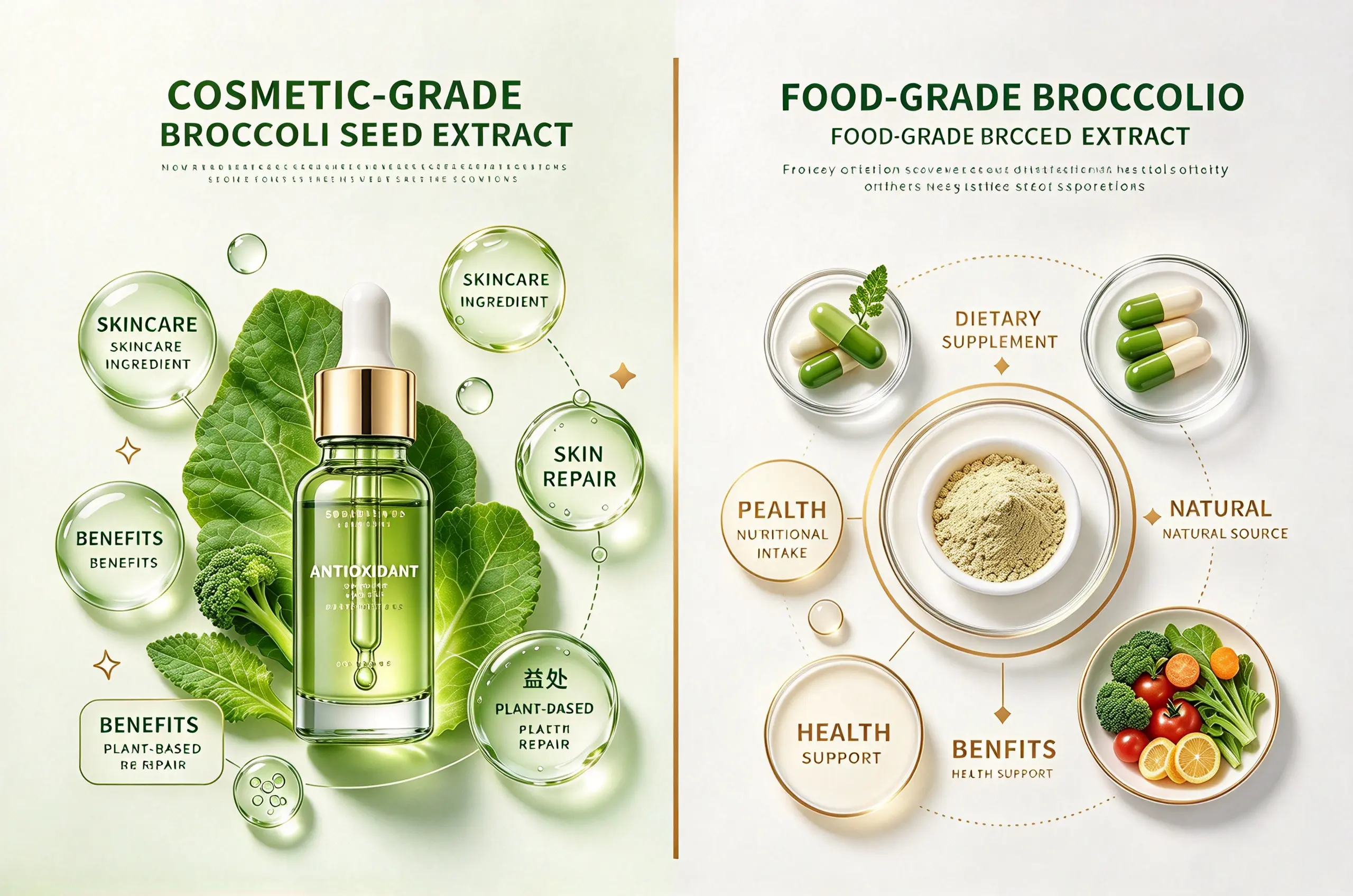
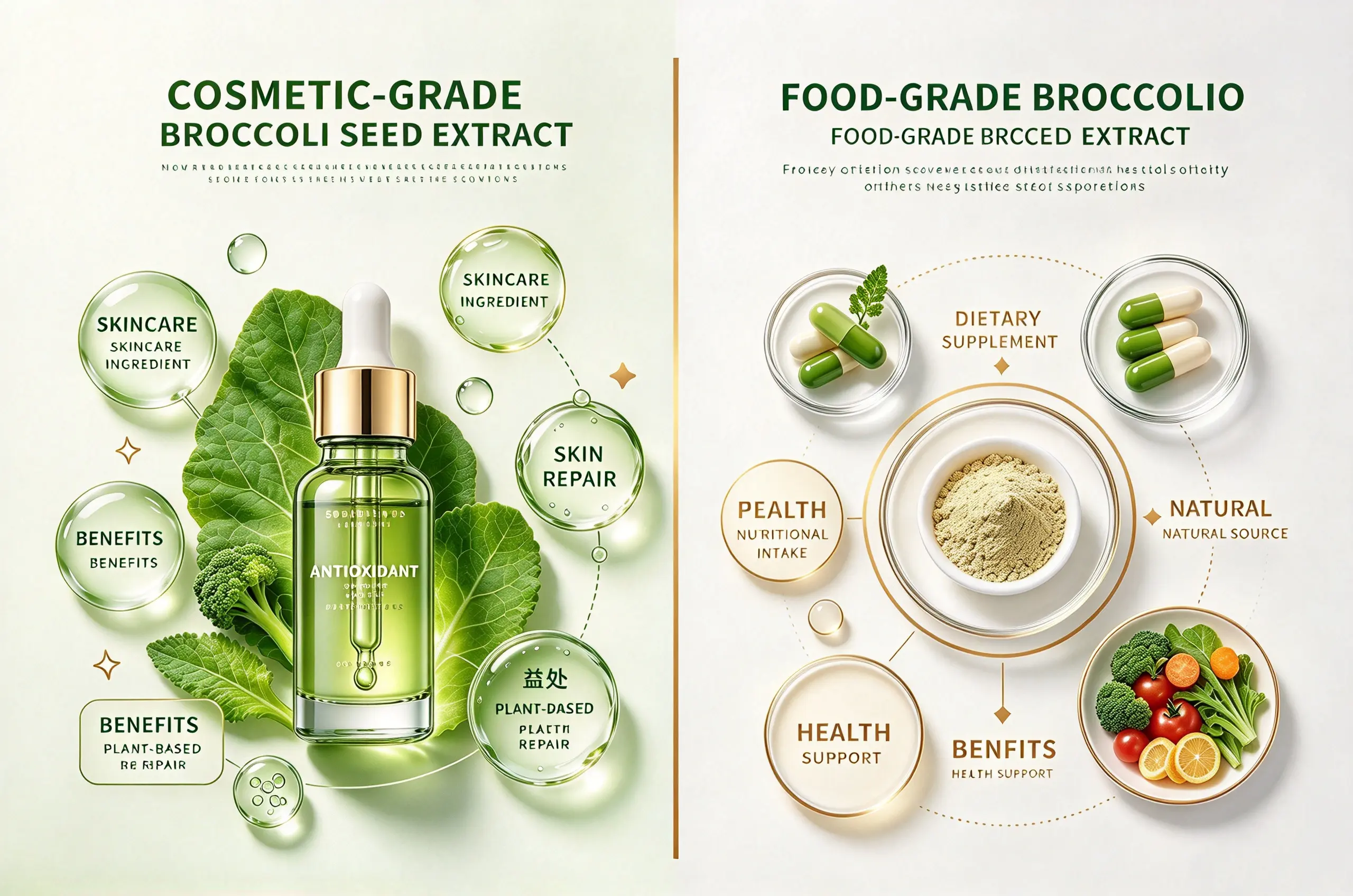
If you source broccoli seed extract for product formulation, you have probably noticed that suppliers use the terms "cosmetic-grade" and "food-grade" loosely - sometimes interchangeably. That inconsistency is not just a labeling quirk. It reflects a genuine gap in how the ingredient is specified, tested, and regulated across different application categories.
The distinction matters more than most buyers initially realize. A broccoli seed extract that performs well in a dietary supplement capsule may be entirely unsuitable for a topical serum - not because the glucoraphanin content is wrong, but because the microbial limits, heavy metal thresholds, solubility profile, and regulatory documentation requirements are fundamentally different between the two use cases.
This article breaks down exactly where those differences lie. Whether you are a cosmetic formulator, a supplement brand, or a procurement manager evaluating multiple suppliers, understanding these distinctions will sharpen your sourcing decisions and help you avoid specification mismatches that create problems downstream.
What Broccoli Seed Extract Actually Contains
Before comparing grades, it helps to be precise about what the ingredient is.
Broccoli seed extract is derived from the seeds of Brassica oleracea var. italica. The seeds are exceptionally rich in glucoraphanin - a glucosinolate compound that serves as the biological precursor to sulforaphane. Glucoraphanin itself is stable and pharmacologically inert. It converts to sulforaphane only when it contacts the enzyme myrosinase, either during digestion or through topical application to skin where microbiome-associated enzymes facilitate the conversion.
The key compounds in a standardized extract include:
- Glucoraphanin - the primary active precursor; the compound that HPLC standardization targets
- Myrosinase - the conversion enzyme; may be preserved or heat-inactivated depending on processing
- Sulforaphane - the bioactive end product; unstable and typically not present in significant quantities in finished extract powder
- Erucic acid and other fatty acids - present in seed-derived extracts; relevant to cosmetic formulation compatibility
- Indole glucosinolates - minor co-occurring compounds in the glucosinolate fraction
- The glucoraphanin content - verified by HPLC - is the primary quality marker for both cosmetic and food-grade specifications. But the similarity largely ends there.
The Core Specification Differences
Here is where the two grade categories diverge in ways that directly affect your formulation and compliance outcomes.
Microbial Limits: Tighter for Cosmetics Than You Might Expect
Many buyers assume food-grade microbial standards are stricter than cosmetic standards. In practice, the opposite is often true for topical applications.
Food-grade (dietary supplement) microbial limits follow USP <61>/<62> guidelines:
- Total aerobic count: ≤ 10,000 CFU/g
- Yeast & mold: ≤ 1,000 CFU/g
- Absence of specified pathogens (Salmonella, E. coli)
Cosmetic-grade microbial limits for leave-on skin products are typically tighter:
- Total aerobic count: ≤ 1,000 CFU/g
- Yeast & mold: ≤ 100 CFU/g
- Absence of Staphylococcus aureus, Pseudomonas aeruginosa, Candida albicans
The additional pathogen panel for cosmetic grades reflects the risk profile of topical application - particularly for products used near the eyes or on compromised skin barriers. A supplier who cannot provide cosmetic-specific microbial testing data is not equipped to serve the topical formulation market properly.
Heavy Metal Thresholds: Different Regulatory Frameworks Apply
Both grades require heavy metal testing. The acceptable limits differ based on the regulatory framework governing each application.
|
Metal |
Food/Supplement Grade |
Cosmetic Grade (EU) |
|
Lead (Pb) |
≤ 3.0 ppm (USP dietary supplement) |
≤ 2.0 ppm (EU Cosmetics Reg.) |
|
Arsenic (As) |
≤ 1.5 ppm |
≤ 0.5 ppm |
|
Mercury (Hg) |
≤ 0.1 ppm |
≤ 0.1 ppm |
|
Cadmium (Cd) |
≤ 1.0 ppm |
≤ 1.0 ppm |
The EU Cosmetics Regulation 1223/2009 applies stricter arsenic and lead limits than most dietary supplement frameworks. If you are formulating for the European cosmetic market, your broccoli seed extract supplier needs to demonstrate compliance with these specific thresholds - not just generic "heavy metals pass" language on a COA.
Glucoraphanin Standardization: Same Marker, Different Purpose
Both cosmetic and food-grade broccoli seed extract are standardized to glucoraphanin content by HPLC. The standardization method is the same. What differs is the functional intent behind the specification.
In food-grade applications, glucoraphanin standardization ensures consistent dosing of the sulforaphane precursor per serving. The conversion to sulforaphane happens in the gut via intestinal microbiome myrosinase activity. Oral bioavailability studies - including research from Johns Hopkins University - have characterized this conversion pathway in human subjects.
In cosmetic-grade applications, glucoraphanin standardization ensures consistent delivery of the Nrf2-activating precursor to skin cells. Conversion relies on skin microbiome myrosinase and keratinocyte-associated enzymatic activity. The topical mechanism is distinct from the oral pathway - and the formulation implications are different. Myrosinase preservation status, particle size, and skin penetration profile all become relevant specification parameters that food-grade COAs typically do not address.
Solubility & Formulation Compatibility
This is a practical difference that catches formulators off guard.
Food-grade broccoli seed extract is typically produced as a dry powder optimized for capsule filling, tablet compression, or powder blend incorporation. Flowability, bulk density, and compressibility are the relevant physical parameters.
Cosmetic-grade broccoli seed extract needs to be compatible with aqueous serum bases, emulsion systems, or gel matrices. Key considerations include:
- Water dispersibility - glucoraphanin is water-soluble, but carrier excipients in spray-dried extracts may not be
- pH stability - glucoraphanin is stable across a broad pH range, but myrosinase activity is pH-dependent (optimal at pH 5.5–6.5, which aligns with skin's natural pH)
- Particle size - finer particle size (≥ 100 mesh) is preferred for cosmetic applications to avoid gritty texture in finished formulas
- Carrier compatibility - maltodextrin carriers used in food-grade spray drying may affect cosmetic formula aesthetics; alternative carriers (cyclodextrin, acacia gum) are sometimes preferred for topical grades
Regulatory Documentation: What Each Market Requires
The documentation package required for market entry differs significantly between cosmetic and food/supplement applications.
For Food-Grade / Dietary Supplement Use
- Certificate of Analysis (COA) with HPLC glucoraphanin assay
- Nutritional analysis (if label declaration required)
- FDA Food Facility Registration (US market)
- FSSC 22000 or equivalent food safety certification
- Allergen declaration
- Non-GMO declaration (US natural channel)
- Country of origin certificate
For Cosmetic-Grade Use
- COA with HPLC glucoraphanin assay plus cosmetic-specific microbial panel
- EU Cosmetics Regulation 1223/2009 compliance statement
- INCI name declaration (Brassica oleracea italica seed extract)
- CosIng database registration confirmation
- Safety Assessment (Part B of the Product Information File for EU market)
- REACH compliance documentation (EU)
- Allergen declaration per EU Regulation 1169/2011
- Heavy metals compliance per EU Cosmetics Regulation limits
- Preservative efficacy compatibility data (on request)
A supplier who provides only a food-grade COA for a cosmetic ingredient inquiry is not equipped to support your EU cosmetic market entry. The documentation gap is real and consequential.
Myrosinase Status: A Specification Point That Separates the Two Grades
This is one of the most overlooked differences between cosmetic and food-grade broccoli seed extract - and one of the most formulation-critical.
Myrosinase is the enzyme that converts glucoraphanin to sulforaphane. Its status in the finished extract powder has different implications depending on the application:
In food-grade extracts: Myrosinase is often heat-inactivated during processing to improve shelf stability of glucoraphanin. The conversion to sulforaphane relies on gut microbiome myrosinase activity - which is sufficient for oral bioavailability. Heat-inactivated extracts have longer shelf life and more predictable glucoraphanin stability.
In cosmetic-grade extracts: Myrosinase preservation is more nuanced. Some formulators prefer myrosinase-active extracts for topical use, relying on skin microbiome enzymatic activity for in-situ sulforaphane generation at the skin surface. Others prefer myrosinase-inactivated extracts with a separate myrosinase co-delivery system to control the conversion rate and prevent premature glucoraphanin degradation during formula shelf life.
The choice affects:
- Shelf life of the finished cosmetic product
- Sulforaphane generation rate at the skin surface
- Formulation pH requirements
- Packaging requirements (nitrogen-flushed for myrosinase-active grades)
When evaluating suppliers, ask explicitly: is myrosinase preserved or heat-inactivated in this extract? The answer shapes your entire formulation strategy.
What B2B Buyers Should Verify Before Placing an Order
Whether you are sourcing for a cosmetic or food application, these are the checkpoints that separate a reliable supplier from a risk:
For cosmetic-grade sourcing:
- Cosmetic-specific microbial panel (including S. aureus, P. aeruginosa)
- EU Cosmetics Regulation 1223/2009 compliance documentation
- INCI name and CosIng confirmation
- Arsenic limit ≤ 0.5 ppm (EU cosmetic threshold)
- Myrosinase status clearly stated
- Particle size data (≥ 100 mesh preferred)
- Preservative compatibility data available on request
For food-grade / supplement sourcing:
- HPLC glucoraphanin assay with reference standard disclosed
- USP <61>/<62> microbial compliance
- FDA Food Facility Registration number
- FSSC 22000 or equivalent food safety certification
- Pesticide residue screening (EU MRL panel for European market)
- Nutritional analysis available for label declaration
For both grades:
- Batch-specific COA (not a generic template)
- ICP-MS heavy metals data (not just specification limits)
- Residual solvent data (ICH Q3C compliant)
- Non-GMO declaration
- Kosher/Halal certification if required by your market
The Overlap Zone: When One Extract Serves Both Markets
Some high-specification broccoli seed extract grades are manufactured to satisfy both cosmetic and food-grade requirements simultaneously. This is achievable when:
- Microbial testing covers both USP <61>/<62> and cosmetic pathogen panels
- Heavy metal limits meet the stricter EU cosmetic thresholds
- Documentation covers both INCI/CosIng requirements and FDA/FSSC food safety requirements
- Particle size and solubility profile are optimized for both capsule filling and aqueous cosmetic bases
This dual-compliance approach is commercially attractive for brands running both topical and oral product lines from the same raw material. It simplifies inventory management and supplier qualification. Not every supplier can deliver it - it requires investment in dual-standard testing and documentation infrastructure that commodity extract producers typically do not maintain.
Why the Grade Distinction Is Getting More Important
Regulatory scrutiny of cosmetic ingredient documentation is increasing in both the EU and US markets. The EU Cosmetics Regulation 1223/2009 enforcement has tightened around ingredient traceability and safety assessment requirements. The US FDA's growing interest in cosmeceutical ingredient substantiation means that "food-grade COA" is no longer an acceptable substitute for proper cosmetic ingredient documentation.
At the same time, the broccoli seed extract market is growing across both application categories. Consumer demand for science-backed skincare actives - driven by the Nrf2 pathway research and the documented UV protection data from Johns Hopkins - is pulling cosmetic-grade demand upward. Oral supplement demand for glucoraphanin-standardized extracts continues to grow alongside the broader sulforaphane research base.
Suppliers who can serve both markets with properly specified, properly documented product are in a stronger commercial position than those who offer a single undifferentiated extract grade for all applications.
Sourcing Broccoli Seed Extract from Jiuyuan Biotech
At Jiuyuan Biotech, we supply both cosmetic-grade and food-grade broccoli seed extract with HPLC-verified glucoraphanin content, batch-specific documentation, and full compliance support for US and EU market entry.
Our broccoli seed extract delivers:
- HPLC-verified glucoraphanin standardization - multiple potency grades
- Cosmetic-grade microbial panel - including S. aureus, P. aeruginosa, C. albicans
- EU Cosmetics Regulation 1223/2009 compliance documentation
- ICP-MS heavy metals - meeting EU cosmetic arsenic and lead thresholds
- EU MRL-compliant pesticide residue screening
- Myrosinase status clearly specified per grade
- Non-GMO, Kosher, Halal certified
- FSSC 22000 food safety management
View the full product specification: 👉 jiuyuanbio.com/standard-plant-extract-powder/broccoli-seed-extract.html
Have a specification question or ready to request a sample? Reach our technical team at info@jiuybiotech.com. We respond to all ingredient inquiries within one business day.
References
- Fahey, J. W., Zhang, Y., & Talalay, P. (1997). Broccoli sprouts: An exceptionally rich source of inducers of enzymes that protect against chemical carcinogens. Proceedings of the National Academy of Sciences, 94(19), 10367–10372.
- Dinkova-Kostova, A. T., & Talalay, P. (2008). Direct and indirect antioxidant properties of inducers of cytoprotective proteins. Molecular Nutrition & Food Research, 52(S1), S128–S138.
- European Commission. (2009). Regulation (EC) No 1223/2009 of the European Parliament and of the Council on cosmetic products. Official Journal of the European Union, L 342, 59–209.
- Shapiro, T. A., Fahey, J. W., Wade, K. L., Stephenson, K. K., & Talalay, P. (2001). Chemoprotective glucosinolates and isothiocyanates of broccoli sprouts: Metabolism and excretion in humans. Cancer Epidemiology, Biomarkers & Prevention, 10(5), 501–508.
- Talalay, P., Fahey, J. W., Healy, Z. R., Wehage, S. L., Benedict, A. L., Min, C., & Dinkova-Kostova, A. T. (2007). Sulforaphane mobilizes cellular defenses that protect skin against damage by UV radiation. Proceedings of the National Academy of Sciences, 104(44), 17500–17505.
- Houghton, C. A. (2019). Sulforaphane: Its "coming of age" as a clinically relevant nutraceutical in the prevention and treatment of chronic disease. Oxidative Medicine and Cellular Longevity, 2019, Article 2716870.