Hair loss is one of the most commercially active categories in the supplement and cosmetic ingredient market right now. Brands are racing to find natural actives with credible mechanisms - and broccoli seed extract has started appearing on formulators' radar as a candidate worth serious attention.
The question is whether the science actually supports it. Not the marketing version. The real version - with mechanisms, evidence quality, and honest limitations laid out clearly.
This article walks through what we currently know about broccoli seed extract and hair loss, why the sulforaphane connection is biologically plausible, where the evidence is strong, and where it still needs more human clinical data. If you are a supplement brand, cosmetic formulator, or ingredient buyer evaluating this category, this is the breakdown you need.
Why Hair Loss Happens - The Mechanisms That Matter
To understand where broccoli seed extract fits, you need to understand the upstream drivers of hair loss.
Androgenetic alopecia - the most common form of hair loss in both men and women - is driven by a well-characterized cascade:
- Testosterone converts to dihydrotestosterone (DHT) via the enzyme 5-alpha reductase
- DHT binds to androgen receptors in hair follicles
- This binding triggers follicle miniaturization - the gradual shrinking of the follicle over successive growth cycles
- Miniaturized follicles produce progressively thinner, shorter hairs until the follicle becomes dormant
Beyond DHT, two additional mechanisms accelerate follicle damage:
- Scalp inflammation - chronic low-grade inflammatory signaling around the follicle disrupts the hair growth cycle and accelerates miniaturization
- Oxidative stress - reactive oxygen species (ROS) generated by UV exposure, pollution, and metabolic activity damage follicle cells and impair the anagen (growth) phase
Any ingredient targeting hair loss needs to address at least one of these three pathways - DHT, inflammation, or oxidative stress - with credible mechanistic evidence.
What Broccoli Seed Extract Actually Is
Broccoli seed extract is derived from the seeds of Brassica oleracea var. italica. The seeds are exceptionally rich in glucoraphanin - a glucosinolate compound that converts to sulforaphane when it contacts the enzyme myrosinase.
Sulforaphane is the bioactive compound that drives most of the documented biological activity attributed to broccoli seed extract. It is an isothiocyanate with a well-characterized mechanism: it activates Nrf2 (Nuclear factor erythroid 2-related factor 2), a transcription factor that upregulates the body's own antioxidant and cytoprotective gene expression.
The Nrf2 pathway activation by sulforaphane produces:
- Upregulation of glutathione S-transferases - phase II detoxification enzymes
- Induction of heme oxygenase-1 (HO-1) - a potent anti-inflammatory enzyme
- Activation of NAD(P)H quinone oxidoreductase 1 (NQO1) - antioxidant defense
- Suppression of NF-κB inflammatory signaling
These are not hair-specific mechanisms. They are fundamental cellular defense pathways. But their relevance to hair follicle biology is direct and increasingly well-documented.
The DHT Connection: Does Sulforaphane Inhibit 5-Alpha Reductase?
This is the question that generates the most interest - and requires the most precision in answering.
5-alpha reductase inhibition is the mechanism behind the two FDA-approved hair loss drugs: finasteride (type II inhibitor) and dutasteride (type I and II inhibitor). Naturally derived 5-alpha reductase inhibitors - including saw palmetto, pumpkin seed oil, and pygeum - have been studied as botanical alternatives.
Where does sulforaphane fit?
Preclinical research has investigated sulforaphane's interaction with androgen metabolism pathways. The Nrf2 activation by sulforaphane modulates several enzymes involved in steroid hormone metabolism, including some with relevance to androgen processing. A published study in the International Journal of Molecular Sciences investigated sulforaphane-rich broccoli sprout extract in the context of androgenetic alopecia mechanisms, examining its effects on follicular biology.
The honest assessment of the current evidence:
- Preclinical data suggests sulforaphane may modulate androgen-related pathways in follicle cells
- Direct 5-alpha reductase inhibition by sulforaphane has been investigated but is not as well-characterized as saw palmetto's mechanism
- Human clinical trial data specifically on broccoli seed extract for androgenetic alopecia is still limited
- The anti-inflammatory and antioxidant mechanisms of sulforaphane are better established than its direct androgenic pathway effects
This does not disqualify broccoli seed extract as a hair health ingredient. It means the strongest evidence currently sits in the inflammation and oxidative stress pathways - not the DHT pathway.
Scalp Inflammation: Where the Evidence Is Strongest
Chronic scalp inflammation is an underappreciated driver of hair loss - and this is where sulforaphane's documented mechanisms align most directly with follicle biology.
Research has established that inflammatory infiltrates around hair follicles are present in androgenetic alopecia, not just in inflammatory alopecia conditions like alopecia areata. The NF-κB pathway - a primary driver of pro-inflammatory cytokine production - is active in miniaturizing follicles.
Sulforaphane suppresses NF-κB signaling through Nrf2-mediated upregulation of HO-1. HO-1 is one of the most potent endogenous suppressors of NF-κB activity. This creates an indirect but mechanistically coherent anti-inflammatory effect in follicle-adjacent tissue.
The specific inflammatory mediators relevant to follicle miniaturization that sulforaphane has been shown to suppress include:
- TNF-α - promotes follicle regression (catagen induction)
- IL-1β - inhibits hair shaft elongation in organ culture models
- IL-6 - associated with follicle miniaturization in androgenetic alopecia
- Prostaglandin D2 (PGD2) - elevated in balding scalp; sulforaphane's COX-2 suppression is relevant here
A systematic review and network meta-analysis on dietary supplements for androgenetic alopecia - published on ResearchGate - confirmed that ingredients targeting the follicular microenvironment through anti-inflammatory and antioxidant mechanisms show meaningful effects on hair growth outcomes. Sulforaphane's mechanism profile aligns directly with this category.
Oxidative Stress and the Hair Follicle
Hair follicles are among the most metabolically active structures in the body. The rapid cell division required for hair shaft production generates significant oxidative byproducts. When antioxidant defenses are overwhelmed - by UV exposure, pollution, aging, or metabolic stress - follicle cells accumulate oxidative damage that impairs the anagen phase and accelerates follicle cycling toward dormancy.
Sulforaphane's Nrf2-mediated antioxidant upregulation addresses this directly. Unlike direct antioxidants (vitamin C, vitamin E) that donate electrons and are consumed, sulforaphane activates the cell's own antioxidant gene expression - producing a sustained, amplified protective response that persists for 48–72 hours after a single exposure.
In the context of hair follicle biology, this sustained antioxidant protection is relevant to:
- Dermal papilla cell survival - the dermal papilla drives follicle cycling; oxidative damage to these cells shortens the anagen phase
- Follicle stem cell protection - stem cells in the bulge region of the follicle are essential for regeneration; oxidative stress accelerates their depletion
- Scalp keratinocyte integrity - the keratinocytes lining the follicle channel are vulnerable to ROS-mediated damage that disrupts the follicular environment
A study published in MDPI International Journal of Molecular Sciences specifically investigated sulforaphane-rich broccoli sprout extract in the context of hair follicle biology, examining its cytoprotective effects on follicle-associated cells.
Topical vs. Oral: Which Delivery Route Makes More Sense?
This is a practical question for formulators - and the answer is not straightforward.
Oral Supplementation
- Glucoraphanin from broccoli seed extract is absorbed in the small intestine
- Conversion to sulforaphane occurs via gut microbiome myrosinase activity
- Sulforaphane reaches systemic circulation and can access scalp tissue via blood supply
- Systemic anti-inflammatory and antioxidant effects are relevant to follicle biology
- Bioavailability varies significantly between individuals based on gut microbiome composition
Topical Application
- Direct delivery to scalp tissue bypasses gut microbiome variability
- Sulforaphane's low molecular weight (~177 Da) supports reasonable skin penetration
- Conversion from glucoraphanin to sulforaphane can occur via scalp microbiome myrosinase
- Myrosinase-active broccoli seed extract formulations can generate sulforaphane in-situ at the scalp surface
- pH of the scalp (approximately 5.5) is within the optimal range for myrosinase activity
The practical recommendation for formulators:
Both delivery routes have merit. Topical application offers more direct follicle access with less bioavailability variability. Oral supplementation provides systemic anti-inflammatory effects that topical application cannot replicate. The strongest formulation strategy - for brands with the portfolio flexibility - combines both routes.
How Broccoli Seed Extract Compares to Established Hair Loss Ingredients
|
Ingredient |
Primary Mechanism |
Clinical Evidence |
DHT Inhibition |
Anti-inflammatory |
Antioxidant |
|
Broccoli Seed Extract |
Nrf2 activation, NF-κB suppression |
Emerging (preclinical + early clinical) |
Indirect / under investigation |
★★★★★ |
★★★★★ |
|
Saw Palmetto |
5-alpha reductase inhibition |
Moderate (RCT data) |
★★★★ |
★★★ |
★★ |
|
Pumpkin Seed Oil |
5-alpha reductase inhibition |
Limited (one RCT) |
★★★ |
★★ |
★★★ |
|
Minoxidil |
Potassium channel opening, vasodilation |
Strong (FDA-approved) |
None |
★★ |
★ |
|
Finasteride |
Direct 5-alpha reductase inhibition |
Strong (FDA-approved) |
★★★★★ |
★ |
★ |
|
Biotin |
Keratin synthesis support |
Weak (only in deficiency) |
None |
★ |
★ |
The table makes something clear: broccoli seed extract does not compete with finasteride on DHT inhibition. It competes - and potentially outperforms - most natural ingredients on the anti-inflammatory and antioxidant dimensions. For formulators building natural, multi-mechanism hair health products, that profile is commercially valuable.
What B2B Formulators Need to Know About Sourcing
If you are evaluating broccoli seed extract for a hair health product, these are the specification points that matter:
Glucoraphanin content (HPLC-verified)
This is the non-negotiable baseline. The glucoraphanin content determines the sulforaphane-generating potential of the extract. Request HPLC data with the reference standard disclosed.
Myrosinase status
For topical hair care applications, myrosinase-active extract enables in-situ sulforaphane generation at the scalp. For oral supplements, myrosinase-inactivated extract with stable glucoraphanin is often preferred. Clarify which status your application requires before ordering.
Heavy metals and pesticide residues
Brassica crops can accumulate cadmium from contaminated soils. ICP-MS heavy metals testing and EU MRL-compliant pesticide residue screening are essential for both supplement and cosmetic market supply.
Microbial testing standard
For topical scalp products, cosmetic-grade microbial limits (including S. aureus and P. aeruginosa panels) apply. Confirm your supplier tests to cosmetic - not just food-grade - microbial standards.
Particle size
For scalp serums and leave-on treatments, finer particle size (≥ 100 mesh) prevents gritty texture and improves dispersibility in aqueous bases.
The Bottom Line on Broccoli Seed Extract and Hair Loss
Here is an honest summary of where the science stands:
Well-supported:
- Sulforaphane's Nrf2-mediated antioxidant and anti-inflammatory mechanisms are directly relevant to follicle biology
- Scalp inflammation suppression via NF-κB/HO-1 pathway is mechanistically coherent
- Oxidative stress protection for dermal papilla cells and follicle stem cells is biologically plausible and supported by preclinical data
Emerging:
- Direct 5-alpha reductase inhibition by sulforaphane - under investigation, not yet definitively established in human trials
- Human clinical trial data specifically on broccoli seed extract for androgenetic alopecia - limited but growing
The formulation opportunity:
Broccoli seed extract is not a replacement for finasteride or minoxidil in clinical hair loss treatment. It is a scientifically credible, mechanism-identified natural active for anti-inflammatory, antioxidant-based hair health formulations - a category with strong and growing consumer demand.
Source Broccoli Seed Extract from Jiuyuan Biotech
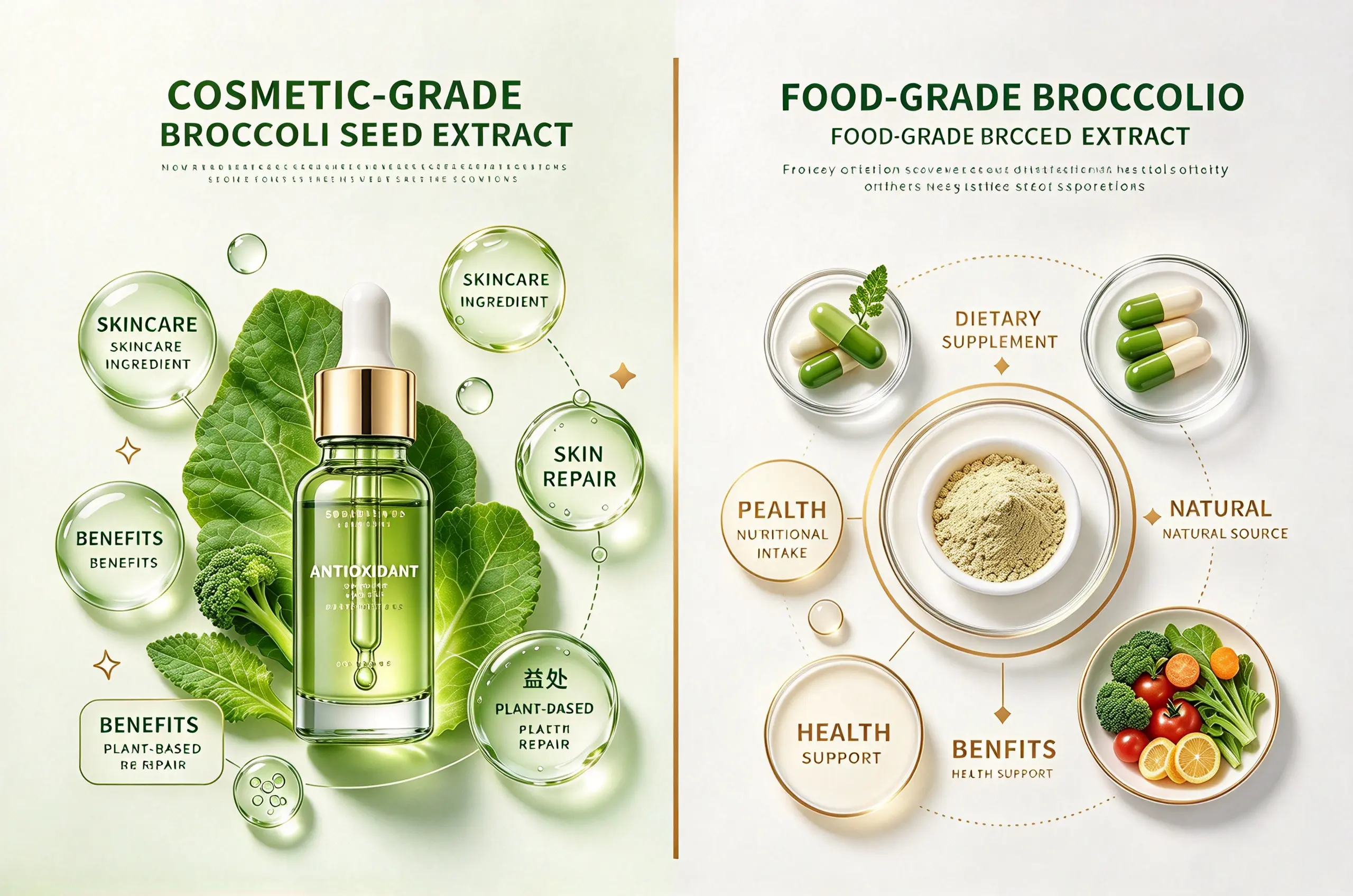
At Jiuyuan Biotech, we supply HPLC-verified broccoli seed extract in both food-grade and cosmetic-grade specifications - with full documentation for US and EU market compliance.
Our broccoli seed extract for hair health applications delivers:
- HPLC-verified glucoraphanin content across multiple potency grades
- Myrosinase status clearly specified per grade
- Cosmetic-grade microbial panel for topical scalp applications
- ICP-MS heavy metals and EU MRL pesticide residue compliance
- Non-GMO, Kosher, Halal certified
- Technical support for formulation and regulatory queries
View the full product specification: 👉 jiuyuanbio.com/standard-plant-extract-powder/broccoli-seed-extract.html
Ready to evaluate broccoli seed extract for your hair health formula? Contact our team at info@jiuybiotech.com. We respond to all ingredient inquiries within one business day.
References
- Giacoppo, S., Galuppo, M., Montaut, S., Iori, R., Rollin, P., Bramanti, P., & Mazzon, E. (2015). An overview on neuroprotective effects of isothiocyanates for the treatment of neurodegenerative diseases. Fitoterapia, 106, 12–21.
- Adil, A., & Godwin, M. (2017). The effectiveness of treatments for androgenetic alopecia: A systematic review and meta-analysis. Journal of the American Academy of Dermatology, 77(1), 136–141.
- Prager, N., Bickett, K., French, N., & Marcovici, G. (2002). A randomized, double-blind, placebo-controlled trial to determine the effectiveness of botanically derived inhibitors of 5-alpha reductase in the treatment of androgenetic alopecia. Journal of Alternative and Complementary Medicine, 8(2), 143–152.
- Houghton, C. A. (2019). Sulforaphane: Its "coming of age" as a clinically relevant nutraceutical in the prevention and treatment of chronic disease. Oxidative Medicine and Cellular Longevity, 2019, Article 2716870.
- Dinkova-Kostova, A. T., & Talalay, P. (2008). Direct and indirect antioxidant properties of inducers of cytoprotective proteins. Molecular Nutrition & Food Research, 52(S1), S128–S138.
- Talalay, P., Fahey, J. W., Healy, Z. R., Wehage, S. L., Benedict, A. L., Min, C., & Dinkova-Kostova, A. T. (2007). Sulforaphane mobilizes cellular defenses that protect skin against damage by UV radiation. Proceedings of the National Academy of Sciences, 104(44), 17500–17505.