

If you've been hearing more about broccoli seed extract in supplement formulation circles lately, you're not imagining things. This ingredient has quietly become one of the most research-backed botanical actives in the nutraceutical industry - backed by over 3,000 published SCI papers and more than 130 completed clinical trials globally.
But what does it actually do in the body? And more importantly - if you're a supplement brand, contract manufacturer, or product developer - is it the right ingredient for your next formulation?
Let's break it down.
The Core Mechanism: It All Starts With Glucoraphanin
Before you can understand what broccoli seed extract does, you need to understand how it works. The active compound most people associate with broccoli is sulforaphane - a potent isothiocyanate with well-documented biological activity.
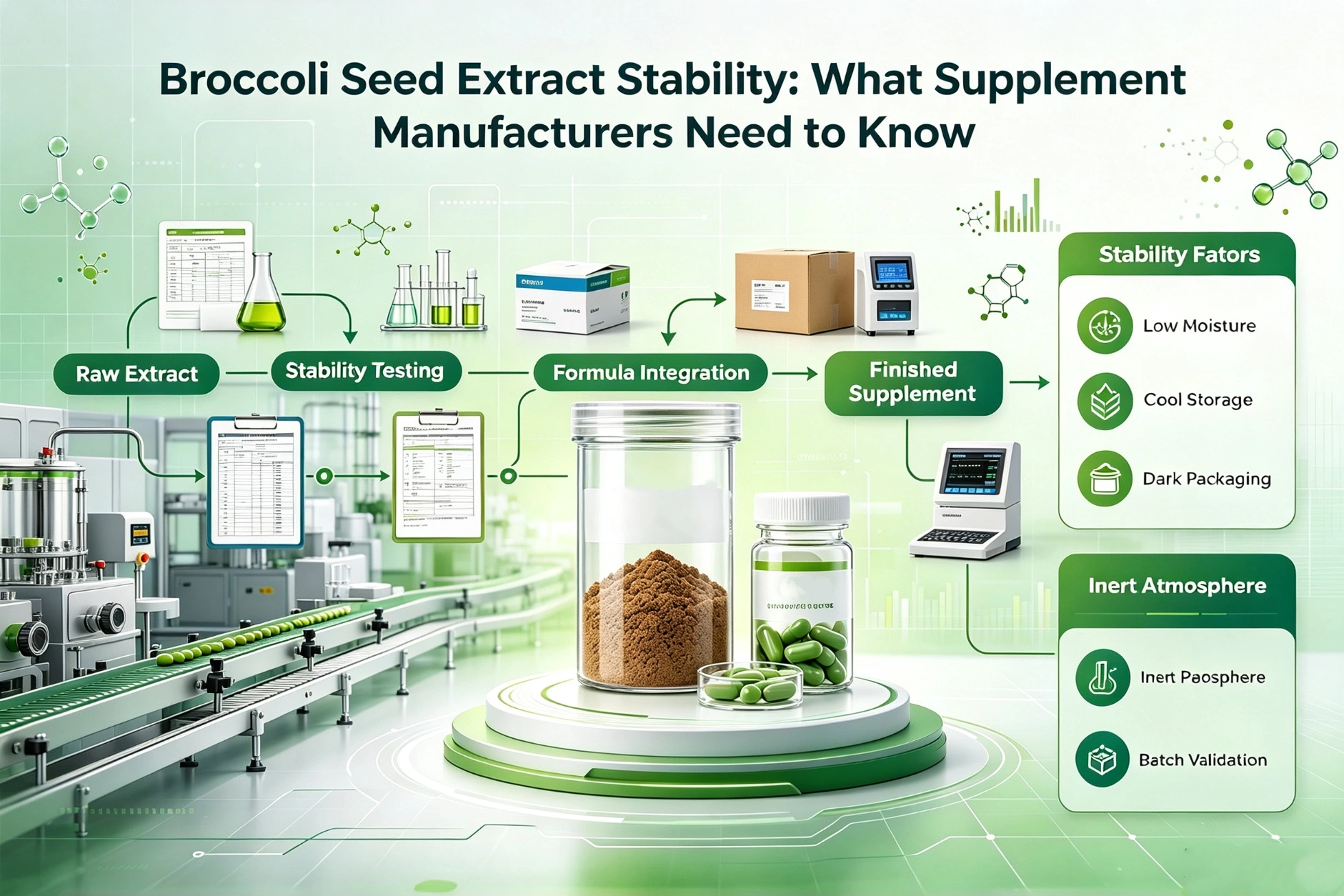
Here's the catch: sulforaphane itself is chemically unstable. It degrades quickly under heat, moisture, and standard manufacturing conditions. That makes it nearly impossible to formulate reliably in its free form.
The industry solution is glucoraphanin - sulforaphane's thermally stable precursor. Glucoraphanin survives processing intact. Once ingested, gut microbial myrosinase converts it to sulforaphane in vivo, delivering a urinary dithiocarbamate recovery rate of 70%–90%.
This is why high-quality broccoli seed extract products are standardized for glucoraphanin content, not just raw sulforaphane. The conversion happens where it needs to - inside the body.

What Sulforaphane Actually Does: 5 Evidence-Backed Functions
1. Activates the Nrf2 Antioxidant Pathway
Sulforaphane is one of the most potent known activators of Nrf2 - a transcription factor that regulates the body's endogenous antioxidant defense system.
When Nrf2 is activated, it upregulates a cascade of cytoprotective enzymes, including:
● Heme oxygenase-1 (HO-1)
● NAD(P)H quinone oxidoreductase 1 (NQO1)
● Glutathione S-transferases (GSTs)
These enzymes neutralize reactive oxygen species (ROS) and electrophilic toxins. This is not a direct antioxidant effect - it's an indirect one that amplifies the body's own defenses. That distinction matters for formulators making structure/function claims.
2. Supports Phase II Detoxification
The same Nrf2 pathway that drives antioxidant activity also governs Phase II detoxification enzymes in the liver. These enzymes conjugate and neutralize carcinogens, environmental pollutants, and metabolic waste products before excretion.
Cruciferous vegetables - particularly broccoli - have long been associated with lower cancer risk in epidemiological studies. A narrative review published in Nutrients (2018) noted the cardiovascular and chemoprotective associations linked to cruciferous vegetable intake, attributing much of this effect to organosulfur compounds including glucosinolates. Concentrated seed extract delivers these compounds at doses far exceeding what dietary intake alone can achieve.
3. Modulates Inflammatory Signaling
Chronic low-grade inflammation sits at the root of most non-communicable diseases - cardiovascular disease, type 2 diabetes, metabolic syndrome, and neurodegeneration among them.
Sulforaphane inhibits NF-κB - a master regulator of pro-inflammatory gene expression. By suppressing NF-κB activation, it reduces the production of cytokines including TNF-α, IL-1β, and IL-6.
This anti-inflammatory mechanism has been studied in the context of:
● Cardiovascular disease - reduced endothelial inflammation and oxidative stress
● Metabolic disorders - improved insulin sensitivity markers in clinical trials
● Neuroinflammation - early-stage research in autism spectrum disorder and schizophrenia at institutions including Johns Hopkins University
4. Exerts Chemopreventive Activity
This is arguably the most studied area of sulforaphane research. The compound's ability to activate Phase II detox enzymes, induce apoptosis in aberrant cells, and inhibit histone deacetylase (HDAC) activity has made it a subject of intense oncology research.
Over 48 clinical trials in North America alone have investigated sulforaphane's role in cancer chemoprevention - covering prostate, breast, bladder, and colorectal cancers, among others. Three randomized controlled trials (NCT03932136, NCT05145270, NCT05148169) are currently ongoing.
It's important to be precise here: this is chemopreventive research, not treatment research. The evidence supports a role in reducing cancer risk, not treating established disease.
5. Supports Cardiovascular Health
Sulforaphane's cardiovascular relevance operates through multiple channels:
● Endothelial protection via Nrf2-mediated antioxidant upregulation
● Blood pressure modulation - a 12-week randomized trial found that glucoraphanin supplementation was associated with modest reductions in systolic blood pressure in hypertensive subjects
● Lipid metabolism - preclinical data suggests sulforaphane may reduce hepatic lipid accumulation
Cruciferous vegetable intake has been consistently associated with reduced cardiovascular disease risk in observational epidemiological studies. Broccoli seed extract concentrates the relevant phytochemicals at clinically meaningful doses.
Glucoraphanin vs. Sulforaphane: Which Should You Formulate With?
This is one of the most common questions from product developers - and the answer depends on your application.
|
Factor |
Glucoraphanin |
Free Sulforaphane |
|
Stability |
High - survives heat, moisture, processing |
Low - degrades rapidly |
|
Shelf life |
24+ months under standard conditions |
Months at best |
|
In vivo conversion |
70–90% urinary recovery |
Direct - no conversion needed |
|
Formulation flexibility |
Tablets, capsules, beverages, gummies |
Limited; requires encapsulation |
|
Regulatory status |
New Food Raw Material (China); widely accepted |
Varies by market |
|
Best for |
Most commercial supplement applications |
Research-grade, clinical trial use |
For the vast majority of commercial formulations, glucoraphanin-standardized extract is the practical choice. The in vivo conversion is efficient, the stability is manageable, and the clinical evidence base is built primarily on glucoraphanin-containing preparations.
Why the Standardization Method Matters More Than You Think
Not all broccoli seed extracts are equal - and the gap between high-quality and commodity material is wider than most buyers realize.
Many suppliers report glucosinolate content using non-specific colorimetric assays. These methods detect all glucosinolates collectively, not glucoraphanin specifically. The result is an inflated declared content that doesn't reflect the actual sulforaphane-generating capacity of the material.
HPLC against certified reference standards is the only method that gives you a defensible, lot-specific glucoraphanin figure. If a supplier can't tell you which analytical method they used - ask. If they can't answer, that's your answer.
At Jiuyuan Biotech, every batch of broccoli seed extract is verified by HPLC against certified reference standards. Our product line covers:
● SFN-1 - Sulforaphane ≥1%
● SFN-5 - Sulforaphane ≥5%
● GR-13 - Glucoraphanin ≥13%
● GR-13 + SFN-1 - Combined specification
● Custom ultra-high potency grades above 10% available on request
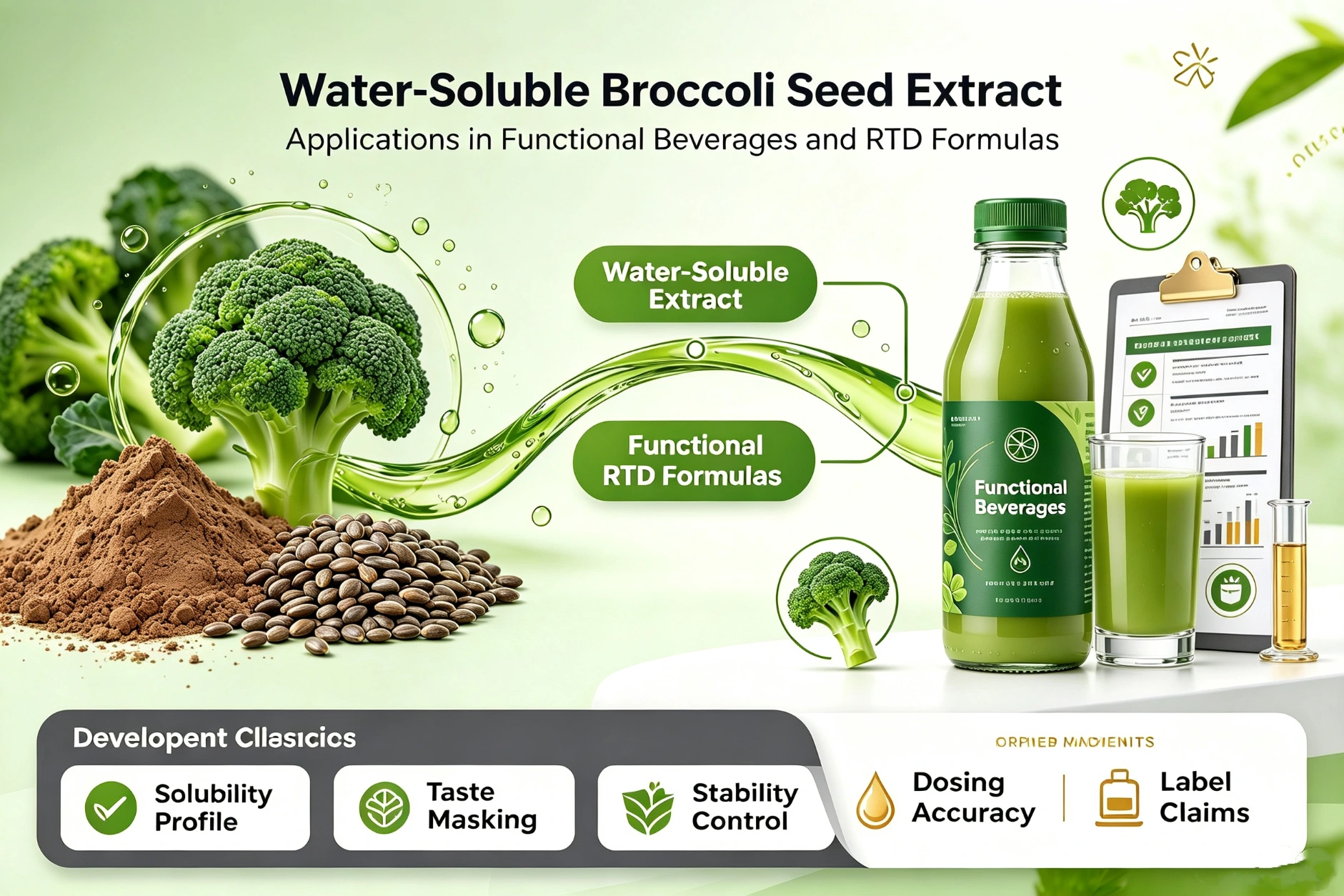
Both water-soluble and oil-soluble powder formats are offered - the water-soluble version achieves ≥98% clarity, making it suitable for transparent beverage applications.
Who Is Using Broccoli Seed Extract - and In What Products?
The ingredient's formulation versatility is one of its commercial strengths. Current applications include:
● Capsules and tablets - the most common delivery format; straightforward to dose
● Functional beverages and wellness shots - water-soluble grade preferred
● Protein powders and meal replacements - blends well with other botanical actives
● Functional gummies - growing category; requires heat-stable glucoraphanin form
● Foods for special medical purposes (FSMPs) - clinical nutrition applications
● Sports nutrition - positioned around cellular protection and recovery
● Infant and maternal nutrition - emerging application; requires pharmaceutical-grade documentation
The mild taste profile - no pungent cruciferous aftertaste - removes a significant formulation barrier that has historically limited broccoli-derived ingredients in consumer-facing products.
The Regulatory Landscape: What B2B Buyers Need to Know
China: The Chinese Dietary Reference Intakes 2023 established a Tolerable Upper Intake Level (TUL) for sulforaphane at 30 mg/day - the first time a regulatory body has set a quantitative reference value for this compound. This enables precise, milligram-level dosing in Chinese market formulations.
United States: Glucoraphanin-containing broccoli seed extract is marketed as a dietary supplement ingredient under DSHEA. No specific FDA-approved health claims exist, but structure/function claims related to antioxidant activity and cellular protection are widely used.
European Union: Broccoli seed extract is used in food supplements across EU member states. Formulators targeting EU markets should confirm novel food status for their specific specification and concentration.
Japan: 18 completed clinical trials and one ongoing UMIN-registered RCT reflect strong regulatory and research interest. The University of Tokyo's Institute of Medical Science has been an active research site.
5 Questions to Ask Before You Source
If you're evaluating broccoli seed extract suppliers, these questions will separate serious manufacturers from commodity traders:
1.What analytical method do you use to verify glucoraphanin content? (HPLC with certified reference standards is the correct answer.)
2.Can you provide lot-specific COA with chromatogram?
3.What is the in vivo conversion rate, and how was it measured?
4.Do you hold FDA facility registration and cGMP compliance documentation?
5.What stability data do you have for your declared specification under accelerated conditions?
If a supplier hesitates on any of these, the risk falls on your formulation - not theirs.
A Note on the Research Base
The clinical evidence behind sulforaphane is unusually robust for a botanical ingredient. Over 3,000 SCI papers have been published using this compound as an intervention. Active research institutions include Johns Hopkins University, Massachusetts General Hospital, Imperial College London, and Karolinska Institutet.
This depth of evidence is commercially relevant - it gives brands the scientific foundation to build credible, defensible product narratives without overstating efficacy.
The Bottom Line
Broccoli seed extract does something that very few botanical ingredients can claim: it activates the body's own protective systems rather than simply delivering exogenous antioxidants. The Nrf2 pathway, Phase II detoxification, NF-κB suppression, and chemopreventive activity are all downstream of a single, well-characterized biochemical cascade initiated by sulforaphane.
For formulators, that mechanistic clarity is an asset. It means the ingredient's benefits are explainable, the dosing is quantifiable, and the evidence base is deep enough to support serious product development.
If you're evaluating broccoli seed extract for your next formulation - whether for a cardiovascular supplement, a detox formula, a sports nutrition product, or a functional beverage - the science is there. The question is whether your source material is good enough to deliver it.
Ready to source pharmaceutical-grade broccoli seed extract for your formulation? Visit our product page at jiuyuanbio.com/standard-plant-extract-powder/broccoli-seed-extract.html or contact our technical team directly at info@jiuybiotech.com. We respond within one business day with a full technical datasheet, lot-specific COA, and sample availability.
References
1.Fahey JW, Zhang Y, Talalay P. Broccoli sprouts: An exceptionally rich source of inducers of enzymes that protect against chemical carcinogens. Proceedings of the National Academy of Sciences USA. 1997;94(19):10367–10372.
2.Shapiro TA, Fahey JW, Wade KL, Stephenson KK, Talalay P. Human metabolism and excretion of cancer chemoprotective glucosinolates and isothiocyanates of cruciferous vegetables. Cancer Epidemiology, Biomarkers & Prevention. 1998;7(12):1091–1100.
3.Kensler TW, Egner PA, Agyeman AS, et al. Keap1–Nrf2 signaling: A target for cancer prevention by sulforaphane. Topics in Current Chemistry. 2013;329:163–177.
4.Blekkenhorst LC, Sim M, Bondonno CP, et al. Cardiovascular health benefits of specific vegetable types: A narrative review. Nutrients. 2018;10(5):595. doi:10.3390/nu10050595.
5.Houghton CA, Fassett RG, Coombes JS. Sulforaphane and other nutrigenomic Nrf2 activators: Can the clinician's expectation be matched by the reality? Oxidative Medicine and Cellular Longevity. 2016;2016:7857186.
6.Vanduchova A, Anzenbacher P, Anzenbacherova E. Isothiocyanate from broccoli, sulforaphane, and its properties. Journal of Medicinal Food. 2019;22(2):121–126.