

If you've ever had a batch of sulforaphane-based product fail potency testing six months after production, you already understand the core challenge with broccoli seed extract: stability is everything. The gap between a high-performing supplement and a failed audit often comes down to one decision made early in formulation - which form of the active compound you chose, and whether your supplier's data actually supports the claims on the label. This guide walks through the science of glucoraphanin and sulforaphane stability, what processing conditions do to potency, and exactly what your QA team should demand before signing a supply agreement.
Glucoraphanin vs. Sulforaphane: The Stability Divide That Defines Your Formula
Most manufacturers entering the broccoli seed extract space make the same early mistake. They assume sulforaphane - the bioactive end compound - is the best ingredient to standardize against. The science says otherwise.
Here's the fundamental chemistry your formulation team needs to understand:
Sulforaphane is an electrophilic isothiocyanate. It's biologically potent, but chemically reactive. That reactivity is precisely what makes it effective inside the body - and precisely what makes it unstable outside of it.
Glucoraphanin is the thermally stable glucosinolate precursor stored naturally in broccoli seeds. It has no direct biological activity on its own. After ingestion, gut microbiota expressing myrosinase-like activity cleave the thioglucose bond and release sulforaphane in vivo.
The practical implications for manufacturing are significant:
- Sulforaphane degrades under heat, UV exposure, oxidation, and moisture
- Glucoraphanin survives standard tablet compression, encapsulation, and pasteurization intact
- Urinary dithiocarbamate recovery from glucoraphanin-standardized extracts reaches 70%–90% in human subjects, confirming reliable oral bioavailability
- Best-in-class water-soluble glucoraphanin extracts achieve 55.8% sulforaphane conversion within 120 minutes of simulated gastric digestion
The takeaway is clear: for most supplement formats - capsules, tablets, powders, and RTD beverages - glucoraphanin-standardized broccoli seed extract delivers superior shelf stability without sacrificing bioavailability.
How Processing Conditions Affect Broccoli Seed Extract Potency
Understanding degradation pathways helps you design a manufacturing process that protects potency from raw material intake through finished product release.
Heat and Thermal Processing
Myrosinase - the endogenous enzyme that converts glucoraphanin to sulforaphane - is heat-labile. It denatures at temperatures above 60°C. This is actually useful for glucoraphanin-standardized extracts:
- Thermal processing inactivates endogenous myrosinase, preventing premature sulforaphane conversion during manufacturing
- Glucoraphanin itself remains chemically stable through pasteurization and standard drying processes
- Direct sulforaphane formats, by contrast, show measurable degradation at temperatures above 40°C
For manufacturers using direct sulforaphane extracts, even standard spray drying conditions can reduce potency by 15–30% before the product reaches a capsule.
Moisture and Humidity
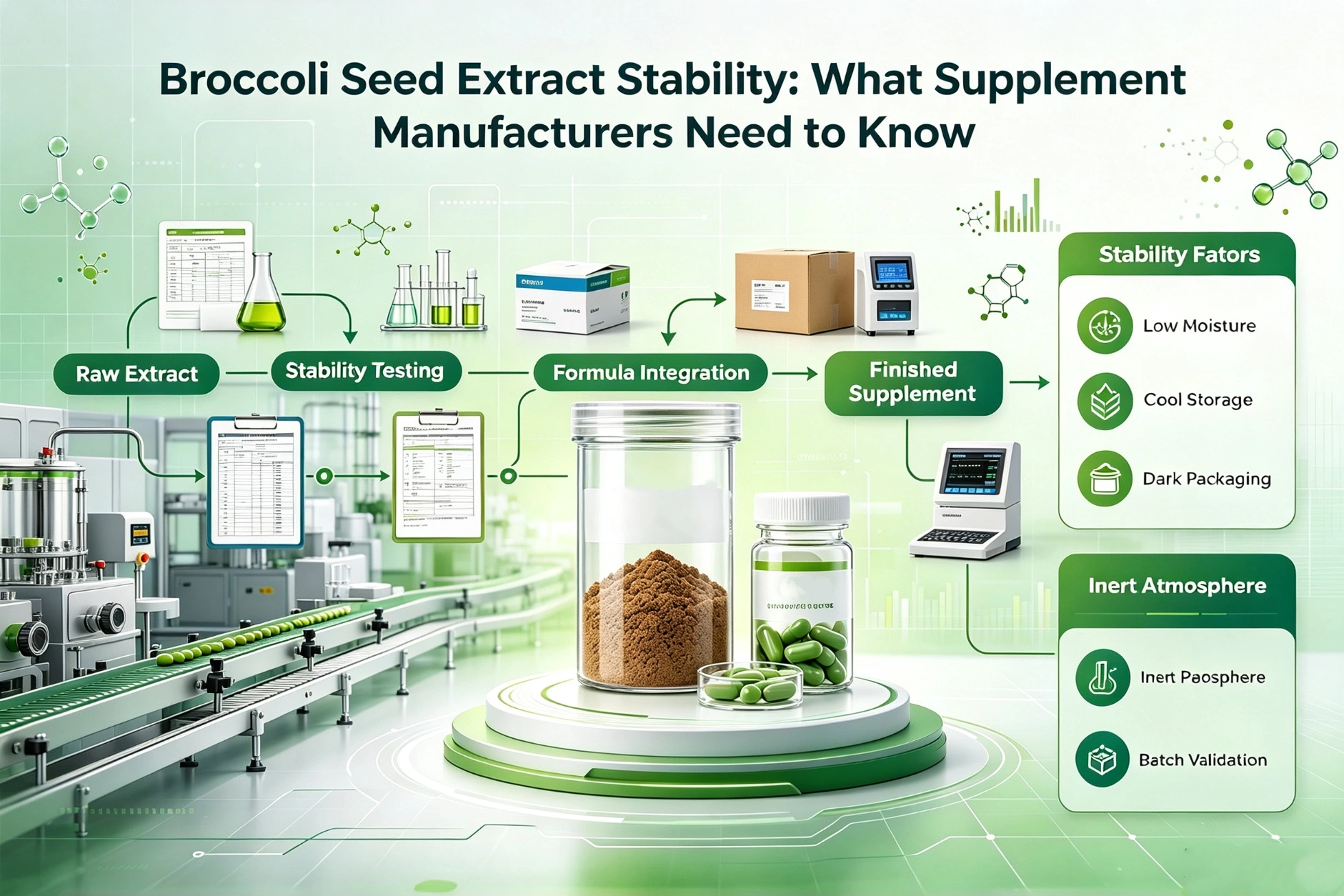
Moisture accelerates glucosinolate hydrolysis. Key benchmarks for storage and packaging:
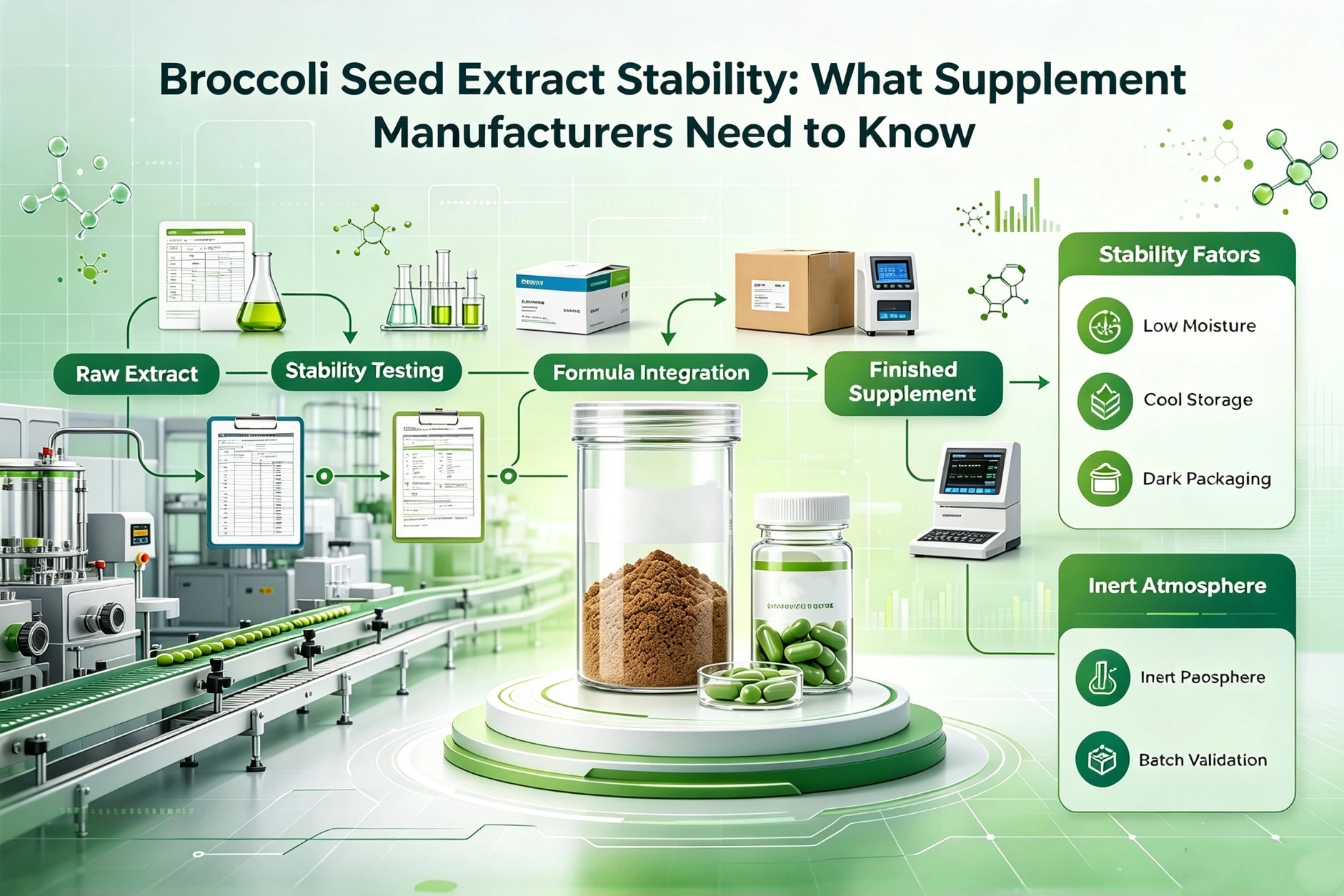
- Water activity (Aw) below 0.4 is the recommended threshold for glucoraphanin powder stability
- Packaging in nitrogen-flushed, moisture-barrier foil extends shelf life significantly
- Accelerated stability testing at 37°C/75% RH is the industry standard - demand 90-day data showing ≥95% potency retention from any supplier
Light and Oxidation
Sulforaphane oxidizes readily under UV exposure. Even indirect light exposure during packaging can initiate degradation chains.
- Use amber glass or opaque packaging for sulforaphane-containing finished products
- Glucoraphanin formats are substantially more light-stable, but still benefit from opaque packaging in long-term storage
pH Sensitivity
Both glucoraphanin and sulforaphane show pH-dependent stability:
- Glucoraphanin is most stable between pH 5.0–7.0
- Sulforaphane degrades rapidly in strongly alkaline conditions (pH > 9.0)
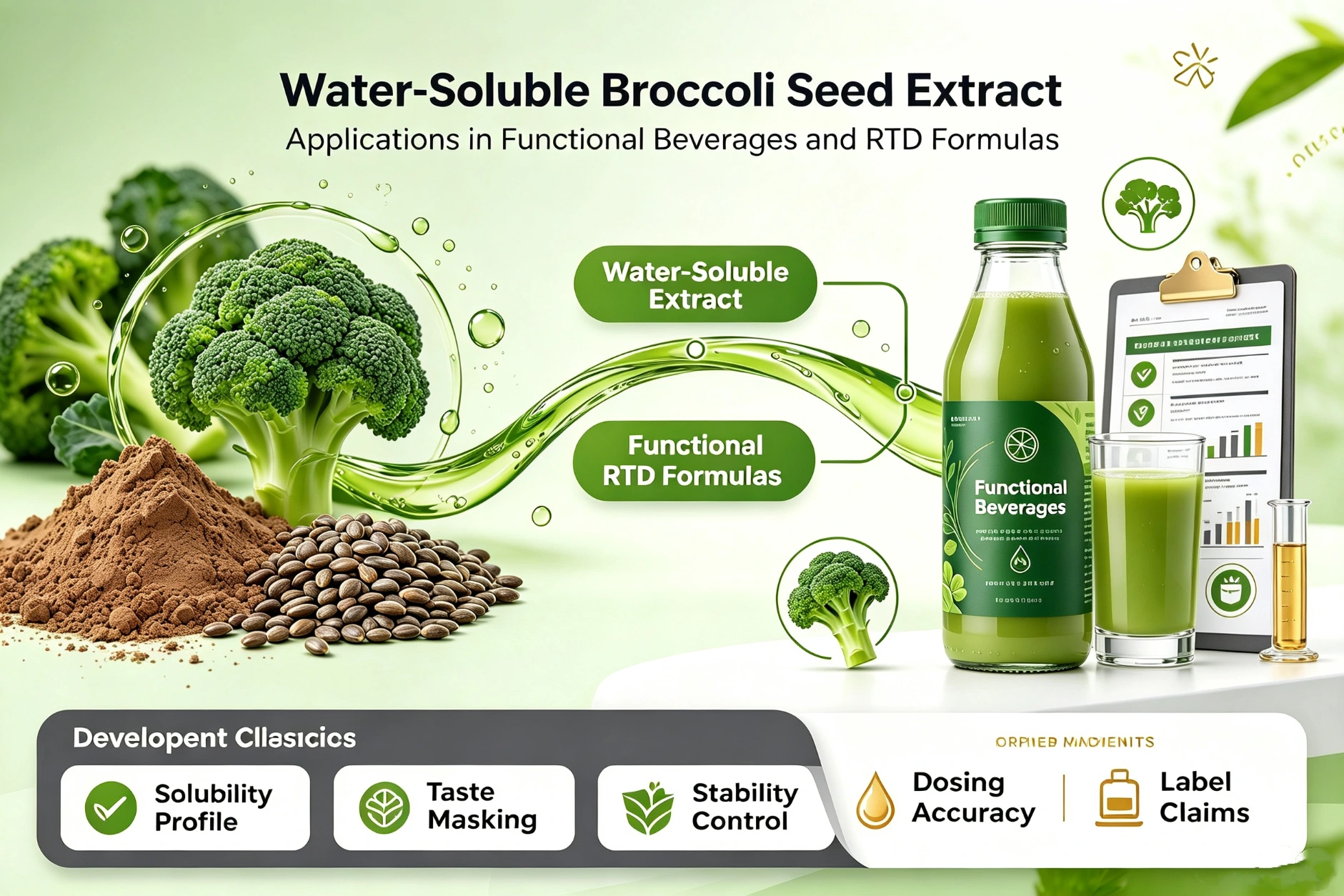
- For beverage applications, pH 4.0–6.0 formulations offer the best balance of stability and palatability
The Myrosinase Question: To Include or Not to Include
One of the most debated formulation decisions in broccoli seed extract supplements is whether to add exogenous myrosinase alongside glucoraphanin.
The argument for inclusion: adding myrosinase ensures sulforaphane conversion even in individuals with low gut microbial myrosinase activity - estimated at 30–40% of the general population.
The argument against: myrosinase is itself a protein enzyme subject to denaturation. If your manufacturing process involves any heat step, the enzyme may be inactive by the time the product reaches the consumer.
The practical framework for your formulation decision:
|
Format |
Myrosinase Included |
Best Application |
|
Glucoraphanin only |
No |
Capsules, tablets, RTD beverages |
|
Glucoraphanin + myrosinase |
Yes (cold-processed) |
Cold-fill capsules, powders, sachets |
|
Direct sulforaphane |
N/A |
Specialized clinical formats |
|
Glucoraphanin + sulforaphane combination |
No |
High-potency dual-pathway products |
If you include myrosinase, your entire downstream process must be cold-chain compatible. Any heat exposure after blending renders the enzyme inactive and your label claim unsupportable.
Specification Tiers: Matching Grade to Application
Not every broccoli seed extract grade suits every supplement format. Here's how the specification landscape maps to real-world applications:
Glucoraphanin 1%–10%
- Mainstream capsules, tablets, and functional food applications
- Moderate active content suitable for general wellness positioning
- Most cost-effective entry point for new product lines
Glucoraphanin 13%–20%
- Premium supplements, clinical nutrition, and FSMPs
- High-potency format supporting milligram-level dosage claims
- Requires tighter QC and batch-specific HPLC verification
Sulforaphane 0.1%–1%
- Direct delivery formats where in-vivo conversion cannot be assumed
- Requires cold-chain manufacturing and specialized packaging
- Higher unit cost; justified in clinical or premium positioning
Glucoraphanin 13% + Sulforaphane 1% combination
- Dual-pathway delivery for maximum bioavailability coverage
- Addresses both high-converter and low-converter consumer populations
- Best suited for premium SKUs with robust clinical substantiation
What Your QA Team Must Demand From Any Supplier
Procurement decisions for botanical extracts carry real downstream liability. A specification that looks correct on a datasheet can collapse under third-party audit if the analytical methodology is weak. Here are the non-negotiable verification checkpoints:
Analytical Method Integrity
- Demand HPLC-verified potency against certified reference standards for every batch
- Reject suppliers using non-specific colorimetric assays - these inflate declared glucosinolate content and cannot withstand regulatory scrutiny
- Ask specifically whether the HPLC method distinguishes glucoraphanin from other glucosinolates - many methods don't
Stability Documentation
- Request batch-specific accelerated stability data: 37°C/75% RH, minimum 90 days
- Confirm potency retention figures are batch-specific, not generic category claims
- Ask for real-time stability data at 12 and 24 months where available
Certification Stack
- Core minimum: ISO 9001, FSSC 22000, cGMP
- US market: FDA-registered and inspected facility
- EU market: EU Organic or EFSA-compliant documentation
- Global distribution: Halal and Kosher certification
Heavy Metals and Contaminant Profile
- Batch-specific COA covering lead, arsenic, cadmium, mercury against USP or EU pharmacopoeia limits
- Residual solvent testing against ICH Q3C guidelines
- Microbiology panel: total plate count, yeast/mold, E. coli, Salmonella
Traceability
- Full field-to-COA traceability: cultivar origin, harvest lot, extraction batch, finished product release
- Confirm whether you're dealing with a manufacturer or a broker - this distinction determines your audit rights and quality escalation path
Shelf Life Benchmarks: What Good Data Actually Looks Like
Many suppliers quote shelf life figures without the underlying data to support them. Here's what credible stability documentation looks like - and what red flags to watch for:
Credible stability data includes:
- Specific storage conditions tested (temperature + RH)
- Time points measured (T=0, T=1mo, T=3mo, T=6mo, T=12mo minimum)
- Analytical method used for potency measurement
- Batch number and manufacturing date
- Statistical confidence intervals on potency retention figures
Red flags in supplier stability claims:
- Generic "24-month shelf life" with no supporting data
- Stability data referencing a different grade or specification than what you're purchasing
- Potency retention figures without stated analytical method
- No distinction between glucoraphanin stability and sulforaphane stability
A well-characterized glucoraphanin-standardized broccoli seed extract, properly packaged in nitrogen-flushed moisture-barrier foil, should demonstrate ≥95% potency retention at 24 months under recommended storage conditions. If a supplier can't provide that data, the shelf life claim is unsupported.
Sourcing Stable Broccoli Seed Extract From a Verified Manufacturer
Jiuyuan Biotech has supplied certified botanical extracts to clients across 30+ countries since 2012. Our broccoli seed extract line covers glucoraphanin specifications from 1% to 20%, sulforaphane grades from 0.1% to 10%, and a combination grade (Glucoraphanin 13% + Sulforaphane 1%) for dual-pathway formulas.
Every commercial batch ships with:
✅ HPLC-verified potency against certified reference standards
✅ Batch-specific COA: assay, heavy metals, residual solvents, microbiology
✅ Accelerated stability data: ≥95% retention at 37°C/75% RH / 90 days
✅ Full certifications: FSSC 22000, ISO 9001, cGMP, Halal, Kosher, USDA Organic, EU Organic
✅ OEM/ODM support: capsules, tablets, sachets, liquid concentrates, custom blends
✅ Dual-patent stabilization technology: zero activity loss in vitro over 2 years
Whether you're qualifying a new ingredient supplier, resolving a stability failure in an existing formula, or developing a first-to-market premium supplement, our technical team supports your project from sample request to commercial batch.
📧 Reach our technical team directly: info@jiuybiotech.com 🌐 Full product specifications and sample request: Broccoli Seed Extract - Jiuyuan Biotech
References
- Fahey, J. W., Zhang, Y., & Talalay, P. (1997). Broccoli sprouts: An exceptionally rich source of inducers of enzymes that protect against chemical carcinogens. Proceedings of the National Academy of Sciences, 94(19), 10367–10372.
- Shapiro, T. A., Fahey, J. W., Wade, K. L., Stephenson, K. K., & Talalay, P. (2001). Chemoprotective glucosinolates and isothiocyanates of broccoli sprouts: Metabolism and excretion in humans. Cancer Epidemiology, Biomarkers & Prevention, 10(5), 501–508.
- Verkerk, R., Schreiner, M., Krumbein, A., Ciska, E., Holst, B., Rowland, I., & Dekker, M. (2009). Glucosinolates in Brassica vegetables: The influence of the food supply chain on intake, bioavailability and human health. Molecular Nutrition & Food Research, 53(S2), S219–S265.
- Dinkova-Kostova, A. T., & Kostov, R. V. (2012). Glucosinolates and isothiocyanates in health and disease. Trends in Molecular Medicine, 18(6), 337–347.
- Vanduchova, A., Anzenbacher, P., & Anzenbacherova, E. (2019). Isothiocyanate from broccoli, sulforaphane, and its properties. Journal of Medicinal Food, 22(2), 121–126.
- Houghton, C. A. (2019). Sulforaphane: Its "coming of age" as a clinically relevant nutraceutical in the prevention and treatment of chronic disease. Oxidative Medicine and Cellular Longevity, 2019, Article 2716870.