


You've probably seen broccoli extract positioned as an antioxidant or detox ingredient. But here's something that surprises a lot of formulators: broccoli seed extract has a meaningful and well-researched relationship with digestive health - one that goes well beyond fiber content or general "gut wellness" marketing language.
The digestive benefits aren't incidental. They're mechanistic, specific, and increasingly backed by clinical data. If you're developing a gut health supplement, a digestive enzyme formula, or even a functional food product, this ingredient deserves a serious look.
Let's get into what the science actually shows.
The Gut-Sulforaphane Connection: Why It's Not Obvious
Most people associate digestive health ingredients with probiotics, prebiotics, or digestive enzymes. Sulforaphane - the primary bioactive derived from broccoli seed extract - doesn't fit neatly into any of those categories.
It works differently. And that's precisely what makes it interesting.
When you consume glucoraphanin (the stable precursor found in broccoli seed extract), your gut microbiome plays a direct role in converting it to sulforaphane. Specific bacterial species - including Bacteroides thetaiotaomicron and Escherichia coli - produce myrosinase-like enzymes that catalyze this conversion in the colon.
This means the gut isn't just a passive recipient of sulforaphane's effects. The gut actively participates in generating the active compound.
That bidirectional relationship - where the gut microbiome produces sulforaphane, and sulforaphane in turn modulates the gut environment - is one of the more elegant aspects of this ingredient's biology.
What Sulforaphane Does in the Digestive Tract
It Protects the Gut Lining
The intestinal epithelium is a single-cell-thick barrier. When it's compromised - a condition often called "leaky gut" or increased intestinal permeability - undigested food particles, bacterial endotoxins, and other molecules can cross into systemic circulation.
Sulforaphane activates Nrf2, a transcription factor that upregulates cytoprotective enzymes including heme oxygenase-1 (HO-1) and glutathione S-transferases. These enzymes reduce oxidative stress in intestinal epithelial cells and help maintain tight junction integrity.
In preclinical studies, sulforaphane has been shown to:
● Reduce intestinal permeability by preserving tight junction proteins (claudin-1, occludin, ZO-1)
● Attenuate oxidative damage to colonocytes under inflammatory conditions
● Suppress NF-κB activation in intestinal epithelial cells, reducing pro-inflammatory cytokine output
For formulators developing products targeting gut barrier function, this is a mechanistically credible active - not just a marketing claim.
It Has Documented Activity Against Helicobacter pylori
This is one of the most clinically specific digestive applications of broccoli-derived compounds.
H. pylori infects approximately 44% of the global population and is the primary causative agent of peptic ulcers and a recognized risk factor for gastric cancer. Standard treatment involves antibiotic combination therapy - but antibiotic resistance is a growing clinical problem.
Sulforaphane has demonstrated bactericidal activity against H. pylori in both in vitro and in vivo studies. A clinical trial published in Cancer Prevention Research (Yanaka et al., 2009) found that daily consumption of broccoli sprout extract for 8 weeks significantly reduced H. pylori colonization and urease activity in infected subjects compared to placebo.
The proposed mechanism involves sulforaphane's ability to:
● Penetrate the gastric mucus layer where H. pylori resides
● Inhibit bacterial urease activity
● Activate Nrf2 in gastric epithelial cells, reducing oxidative damage caused by the infection
This is not a theoretical benefit. It's one of the more clinically substantiated digestive applications in the broccoli extract literature.
It Modulates Intestinal Inflammation
Chronic low-grade intestinal inflammation underlies conditions including irritable bowel syndrome (IBS), inflammatory bowel disease (IBD), and non-specific digestive discomfort. Sulforaphane's dual mechanism - Nrf2 activation and NF-κB inhibition - directly addresses the oxidative and inflammatory drivers of these conditions.
Preclinical data in colitis models has shown that sulforaphane:
Reduces colonic myeloperoxidase activity (a marker of neutrophil infiltration)
Lowers pro-inflammatory cytokines including IL-6, IL-1β, and TNF-α in intestinal tissue
Preserves goblet cell density - goblet cells produce the mucus layer that protects the intestinal epithelium
Clinical translation is still developing, but the mechanistic rationale is solid. Several ongoing RCTs are investigating sulforaphane in IBD-related endpoints.
It Interacts With the Gut Microbiome
The relationship between sulforaphane and the gut microbiome is bidirectional and nuanced.
On one hand, gut bacteria are required for efficient glucoraphanin-to-sulforaphane conversion. Individuals with lower populations of myrosinase-producing bacteria convert glucoraphanin less efficiently - which is one reason why the "Myrosinase + Stabilization" dual-patent platform used in high-quality extracts matters so much. It delivers active myrosinase alongside glucoraphanin, ensuring conversion doesn't depend entirely on the consumer's microbiome composition.
On the other hand, sulforaphane itself has prebiotic-adjacent effects. Research suggests it selectively modulates microbial populations - reducing pathogenic species while supporting commensal bacteria. This isn't a probiotic effect; it's a selective antimicrobial and anti-inflammatory effect that shapes the gut environment.

The Formulation Angle: Why This Matters for B2B Buyers
If you're a supplement brand or contract manufacturer, the digestive health category is one of the most competitive spaces in the nutraceutical market. Standing out requires ingredients with:
● Mechanistic differentiation - not just "supports gut health"
● Clinical evidence - something you can reference in marketing without overclaiming
● Formulation stability - the ingredient has to survive manufacturing
Broccoli seed extract checks all three boxes - if you source the right specification.
Here's what to look for:
Glucoraphanin standardization, not just "glucosinolate" content.
Non-specific colorimetric assays detect all glucosinolates collectively. Only HPLC against certified reference standards gives you a defensible glucoraphanin figure. Ask your supplier which method they use.
Myrosinase activity declaration.
If the extract contains active myrosinase, the in vivo conversion rate is significantly higher. Enzyme-free extracts rely entirely on gut bacteria for conversion - which is variable across individuals. A myrosinase-active extract delivers more consistent results.
Stability data under realistic conditions.
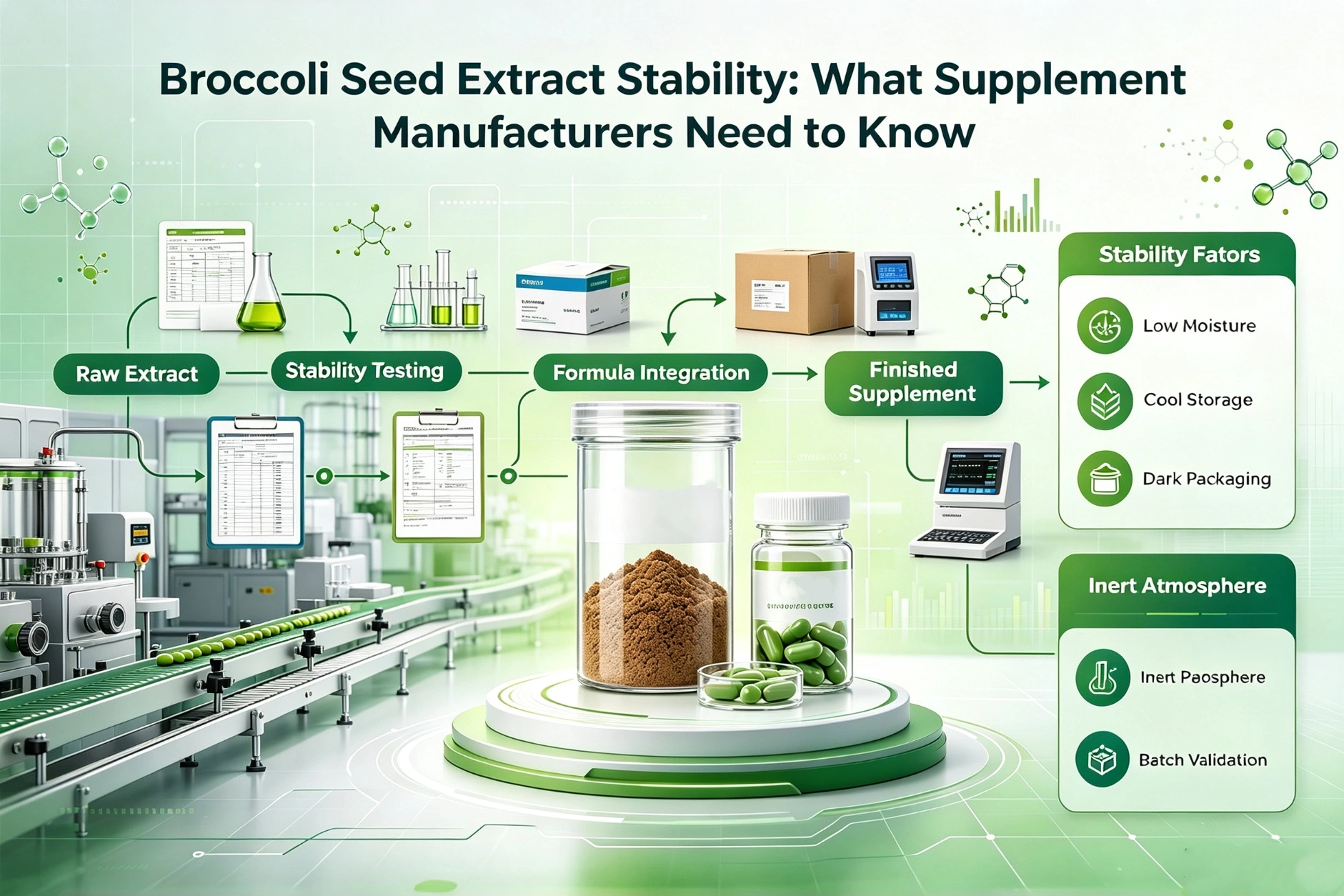
Glucoraphanin is relatively stable, but myrosinase is not. Ask for accelerated stability data (37°C/75% RH) for the specific format you're formulating with - powder, capsule, or beverage.
Water-soluble vs. oil-soluble format.
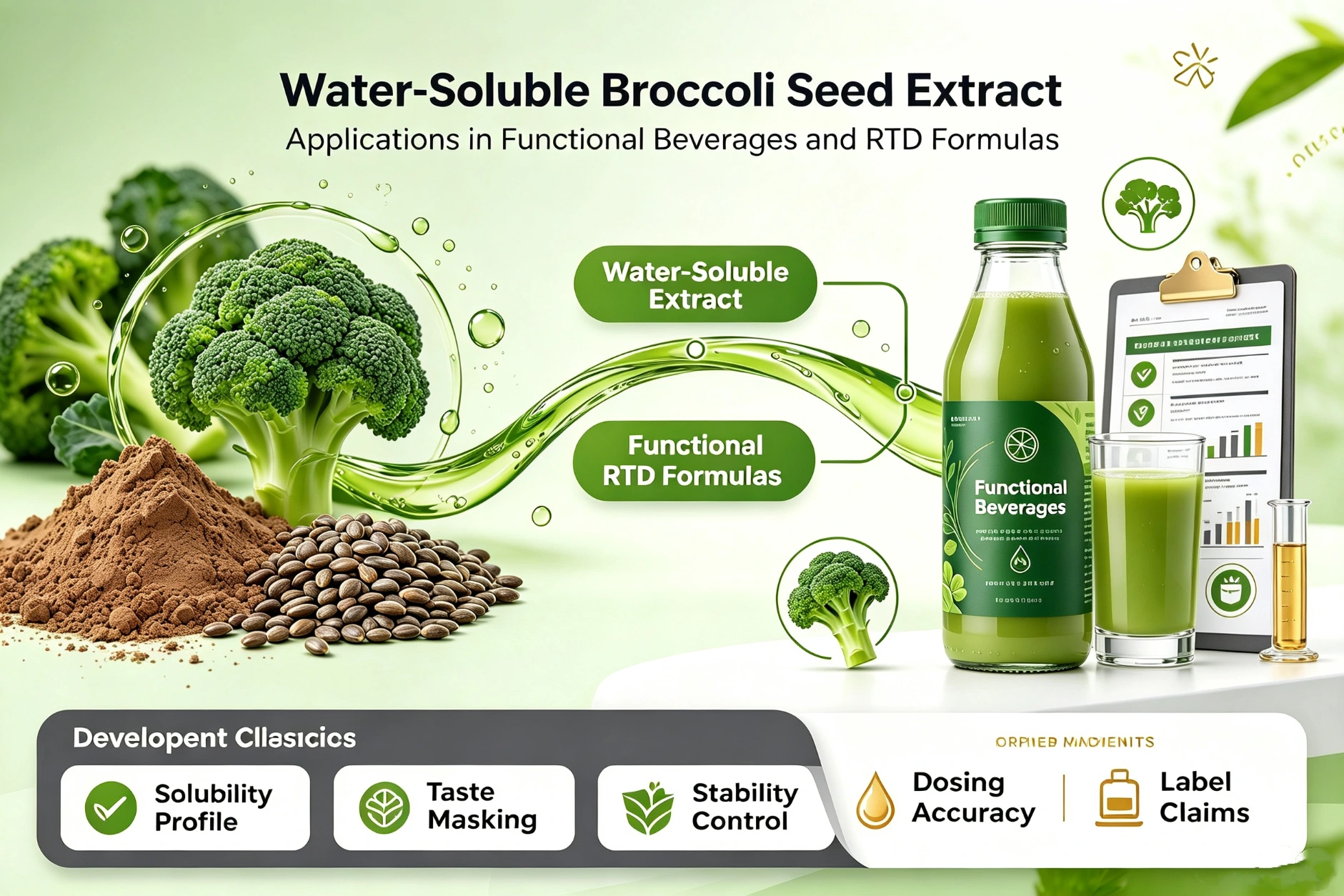
For transparent beverage applications, water-soluble broccoli seed extract with ≥98% clarity is the appropriate choice. For capsules and tablets, standard powder formats work well.
Digestive Health Applications: Where This Ingredient Fits
Broccoli seed extract isn't a one-size-fits-all digestive ingredient. Here's where it makes the most formulation sense:
Gut barrier and intestinal permeability products
Positioned alongside zinc carnosine, L-glutamine, or collagen peptides. The Nrf2-mediated epithelial protection mechanism complements these established gut barrier actives.
H.pylori support formulas
A niche but growing category. Sulforaphane's documented bactericidal activity against H. pylori gives this application genuine clinical credibility. Often combined with mastic gum or berberine.
Anti-inflammatory digestive support
Relevant for IBS-adjacent products targeting bloating, cramping, and irregular bowel habits driven by intestinal inflammation. The NF-κB inhibition mechanism is the key differentiator here.
Microbiome-modulating formulas
Positioned as a "microbiome optimizer" rather than a probiotic. Appeals to consumers who want to support their gut environment without adding live bacteria.
Functional foods and beverages
The water-soluble format integrates cleanly into kombucha, functional shots, and gut health RTDs. No pungent cruciferous aftertaste - a practical formulation advantage that matters in consumer-facing products.
A Note on Dosing
The Chinese Dietary Reference Intakes 2023 established a Tolerable Upper Intake Level (TUL) for sulforaphane at 30 mg/day - the first regulatory body to set a quantitative reference value for this compound. This enables precise, milligram-level formulation rather than the vague "proprietary blend" approach that has historically made dosing claims difficult to defend.
For digestive health applications specifically, the clinical literature on H. pylori has used broccoli sprout preparations delivering approximately 30–60 mg of sulforaphane equivalent per day. Gut barrier studies have used a range of doses; no single consensus dose has been established for intestinal permeability endpoints.
Work with your supplier's technical team to align your specification with the clinical evidence relevant to your target claim.
What to Ask Your Supplier Before You Commit
Before placing a commercial order for any broccoli seed extract intended for a digestive health application, get clear answers on these points:
● What is the HPLC-verified glucoraphanin content per gram?
● Does the extract contain active myrosinase, and if so, what is the declared activity?
● What is the in vivo conversion rate, and how was it measured?
● Do you hold FDA facility registration and cGMP documentation?
● Can you provide lot-specific COA with chromatogram, not a generic template?
● What stability data exists for the specific format (powder, capsule, beverage)?
These questions separate manufacturers who understand the ingredient from traders who are reselling commodity material with inflated specifications.
The Short Answer
Does broccoli extract help digestion? Yes - but not in the way most people expect.
It doesn't add fiber. It doesn't contain digestive enzymes. What it does is protect the gut lining, reduce intestinal inflammation, demonstrate clinically documented activity against H. pylori, and interact meaningfully with the gut microbiome.
That's a genuinely differentiated digestive health mechanism - and one that's increasingly supported by peer-reviewed clinical data.
For formulators building in the gut health space, broccoli seed extract offers something rare: a botanical active with mechanistic clarity, a growing clinical evidence base, and real formulation versatility across capsules, powders, and beverages.
Looking to source high-quality broccoli seed extract for your digestive health formulation?
Visit our product page at jiuyuanbio.com/standard-plant-extract-powder/broccoli-seed-extract.html for full technical specifications, HPLC-verified grades, and sample availability.
Our technical team is ready to help you match the right specification to your formulation. Reach out directly at info@jiuybiotech.com - we respond within one business day.
References
1.Yanaka A, Fahey JW, Fukumoto A, et al. Dietary sulforaphane-rich broccoli sprouts reduce colonization and attenuate gastritis in Helicobacter pylori-infected mice and humans. Cancer Prevention Research. 2009;2(4):353–360.
2.Dinkova-Kostova AT, Talalay P. Direct and indirect antioxidant properties of inducers of cytoprotective proteins. Molecular Nutrition & Food Research. 2008;52(S1):S128–S138.
3.Houghton CA, Fassett RG, Coombes JS. Sulforaphane and other nutrigenomic Nrf2 activators: Can the clinician's expectation be matched by the reality? Oxidative Medicine and Cellular Longevity. 2016;2016:7857186.
4.Fahey JW, Haristoy X, Dolan PM, et al. Sulforaphane inhibits extracellular, intracellular, and antibiotic-resistant strains of Helicobacter pylori and prevents benzo[a]pyrene-induced stomach tumors. Proceedings of the National Academy of Sciences USA. 2002;99(11):7610–7615.
5.Shapiro TA, Fahey JW, Dinkova-Kostova AT, et al. Safety, tolerance, and metabolism of broccoli sprout glucosinolates and isothiocyanates: A clinical phase I study. Nutrition and Cancer. 2006;55(1):53–62.
6.Ruhee RT, Suzuki K. The integrative role of sulforaphane in preventing inflammation, oxidative stress and fatigue: A review of a potential protective phytochemical. Antioxidants. 2020;9(6):521.