

If you've ever requested quotes for broccoli seed extract from multiple suppliers, you already know the numbers can be wildly inconsistent. One supplier quotes $30/kg. Another quotes $280/kg. Both claim to sell "broccoli seed extract." So what's actually going on - and how do you know which price reflects real value?
The global broccoli extract market was valued at approximately $253.1 million in 2025 and is projected to reach $382.1 million by 2032, growing at a CAGR of 6.1%. That growth is pulling in a wave of new suppliers - some rigorous, many not. Understanding what drives price per kilogram is the most practical skill you can develop as a procurement professional in this space.
This guide breaks down every variable that moves the needle on cost, so you can evaluate quotes with confidence and avoid the traps that catch most first-time buyers.
Glucoraphanin Potency Is the Single Biggest Price Driver
Before anything else, you need to understand one rule: price per kilogram is meaningless without knowing the glucoraphanin concentration.
Broccoli seed extract is standardized to glucoraphanin - the stable precursor that converts to sulforaphane in the body. The higher the glucoraphanin content, the more raw material and processing time required per kilogram of finished extract. That directly drives cost.
Here's how potency tiers typically map to price ranges in the current market:
|
Glucoraphanin Content |
Typical Price Range (USD/kg) |
Common Application |
|
1% glucoraphanin |
$30 – $60 |
Entry-level supplements, food fortification |
|
5% glucoraphanin |
$80 – $130 |
Mid-range capsule formulas |
|
10% glucoraphanin |
$150 – $220 |
Premium supplement lines |
|
13% glucoraphanin |
$220 – $300+ |
High-potency clinical-grade products |
|
0.5–1% sulforaphane |
$250 – $400+ |
Specialized bioactive formulas |
A supplier offering 10% glucoraphanin at $40/kg is either misrepresenting the assay method or cutting corners somewhere in the supply chain. Neither outcome is acceptable for a finished product brand.
The key question to ask every supplier: "What assay method do you use to verify glucoraphanin content - HPLC or UV?"
UV colorimetric assays are non-specific. They measure total glucosinolates, not glucoraphanin specifically. This allows commodity suppliers to inflate declared potency figures. HPLC is the only analytically defensible method for glucoraphanin quantification.
Raw Material Quality: Seeds Are Not All Equal
The glucoraphanin content of broccoli seeds varies significantly by cultivar, growing region, harvest timing, and post-harvest handling. These upstream variables directly shape extraction yield - and therefore your final price per kilogram.
Factors that affect raw seed quality:
- Cultivar selection: Certain Brassica oleracea var. italica cultivars are specifically bred for high glucosinolate density. Seeds from these cultivars command a premium at the agricultural level but reduce the extraction volume needed to hit a target potency
- Growing region: Seeds grown at higher altitudes or in specific soil mineral profiles tend to accumulate higher glucosinolate concentrations - a well-documented agronomic phenomenon
- Harvest timing: Glucoraphanin content peaks at specific seed maturity windows. Early or late harvest reduces glucosinolate density and lowers extraction efficiency
- Post-harvest storage: Improper drying or storage conditions activate endogenous myrosinase, which prematurely hydrolyzes glucoraphanin before extraction even begins - destroying the very compound you're paying for
Suppliers with direct grower partnerships and field-level traceability can control these variables. Suppliers buying through brokers cannot. That traceability difference is real, and it shows up in batch-to-batch consistency - which is ultimately what you're paying for.

Extraction and Drying Method: Where Processing Costs Diverge
The extraction process is where most of the manufacturing cost accumulates. Two suppliers can start with identical raw seeds and end up with dramatically different products - and price points - based on how they process them.
Low-Temperature Aqueous Extraction
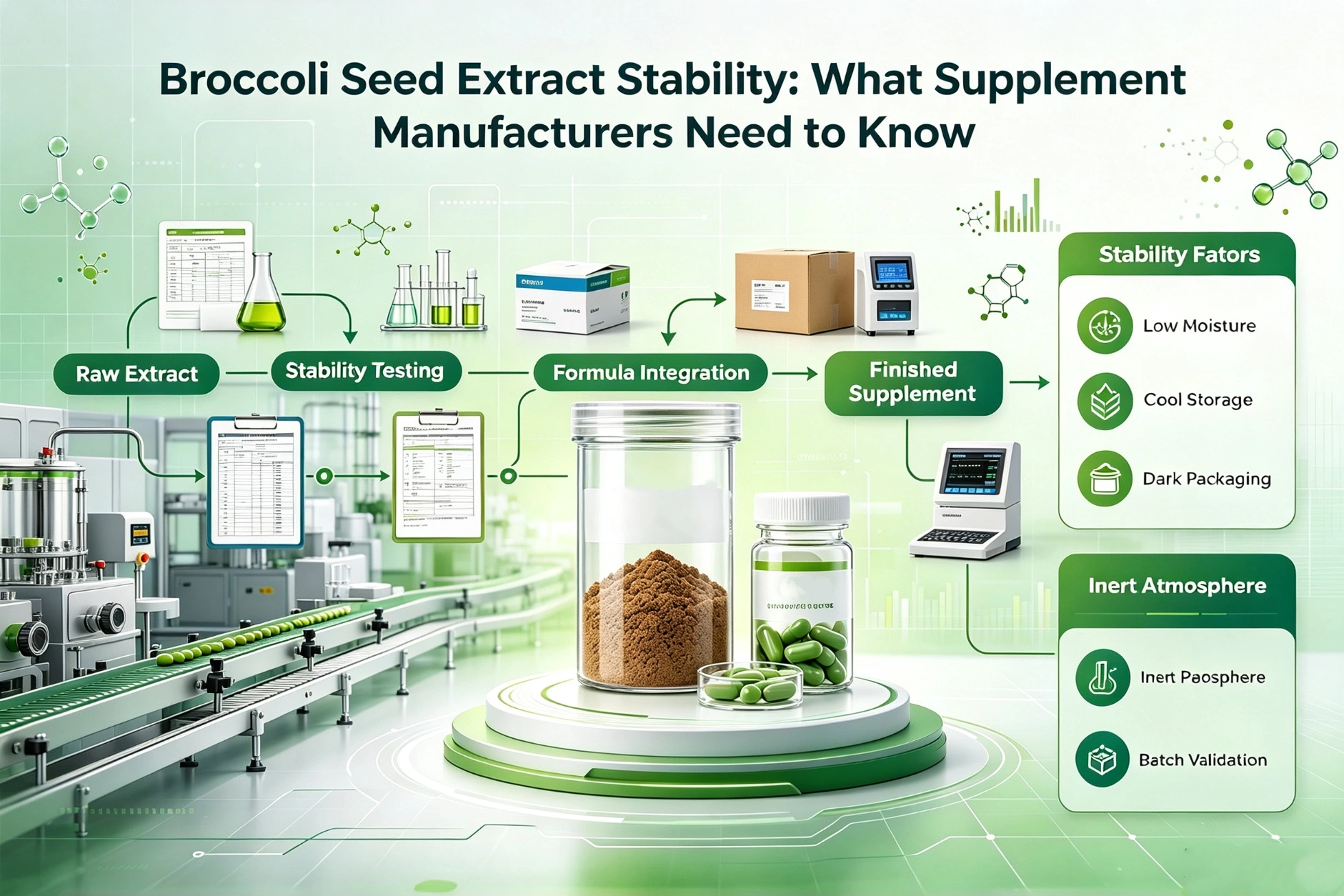
Glucoraphanin is water-soluble but thermally sensitive. Responsible manufacturers use controlled low-temperature aqueous extraction (typically ≤50°C) to maximize glucosinolate yield while preventing premature enzymatic hydrolysis by endogenous myrosinase.
Higher processing temperatures reduce equipment and energy costs - but they also degrade glucoraphanin content. A supplier cutting costs with high-temperature extraction will show lower potency on the COA, or worse, will use a less specific assay method to mask the degradation.
Spray Drying vs. Freeze Drying
Final drying method is a meaningful cost variable:
- Spray drying - the standard commercial approach. Cost-efficient, scalable, produces excellent flowability. Suitable for most supplement applications where maximum bioactivity retention is not the primary brief
- Freeze drying - significantly more expensive (typically 3–5× the drying cost of spray drying). Preserves thermolabile compounds and myrosinase activity more effectively. Required for premium grades where myrosinase co-activity is part of the specification
If a supplier quotes the same price for spray-dried and freeze-dried grades, that's a red flag. The process costs are genuinely different.
Membrane Filtration and Purification Steps
Higher-potency grades require additional purification passes - ultrafiltration, ion exchange, or chromatographic separation - to concentrate glucoraphanin and remove co-extracted impurities. Each additional step adds cost. A 13% glucoraphanin extract requires substantially more downstream processing than a 1% extract, which explains the non-linear price scaling between potency tiers.
Certifications: They Cost Money - and They're Worth It
Certifications are not marketing decoration. Each one represents a real audit process, ongoing compliance infrastructure, and documented quality systems. They also determine which markets your finished product can enter.
Certifications and their market access implications:
|
Certification |
What It Covers |
Market Access Impact |
|
ISO 9001 / FSSC 22000 |
Quality management system |
Global baseline requirement |
|
cGMP |
Manufacturing process integrity |
US, EU, AU mandatory |
|
FDA Facility Registration |
US import eligibility |
Required for US market supply |
|
Halal |
Compliance with Islamic dietary law |
Middle East, SE Asia markets |
|
Kosher |
Compliance with Jewish dietary law |
US, EU specialty channels |
|
NOP & EU Organic |
Organic agricultural standards |
Organic-positioned product lines |
|
COSMOS / Ecocert |
Natural & organic cosmetics |
Personal care applications |
A supplier holding all of the above certifications carries higher operational overhead than one holding only a basic GMP certificate. That overhead is embedded in the price - and it's legitimate.
What to watch for: Some suppliers display certification logos on their website without current, valid certificates. Always request the actual certificate documents with issue dates and expiry dates. Call the certifying body to verify if the order size justifies the due diligence.
MOQ, Order Volume, and Pricing Tiers
Like most specialty botanical ingredients, broccoli seed extract pricing follows a volume-discount curve. Understanding the typical tier structure helps you negotiate more effectively.
Standard commercial pricing tiers:
- Sample quantity (100g – 1kg): Priced at a significant premium - often 3–5× the commercial rate. This covers analytical testing, custom packaging, and administrative overhead on small orders
- Small commercial (1kg – 25kg): Moderate premium over bulk pricing. Suitable for pilot batches and initial market launches
- Standard commercial (25kg – 100kg): Base commercial pricing. Most B2B transactions fall in this range
- Large volume (100kg+): Negotiated pricing. Discounts of 10–25% below standard commercial rates are achievable with annual volume commitments
Practical negotiation leverage points:
- Committing to a 12-month supply agreement typically unlocks better pricing than spot purchases
- Requesting a fixed-price contract for 6 months protects you from raw material cost fluctuations during brassica harvest cycles
- Consolidating multiple extract SKUs with a single supplier often yields better overall pricing than splitting orders across multiple vendors
Market Dynamics: What's Moving Prices Right Now
The broccoli extract market doesn't exist in isolation. Several macro factors are currently influencing price trajectories that any serious buyer should track.
Upward price pressures:
- Growing clinical evidence base: With over 130 registered clinical trials using sulforaphane or glucoraphanin-based extracts, consumer and brand demand for high-potency grades is accelerating. Higher demand for 10%+ glucoraphanin grades is tightening supply of premium raw material
- Certification compliance costs: Increasing regulatory scrutiny in the EU and US is raising the compliance overhead for responsible manufacturers
- Energy and logistics costs: Post-2022 global logistics normalization has stabilized somewhat, but freeze-drying energy costs remain elevated compared to pre-2020 baselines
Downward price pressures:
- Expanded cultivation: More contract farming programs in China, India, and Eastern Europe are increasing raw seed supply for standard grades
- Process efficiency improvements: Advances in membrane filtration technology are reducing purification costs for mid-potency grades
- Competitive supplier landscape: The market entry of new manufacturers - particularly from China - has compressed margins on commodity 1%–5% grades
The net effect: standard grades (1%–5%) are under price compression, while premium grades (10%–13%) remain firm or are trending upward due to demand outpacing quality-controlled supply.
The Hidden Costs Most Buyers Overlook
The price per kilogram on a supplier's quote sheet is never the full cost of procurement. Experienced buyers factor in these additional variables:
Analytical verification costs:
- Third-party HPLC testing of incoming lots: $150–$400 per test depending on the panel
- If a supplier's COA proves inaccurate, you absorb the cost of reformulation, label correction, and potential product recall
Logistics and import costs:
- Customs duties on botanical extracts vary by HS code classification and destination country
- Cold-chain requirements for certain grades add $0.50–$2.00/kg in freight premium
Shelf life and inventory carrying costs:
- A 24-month ambient-stable glucoraphanin extract allows larger forward purchases to capture volume pricing
- A shorter-shelf-life ingredient forces smaller, more frequent orders at higher per-unit cost
Regulatory documentation costs:
- Incomplete supplier documentation (missing COA, no stability data, absent allergen declarations) creates downstream compliance work that costs real staff time
How to Evaluate a Quote: A Practical Checklist
When you receive a price quote for broccoli seed extract, run it through this checklist before responding:
Specification clarity:
- Is glucoraphanin content declared as a specific percentage (e.g., 10%), not a vague "high glucosinolate" claim?
- Is the assay method specified as HPLC?
- Is the botanical source identified as Brassica oleracea var. italica seed (not sprout or whole plant)?
Documentation package:
- Full COA with heavy metals, microbiology, pesticide residues, and moisture content
- HPLC chromatogram available on request
- Accelerated stability data (37°C / 75% RH, minimum 90 days)
- Allergen and GMO declaration
Supplier credentials:
- Valid cGMP certificate with current expiry date
- FDA facility registration number (for US supply)
- ISO 9001 or FSSC 22000 certificate
- Traceability documentation from seed lot to finished extract
Commercial terms:
- Clear MOQ and pricing tier structure
- Lead time for standard and expedited orders
- Packaging options (25kg fiber drum, vacuum foil bag, custom)
- Sample availability and cost
FAQ
Q: Why do broccoli seed extract prices vary so much between suppliers? The primary driver is glucoraphanin concentration - a 1% extract and a 13% extract are fundamentally different products despite sharing the same name. Secondary drivers include assay methodology, certification status, extraction process, and raw material traceability. Price ranges from $30/kg to over $300/kg reflect this full spectrum.
Q: Is a lower price always a red flag? Not automatically - but it warrants scrutiny. A low price on a 1% glucoraphanin grade from a cGMP-certified supplier may be entirely legitimate. A low price on a claimed 10% grade should prompt you to request the full HPLC chromatogram and third-party verification before committing to a purchase.
Q: How does organic certification affect pricing? NOP and EU Organic certified broccoli seed extract typically carries a 20–40% price premium over conventional grades. This reflects the higher cost of certified organic seed sourcing, segregated processing lines, and annual third-party organic certification audits.
Q: What's the typical lead time for commercial orders? For standard grades (1%–10% glucoraphanin) from established manufacturers, lead times of 2–4 weeks for orders up to 100kg are typical. Custom potency grades or large-volume orders may require 4–8 weeks. Always confirm lead time against your production schedule before finalizing a purchase order.
Q: Can I negotiate price on a first order? Yes - but leverage is limited on a first transaction. Most suppliers offer better pricing after you've established a purchasing history. A more effective strategy on a first order is to negotiate sample quantity pricing, documentation completeness, and payment terms rather than pushing hard on unit price.
Q: How do I verify that the glucoraphanin content matches the COA? Send a portion of each incoming lot to an accredited third-party laboratory for independent HPLC verification. The cost ($150–$400 per test) is negligible relative to the risk of formulating with an under-potent ingredient. Build this into your incoming quality control protocol as standard practice.
References
- Fahey, J. W., Zhang, Y., & Talalay, P. (1997). Broccoli sprouts: An exceptionally rich source of inducers of enzymes that protect against chemical carcinogens. Proceedings of the National Academy of Sciences, 94(19), 10367–10372.
- Manchali, S., Murthy, K. N. C., & Patil, B. S. (2012). Crucial facts about health benefits of popular cruciferous vegetables. Journal of Functional Foods, 4(1), 1–9.
- Liang, H., Yuan, Q. P., Xiao, Q., et al. (2021). The challenges of designing and implementing clinical trials with broccoli sprout-based sulforaphane. Frontiers in Nutrition, 8, 648788.
- Persistence Market Research. (2025). Broccoli Extract Market: Global Industry Analysis and Forecast 2025–2032. Persistence Market Research Report.
- Vanduchova, A., Anzenbacher, P., & Anzenbacherova, E. (2019). Isothiocyanate from broccoli, sulforaphane, and its properties. Journal of Medicinal Food, 22(2), 121–126.
- United States Pharmacopeia. (2023). USP General Chapter <561>: Articles of Botanical Origin. United States Pharmacopeial Convention.
Sourcing broccoli seed extract for your next production run? Jiuyuan Biotech supplies HPLC-verified glucoraphanin extract in grades from 1% to 13% potency - with full seed-to-COA traceability, cGMP manufacturing, and 12 international certifications including Halal, Kosher, and EU Organic. Whether you need a 1 kg sample or a 500 kg commercial shipment, our technical team is ready to support your formulation brief. Contact us at info@jiuybiotech.com or visit jiuyuanbio.com to request a specification sheet, COA, and current pricing for your broccoli seed extract project.