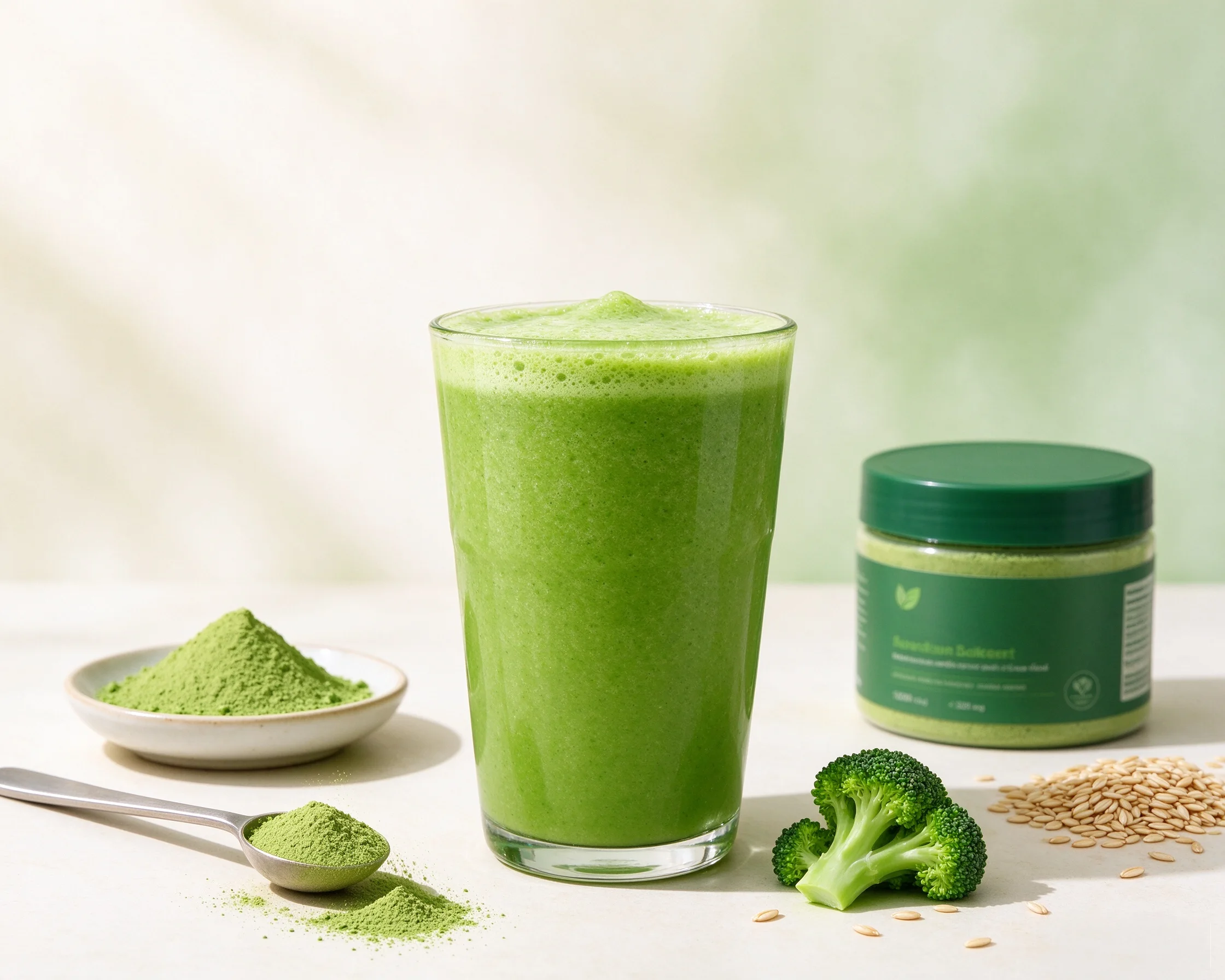
When you're building a supplement formula around broccoli-derived bioactives, one decision defines everything downstream: do you source broccoli seed extract standardized to glucoraphanin, or do you go straight to pre-formed sulforaphane?
Both ingredients target the same biological pathway. Both appear on similar product briefs. But they behave in fundamentally different ways - on your production floor, in your regulatory filing, and across your supply chain. Getting this choice wrong costs real money.
This guide gives you the technical depth to get it right.
The Chemistry Behind the Choice
Understanding what you're actually buying requires a clear look at the molecular relationship between these two compounds.
Glucoraphanin (CAS 21414-41-5) is a glucosinolate - a sulfur-containing glycoside found at high concentrations in Brassica oleracea var. italica seeds. It is biologically inert on its own. When consumed, gut microbial myrosinase-like enzymes cleave the thioglucose bond, releasing sulforaphane (CAS 4478-93-7) - the electrophilic isothiocyanate that drives the therapeutic effects.
Sulforaphane activates the Keap1/NRF2/ARE signaling pathway - one of the most well-characterized cytoprotective mechanisms in human biochemistry. NRF2 (Nuclear factor erythroid 2-related factor 2) is the master transcription factor governing phase II detoxification enzyme expression, including heme oxygenase-1 (HO-1), NAD(P)H quinone oxidoreductase 1 (NQO1), and glutathione S-transferases.
Under basal conditions, Keap1 sequesters NRF2 in the cytoplasm and targets it for proteasomal degradation. Sulforaphane alkylates critical cysteine residues on Keap1, disrupting this interaction and allowing NRF2 to translocate to the nucleus and drive antioxidant response element (ARE)-mediated gene transcription.
This is the mechanism both ingredient forms are trying to deliver. The question is which one delivers it more reliably, more safely, and more cost-effectively at commercial scale.
The Stability Problem: Why Pre-Formed Sulforaphane Is Harder Than It Looks
Here is where most ingredient comparisons avoid the uncomfortable details.
Sulforaphane's therapeutic potency comes directly from its electrophilic reactivity. That same reactivity makes it chemically unstable in finished product formats.
Documented stability challenges with pre-formed sulforaphane include:
- Thermal degradation: Sulforaphane undergoes thermal breakdown to 3-butenyl isothiocyanate and other degradation products during standard encapsulation temperatures, reducing declared potency before the product even reaches the shelf
- Moisture reactivity: The isothiocyanate group reacts readily with nucleophilic excipients - including common capsule shell materials and co-formulated amino acids - under humid processing conditions
- Oxidative instability: Sulforaphane oxidizes to sulforaphane sulfoxide, a less bioactive metabolite, during storage without rigorous inert-atmosphere packaging
- Excipient incompatibility: Published formulation data confirms sulforaphane reacts with other organic compounds in blended formulas, making multi-ingredient products technically complex to stabilize
- Cold-chain dependency: Most commercially viable sulforaphane ingredients require refrigerated storage and cold-chain logistics, adding significant cost and complexity to global distribution
Glucoraphanin, by contrast, is inherently stable. The plant itself stores glucoraphanin - not sulforaphane - precisely because the precursor form is stable for long-term preservation. Freeze-dried and spray-dried glucoraphanin-rich broccoli seed extract maintains potency under standard ambient storage conditions (cool, dry, sealed) for up to 24 months without significant degradation.
For a manufacturer running commercial-scale batches, that stability differential directly impacts yield consistency, rework rates, and COA reproducibility across lots.

Bioavailability: Does the Precursor Conversion Route Actually Deliver?
This is the question every formulation scientist raises - and the clinical evidence provides a substantive answer.
Orally consumed glucoraphanin survives gastric acid largely intact and reaches the colon, where resident bacteria expressing myrosinase-like thioglucosidase activity (notably Bacteroides and Lactobacillus species) hydrolyze it to sulforaphane. Urinary dithiocarbamate excretion - the validated bioavailability marker for isothiocyanates - consistently demonstrates efficient systemic absorption of sulforaphane derived from glucoraphanin-rich extracts.
A 2026 randomized clinical trial published in Scientific Reports demonstrated that co-administration of exogenous myrosinase from mustard seed with a glucoraphanin-rich broccoli seed extract doubled sulforaphane bioavailability compared to glucoraphanin alone - increasing conversion efficiency from approximately 19% to 40% in human subjects. This finding has significant practical implications for formulators: adding a small quantity of stabilized myrosinase (e.g., radish powder, mustard seed powder) to a glucoraphanin-based formula is a clinically validated strategy to maximize and normalize sulforaphane delivery across diverse gut microbiome phenotypes.
Key bioavailability data points for formulators:
|
Delivery Form |
Conversion Efficiency |
Storage Requirement |
Formulation Complexity |
|
Glucoraphanin extract alone |
~19–40% (microbiome-dependent) |
Ambient |
Low |
|
Glucoraphanin + exogenous myrosinase |
~40%+ (normalized) |
Ambient |
Low–Moderate |
|
Pre-formed sulforaphane |
High if stable; variable due to degradation |
Cold chain typically required |
High |
The practical takeaway: a well-formulated glucoraphanin-based product with myrosinase co-factor delivers clinically meaningful sulforaphane exposure without the manufacturing and logistics overhead of pre-formed sulforaphane.
Regulatory Landscape: What Your Legal Team Needs to Know
Regulatory fit is a non-negotiable variable in ingredient selection - and this is where glucoraphanin-based broccoli seed extract holds a structural advantage.
Broccoli Seed Extract (Glucoraphanin-standardized):
- Classified as a botanical extract across the US, EU, and most Asia-Pacific markets
- Eligible for US dietary supplement NDI (New Dietary Ingredient) notification under DSHEA with established precedent
- Covered under EU Novel Food Regulation (EU) 2015/2283 with existing authorized applications providing regulatory pathway clarity
- China's Dietary Reference Intakes 2023 establishes a Tolerable Upper Intake Level (TUL) of 30 mg/day for sulforaphane - enabling milligram-level label claims when formulating with a standardized glucoraphanin extract
- Pesticide residue compliance benchmarked against EU Regulation 396/2005 and USP <561> - both achievable with rigorous agricultural sourcing
Pre-formed Sulforaphane:
- Regulatory status varies materially by jurisdiction
- Isolated sulforaphane at concentrated doses may trigger Novel Food requirements in certain EU member states, requiring a full safety dossier submission
- Fewer established safety dossiers compared to glucoraphanin-based ingredients in international regulatory databases
- Higher compliance burden for multi-market product launches
For brands distributing across North America, Europe, and Asia simultaneously, glucoraphanin-based broccoli seed extract carries a substantially lower regulatory risk profile and faster time-to-market in most jurisdictions.
The Real Cost Comparison: Beyond Price Per Kilogram
Sticker price per kilogram is a misleading procurement metric. The number that matters is cost per milligram of bioavailable sulforaphane delivered to the end consumer.
|
Cost Factor |
Broccoli Seed Extract |
Pre-formed Sulforaphane |
|
Raw material unit cost |
Moderate |
Higher |
|
Storage requirement |
Ambient (standard warehouse) |
Refrigerated (cold chain) |
|
Manufacturing yield consistency |
High - stable precursor |
Variable - degradation during processing |
|
Shelf life |
24 months (ambient) |
Shorter, condition-dependent |
|
Excipient compatibility |
Broad |
Restricted - reactive with many co-ingredients |
|
Regulatory filing cost |
Lower - established pathways |
Higher - jurisdiction-specific dossiers |
|
Multi-market scalability |
High |
Moderate to low |
|
Clinical evidence base |
Extensive (130+ published trials) |
Growing but narrower |
When cold-chain logistics, shorter shelf life, higher rework rates, excipient incompatibility constraints, and regulatory consulting fees are factored in, pre-formed sulforaphane frequently carries a higher total cost of ownership - not lower.
NRF2 Pathway Applications: Where the Science Points
The breadth of peer-reviewed research on the Keap1/NRF2/ARE pathway explains why glucoraphanin-based ingredients appear across such a wide range of product categories.
Documented application areas with clinical or preclinical evidence:
- Cellular antioxidant defense: NRF2 activation upregulates glutathione synthesis and phase II detoxification enzymes, supporting systemic oxidative stress management
- Neurological health: Multiple clinical trials have investigated sulforaphane in autism spectrum disorder, schizophrenia, and cognitive aging - with promising signals in NRF2-mediated neuroprotection
- Metabolic health: Intervention studies have examined glucoraphanin-rich extracts in the context of type 2 diabetes, non-alcoholic fatty liver disease (NAFLD), and obesity-associated inflammation
- Cardiovascular protection: NRF2-driven HO-1 induction has demonstrated cardioprotective effects in preclinical models, with translational human data emerging
- Oncology prevention: The chemopreventive properties of sulforaphane via NRF2 activation and phase II enzyme induction represent one of the most extensively studied areas in cancer prevention research
- Skin health: Topical and oral sulforaphane delivery has been investigated for UV-induced oxidative damage protection and photocarcinogenesis prevention
This breadth of application makes a high-quality, well-characterized broccoli seed extract one of the most versatile actives available to supplement formulators today.
Supplier Qualification: A Technical Checklist
Not all broccoli seed extracts on the market are equivalent. Commodity suppliers frequently use UV colorimetric assays - which are non-specific for glucosinolates - to declare inflated potency figures. Here is a rigorous qualification framework:
Analytical verification:
- Demand HPLC-verified glucoraphanin content as the primary assay method - UV is acceptable only as a secondary confirmation
- Request the full HPLC chromatogram, not just the summary COA figure
- Verify that the glucosinolate profile distinguishes glucoraphanin from other brassica glucosinolates (glucoiberin, glucoerucin, sinigrin)
Specification grades to evaluate:
- Standard commercial grades: 1%, 5%, 10%, 13% glucoraphanin by HPLC
- Sulforaphane-active grades: 0.1%–1.0% sulforaphane (with or without myrosinase)
- Custom potency grades for specific formulation targets
Contaminant controls:
- Heavy metals: Pb ≤1 ppm, As ≤1 ppm, Hg ≤0.1 ppm, Cd ≤1 ppm
- Pesticide residues: EU Reg. 396/2005 and USP <561> compliant
- Solvent residues: ICH Q3C Class 2 limits
- Microbiology: Total plate count ≤1,000 CFU/g; Salmonella and E. coli negative
Certifications to verify:
- ISO 9001 / FSSC 22000 - quality management system
- cGMP compliance - manufacturing process integrity
- Halal & Kosher - access to Middle East and Jewish market segments
- NOP & EU Organic - for organic-positioned product lines
- FDA facility registration - mandatory for US market supply
Traceability and stability:
- Full seed-to-COA traceability documentation available for audit
- Accelerated stability data (37°C / 75% RH, 90-day minimum)
- Confirmed 24-month ambient shelf life with supporting data
FAQ
Q: Is glucoraphanin the same compound as sulforaphane? No. Glucoraphanin is the stable glucosinolate precursor; sulforaphane is the bioactive isothiocyanate released via enzymatic hydrolysis. They share a biosynthetic relationship but are chemically distinct with fundamentally different stability and reactivity profiles.
Q: How much glucoraphanin is needed to deliver a clinically relevant sulforaphane dose? Based on urinary dithiocarbamate recovery data, a 10 mg glucoraphanin dose with co-administered myrosinase yields approximately 4 mg of bioavailable sulforaphane equivalent under optimized conditions. China's DRI 2023 establishes a TUL of 30 mg/day for sulforaphane, providing a practical upper-bound reference for formulation design.
Q: Can broccoli seed extract be used in beverage applications? Yes - water-soluble grades with high clarity are suitable for ready-to-drink formats. Flavor masking may be required at concentrations above 0.5% to address residual cruciferous organoleptic notes. Well-processed spray-dried grades typically carry a mild, neutral taste profile suitable for most beverage matrices.
Q: What is the most effective way to maximize sulforaphane conversion from glucoraphanin? Co-formulating with an exogenous myrosinase source - such as mustard seed powder or stabilized myrosinase enzyme - is the most clinically validated approach. A 2026 randomized trial confirmed this strategy doubles conversion efficiency in human subjects, normalizing delivery across variable gut microbiome phenotypes.
Q: Does pre-formed sulforaphane degrade during standard encapsulation? Yes. Published analytical data confirms sulforaphane undergoes thermal degradation to 3-butenyl isothiocyanate and related breakdown products at temperatures encountered during standard encapsulation and tableting processes. This degradation reduces declared potency and introduces uncharacterized degradation products into the finished product.
Q: What certifications are essential for EU market supply? At minimum: FSSC 22000 or ISO 22000, pesticide residue compliance with EU Regulation 396/2005, heavy metal compliance with EU maximum limits, and a full COA with HPLC assay data. EU Organic certification (NOP/EU) is required if your product line carries organic positioning.
Q: How many clinical trials have used glucoraphanin-rich broccoli extracts? As of the most recent systematic review on ClinicalTrials.gov, over 130 registered clinical trials have used sulforaphane or broccoli-derived glucoraphanin extracts as intervention ingredients - spanning oncology prevention, metabolic health, neurological conditions, and cardiovascular protection. This represents one of the most extensively studied botanical actives in the current clinical literature.
Q: Is there a risk of goitrogenic effects from high-dose broccoli seed extract? At standard supplement doses, glucoraphanin-rich broccoli seed extract does not present clinically significant goitrogenic risk in individuals with normal thyroid function. Goitrogenic effects associated with brassica vegetables are primarily attributed to indole glucosinolates (e.g., glucobrassicin) rather than glucoraphanin. Nonetheless, individuals with pre-existing thyroid conditions should consult a healthcare practitioner, and formulators should note this in product documentation.
References
- Guo, Y., et al. (2025). Sulforaphane as a potential therapeutic agent: A review of clinical trials registered on ClinicalTrials.gov. PMC / National Institutes of Health. PMC12451241.
- Fahey, J. W., et al. (2026). Exogenous myrosinase from mustard seed increases bioavailability of sulforaphane from a glucoraphanin-rich broccoli seed extract: A randomized controlled trial. Scientific Reports. doi:10.1038/s41598-026-39389-4.
- Dinkova-Kostova, A. T., & Talalay, P. (2017). KEAP1 and done? Targeting the NRF2 pathway with sulforaphane. Trends in Biochemical Sciences / PMC. PMC5725197.
- Liang, H., et al. (2021). The challenges of designing and implementing clinical trials with broccoli sprout-based sulforaphane. Frontiers in Nutrition, 8, 648788.
- Vanduchova, A., Anzenbacher, P., & Anzenbacherova, E. (2019). Isothiocyanate from broccoli, sulforaphane, and its properties. Journal of Medicinal Food, 22(2), 121–126.
- Egner, P. A., et al. (2014). Rapid and sustainable detoxicant activity of sulforaphane from broccoli sprout beverage: Results of a randomized clinical trial in China. Cancer Prevention Research, 7(8), 813–823.
Ready to evaluate a standardized broccoli seed extract for your next formulation? Jiuyuan Biotech supplies HPLC-verified glucoraphanin extract - from 1% to 13% potency - with full seed-to-COA traceability, 12 international certifications, and dedicated technical formulation support. Contact our team directly at info@jiuybiotech.com or visit jiuyuanbio.com to request a sample COA, specification sheet, and pricing for your broccoli seed extract project.