

If you're sourcing broccoli seed extract for a supplement, functional food, or clinical-grade product, you've likely run into this question: should you specify sulforaphane or glucoraphanin? They come from the same plant. They're often listed on the same COA. But they are not the same compound - and choosing the wrong one can quietly undermine your entire formulation.
This guide walks you through the real differences between the two, what they mean for your product, and how to match the right specification to your application.
What Are Sulforaphane and Glucoraphanin, Really?
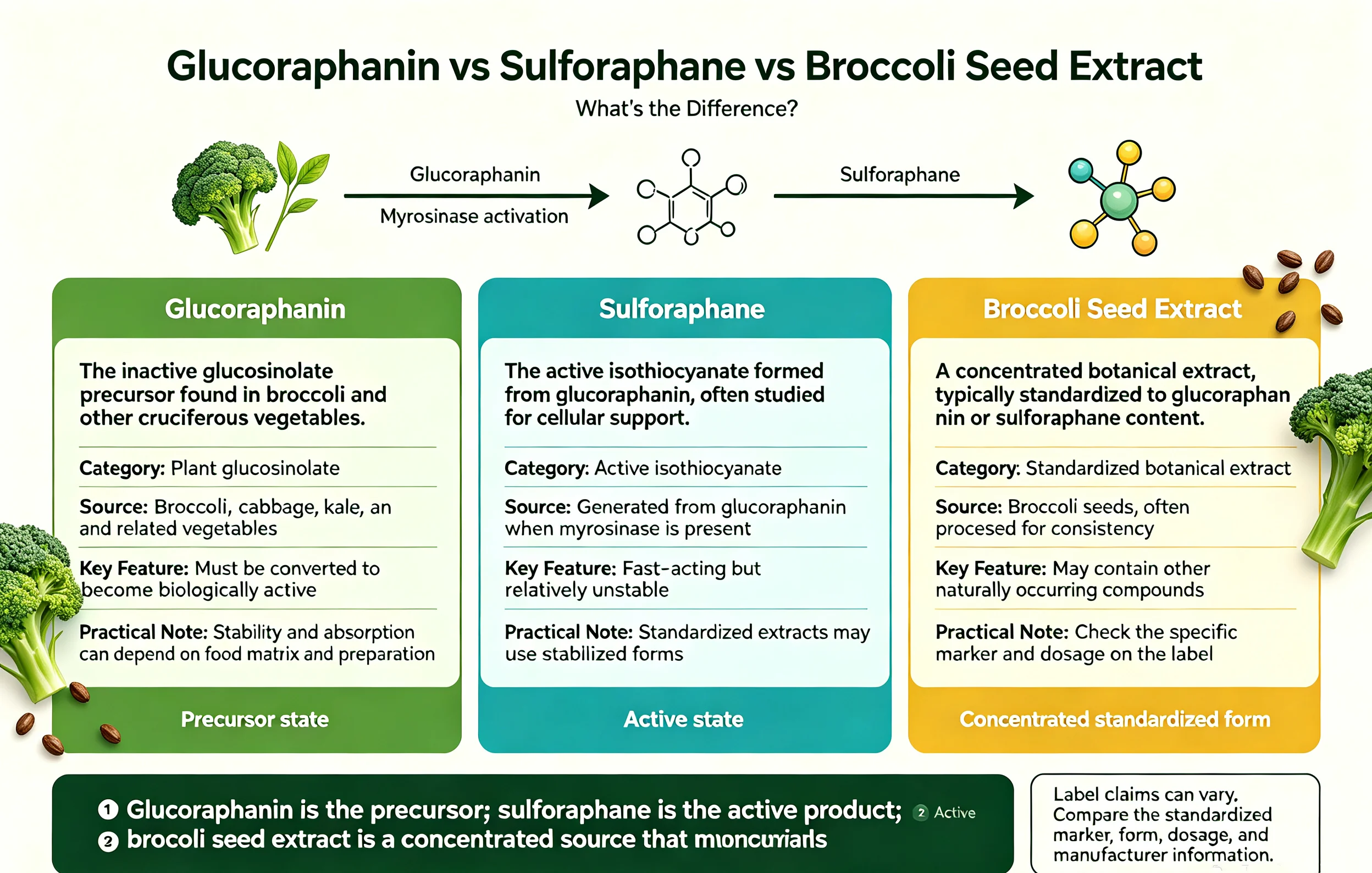
These two compounds exist in a precursor-product relationship. Understanding that relationship is the foundation of every smart sourcing decision.
Glucoraphanin is a glucosinolate - a stable, water-soluble molecule stored naturally in broccoli seeds and sprouts. It has no direct biological activity on its own. When you consume it, gut bacteria that express myrosinase-like enzymes cleave the thioglucose bond and release sulforaphane.
Sulforaphane is the active isothiocyanate that actually does the work inside the body. It activates the Nrf2 pathway, triggers Phase II detoxification enzymes like NQO1, HO-1, and GST, and drives the antioxidant response element (ARE). Over 3,000 peer-reviewed SCI papers have investigated its mechanisms.
Here's the key tension every formulator faces:
- Sulforaphane is biologically active but chemically unstable
- Glucoraphanin is thermally stable but requires gut conversion to become active
Neither is universally "better." The right choice depends on your product format, processing conditions, and target consumer.
The Stability Problem With Sulforaphane
Sulforaphane degrades fast. That's not a minor inconvenience - it's a core formulation challenge.
Sulforaphane is an electrophilic molecule. It reacts readily with:
- Heat during granulation, spray drying, or encapsulation
- Moisture during blending or storage
- Oxygen in standard packaging environments
- Alkaline pH in certain tablet excipients
Studies confirm that sulforaphane is difficult and expensive to stabilize for extended clinical use. In standard manufacturing conditions, free sulforaphane can lose a significant portion of its potency before the product even reaches the consumer.
This is why most commercial supplement SKUs are built on glucoraphanin-rich broccoli seed extract, not free sulforaphane. The precursor survives processing intact. It ships, stores, and blends without special handling. And it converts to sulforaphane in vivo where it's needed.

Glucoraphanin Bioavailability: What the Research Shows
A common objection from formulators: "If glucoraphanin needs gut bacteria to convert, isn't bioavailability unpredictable?"
It's a fair question. Here's what the data actually says.
Research published in PLOS ONE confirmed that glucoraphanin from broccoli seeds is a water-soluble, relatively inert precursor that delivers consistent urinary dithiocarbamate recovery of 70%–90% after oral ingestion. That's a high and reproducible conversion rate across diverse populations.
Conversion efficiency depends on gut microbiome composition - specifically populations of Bacteroides and Lactobacillus species that express thioglucosidase activity. Individuals with robust populations of these bacteria convert glucoraphanin more efficiently.
One practical strategy to boost conversion: co-administer glucoraphanin with a small amount of exogenous myrosinase - from fresh broccoli sprout powder or radish powder. A published human clinical trial showed this approach doubled sulforaphane bioavailability compared to glucoraphanin alone.
Key takeaway for formulators:
- Glucoraphanin alone: reliable 70–90% dithiocarbamate recovery
- Glucoraphanin + exogenous myrosinase: significantly higher active sulforaphane yield
- Free sulforaphane: high initial potency, but stability losses during manufacturing can offset the advantage
Side-by-Side Comparison: Sulforaphane vs. Glucoraphanin
Here's a direct comparison of the two specifications across the dimensions that matter most for B2B buyers:
|
Factor |
Sulforaphane (Free Form) |
Glucoraphanin (Precursor) |
|
Chemical stability |
Low - degrades with heat, moisture, O₂ |
High - survives standard processing |
|
Manufacturing fit |
Requires cold-chain, inert atmosphere |
Standard blending, granulation, encapsulation |
|
Bioavailability |
Direct - no conversion needed |
Gut-microbiome dependent (70–90% recovery) |
|
Assay method |
HPLC for isothiocyanate content |
HPLC for glucosinolate content |
|
Shelf life |
Shorter; needs stabilized formulation |
24+ months under standard conditions |
|
Dosage precision |
High if potency is retained |
High - Chinese DRIs 2023 sets TUL at 30 mg/day |
|
Best application |
Research substrates, short-cycle products |
Supplements, functional foods, FSMPs, beverages |
|
Cost at scale |
Higher - stabilization adds cost |
Lower - stable precursor, simpler logistics |
The bottom line: glucoraphanin is the industry-standard choice for commercial-scale supplement manufacturing. Free sulforaphane has a role in research settings and premium short-cycle formats where cold-chain logistics are feasible.
Which Specification Fits Your Application?
Let's make this practical. Here's how to match the specification to your product type.
Choose glucoraphanin (13%–20% HPLC) if you are:
- Manufacturing capsules, tablets, or powder blends at commercial scale
- Formulating functional beverages (water-soluble, clarity ≥98% available)
- Developing FSMPs, infant/maternal nutrition, or sports nutrition products
- Working with standard production equipment without cold-chain infrastructure
- Targeting a 24-month shelf life with conventional packaging
Choose sulforaphane (0.1%–10% HPLC) if you are:
- Supplying research institutions or clinical trial substrates
- Producing short-cycle premium SKUs with controlled storage and distribution
- Formulating products where direct isothiocyanate activity is a marketing or regulatory requirement
- Working in markets where sulforaphane is the labeled active ingredient
Consider a combined specification (e.g., Glucoraphanin 13% + Sulforaphane 1%) if you are:
- Building a premium positioning product that needs both label credibility and manufacturing stability
- Targeting consumers who recognize sulforaphane by name but need a product that survives a 2-year shelf life
Why the Assay Method on Your COA Matters More Than You Think
This is where many B2B buyers get burned.
Not all broccoli seed extract COAs are created equal. Some commodity suppliers use non-specific colorimetric assays - like the Cyclocondensation method - to measure total glucosinolate content. These methods can inflate declared values by measuring compounds other than glucoraphanin or sulforaphane.
The only defensible assay method for a specification you'll put on a label or defend in a third-party audit is HPLC against certified reference standards. HPLC separates and quantifies individual compounds. It tells you exactly how much glucoraphanin or sulforaphane is present - not a proxy measurement that lumps in minor glucosinolates.
When evaluating a supplier's COA, ask:
- Is the assay method HPLC or colorimetric?
- What reference standard was used for calibration?
- Does the COA cover heavy metals, residual solvents, and microbiology - or just assay?
- Is the declared value for glucoraphanin, sulforaphane, or total glucosinolates?
These four questions will separate credible suppliers from commodity traders faster than any other due diligence step.
What to Look for in a Broccoli Seed Extract Manufacturer
Sourcing the right specification is only half the equation. You also need a manufacturer who can deliver it consistently, batch after batch, at production scale.
Here's what a qualified broccoli seed extract manufacturer should demonstrate:
- Vertically integrated supply chain - from raw material sourcing to finished extract, with full field-to-COA traceability
- HPLC-verified potency on every batch, not periodic testing
- Stability data - accelerated stability testing (e.g., 90 days at 37°C/75% RH) showing potency retention
- Multiple specifications available - so you can switch grades as your formulation evolves without changing suppliers
- Relevant certifications - at minimum ISO 9001, FSSC 22000, cGMP, and ideally Halal, Kosher, and USDA/EU Organic for market access
- Clinical-grade documentation - COAs that hold up in FDA inspections and EU regulatory submissions
The difference between a supplier who checks these boxes and one who doesn't isn't just quality - it's your ability to defend your product in an audit, a recall investigation, or a customer complaint.
The Jiuyuan Biotech Broccoli Seed Extract Line
At Jiuyuan Biotech, we've built our broccoli seed extract line around the formulator's real-world needs - not just the chemistry.
Our product range covers three HPLC-verified core specifications:
- SFN-1 - Sulforaphane ≥1%
- SFN-5 - Sulforaphane ≥5%
- GR-13 - Glucoraphanin ≥13%
- Combined grade - Glucoraphanin 13% + Sulforaphane 1%
- Ultra-high potency custom grades above 10% available on request
Every batch ships with a full COA covering assay (HPLC), heavy metals, residual solvents, and microbiology. Our accelerated stability testing - 90 days at 37°C/75% RH - shows >95% potency retention, with zero activity loss over a 2-year shelf life.
Our facility at the foot of China's Qinling Mountains holds 12 international certifications including ISO 9001, FSSC 22000, cGMP, USDA/EU Organic, Halal, and Kosher. We serve clients across 30+ countries in dietary supplements, functional food, cosmetics, and pharmaceuticals.
Explore our full broccoli seed extract specifications at jiuyuanbio.com.
Ready to Source the Right Specification?
Choosing between sulforaphane and glucoraphanin isn't a trivial decision. It affects your product's stability, your manufacturing process, your label claims, and your ability to pass third-party audits. Getting it right from the start saves time, money, and compliance headaches down the line.
If you're evaluating broccoli seed extract suppliers or need help matching a specification to your formulation, reach out to our technical team directly. 📧 Contact us: info@jiuybiotech.com
We provide samples, full technical documentation, and formulation support - no minimum commitment required for initial inquiry.
References
- Fahey, J. W., Wehage, S. L., Holtzclaw, W. D., Kensler, T. W., Egner, P. A., Shapiro, T. A., & Talalay, P. (2012). Protection of humans by plant glucosinolates: Efficiency of conversion of glucosinolates to isothiocyanates by the gastrointestinal microflora. Cancer Prevention Research, 5(4), 603–611.
- Cramer, J. M., Teran-Garcia, M., & Bhagwat, S. (2019). Broccoli or sulforaphane: Is it the source or dose that matters? Molecules, 24(19), 3593.
- Dinkova-Kostova, A. T., & Fahey, J. W. (2015). Sulforaphane bioavailability from glucoraphanin-rich broccoli: Control by active endogenous myrosinase. PLOS ONE, 10(11), e0140963.
- Egner, P. A., Chen, J. G., Zarth, A. T., Ng, D. K., Wang, J. B., Kensler, K. L., & Kensler, T. W. (2014). Rapid and sustainable detoxication of airborne pollutants by broccoli sprout beverage: Results of a randomized clinical trial in China. Cancer Prevention Research, 7(8), 813–823.
- Shapiro, T. A., Fahey, J. W., Dinkova-Kostova, A. T., Holtzclaw, W. D., Stephenson, K. K., Wade, K. L., & Talalay, P. (2006). Safety, tolerance, and metabolism of broccoli sprout glucosinolates and isothiocyanates: A clinical phase I study. Nutrition and Cancer, 55(1), 53–62.
- Vanduchova, A., Anzenbacher, P., & Anzenbacherova, E. (2019). Isothiocyanate from broccoli, sulforaphane, and its properties. Journal of Medicinal Food, 22(2), 121–126.