If you're building a supplement line around antioxidant support or cellular defense, you've probably already heard the buzz about broccoli seed extract. It's one of the few botanical ingredients with a genuinely well-mapped mechanism, backed by a growing pile of clinical research rather than vague "wellness" marketing. But launching a private label product with this ingredient isn't as simple as picking a supplier off a directory and placing an order.
This guide walks you through exactly what broccoli seed extract is, how the science behind it actually works, and the practical steps you need to take to get a private label product to market without formulation mistakes or supplier surprises.
What Is Broccoli Seed Extract, and Why Are Brands Adding It?
Broccoli seed extract comes from the seeds of Brassica oleracea, processed to concentrate two key compounds: glucoraphanin and sulforaphane. You might also see it labeled as sulforaphane powder, glucoraphanin extract, or broccoli sprout extract, since all these terms describe the same underlying chemistry.
Here's why brands keep formulating with it:
- It has a single, well-defined mechanism of action rather than a vague "blend of antioxidants" story.
- It's supported by a substantial body of peer-reviewed clinical research, not just cell-culture studies.
- Regulatory bodies have started setting formal intake guidance, which makes dosing far less guesswork than most botanicals.
- It works across almost every dosage form, from capsules to functional beverages.
That last point matters if you're trying to differentiate a product line. A single raw material that performs well in tablets, gummies, and ready-to-drink formats gives you flexibility without needing three separate suppliers.

The Science Behind Broccoli Seed Extract: Glucoraphanin, Sulforaphane, and Gut Bacteria
Understanding the chemistry isn't optional if you're formulating with this ingredient. Your customers - and increasingly, your retail buyers - expect you to know the mechanism, not just the marketing copy.
How Your Body Converts Glucoraphanin into Sulforaphane
Sulforaphane itself is unstable. It degrades quickly and reacts too fast to survive standard manufacturing steps like heat processing or long shelf storage. That's why most reputable broccoli seed extract products are built around glucoraphanin, the thermally stable precursor compound.
Here's the conversion pathway in plain terms:
1.You ingest glucoraphanin, which passes through the stomach mostly intact.
2.Gut bacteria expressing an enzyme called myrosinase cleave the glucoraphanin molecule.
3.This cleavage releases active sulforaphane in the colon.
4.Sulforaphane then activates the Nrf2 pathway, which switches on a set of protective enzymes including NQO1, HO-1, and glutathione-related enzymes.
This isn't a theoretical mechanism. Published pharmacokinetic work shows that between 70% and 90% of an oral glucoraphanin dose gets recovered as urinary dithiocarbamate metabolites, which confirms the conversion actually happens at meaningful rates in real people.
Why Bioavailability Data Matters for Formulators
Here's the catch that a lot of brands miss: conversion efficiency isn't identical across all consumers. Individual gut microbiome composition - specifically the presence of myrosinase-expressing bacteria such as certain Bacteroides and Lactobacillus species - directly affects how much sulforaphane a person actually absorbs from a glucoraphanin dose.
A controlled human study went further and identified specific microbial genes correlated with sulforaphane conversion efficiency, giving formulators a clearer picture of why response varies person to person.
This is exactly why some manufacturers pair glucoraphanin with small amounts of exogenous myrosinase, sourced from fresh broccoli sprout powder or radish powder, to boost conversion regardless of a consumer's individual gut flora.
Choosing the Right Broccoli Seed Extract Specification
Not every "broccoli extract" on the market is built the same way. Specifications vary widely, and this is where a lot of private label brands get burned by inflated potency claims.
|
Specification |
Typical Marker |
Best For |
|
SFN-1 |
Sulforaphane ≥1% |
General wellness capsules |
|
SFN-5 |
Sulforaphane ≥5% |
Higher-potency antioxidant formulas |
|
GR-13 |
Glucoraphanin ≥13% |
Stability-focused, controlled-release positioning |
A critical detail: potency should be verified by HPLC against certified reference standards, not by non-specific colorimetric assays. Colorimetric testing is cheaper, but it's also how some commodity suppliers inflate declared glucosinolate content on paper without the actual compound being present at that level. If your supplier can't produce an HPLC-based Certificate of Analysis, treat that as a red flag before you sign a purchase order.
You'll also want to decide between:
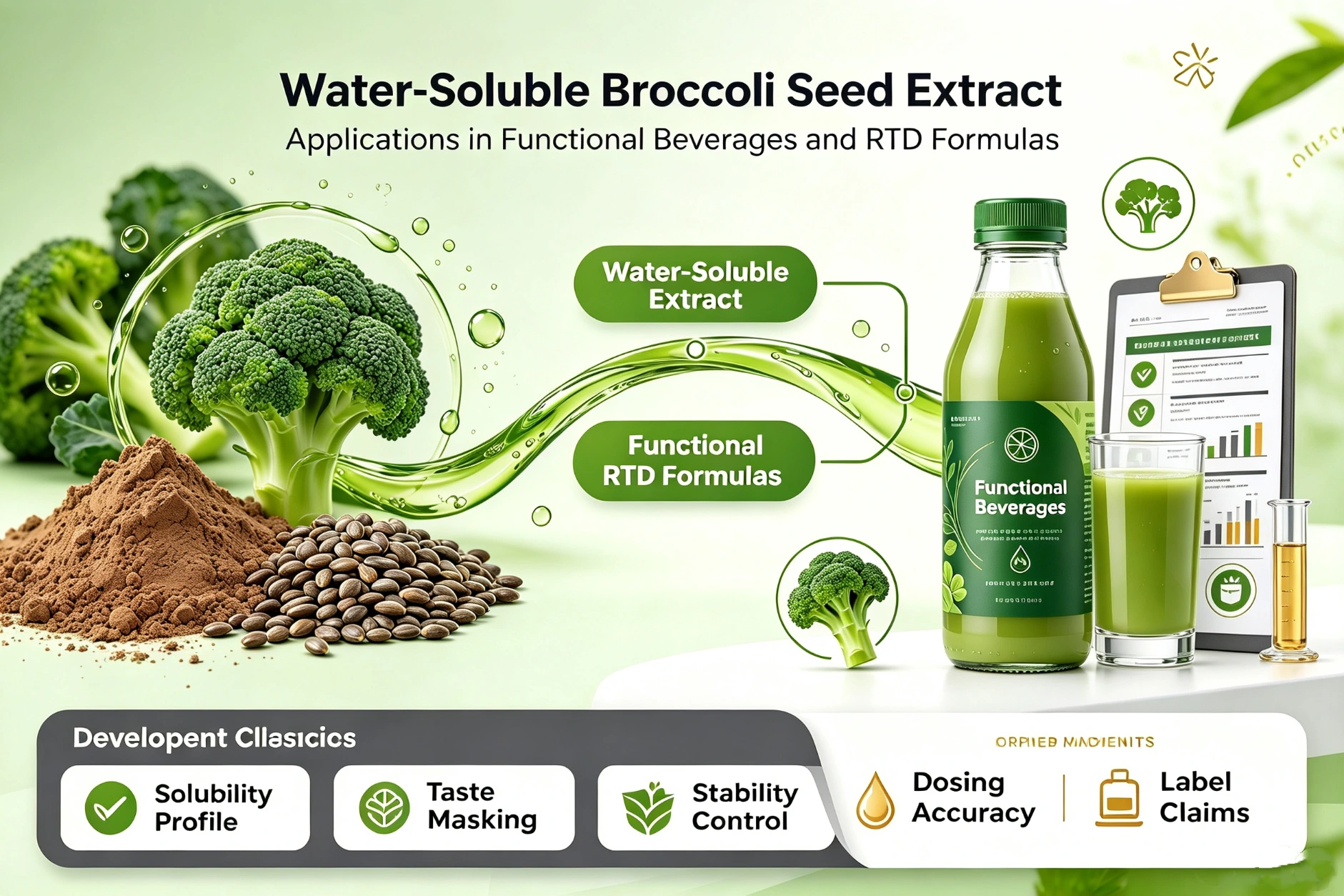
- Water-soluble powder - ideal for clear beverages, with clarity ratios above 98% in top-tier extracts.
- Oil-soluble powder - better suited to softgel and oil-based delivery systems.
Step-by-Step: Launching Your Private Label Broccoli Seed Extract Product
Once you understand the science and the spec sheet, the next challenge is execution. Here's a practical sequence that avoids the most common launch delays.
Step 1: Define Your Formulation Goal
Decide whether your product is positioned around antioxidant support, detox/Phase II enzyme support, or general cellular defense. This shapes which specification (SFN-1, SFN-5, or GR-13) fits your label claims.
Step 2: Vet the Supplier's Certifications
At minimum, look for:
- ISO 9001 and FSSC 22000 for quality management
- cGMP compliance for manufacturing practices
- Halal and Kosher certification if you're selling into those markets
- NOP/EU Organic if your brand positioning depends on organic sourcing
A supplier holding a dozen certifications isn't just a marketing badge - it usually signals real infrastructure behind the product, including in-house HPLC, GC, and microbiology testing capacity.
Step 3: Request a Batch-Specific COA
Every shipment should ship with its own Certificate of Analysis covering:
- Assay/potency (HPLC-verified)
- Heavy metals
- Residual solvents
- Microbiological limits
Generic certificates that aren't tied to a specific lot number are worth questioning.
Step 4: Select Your Dosage Form
Broccoli seed extract adapts well to:
- Capsules and tablets
- Functional powders and sachets
- Ready-to-drink beverages
- Gummies
- Infant and maternal nutrition formats
- Pet nutrition products
The mild taste profile, without a pungent cruciferous aftertaste, makes it easier to formulate into beverages and gummies compared to raw broccoli powder.
Step 5: Confirm MOQ, Packaging, and Lead Times
Ask specifically about:
- Minimum order quantity for your target specification
- Packaging options (foil-lined canisters vs. bulk vacuum-sealed drums)
- OEM sachet or capsule support if you don't have your own filling line
- Realistic production and shipping lead times
Step 6: Run a Pilot Batch
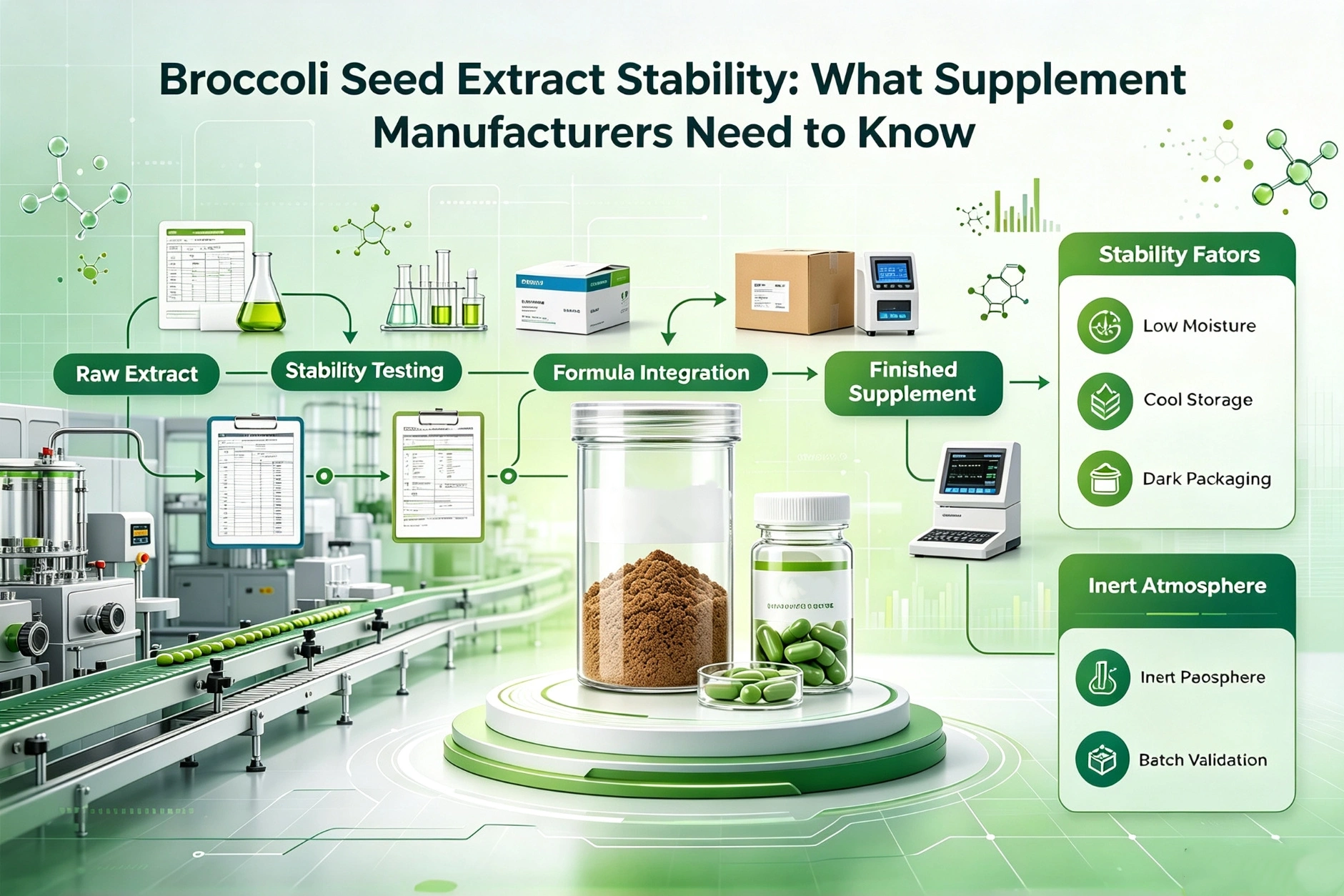
Before committing to full production volume, request a small pilot batch. Test it in your actual finished product - not just as raw powder - to confirm color, taste, and stability under your specific formulation conditions.
What to Look for in a Broccoli Seed Extract Supplier
If you're searching for a broccoli seed extract supplier, broccoli seed extract factory, or broccoli seed extract manufacturer, here's what separates a reliable long-term partner from a broker reselling someone else's stock:
- Direct grower relationships rather than purchasing through brokers, which affects both traceability and pricing consistency.
- In-house testing labs (HPLC, GC, UV, AAS, microbiology) rather than outsourced third-party testing on every batch.
- Vertical integration from raw seed sourcing through to finished powder, reducing the number of hands the material passes through.
- Documented clinical usage of their specific material, not just general sulforaphane research pulled from unrelated sources.
JiuYuan Biotech, based at the foot of China's Qinling Mountains, has built its broccoli seed extract line around exactly this model: premium cultivars selected for peak glucosinolate accumulation, harvest lots verified before extraction, and HPLC-confirmed potency across every batch. The facility runs 10 production lines with more than 6,000 tons of annual capacity, holds certifications including ISO 9001, FSSC 22000, and cGMP, and supports OEM sachet and capsule formats for brands that need a turnkey private label solution.
Applications Across Your Product Line
Once you've locked in a formulation, broccoli seed extract fits into a wider range of categories than most single-ingredient botanicals:
Antioxidant and cellular defense capsules - typically using GR-13 or SFN-5 grades
Detox and Phase II support blends - often paired with milk thistle or NAC
Sports nutrition formulas - leveraging the antioxidant load from training stress
Functional beverages - using water-soluble grades with high clarity
Pet nutrition - an emerging category with growing consumer interest in cruciferous-derived antioxidants for companion animals
Bringing It All Together
Launching a private label broccoli seed extract supplement isn't complicated once you understand the underlying science and ask your supplier the right questions upfront. Confirm the specification you actually need, insist on HPLC-verified COAs, and pilot test before committing to full-scale production.
If you're ready to move forward with a broccoli seed extract supplier that can back up its specifications with real testing data and manufacturing transparency, reach out to our team at info@jiuybiotech.com. We're happy to walk through specification options, request samples, or discuss OEM formatting for your specific product line.
References
Fahey, J.W., Zalcmann, A.T., & Talalay, P. (2001). The chemical diversity and distribution of glucosinolates and isothiocyanates among plants. Phytochemistry, 56(1), 5–51.
Egner, P.A., Chen, J.G., Wang, J.B., et al. (2011). Bioavailability of Sulforaphane from Two Broccoli Sprout Beverages: Results of a Short-Term, Cross-Over Clinical Trial in Qidong, China. Cancer Prevention Research, 4(3), 384–395.
Vermeulen, M., Klöpping-Ketelaars, I.W.A.A., van den Berg, R., & Vaes, W.H.J. (2008). Bioavailability and Kinetics of Sulforaphane in Humans After Consumption of Cooked versus Raw Broccoli. Journal of Agricultural and Food Chemistry, 56(22), 10505–10509.
Yagishita, Y., Fahey, J.W., Dinkova-Kostova, A.T., & Kensler, T.W. (2019). Broccoli or Sulforaphane: Is It the Source or Dose That Matters? Molecules, 24(19), 3593.
Kensler, T.W., Ng, D., Carmella, S.G., et al. (2012). Modulation of the metabolism of airborne pollutants by glucosinolate-rich and sulforaphane-rich broccoli sprout beverages in Qidong, China. Carcinogenesis, 33(1), 101–107.
Bahadoran, Z., Mirmiran, P., & Azizi, F. (2013). Potential efficacy of broccoli sprouts as a unique supplement for management of type 2 diabetes and its complications. Journal of Medicinal Food, 16(5), 375–382.