

Picking the wrong broccoli seed extract manufacturer can quietly destroy a product launch before it ever reaches a shelf. The wrong partner ships inconsistent potency, fails third-party audits, and leaves your brand holding the liability. The right one becomes a technical asset - someone who helps you formulate smarter, scale faster, and defend every claim on your label. This guide walks you through exactly what to look for, what to ask, and what to walk away from.
Understand What You're Actually Buying First
Before you evaluate a single manufacturer, you need clarity on the ingredient itself. Broccoli seed extract is not one product - it's a category with meaningfully different specifications, each suited to a different formulation goal.
The two primary active compounds are:
- Glucoraphanin - the thermally stable precursor. It survives heat, blending, and encapsulation intact. In the gut, resident microbiota convert it to sulforaphane via myrosinase-like enzyme activity. Urinary dithiocarbamate recovery rates of 70%–90% confirm reliable oral delivery.
- Sulforaphane - the bioactive isothiocyanate. It activates the Nrf2/Keap1 pathway, triggering cytoprotective enzymes including NQO1, HO-1, and glutathione S-transferases. It is volatile and reactive. It degrades under standard manufacturing conditions.
Why this matters for brand owners: if your finished product goes through heat-intensive processing - tablet compression, spray drying, extrusion - a glucoraphanin-standardized extract will outperform a sulforaphane-standardized extract on shelf-life stability.
Common specification tiers from credible manufacturers include:
- Glucoraphanin 1%, 10%, 13%–20%
- Sulforaphane 0.1%, 1%, 5%, 10%
- Combination grades: Glucoraphanin 13% + Sulforaphane 1%
A manufacturer who cannot explain the trade-offs between these grades is not a technical partner. They are a commodity trader with a product list.
Verify the Testing Method - This Is Non-Negotiable
The most consequential question you can ask any broccoli seed extract manufacturer is: how do you verify potency?
Two methods dominate the market:
|
Testing Method |
What It Detects |
Reliability |
|
HPLC (High-Performance Liquid Chromatography) |
Specific glucosinolate or isothiocyanate compounds |
High - compound-specific, audit-defensible |
|
Colorimetric / UV Spectrophotometry |
Non-specific chromogenic reaction |
Low - inflates declared content, fails third-party verification |
Colorimetric assays are cheaper and faster. They are also notoriously non-specific. A manufacturer using UV-based colorimetric testing can declare a glucosinolate content that looks impressive on paper but collapses under independent HPLC verification. This is a documented pattern in commodity botanical extract markets - not a theoretical risk.
What a credible manufacturer provides without hesitation:
- Batch-specific COA with HPLC assay data
- Named reference standard used for HPLC calibration
- Heavy metals panel: lead, arsenic, cadmium, mercury
- Residual solvents report (water and/or ethyl alcohol extraction)
- Microbiology results: total plate count, yeast/mold, E. coli, Salmonella
- Pesticide residue screening report
If a manufacturer sends you a generic, undated COA with no batch number and no testing method disclosed, that document is decorative. It protects no one.

Certifications That Actually Matter for Brand Protection
Certifications are not marketing ornaments. They are independently audited evidence that a manufacturer's quality management system meets a defined standard. For brands selling into regulated markets, the following are the baseline:
Manufacturing & Quality Systems
- ISO 9001 - documented quality management processes
- ISO 22000 / FSSC 22000 - food safety management with HACCP controls
- cGMP - current Good Manufacturing Practice; required for dietary supplement supply chains in the US
Market Access Credentials
- FDA registration - mandatory for any manufacturer exporting to the United States
- USDA NOP / EU Organic - required if your label carries an organic claim
- Halal & Kosher - required for Middle Eastern and Jewish market distribution
The operational advantage: a manufacturer who already holds these certifications dramatically reduces your supplier qualification burden. You inherit their audit history instead of building one from scratch.
One practical step most brand owners skip: ask for the original certificate documents - not website logos - and verify the certificate numbers directly with the issuing body. Certificates expire. Some are not renewed. A logo on a homepage tells you nothing about current status.
Evaluate the Manufacturer's Raw Material Control
The quality of any broccoli seed extract is determined before extraction begins. Glucosinolate accumulation in Brassica oleracea seeds is sensitive to cultivar genetics, soil fertility, irrigation timing, and harvest conditions. A manufacturer who sources raw material from open-market brokers cannot guarantee batch-to-batch consistency - regardless of how sophisticated their extraction equipment is.
Questions that reveal a manufacturer's raw material discipline:
- Do you source from dedicated contract growers or spot-market brokers?
- Can you provide field-to-COA traceability documentation for each batch?
- Do you test incoming raw material for glucosinolate content before extraction begins?
- What is your batch-to-batch variation tolerance for the primary active compound?
Manufacturers with direct grower partnerships and documented incoming quality control consistently outperform broker-dependent operations on specification consistency. This matters enormously when you're scaling a product line and need predictable potency across multiple production runs.
Assess OEM and Formulation Capability
If you're building a brand - not just sourcing a raw material - you need a manufacturer who can grow with you. The difference between a raw extract supplier and a genuine OEM partner is significant.
What a full-service broccoli seed extract manufacturer should offer:
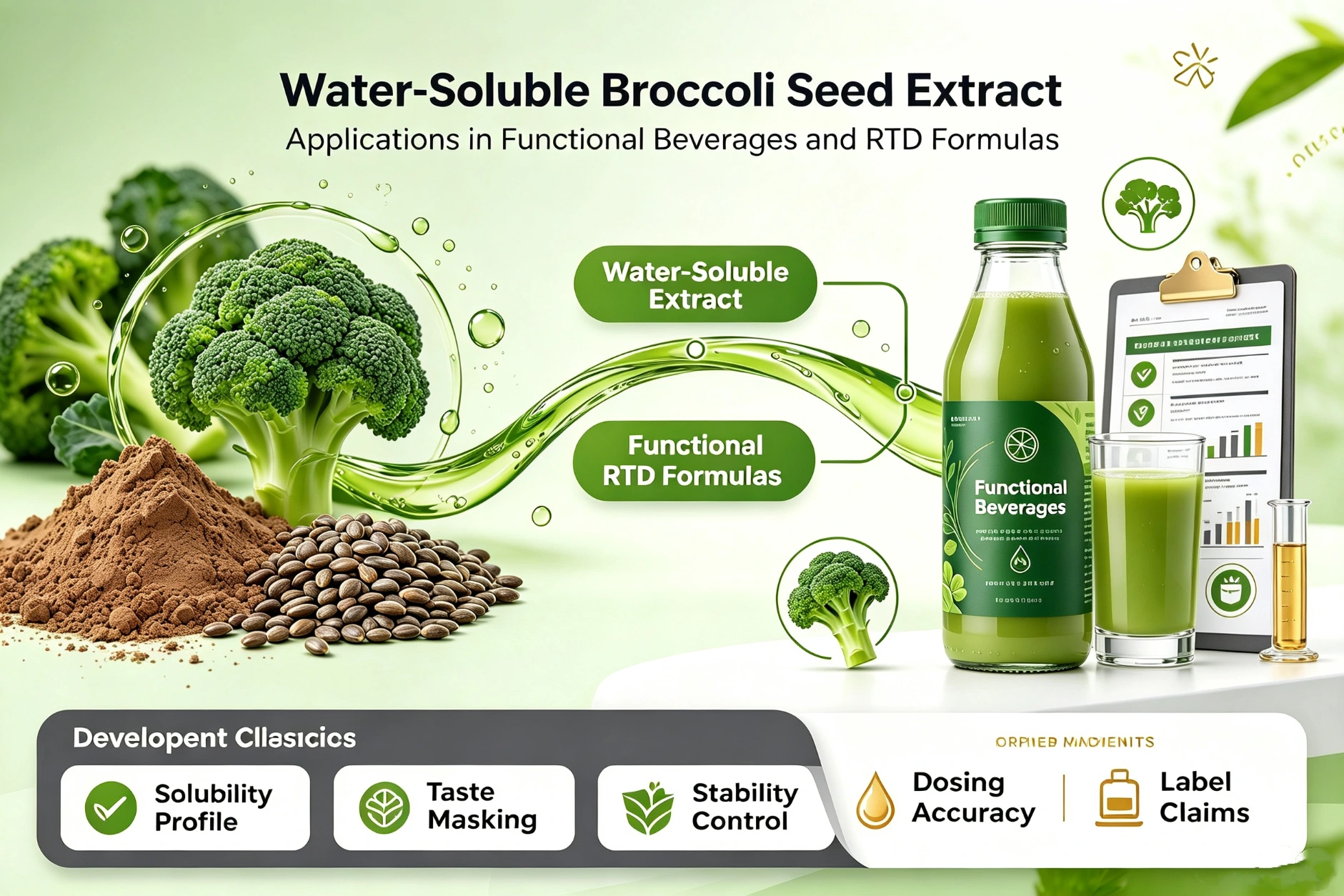
- Multiple dosage forms: capsules, tablets, powder blends, ready-to-drink formats, functional gummies, sachets
- Custom specification development: ability to hit a target potency outside their standard product line
- Formulation support: guidance on compatibility with other actives, solubility optimization, taste masking
- Stability testing: accelerated stability data (37°C/75% RH) for your specific finished-product format
- Private label / white label packaging: branded packaging with your label, compliant with target market regulations
- Flexible MOQ: minimum order quantities that match your production scale, not just theirs
A manufacturer who only ships bulk powder and hands you an invoice is not an OEM partner. They are a starting point. If your brand ambitions extend beyond a single SKU, you need a partner whose capabilities extend with you.
Scrutinize Stability Data and Packaging Integrity
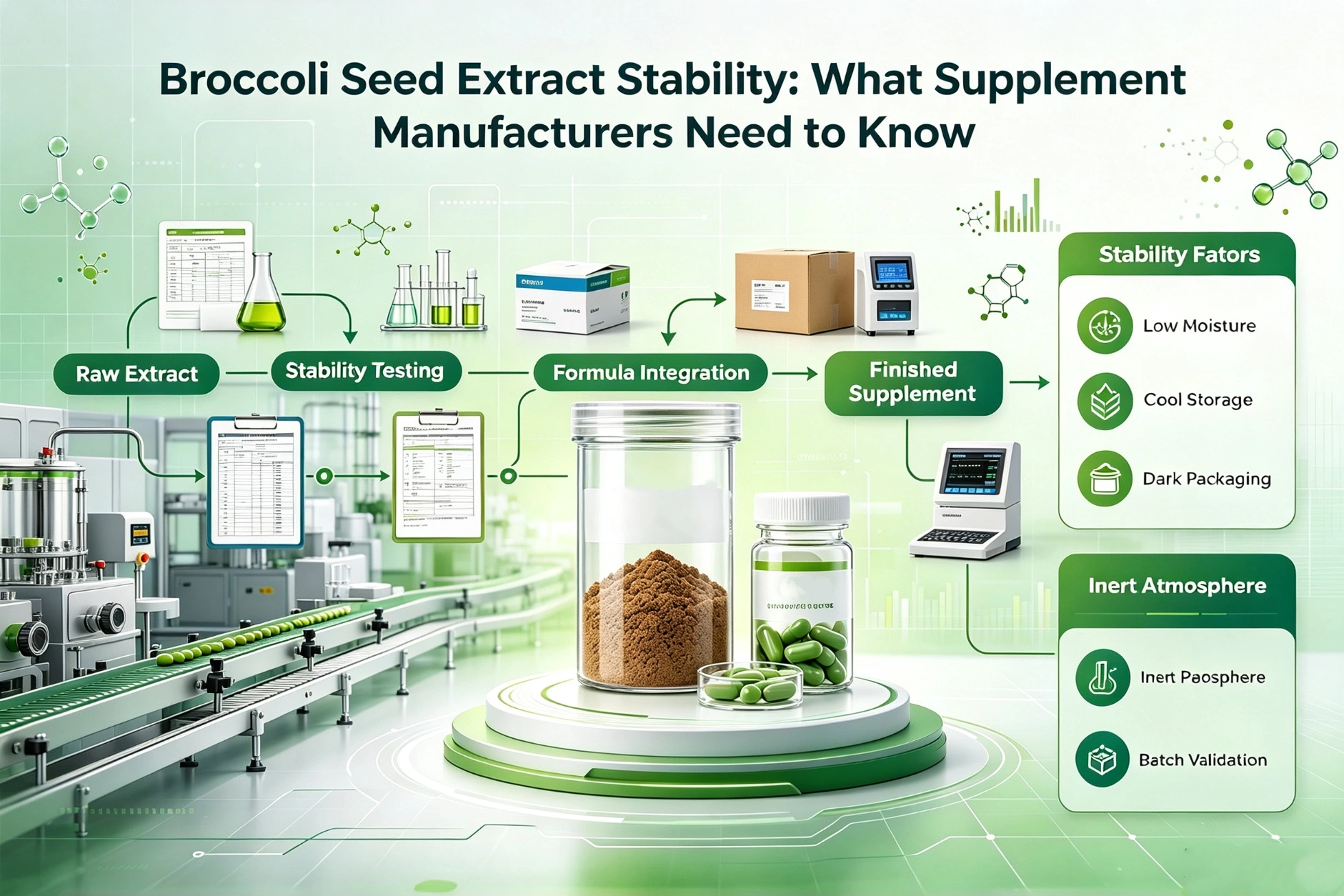
Glucoraphanin is thermally stable. Sulforaphane is not. Both compounds degrade under moisture and oxygen exposure over time. A manufacturer who ships broccoli seed extract in non-inert, non-sealed packaging is transferring a degradation risk directly onto your brand.
Packaging formats that protect active compound integrity:
- 1 kg foil-lined tin canisters - suitable for R&D quantities and small-batch production
- 25 kg vacuum aluminum buckets - standard for commercial bulk orders
- Nitrogen-flushed, moisture-barrier sealed bags - critical for sulforaphane-containing grades
Shelf life benchmarks to verify with any manufacturer:
- Glucoraphanin-standardized extract: minimum 24 months under proper storage conditions (cool, dry, light-protected)
- Sulforaphane-standardized extract: typically 12–18 months; accelerated stability data should be available on request
Ask specifically for accelerated stability testing data - not just a stated shelf life on a spec sheet. A manufacturer with a genuine quality program generates this data routinely. A commodity trader will not have it.
Ask About Clinical and Scientific Backing
This point separates ingredient-grade manufacturers from brand-grade partners. If your product makes a functional claim - antioxidant support, detoxification, cellular defense - you need an ingredient with a published evidence base that supports that claim.
What to look for in a manufacturer's scientific dossier:
- Published peer-reviewed clinical trials using their specific extract as the intervention ingredient
- SCI-indexed research papers citing their product's specifications
- Ongoing registered clinical trials (NCT, EudraCT, UMIN, ChiCTR) using their material
- Regulatory dossiers supporting novel food or new dietary ingredient status
An extract backed by 3,000+ SCI papers and 130+ clinical trials gives your brand a defensible scientific foundation. An extract with no published clinical use gives your marketing team a problem.
A Pre-Contract Checklist for Brand Owners
Before signing any supply agreement with a broccoli seed extract manufacturer, work through this list:
- Specification confirmed: glucoraphanin %, sulforaphane %, or combination grade
- Testing method confirmed: HPLC with named reference standard
- Batch-specific COA reviewed and verified
- Heavy metals, solvents, and microbiology data confirmed
- Certifications verified - original documents, not website logos
- Raw material origin and traceability documentation obtained
- OEM capability assessed: dosage forms, MOQ, lead time
- Accelerated stability data reviewed for your target format
- Pre-contract sample obtained and sent for independent third-party testing
- Technical support scope agreed in writing
This checklist will not guarantee a perfect manufacturing partner. It will eliminate the ones who cannot meet a professional standard - and that alone saves significant time, money, and brand risk.
Why Jiuyuan Biotech Works as a Manufacturing Partner
At Jiuyuan Biotech, we built our broccoli seed extract program around one principle: every specification we declare must be audit-defensible. Our 70,000 m² facility at the foot of China's Qinling Mountains runs 10 production lines with 6,000+ tons of annual capacity. We own the full chain - from contract grower partnerships to in-house HPLC verification against certified reference standards.
Our standard product line covers three verified grades:
- SFN-1: Sulforaphane ≥1%
- SFN-5: Sulforaphane ≥5%
- GR-13: Glucoraphanin ≥13%
Ultra-high potency custom grades above 10% are available on request. Both water-soluble and oil-soluble formats are supported, with OEM capability across capsules, tablets, sachets, and ready-to-drink formats.
Our facility holds 12 international certifications - ISO 9001, FSSC 22000, cGMP, FDA registration, USDA/EU Organic, Halal, and Kosher. Every batch ships with a full batch-specific COA. No generic certificates. No colorimetric assay shortcuts.
Our broccoli seed extract has served as the intervention ingredient in over 3,000 global SCI papers and 130+ clinical trials, including ongoing RCTs at Johns Hopkins, Mass General, and Imperial College London. The Chinese Dietary Reference Intakes 2023 established a Tolerable Upper Intake Level for sulforaphane at 30 mg/day - the first time a regulatory body has set a quantified daily limit for this compound, enabling precise milligram-level formulation.
If you're selecting a broccoli seed extract manufacturer for your brand and want a technical dossier, sample set, and full COA package before committing, reach out directly.
📧 Contact us: info@jiuybiotech.com
References
- Fahey, J. W., Zhang, Y., & Talalay, P. (1997). Broccoli sprouts: An exceptionally rich source of inducers of enzymes that protect against chemical carcinogens. Proceedings of the National Academy of Sciences, 94(19), 10367–10372.
- Shapiro, T. A., Fahey, J. W., Wade, K. L., Stephenson, K. K., & Talalay, P. (2001). Chemoprotective glucosinolates and isothiocyanates of broccoli sprouts: Metabolism and excretion in humans. Cancer Epidemiology, Biomarkers & Prevention, 10(5), 501–508.
- Vanduchova, A., Anzenbacher, P., & Anzenbacherova, E. (2019). Isothiocyanate from broccoli, sulforaphane, and its properties. Journal of Medicinal Food, 22(2), 121–126.
- Egner, P. A., Chen, J. G., Zarth, A. T., Ng, D. K., Wang, J. B., Kensler, K. H., & Kensler, T. W. (2014). Rapid and sustainable detoxication of airborne pollutants by broccoli sprout beverage: Results of a randomized clinical trial in China. Cancer Prevention Research, 7(8), 813–823.
- Kensler, T. W., Egner, P. A., Agyeman, A. S., Visvanathan, K., Groopman, J. D., Chen, J. G., & Talalay, P. (2013). Keap1–Nrf2 signaling: A target for cancer prevention by sulforaphane. Topics in Current Chemistry, 329, 163–177.
- Chinese Nutrition Society. (2023). Chinese Dietary Reference Intakes (2023 Edition). People's Medical Publishing House. [Tolerable Upper Intake Level for sulforaphane established at 30 mg/day.]