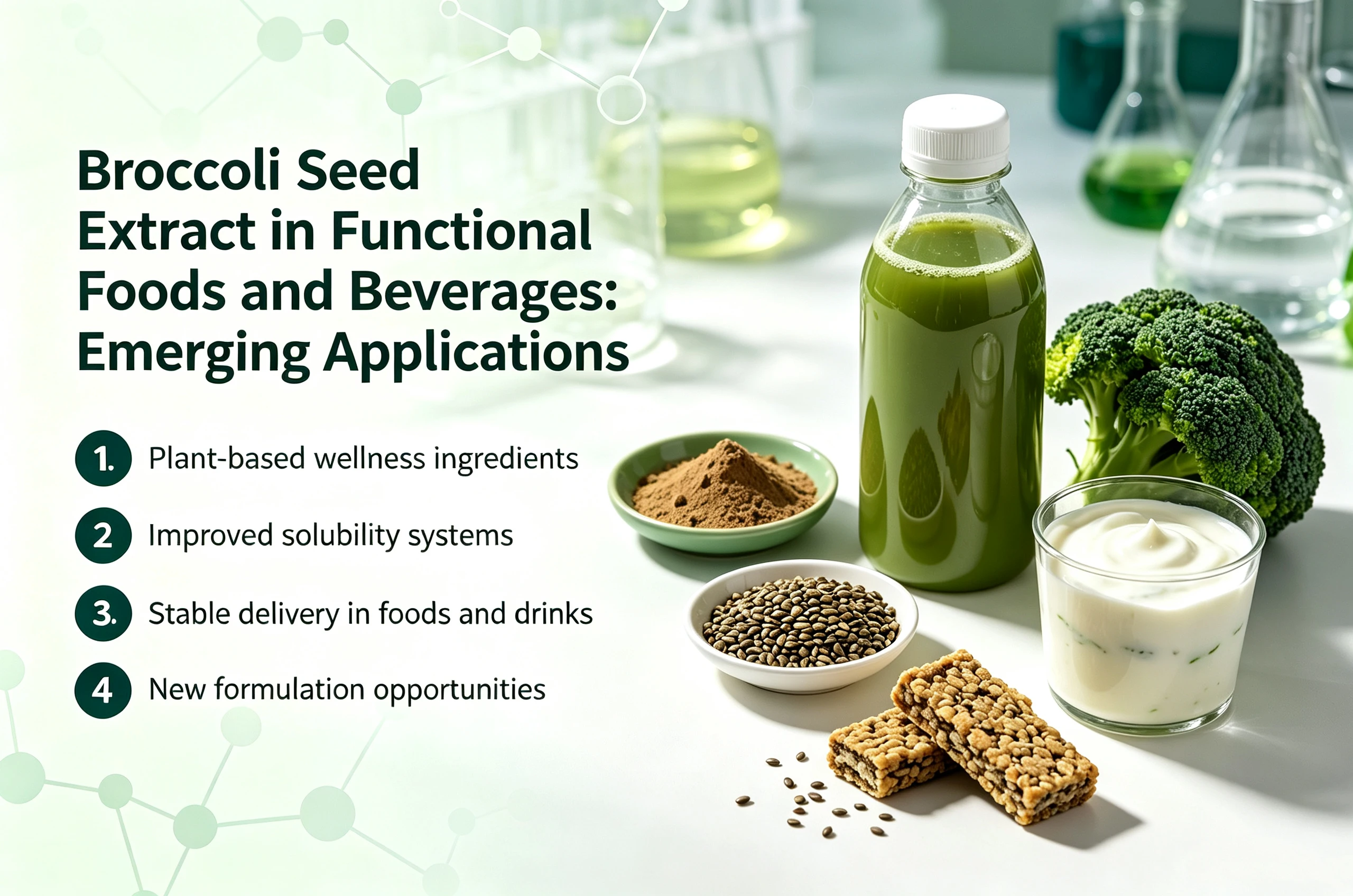


If you're developing a supplement, functional food, or nutraceutical product, broccoli seed extract is one of the most scientifically validated ingredients you can work with right now. The active compound - sulforaphane - has been studied in over 3,000 SCI-indexed papers and more than 130 clinical trials worldwide. But here's the challenge most formulators run into: sulforaphane is chemically unstable, volatile, and notoriously difficult to preserve through standard manufacturing processes.
This guide walks you through exactly what you need to know - from choosing the right extract grade to managing stability, solubility, and dosage in real-world formulations. Whether you're a product developer, procurement manager, or brand owner, these practical tips will help you get the most out of this powerful ingredient.
What's Actually in Broccoli Seed Extract?
Before you can formulate effectively, you need to understand what you're working with. Broccoli seed extract contains two primary bioactive forms:
- Sulforaphane (SFN) - the active isothiocyanate that directly activates the Nrf2 pathway, triggering cytoprotective enzyme production. It's potent, but chemically reactive and unstable.
- Glucoraphanin (GR) - the stable glucosinolate precursor to sulforaphane. It survives processing intact and converts to sulforaphane in vivo via gut microbial myrosinase enzymes.
Why does this distinction matter for formulators?
Sulforaphane degrades rapidly under heat, humidity, and oxidative conditions. Glucoraphanin, by contrast, is water-soluble and thermally stable - it withstands standard manufacturing conditions without significant activity loss. Research confirms that between 70% and 90% of an oral glucoraphanin dose is recovered as urinary dithiocarbamate metabolites, validating its oral bioavailability.
The Glucoraphanin → Sulforaphane Cascade
Once glucoraphanin reaches the colon, resident gut bacteria expressing myrosinase-like activity cleave the thioglucose bond. This releases sulforaphane - an electrophilic isothiocyanate that reacts with cysteine residues on the Keap1 repressor protein, freeing Nrf2 to migrate to the nucleus and upregulate antioxidant response elements (ARE).
The key enzymes induced by this pathway include:
|
Enzyme |
Primary Function |
|
NQO1 |
Phase II detoxification |
|
HO-1 |
Anti-inflammatory, cytoprotective |
|
GST |
Carcinogen conjugation |
|
GCL |
Glutathione biosynthesis |
|
Thioredoxin reductase |
Redox homeostasis |
This mechanistic clarity is precisely why broccoli seed extract commands serious attention from clinical researchers and product developers alike.
Stability: The #1 Formulation Challenge
Stability is where most broccoli extract formulations fail. Here's what you need to watch for.
Sulforaphane Is Inherently Unstable
Free sulforaphane degrades through multiple pathways:
- Heat degradation - sulforaphane breaks down rapidly above 60°C. High-temperature processing (granulation, spray drying, pasteurization) destroys a significant portion of activity.
- Oxidation - exposure to oxygen accelerates degradation, especially in powder blends without antioxidant protection.
- Hydrolysis - aqueous environments at neutral-to-alkaline pH accelerate sulforaphane breakdown into inactive nitrile byproducts.
- Moisture - high relative humidity (above 60% RH) destabilizes both sulforaphane and glucoraphanin over time.
Glucoraphanin Is the Stable Choice for Manufacturing
For most commercial formulations, glucoraphanin-standardized extract is the smarter raw material. It survives:
- Tablet compression
- Capsule filling
- Spray drying
- Moderate heat during blending
Accelerated stability testing at 37°C / 75% RH for 90 days has shown that high-quality glucoraphanin extracts retain >95% potency - a benchmark that free sulforaphane products cannot match.
Practical Stability Tips for Your Production Line
- Store at ≤25°C in sealed, moisture-barrier packaging (foil-lined or vacuum aluminum).
- Use nitrogen flushing during filling and packaging to minimize oxidative degradation.
- Avoid co-formulating with strongly alkaline excipients - high pH accelerates sulforaphane hydrolysis.
- Keep water activity (Aw) below 0.3 in finished powder products.
- Choose encapsulated or microencapsulated sulforaphane formats if you specifically need free SFN in the formula - the protective coating dramatically extends shelf life.
- Request accelerated stability data (COA) from your supplier before committing to a specification. Any credible supplier should provide HPLC-verified batch data, not colorimetric assay results.
Solubility: Matching the Extract to Your Dosage Form
Solubility directly determines which product formats work - and which don't. Here's a practical breakdown.
Water-Soluble Broccoli Seed Extract
Glucoraphanin is naturally water-soluble. This makes it ideal for:
- Ready-to-drink (RTD) beverages - especially clear or lightly colored drinks. High-quality water-soluble grades achieve ≥98% clarity in solution.
- Stick packs and effervescent powders - dissolves cleanly without cloudiness or sediment.
- Functional gummies - blends smoothly into gummy matrices without affecting texture.
- Infant and maternal nutrition formulas - water solubility is non-negotiable in these categories.
Key tip: When adding broccoli seed extract to transparent beverages, always verify the clarity specification. A clarity of ≥98% ensures your finished product stays visually appealing on shelf.
Oil-Dispersible / Lipid-Compatible Formats
Some formulations - particularly softgels, lipid-based delivery systems, and certain food matrices - require an oil-dispersible format. Specialized oil-soluble broccoli seed extract powders are available for these applications.
Use oil-dispersible grades for:
- Softgel capsules
- Lipid-based nutraceutical systems
- Fat-containing functional foods (nutrition bars, spreads)
Dosage Form Compatibility at a Glance
|
Dosage Form |
Recommended Extract Type |
Key Consideration |
|
Hard capsules |
Water-soluble GR powder |
Moisture control critical |
|
Tablets |
Water-soluble GR powder |
Avoid alkaline binders |
|
RTD beverages |
Water-soluble, high-clarity |
Clarity ≥98% required |
|
Softgels |
Oil-dispersible SFN |
Check oxidative stability |
|
Gummies |
Water-soluble GR powder |
pH of gummy matrix matters |
|
Stick packs |
Water-soluble GR powder |
Nitrogen flush packaging |
|
FSMPs / infant formula |
Water-soluble GR powder |
Strict purity specs needed |
Dosage: What the Evidence Actually Supports
Getting the dose right is critical - both for efficacy and regulatory compliance.
The New Benchmark: 30 mg/day Sulforaphane TUL
In 2023, China's Dietary Reference Intakes established - for the first time - a Tolerable Upper Intake Level (TUL) of 30 mg/day for sulforaphane. This milestone gives formulators a science-backed ceiling for dosing, enabling precise, milligram-level product development.
Clinically Studied Dose Ranges
Published clinical trials have used a wide range of doses. Here's what the evidence shows:
- Low-dose maintenance (antioxidant/detox support): 10–30 mg sulforaphane equivalent per day, typically from glucoraphanin-standardized extract.
- Moderate clinical dose (Nrf2 activation, metabolic support): 30–100 mg glucoraphanin per day - equivalent to approximately 10–35 mg sulforaphane after gut conversion.
- Higher research doses (chemoprevention, neurological studies): 100–200 mg glucoraphanin per day, used in institutional clinical trials at centers including Johns Hopkins and Mass General Hospital.
Bioavailability Factors That Affect Effective Dose
Not all consumers convert glucoraphanin to sulforaphane at the same rate. Gut microbiome composition is the primary variable - individuals with robust populations of Bacteroides and Lactobacillus species convert more efficiently.
A practical formulation strategy: co-administer glucoraphanin with a small amount of exogenous myrosinase - such as radish powder or fresh broccoli sprout powder. Published research shows this co-administration significantly boosts sulforaphane yield from glucoraphanin in individuals with lower gut myrosinase activity.
Dosage Tips by Product Category
- Dietary supplements (capsules/tablets): Target 10–30 mg sulforaphane equivalent per serving. Use glucoraphanin ≥13% grade for precise milligram dosing.
- Functional beverages: 5–15 mg sulforaphane equivalent per serving works well for daily-use positioning.
- Sports nutrition: 20–40 mg sulforaphane equivalent, often combined with antioxidant blends.
- FSMPs / clinical nutrition: Work with your regulatory team - dose must align with approved health claim frameworks in your target market.
Choosing the Right Extract Grade for Your Formula
Not all broccoli seed extracts are equivalent. The specification you choose determines your formulation outcome.
Key Grades to Know
|
Grade |
Specification |
Best Application |
|
SFN-1 |
Sulforaphane ≥1% |
Entry-level supplements, cost-sensitive SKUs |
|
SFN-5 |
Sulforaphane ≥5% |
Mid-potency capsules, functional foods |
|
GR-10 |
Glucoraphanin ≥10% |
Stable powder blends, beverages |
|
GR-13 |
Glucoraphanin ≥13% |
High-potency supplements, clinical-grade products |
|
Custom ≥10% SFN |
On request |
R&D, ultra-high-potency formulations |
What to Ask Your Supplier
Before placing a bulk order, verify these points:
- HPLC-verified potency - not colorimetric assay. Colorimetric methods can overstate glucosinolate content by 20–40%.
- Heavy metals testing - COA should cover lead, arsenic, cadmium, and mercury.
- Residual solvent data - extraction with water and ethyl alcohol is standard; confirm solvent residuals meet your market's pharmacopoeial limits.
- Accelerated stability data - ask for 90-day accelerated stability results at 37°C/75% RH.
- Certifications - for US and EU markets, look for cGMP, FSSC 22000, ISO 9001, and Organic certification where applicable.
Why Formulation-Ready Broccoli Seed Extract Matters for B2B Buyers
For procurement managers and product developers sourcing at scale, ingredient quality is only part of the equation. You also need:
- Batch-to-batch consistency - critical for label claims and regulatory compliance.
- Flexible packaging formats - from 1 kg trial quantities to 25 kg production-scale orders.
- OEM/ODM support - finished dosage form production (capsules, sachets, tablets) under your brand.
- Technical documentation - full dossier support for regulatory submissions in the US, EU, and Asian markets.
- Responsive technical support - formulation guidance from a team that understands your application, not just a sales team that ships powder.
These are the criteria that separate a strategic ingredient partner from a commodity supplier.
Ready to Source Broccoli Seed Extract for Your Next Formula?
JiuYuan Biotech has supplied HPLC-verified broccoli seed extract to manufacturers across 30+ countries since 2012. Our facility - a 70,000 m² production complex at the foot of China's Qinling Mountains - runs 10 production lines with 6,000+ tons of annual capacity. We hold 12 international certifications including ISO 9001, FSSC 22000, cGMP, Halal, Kosher, and USDA/EU Organic.
Our broccoli seed extract line covers:
- SFN-1, SFN-5, GR-13 standard grades - HPLC-verified, COA with every batch
- Water-soluble and oil-dispersible formats
- Custom high-potency grades (>10% sulforaphane) available on request
- OEM capsule and sachet formats supported
Explore our full product specifications at jiuyuanbio.com, or reach out directly to discuss your formulation requirements:
Our technical team responds within one business day and can provide samples, COAs, and formulation consultation at no charge.
References
- Fahey, J. W., Wehage, S. L., Holtzclaw, W. D., Kensler, T. W., Egner, P. A., Shapiro, T. A., & Talalay, P. (2012). Protection of humans by plant glucosinolates: Efficiency of conversion of glucosinolates to isothiocyanates by the gastrointestinal microflora. Cancer Prevention Research, 5(4), 603–611.
- Cramer, J. M., Teran-Garcia, M., & Bhagwat, S. (2015). Sulforaphane bioavailability from glucoraphanin-rich broccoli: Control by active endogenous myrosinase. PLOS ONE, 10(11), e0140963.
- Vanduchova, A., Anzenbacher, P., & Anzenbacherova, E. (2019). Isothiocyanate from broccoli, sulforaphane, and its properties. Journal of Medicinal Food, 22(2), 121–126.
- Mahn, A., & Reyes, A. (2012). An overview of health-promoting compounds of broccoli (Brassica oleracea var. italica) and the effect of processing. Food Science and Technology International, 18(6), 503–514.
- Shapiro, T. A., Fahey, J. W., Dinkova-Kostova, A. T., Holtzclaw, W. D., Stephenson, K. K., Wade, K. L., Ye, L., & Talalay, P. (2006). Safety, tolerance, and metabolism of broccoli sprout glucosinolates and isothiocyanates: A clinical phase I study. Nutrition and Cancer, 55(1), 53–62.
- Chinese Nutrition Society. (2023). Chinese Dietary Reference Intakes 2023. People's Medical Publishing House. [Tolerable Upper Intake Level for sulforaphane established at 30 mg/day.]