




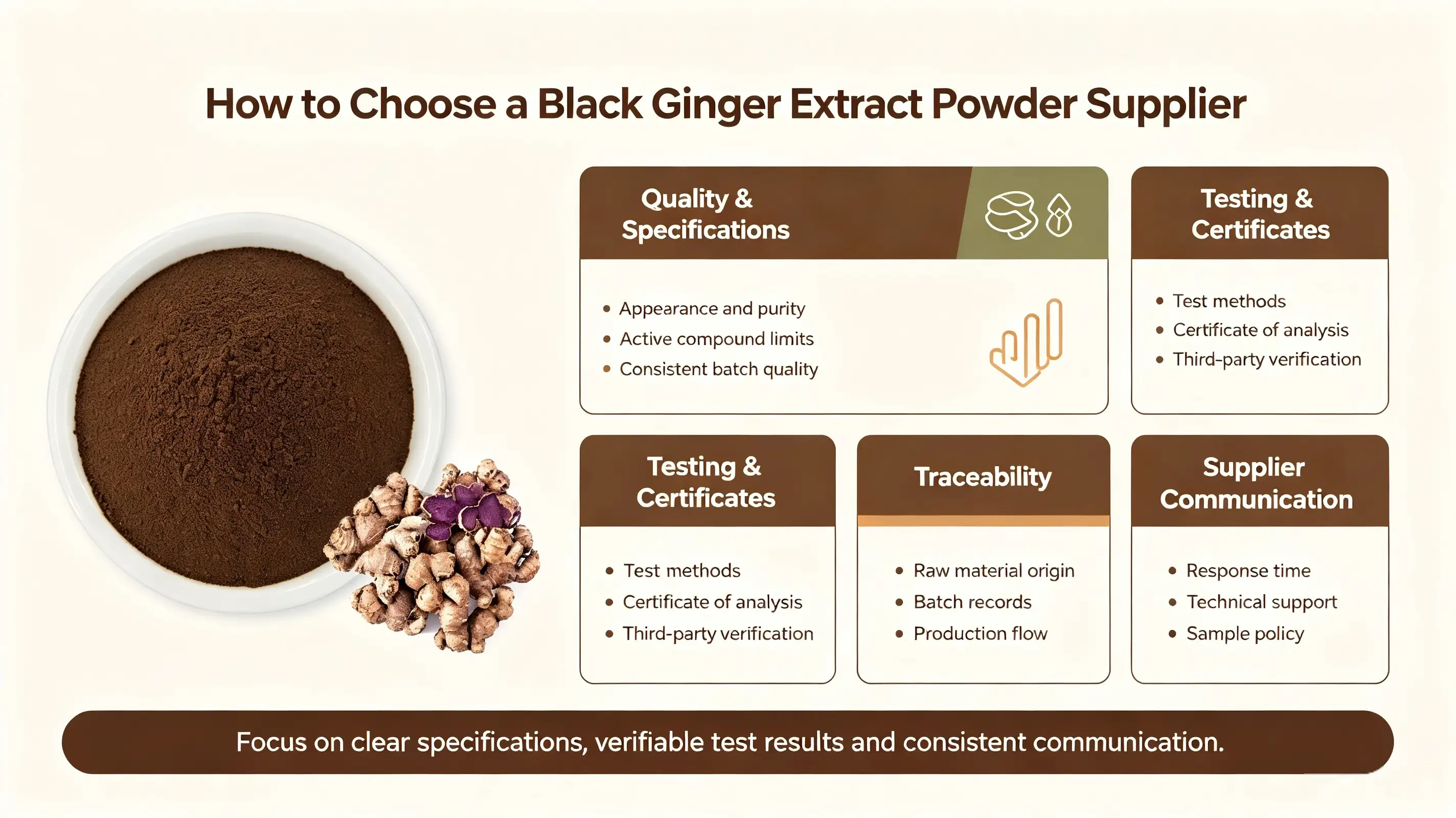
Choosing a Black Ginger Extract Powder supplier is not just about finding the lowest price. You need a partner who can prove the botanical source, control the active markers, provide clear documents, and support stable bulk supply.
Black ginger, also known as Kaempferia parviflora, is different from common ginger. It is valued for polymethoxyflavones, often called PMFs. One common marker is 5,7-dimethoxyflavone, also known as 5,7-DMF.
If you are developing capsules, tablets, gummies, beverage powders, or sports nutrition products, your supplier choice affects your formula, label claims, production stability, and customer trust.
This guide explains how to evaluate a black ginger extract supplier with a practical B2B sourcing mindset.
Why Supplier Selection Matters for Black Ginger Extract Powder
A good supplier gives you more than raw material. A good supplier reduces risk.
With Black Ginger Extract Powder, risk can come from many places:
- Wrong botanical source
- Unclear active marker
- Weak COA data
- Inconsistent color or particle size
- Heavy metal concerns
- Poor microbiological control
- Missing pesticide residue data
- Unclear extraction method
- Limited export experience
- Slow communication during quality review
Black ginger has become popular in sports nutrition, active lifestyle formulas, men's wellness products, and premium botanical blends. Human research has explored Kaempferia parviflora extract in relation to physical performance and energy-related outcomes. Yet brands still need careful wording and proper compliance review. A supplier should support ingredient quality, not make finished-product medical claims.
For B2B buyers, the right question is simple:
Can this supplier provide the exact specification, documents, and batch consistency my product needs?
If the answer is not clear, the price does not matter much.
Confirm the Botanical Source: Kaempferia parviflora
The most important step is confirming the plant identity.
Black Ginger Extract Powder should come from:
- Botanical Source: Kaempferia parviflora
- Part Used: Rhizome
This matters because black ginger is not the same as regular ginger.
Regular ginger comes from:
- Botanical Source: Zingiber officinale
- Part Used: Rhizome
Both plants belong to the ginger family, but they have different phytochemical profiles. Black ginger is known for PMFs. Common ginger is known for gingerols and shogaols.
A reliable supplier should clearly list:
- Product name
- Latin name
- Plant part used
- Country of origin
- Extraction ratio or active marker
- Test method
- Batch number on COA
Avoid suppliers who only write "ginger extract" or "black ginger" without the Latin name. That is too vague for supplement production.
What to ask your supplier
Use these questions during sourcing:
- Is the botanical source Kaempferia parviflora?
- Which plant part do you use?
- Do you use rhizome material?
- Can you provide botanical identification?
- Can you provide a product specification sheet?
- Does the COA match the product name and Latin name?
A strong supplier answers these questions without hesitation.
Check the Active Marker: 5,7-DMF or Total PMFs
Black ginger extract is often valued for polymethoxyflavones. A common commercial marker is 5,7-dimethoxyflavone.
Depending on your formula, you may request:
- Extract ratio grade
- 5,7-DMF standardized grade
- Total PMFs standardized grade
- Custom marker specification
- Water-dispersible grade
- Fine powder grade for capsules or tablets
Not every project needs the same assay. A sports nutrition brand may want a stronger standardized extract. A botanical blend may use an extract ratio grade.
Common specification language
You may see terms like:
- Black Ginger Extract Powder 10:1
- Black Ginger Extract Powder standardized for 5,7-DMF
- Kaempferia parviflora Extract Powder with total PMFs
The supplier should define what the specification means. "10:1" does not equal "5,7-DMF standardized." Extract ratio and active marker content are different quality concepts.
What to ask your supplier
Ask:
- What is the active marker?
- Do you test 5,7-DMF?
- Do you test total polymethoxyflavones?
- What method do you use?
- Can you show a batch-specific assay result?
- Is the assay tested in-house or by a third-party lab?
- Can you customize the specification?
A reliable Black Ginger Extract Powder supplier should provide clear assay logic, not just marketing phrases.
Review the Testing Method and COA
The COA is one of your most important sourcing documents. It should confirm the batch quality.
For black ginger extract, the COA should include:
- Product name
- Latin name
- Batch number
- Manufacture date
- Expiration date
- Appearance
- Active marker assay
- Test method
- Moisture
- Ash
- Particle size
- Heavy metals
- Microbiology
- Pesticide residues, when required
- Residual solvents, when required
- Storage condition
- Shelf life
HPLC for defined marker compounds
For a defined compound such as 5,7-DMF, HPLC is commonly used. If your supplier claims a 5,7-DMF specification, ask for the HPLC method or validated testing details.
A good COA should show:
- Assay: 5,7-dimethoxyflavone
- Method: HPLC
- Result: batch-specific value
A weak COA may only say:
Assay: conforms
That may not be enough for premium buyers.
Watch for vague COA problems
Be careful if the COA has:
- No Latin name
- No active marker result
- No test method
- Only "conform" for every item
- No batch number
- No manufacture date
- No heavy metal data
- No microbiology data
- Spelling errors in technical fields
- Different product name from the quotation
These signs do not always mean the supplier is unsafe. They do mean you need more clarification before buying.
Evaluate Heavy Metals, Microbiology, and Pesticide Residues
Active content matters, but safety matters just as much.
A supplier should control basic quality items for export markets.
Heavy metals
Your COA should cover:
- Lead
- Arsenic
- Cadmium
- Mercury
- Total heavy metals, when applicable
Limits may depend on your target market and product type. The United States, European Union, and other regions may apply different limits. Your finished product team should confirm the final standard.
Microbiology
A typical botanical extract COA may include:
- Total plate count
- Yeast and mold
- E. coli
- Salmonella
Capsules, gummies, and beverage powders may have different internal limits. Ask your supplier if they can meet your brand's standard.
Pesticide residues
Pesticide residue testing becomes more important when your product targets:
- EU market
- Organic product lines
- Clean-label brands
- Premium supplement positioning
- Retail chains with strict quality review
Ask your supplier:
- Can you provide pesticide residue testing?
- Which standard do you follow?
- Can you support EU pesticide requirements?
- Is the test batch-specific?
A reliable supplier will know these questions are normal.
Ask About Extraction Method and Processing Control
Black ginger extract quality depends on the raw material and the process.
A professional supplier should describe the production flow in a clear way.
A typical process may include:
Raw Material Selection → Cleaning → Drying → Crushing → Extraction → Filtration → Concentration → Drying → Sieving → Testing → Packaging → Storage
The exact process may vary by specification.
Why extraction method matters
Extraction affects:
- Active marker level
- Color
- Odor
- Solvent residue profile
- Powder flow
- Taste
- Stability
- Cost
Ask your supplier:
- What solvent system do you use?
- Is ethanol used?
- Is water extraction available?
- Do you test residual solvents?
- What drying method do you use?
- Can you provide a production flow chart?
- Can you customize particle size?
A good supplier can explain the process without revealing confidential manufacturing details.
Match the Specification to Your Dosage Form
Not every black ginger extract grade fits every product.
Your supplier should help you select the right grade based on the dosage form.
Capsules
Capsules need good flowability and consistent particle size.
Ask about:
- Bulk density
- Mesh size
- Flowability
- Assay level
- Moisture
- Compatibility with excipients
Tablets
Tablets need stable compression behavior.
Ask about:
- Particle size
- Compressibility
- Granulation needs
- Moisture control
- Color consistency
- Odor profile
Gummies
Gummies need taste and heat evaluation.
Ask about:
- Flavor impact
- Color impact
- Heat stability
- Assay after processing
- Solubility or dispersibility
- Recommended use level
Beverage powders
Beverage powders need dispersibility.
Ask about:
- Water dispersibility
- Sedimentation
- Mouthfeel
- Taste profile
- Particle size
- Carrier system, if used
A supplier who understands formulation needs can save weeks of trial work.
Compare Price with Real Specification Value
Price per kilogram can mislead you.
A lower-priced material may have:
- Lower active marker content
- Weaker testing
- Poor batch consistency
- Missing pesticide data
- High moisture
- Inconsistent color
- Limited documentation
- Long lead times
- No sample support
A higher-priced material may offer better value if it provides:
- Standardized 5,7-DMF or PMFs
- HPLC assay
- Better safety data
- Stable supply
- Better communication
- Customization support
- Faster QA approval
Check Certifications and Export Documents
B2B buyers often need more than a COA.
Depending on your market, ask for:
- ISO certificate
- HACCP certificate
- Halal certificate
- Kosher certificate
- Organic certificate, when applicable
- MSDS
- Allergen statement
- Non-GMO statement
- Flow chart
- Country of origin
- Pesticide residue report
- Heavy metal report
- Third-party test report, when required
Make sure certificates are current and relevant. A company certificate is not the same as a product-specific organic certificate.
Organic claims need special care
If you plan to sell an organic finished product, ask:
- Is this exact product certified organic?
- Which certifier issued the certificate?
- Does the certificate cover Kaempferia parviflora extract?
- Is a transaction certificate available?
- Does it meet the destination market requirements?
Organic compliance should never rely on a verbal promise.
Review Supplier Communication and Technical Support
Good communication matters in B2B sourcing.
A supplier should respond clearly to technical questions. They should not only send a price list.
Look for these signs:
- Fast response to specification questions
- Clear English documents
- Matching product names across quote, COA, and spec sheet
- Willingness to provide samples
- Ability to discuss custom grades
- Practical lead time information
- Transparent MOQ
- Clear packaging details
- Export experience
- Stable follow-up after sample testing
Poor communication during sampling often becomes worse during bulk orders.
Choose a supplier who helps your QA and R&D teams move faster.
Packaging, MOQ, and Lead Time Questions
Packaging affects stability and logistics.
Ask your supplier:
- What is the sample size?
- What is the bulk MOQ?
- What is the standard package?
- Is 25 kg/drum available?
- Are double food-grade plastic bags used?
- Can you support 1 kg or 5 kg packaging?
- What is the lead time for stock grade?
- What is the lead time for custom grade?
- Can you ship by express, air, or sea?
- Can you work with our freight forwarder?
Red Flags When Choosing a Black Ginger Extract Powder Supplier
Some warning signs deserve attention.
Watch out for suppliers who:
- Cannot provide the Latin name
- Confuse black ginger with regular ginger
- Offer no active marker information
- Avoid test method questions
- Provide only generic COA templates
- Claim unrealistic purity without proof
- Cannot provide heavy metal data
- Cannot explain the extraction method
- Change product details between emails
- Push bulk orders before sample testing
- Refuse basic documentation requests
A trustworthy supplier does not need to be perfect. They need to be clear, consistent, and technically honest.
Supplier Evaluation Checklist
Use this checklist before you approve a supplier.
| Evaluation Item | What You Should Confirm |
|---|---|
| Botanical identity | Kaempferia parviflora |
| Part used | Rhizome |
| Active marker | 5,7-DMF or total PMFs |
| Test method | HPLC or validated method |
| COA quality | Batch-specific data |
| Safety testing | Heavy metals and microbiology |
| Pesticide data | Available when required |
| Processing | Clear extraction and drying flow |
| Dosage form fit | Capsule, tablet, gummy, or beverage suitability |
| Documents | COA, spec sheet, MSDS, allergen, non-GMO |
| Certifications | ISO, HACCP, Halal, Kosher, organic if needed |
| MOQ | Suitable for sample and bulk order |
| Lead time | Clear stock and custom production timing |
| Communication | Responsive and technically clear |
This checklist helps you compare suppliers beyond price.
FAQ
1. What is Black Ginger Extract Powder?
Black Ginger Extract Powder is an extract made from the rhizome of Kaempferia parviflora. It is different from regular ginger extract made from Zingiber officinale.
2. What active marker should I ask for?
You can ask for 5,7-dimethoxyflavone, total polymethoxyflavones, or an extract ratio grade. The right choice depends on your formula.
3. What test method is common for 5,7-DMF?
HPLC is commonly used for defined marker compounds such as 5,7-dimethoxyflavone.
4.Is Black Ginger Extract Powder suitable for capsules?
Yes. It is commonly used in capsules and tablets. You should check particle size, flowability, assay, and bulk density.
5.Can I use Black Ginger Extract Powder in gummies?
Yes, but you should test taste, color, heat stability, and assay after processing.
6.What documents should a supplier provide?
Ask for COA, specification sheet, MSDS, flow chart, allergen statement, non-GMO statement, heavy metal test, microbiology test, and pesticide residue data when needed.
7.How do I compare two supplier quotes?
Compare active marker level, test method, COA quality, safety data, lead time, MOQ, and sample support. Do not compare price per kilogram alone.
8.What is the difference between black ginger and regular ginger?
Black ginger comes from Kaempferia parviflora and is known for PMFs. Regular ginger comes from Zingiber officinale and is known for gingerols and shogaols.
Final Notes: Choose a Supplier Who Can Support Your Formula
Choosing a Black Ginger Extract Powder supplier becomes easier when you focus on quality proof, not sales claims.
A good supplier should confirm the botanical source, provide active marker testing, share a clear COA, support safety data, and help you match the extract grade to your dosage form. That level of support protects your product development and reduces sourcing risk.
Jiuyuan Bio supplies Black Ginger Extract Powder for capsules, tablets, gummies, beverage powders, functional foods, sports nutrition formulas, and botanical blends. We support specification discussion, sample requests, COA review, custom grades, and bulk supply.
For Black Ginger Extract Powder specifications, samples, COA, or bulk quotation, contact us at: info@jiuybiotech.com
Website: https://www.jiuyuanbio.com/
References
- Toda, K., et al. "Black Ginger Extract Increases Physical Fitness Performance and Muscular Endurance by Improving Inflammation and Energy Metabolism." Heliyon, 2016.
- Saokaew, S., et al. "Clinical Effects of Krachaidum, Kaempferia parviflora: A Systematic Review." Journal of Evidence-Based Integrative Medicine.
- Han, A. R., et al. "Flavonoids and Other Constituents from the Rhizomes of Kaempferia parviflora." Phytochemistry.
- Yoshino, S., et al. "Daily Intake of Kaempferia parviflora Extract Decreases Abdominal Fat in Overweight and Preobese Subjects: A Randomized, Double-Blind, Placebo-Controlled Clinical Study." Diabetes, Metabolic Syndrome and Obesity: Targets and Therapy.
- Mekjaruskul, C., et al. "Bioavailability and Pharmacokinetics of Kaempferia parviflora Extract." Journal of Natural Medicines.
- Chaipech, S., et al. "Anti-inflammatory Effect of Kaempferia parviflora Wall. ex Baker Extract and Its Flavonoid Constituents." Journal of Ethnopharmacology.