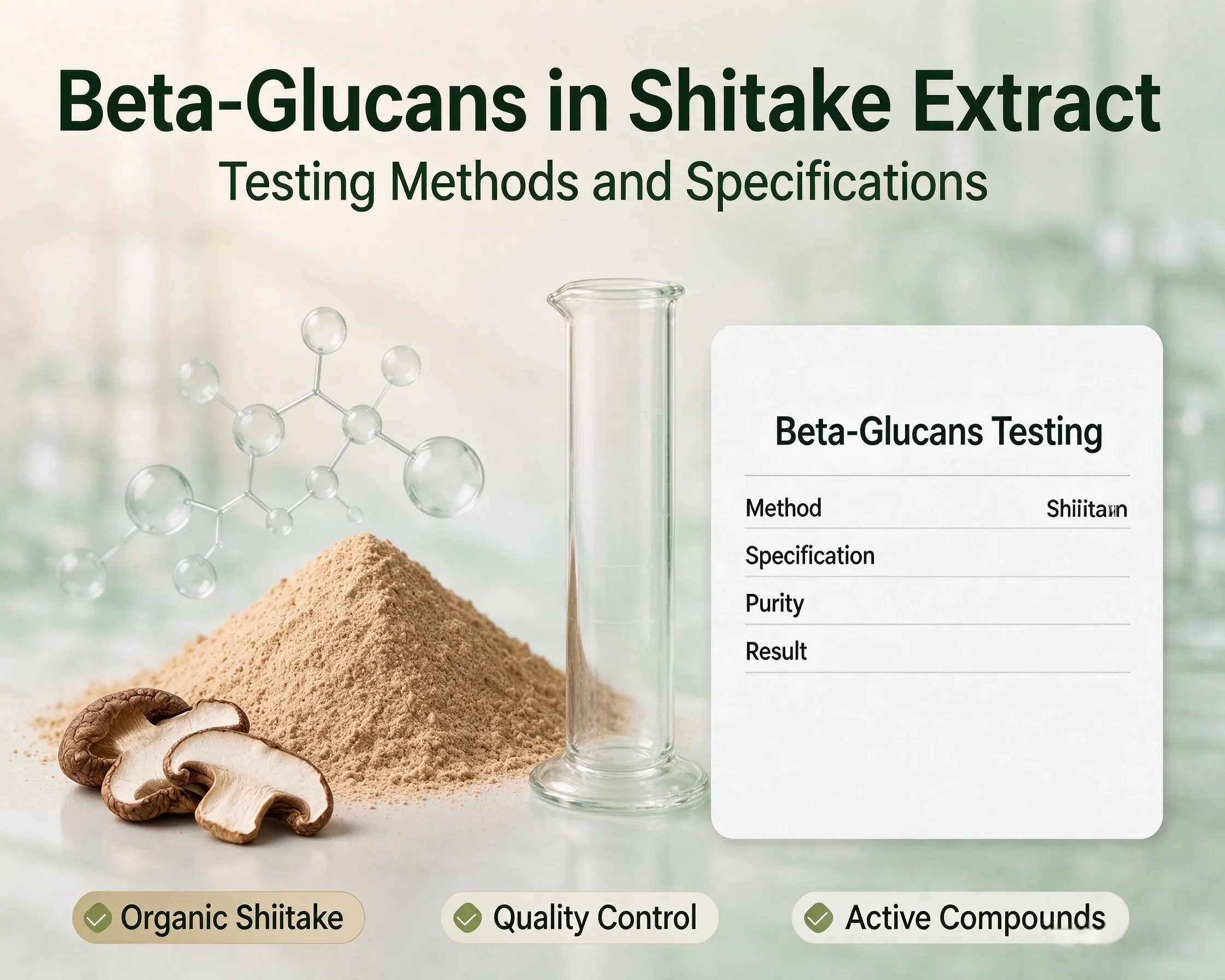


When you source Organic Shiitake Extract Powder, beta-glucan testing can quickly become one of the most important quality questions. You may see many suppliers list "polysaccharides," "beta-glucans," or "lentinan" on a specification sheet. These terms look similar, but they do not always mean the same thing.
If you buy mushroom extracts for capsules, gummies, beverage powders, tablets, or functional foods, you need more than a product name. You need a clear test method, a reliable COA, and a specification that fits your formulation.
In this guide, I'll explain how beta-glucans in shiitake extract are tested, how they differ from general polysaccharides, and what B2B buyers should ask before placing a bulk order.
Why Beta-Glucans Matter in Organic Shiitake Extract Powder
Beta-glucans are natural polysaccharides found in mushrooms, grains, yeast, and some other biological materials. In mushroom extracts, they often act as key quality markers.
For Organic Shiitake Extract Powder, buyers often care about beta-glucans because they help define the product's technical value. A shiitake extract with a clear beta-glucan specification gives your team better control over formulation and label positioning.
What beta-glucans tell you
Beta-glucan content can help you understand:
- Ingredient concentration
- Extraction quality
- Batch consistency
- Suitability for supplement formulas
- Difference between extract powder and ordinary mushroom powder
- Quality level compared with low-grade mushroom materials
Shiitake mushroom, known scientifically as Lentinula edodes, contains several compound groups. These include beta-glucans, other polysaccharides, proteins, minerals, and small metabolites. Research on edible fungi shows that fruiting bodies and mycelia can differ in their composition, including polysaccharides and other nutrients.
For B2B buyers, this means one thing: source and testing both matter.
A product made from shiitake fruiting body and tested with a suitable method gives you more confidence than a product with only a broad marketing claim.
Beta-Glucans, Polysaccharides, and Lentinan: What Is the Difference?
Many product pages use these three words together. That can create confusion.
Let's break them down in a buyer-friendly way.
Polysaccharides
Polysaccharides are large carbohydrate molecules. In mushroom extracts, suppliers often use total polysaccharides as a commercial specification.
You may see specifications such as:
- Polysaccharides 10%
- Polysaccharides 20%
- Polysaccharides 30%
- Polysaccharides 50%
These values often come from UV testing. UV testing can work as a general quality marker, but it may count more than the specific beta-glucan fraction.
That is why polysaccharides do not automatically equal beta-glucans.
Beta-glucans
Beta-glucans are a more specific group of polysaccharides. In mushroom extracts, they are usually more meaningful for premium supplement brands.
When a buyer asks for beta-glucan content, the supplier should not simply provide a broad polysaccharide value. The supplier should provide a clear beta-glucan test method.
Lentinan
Lentinan is a beta-glucan associated with shiitake mushroom. It has been widely studied in scientific and technical literature.
That distinction matters. Whole Organic Shiitake Extract Powder is a complex botanical and fungal extract. It does not have one single CAS number in the same way a purified compound does.
Why Total Polysaccharides Alone May Not Be Enough
A specification that says "polysaccharides 50%" may look attractive. Yet you should read it carefully.
Total polysaccharides can include different carbohydrate fractions. Some may come from mushroom cell wall compounds. Some may come from other carbohydrates. In some cases, starch or carrier materials can affect interpretation if the method does not separate fractions well.
This is why premium mushroom buyers often ask for beta-glucan data.
What can go wrong with vague specifications?
A weak specification may leave you with unclear answers:
- Does the number represent total polysaccharides or beta-glucans?
- Which method was used?
- Does the COA show a numeric result?
- Was the product made from fruiting body or mycelium?
- Does the product contain carriers?
- Does the assay match the product label?
- Can the supplier repeat the result batch after batch?
These details matter for supplement brands. They also matter for distributors who sell ingredients to demanding manufacturers.
A broad polysaccharide claim can support basic sourcing. Yet beta-glucan testing gives a stronger technical view.
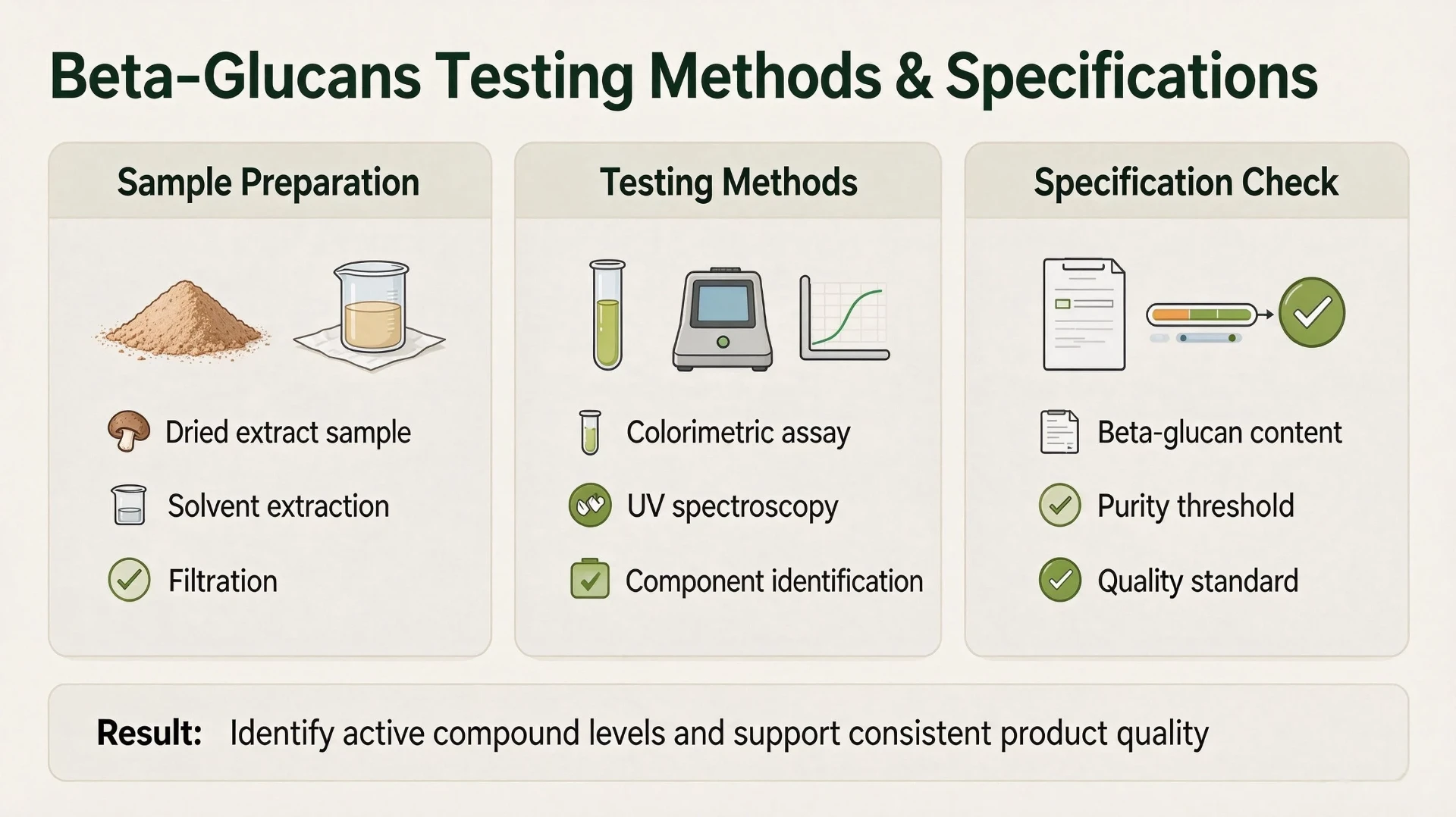
Common Testing Methods for Shiitake Extract
Testing methods can shape how you interpret the result. A higher number does not always mean better quality if the method is unclear.
Here are the common methods used in shiitake extract quality control.
UV testing for polysaccharides
UV testing is widely used for total polysaccharides in mushroom extracts. It is common, affordable, and useful for routine commercial specifications.
A supplier may list:
Polysaccharides: 30% by UV
This can work well for many products. It helps buyers compare general extract grades.
Yet UV testing usually gives a broad polysaccharide value. It may not specifically measure beta-glucans.
Megazyme enzymatic assay for beta-glucans
The Megazyme enzymatic assay is widely used for measuring beta-glucans in mushroom and fungal products. Many premium mushroom supplement brands prefer it because it can distinguish beta-glucans from other carbohydrate fractions better than broad polysaccharide testing.
A supplier may list:
Beta-glucans: tested by Megazyme enzymatic assay
For B2B sourcing, this is often the preferred way to verify beta-glucan content.
HPLC for specific marker compounds
HPLC can help test certain defined compounds, depending on the marker and validated method.
For shiitake, HPLC may apply to specific compounds in some cases. But you should not assume HPLC is the main method for beta-glucans unless the supplier provides a validated method.
For beta-glucans, ask for the actual method details.
Microbiology and safety testing
Beta-glucan content is only one part of quality. Your COA should also cover safety.
A good shiitake extract specification usually includes:
- Total plate count
- Yeast and mold
- E. coli
- Salmonella
- Lead
- Arsenic
- Cadmium
- Mercury
- Pesticide residues, when required
- Moisture
- Ash
- Particle size
A strong product needs both active marker testing and safety testing.
Recommended Specifications for Organic Shiitake Extract Powder
Your ideal specification depends on your product type. A capsule brand may need a stronger extract. A beverage brand may care more about taste and dispersibility. A gummy brand may care about color, heat stability, and flavor.
Below is a practical B2B specification structure.
| Specification Item | Common Range or Requirement | Suggested Method |
|---|---|---|
| Botanical Source | Lentinula edodes | Supplier declaration |
| Part Used | Fruiting body | Supplier declaration |
| Appearance | Yellow-brown fine powder | Visual |
| Polysaccharides | 10%–50% | UV |
| Beta-glucans | Customizable | Megazyme enzymatic assay |
| Lentinan | Available upon request | Validated method |
| Particle Size | 80 mesh or customized | Sieve |
| Moisture | ≤7.0% | GB / USP / in-house |
| Ash | ≤9.0% | GB / USP / in-house |
| Total Heavy Metals | ≤10 ppm | ICP-MS / GB method |
| Lead | ≤2.0 ppm or buyer standard | ICP-MS / GB method |
| Arsenic | ≤2.0 ppm or buyer standard | ICP-MS / GB method |
| Cadmium | ≤1.0 ppm or buyer standard | ICP-MS / GB method |
| Mercury | ≤1.0 ppm or buyer standard | ICP-MS / GB method |
| Total Plate Count | ≤10,000 cfu/g | GB / USP / ISO |
| Yeast & Mold | ≤1,000 cfu/g | GB / USP / ISO |
| E. coli | Negative / 25g | GB / USP / ISO |
| Salmonella | Negative / 25g | GB / USP / ISO |
This table gives you a strong starting point. Your final specification should match your target market, dosage form, and regulatory needs.
How to Read a COA for Beta-Glucans
A COA should help you verify the material. It should not create new questions.
When you review a COA for Organic Shiitake Extract Powder, check these sections closely.
Product identity
Look for:
- Product name
- Latin name: Lentinula edodes
- Part used: fruiting body
- Country of origin
- Batch number
- Production date
- Expiration date
Avoid vague terms like "mushroom extract" without species or part used.
Assay section
This is the most important section for beta-glucans.
A strong COA should show:
- Polysaccharide result, if claimed
- Beta-glucan result, if claimed
- Test method
- Numeric result
- Batch-specific data
A COA that only says "conforms" may not satisfy premium buyers. Numeric values help your QA team and your customers.
Physical data
Check:
- Color
- Odor
- Appearance
- Particle size
- Moisture
- Ash
These items affect production. High moisture can affect flow, stability, and shelf life. Particle size can affect blending, capsule filling, and beverage texture.
Safety data
Check:
- Heavy metals
- Microbiology
- Pesticides, when required
- Residual solvents, when relevant
Organic certification does not replace safety testing. It supports sourcing and production claims, but the COA still needs safety data.
Fruiting Body vs Mycelium: Why It Affects Beta-Glucan Specifications
Many buyers ask whether shiitake extract comes from fruiting body or mycelium. This question matters because the material source can affect the final composition.
The fruiting body is the mushroom structure most people recognize. Mycelium is the root-like network of fungal growth. Some mycelium products grow on grain. That can add extra carbohydrates to the final material if not handled carefully.
For Organic Shiitake Extract Powder, many supplement brands prefer fruiting body extract because it offers:
- Clearer mushroom identity
- Better consumer understanding
- Stronger supplement positioning
- Easier label communication
- Less confusion around grain substrate
This does not mean all mycelium materials are poor. It means buyers should ask precise questions.
Ask your supplier:
- Is the product made from fruiting body?
- Does it contain mycelium?
- Was grain substrate used?
- Are carriers or fillers added?
- Does the beta-glucan test separate alpha-glucans?
- Can you provide batch COA data?
The answer can change how you evaluate price and quality.
How Extraction Method Affects Beta-Glucan Quality
Shiitake extract is usually made through hot water extraction or dual extraction.
Hot water extraction
Hot water extraction is common for mushroom extracts. It helps extract water-soluble compounds, including many polysaccharide fractions.
It suits:
- Capsules
- Tablets
- Mushroom blends
- Powder supplements
- Sachets
- Functional beverages
A hot water extract often works well when your main target is polysaccharides or beta-glucans.
Dual extraction
Dual extraction uses water and ethanol. It may suit formulas that target a wider compound profile.
If you choose dual extraction, ask the supplier about:
- Solvent system
- Residual solvent testing
- Active markers
- Drying method
- Organic compliance
- COA format
The extraction method should match your product goal. A premium capsule may need a beta-glucan-standardized hot water extract. A broader mushroom blend may use dual extraction.
How B2B Buyers Can Set a Practical Shiitake Extract Specification
A good purchasing specification should be clear enough for QA, sourcing, and production teams.
Product: Organic Shiitake Extract Powder
Botanical Source: Lentinula edodes
Part Used: Fruiting body
Specification: Polysaccharides 30% by UV
Beta-Glucans: Please quote Megazyme assay option
Particle Size: 80 mesh
Application: Capsules / tablets / gummies / beverage powder
Documents Needed: COA, organic certificate, specification sheet, MSDS, allergen statement, non-GMO statement
Quantity: Trial sample and bulk order
Destination Market: United States / European Union / other market
This kind of request saves time. It also helps the supplier quote the right product.
For capsules
Focus on:
- Assay
- Particle size
- Flowability
- Bulk density
- Heavy metals
- Microbiology
For gummies
- Focus on:
- Taste
- Color
- Heat stability
- Fine particle size
- Assay after processing
- Regulatory claims
For beverage powders
Focus on:
- Dispersibility
- Flavor
- Color
- Solubility behavior
- Sedimentation
- Particle size
Your supplier should help you match the specification to the format.
Common Mistakes When Buying Organic Shiitake Extract Powder
Many sourcing problems come from unclear specifications. Here are common mistakes to avoid.
Mistake: Comparing only price per kilogram
A cheaper product may have lower assay, weak documentation, or unclear source. Always compare price against active content, method, and COA quality.
Mistake: Treating polysaccharides and beta-glucans as the same
They are related, but not identical. Polysaccharides are broader. Beta-glucans are more specific.
Mistake: Accepting no test method
A number without a method has limited value. Always ask how the supplier tested it.
Mistake: Ignoring part used
Fruiting body, mycelium, and grain-grown material can differ. Ask for clear source details.
Mistake: Missing organic certification scope
Organic claims must match the actual product and market. Ask for current organic documents.
Mistake: Forgetting the final dosage form
A powder that works in capsules may not work in beverages. Test samples before bulk purchase.
What Makes a Reliable Organic Shiitake Extract Powder Supplier?
A reliable supplier should support both sales and technical teams. You need more than a low quote.
Look for a supplier that can provide:
- Clear product name and Latin name
- Fruiting body source information
- Organic documentation
- Polysaccharide and beta-glucan options
- Megazyme assay support
- Batch COA
- Heavy metal and microbiology testing
- Custom specification support
- Sample availability
- Stable bulk supply
- Responsive communication
A strong supplier will also explain limitations. That builds trust. No serious technical buyer wants vague claims.
At Jiuyuan Bio, we focus on practical B2B sourcing needs. We support buyers with Organic Shiitake Extract Powder, specification customization, COA support, sample evaluation, and bulk supply.
FAQ
1. What are beta-glucans in shiitake extract?
Beta-glucans are specific polysaccharides found in shiitake mushroom. They are often used as quality markers in mushroom extract powders.
2. Is beta-glucan the same as polysaccharide?
No. Beta-glucans are a specific type of polysaccharide. Total polysaccharides include a broader group of carbohydrate compounds.
3. What is the best test method for beta-glucans?
Many mushroom extract buyers prefer the Megazyme enzymatic assay. It provides more specific beta-glucan data than broad polysaccharide testing.
4. What method is used for polysaccharides?
UV testing is commonly used for total polysaccharides in commercial mushroom extract specifications.
5.What beta-glucan specification should I choose?
It depends on your formula. Capsules and premium mushroom supplements often need clearer beta-glucan data. Food and beverage products may use polysaccharide-standardized grades.
6.Is Organic Shiitake Extract Powder made from fruiting body?
Jiuyuan Bio can supply fruiting body-based Organic Shiitake Extract Powder according to buyer requirements and certification scope.
7. Does lentinan have a CAS number?
Yes. Lentinan CAS No. is 37339-90-5. This number refers to lentinan, not the whole shiitake extract powder.
8. What documents should I request from a supplier?
Ask for COA, specification sheet, organic certificate, MSDS, allergen statement, non-GMO statement, heavy metal test, microbiology test, and pesticide residue data when required.
Final Notes for Buyers
When you buy Organic Shiitake Extract Powder, beta-glucan testing should never be an afterthought. It affects your specification, formula design, label positioning, and buyer confidence.
A strong shiitake extract specification should clearly state the source, part used, assay, test method, safety data, and documentation package. Polysaccharides by UV can support general commercial grades. Beta-glucans by Megazyme assay can support more technical mushroom extract projects.
Jiuyuan Bio supplies Organic Shiitake Extract Powder for supplement, functional food, beverage, gummy, capsule, tablet, and powder blend applications. We can support COA, organic documentation, specification customization, sample evaluation, and bulk supply.
For Organic Shiitake Extract Powder specifications, beta-glucan testing options, COA requests, samples, or bulk quotation, contact us at:
Website: https://www.jiuyuanbio.com/
References
- McCleary, B. V., and Draga, A. "Measurement of β-Glucan in Mushrooms and Mycelial Products." Journal of AOAC International.
- Berger, R. G., et al. "Mycelium vs. Fruiting Bodies of Edible Fungi-A Comparison of Metabolites." Foods, 2022.
- Wasser, S. P. "Medicinal Mushroom Science: History, Current Status, Future Trends, and Unsolved Problems." International Journal of Medicinal Mushrooms.
- Ruthes, A. C., Smiderle, F. R., and Iacomini, M. "Mushroom Heteropolysaccharides: A Review on Their Sources, Structure and Biological Effects." Carbohydrate Polymers.
- Vetvicka, V., and Vetvickova, J. "Immune Enhancing Effects of Mushroom Beta-Glucans." International Journal of Medicinal Mushrooms.
- Synytsya, A., and Novák, M. "Structural Diversity of Fungal Glucans." Carbohydrate Polymers.