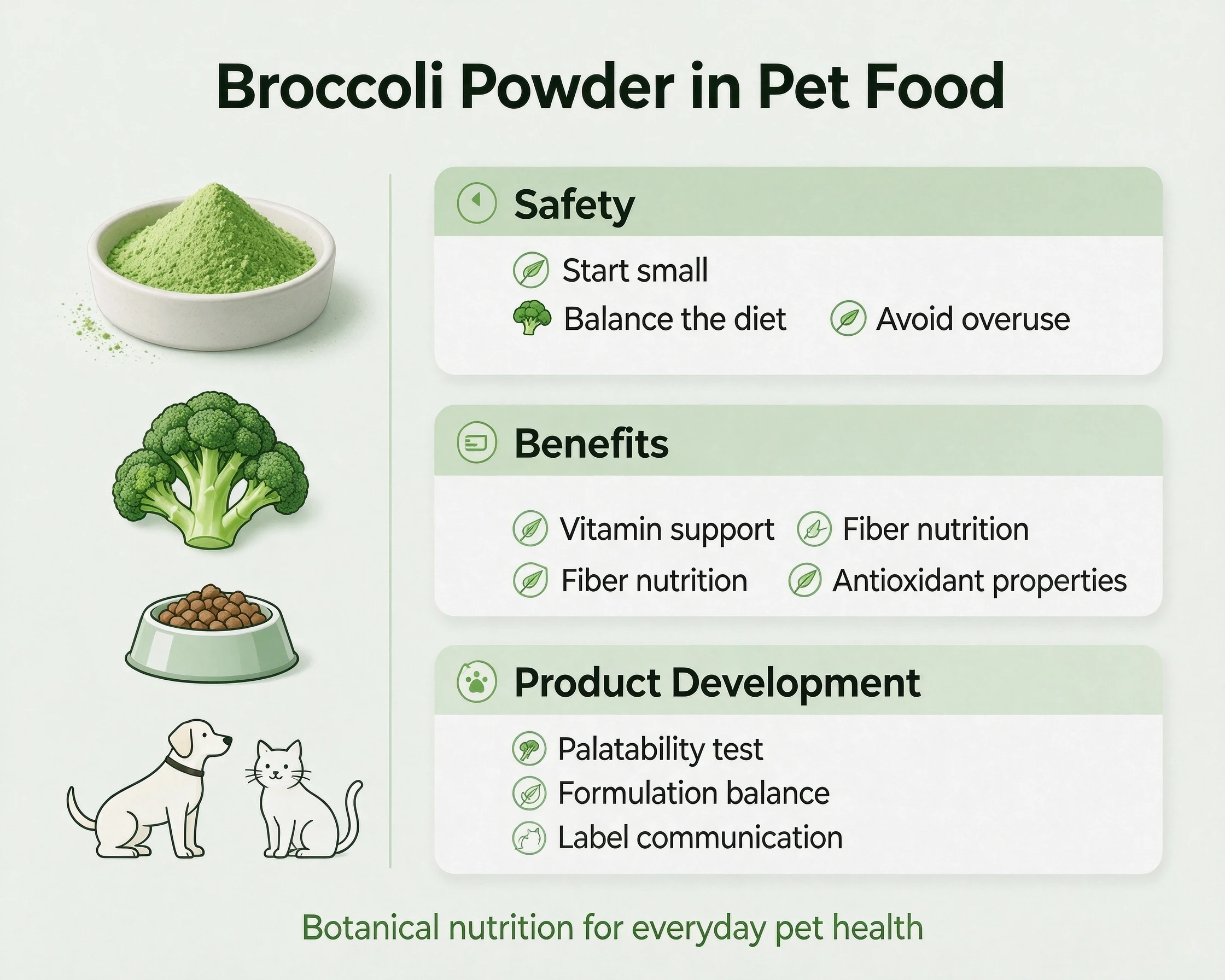


Can dogs eat broccoli? Many healthy dogs tolerate small amounts of plain broccoli . But if you develop pet food, that answer only gets you so far. A broccoli floret contains water. A scoop of organic broccoli powder delivers dry vegetable solids. A dog might eat one biscuit or receive several during a training session.
The useful question is how much broccoli reaches the pet, in what form, and for what purpose. You might want a recognizable vegetable in a baked treat, a source of fiber, or a powder that blends evenly into a topper. Each goal calls for a different test.
Here's how to assess safety, identify a benefit you can support, and choose a grade that works on your production line.
Is organic broccoli powder safe for dogs and cats?
Small amounts of plain broccoli can fit into many dogs' diets. That does not establish a safe daily dose for every broccoli powder. The plant part, processing method, serving size, and pet all matter. Cats also need a separate assessment rather than a smaller version of a dog's serving.
For dogs, evaluate the full day's intake
Broccoli florets contain compounds called isothiocyanates. These can irritate a dog's stomach, especially when the dog eats a large amount . Drying changes how much broccoli fits into a spoonful. Fresh-floret feeding advice does not translate directly into teaspoons of powder.
For a dog treat, record the broccoli powder per piece and the maximum number of pieces in your feeding guide. Consider how owners will use the product. A bedtime biscuit and a training reward may look alike on your production line, but dogs rarely receive them at the same frequency.
The World Small Animal Veterinary Association recommends keeping treats below 10% of a dog's daily calories . That is a calorie guideline for all treats combined. It does not mean broccoli powder can safely make up 10% of a recipe or a dog's diet.
For cats, start with a different brief
Cats are obligate carnivores. They need nutrients such as taurine in their diet . Organic broccoli powder cannot replace taurine or make an incomplete recipe nutritionally adequate. A successful dog biscuit trial also tells you little about whether cats will accept the same ingredient in wet food.
If you develop a cat topper, test it on the intended food. Measure how much of the whole meal the cat eats. A cat that licks the surface and leaves the food underneath has not given you a useful sign of meal acceptance.
Ask a qualified veterinary nutritionist to review the intended amount and frequency before a feeding trial. Use particular care with products for growth or pets on prescribed diets.
Know which broccoli ingredient you are buying
Whole vegetable powder, sprout powder, and seed extract are not interchangeable. Young broccoli sprouts can contain much higher concentrations of certain glucosinolates than mature broccoli . That finding describes plant chemistry. It does not establish a health benefit or a feeding rate for pets.
If your approved recipe calls for dried mature broccoli, name that material in the purchase specification. Require your approval before the supplier changes the plant part or substitutes an extract. The word broccoli on both bags does not make them equivalent.
What benefits can organic broccoli powder bring to pet food?
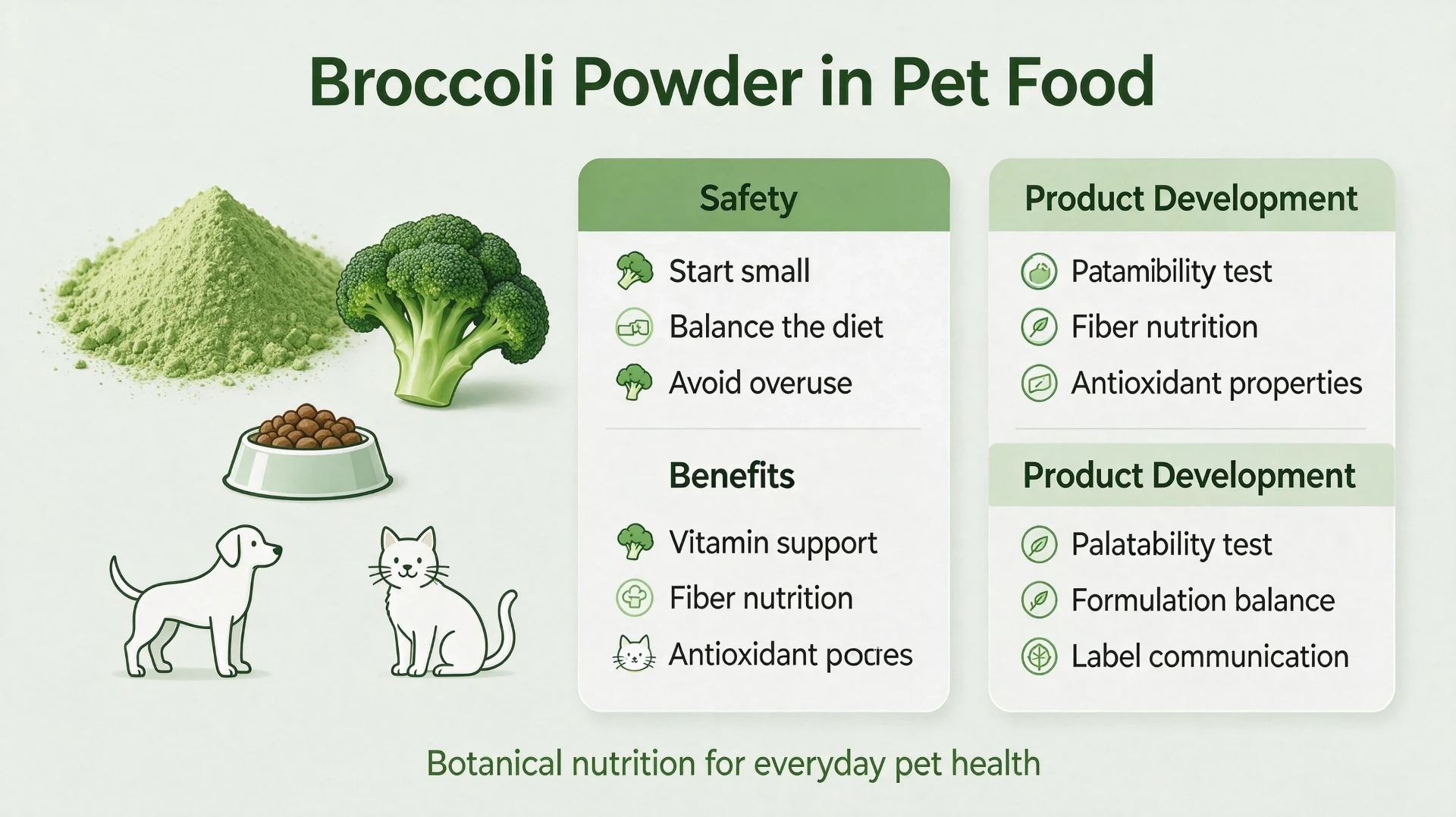
The most useful benefit may be a practical one. A dry powder lets you weigh broccoli into a biscuit dough without washing, chopping, or draining fresh florets. It also gives you a way to add the same target weight across batches. Neither advantage requires a health claim.
A recognizable vegetable ingredient
If your brief calls for a dog biscuit made with broccoli, start with identity and flavor. Ask which plant parts the supplier mills and whether the powder contains carriers. Then bake a sample in your actual dough.
Compare it with a biscuit from the same recipe without broccoli. Look at the broken edge, smell both samples after cooling, and check how readily they snap. A powder that looks bright green in the bag may look olive or brown after baking. That matters if your packaging shows a green treat.
Judge the biscuit, not the powder swatch. A lower-cost grade that meets your finished color and acceptance targets may be the better purchase.
A measurable contribution of dietary fiber
Broccoli solids can contribute dietary fiber. The amount that reaches a pet depends on the tested powder and the amount in one serving. The presence of broccoli alone does not establish a digestive benefit.
Consider an illustrative calculation. Suppose a supplier reports 10 grams of dietary fiber per 100 grams of powder. A serving containing 0.2 grams of that powder would receive 0.02 grams of dietary fiber from broccoli. These are sample figures, not a Jiuyuan specification or feeding recommendation.
That calculation can save your team an expensive reformulation. If your target is fiber delivery, work backward from the amount you need in the serving. Also check what the laboratory measured. Dietary fiber and crude fiber are different measurements. Do not treat them as matching figures on a supplier sheet and a pet food label.
Plant compounds without an unsupported health promise
Broccoli contains glucosinolates. One of them, glucoraphanin, can form sulforaphane under suitable conditions . A test for glucoraphanin does not tell you how much sulforaphane a dog or cat receives from a finished treat.
Keep your wording close to your evidence. "Made with organic broccoli powder" describes an ingredient when your records support its identity and organic status. A statement about antioxidant effects in dogs or cats needs evidence relevant to the species, serving, and finished product. A green color or a study of broccoli sprouts cannot supply that evidence.
How to develop and source organic broccoli powder for pet products
Start with the way the owner will serve your product. That decision shapes your sample request, your pilot batch, and even the scoop you put in the pouch.
Match the test to the product
Use this table to decide what could go wrong between the factory and the feeding bowl.
|
Pet product |
Development question |
Useful pilot test |
|
Baked dog biscuits |
Does the powder change dough handling or make the biscuit crumble? |
Compare dough, cooled biscuits, and breakage after packing against a control batch. |
|
Dry meal toppers |
Does a level scoop deliver a consistent weight after shipping? |
Weigh scoops from the top and bottom of several pouches after a transport trial. |
|
Wet dog or cat food |
Does the vegetable aroma change during thermal processing? |
Assess the finished pack after your validated process, not just the uncooked mix. |
|
Coated kibble |
Does the broccoli stay on the kibble or collect in the bag? |
Compare coated pieces and loose powder before and after handling. |
The loose powder at the bottom of a kibble bag is more than a packaging nuisance. If the owner discards it, the pet receives less than your recipe predicts. A simple coating check can reveal that problem before you commission more costly tests.
Choose a drying method by testing it in your recipe
Jiuyuan lists low-temperature air-dried and freeze-dried options on its organic broccoli powder product page. Ask which process applies to each sample. Compare the two grades at the same weight in your finished product.
For a baked dog treat, focus on aroma after cooling, breakage, and acceptance. For a dry topper, pay more attention to flow, clumping, and scoop weight. If a nutrient matters to your formula, test it after processing. Do not pay a premium for an assumed advantage that disappears in the oven.
Ask a bulk supplier for documents that guide a decision
A product specification tells you what a supplier agrees to deliver. A certificate of analysis, or COA, reports results for a particular lot. Ask for both when sourcing organic broccoli powder for pet food.
|
Request |
What to check |
Why it matters |
|
Ingredient identity |
Botanical identity, plant part, country of origin, carriers, and processing steps |
Confirms that you are buying the same material you tested. |
|
Organic documentation |
Current certificate, issuing body, operator, and covered product |
Supports your purchasing records and organic label review. |
|
Lot-specific safety results |
Relevant microbial results, pesticide screens, and individual heavy metal results |
Lets your quality team compare the lot against your acceptance limits. |
|
Physical specifications |
Particle size, bulk density, moisture, and storage instructions |
Helps predict mixing, scoop weight, and handling after opening. |
|
Commercial details |
Pack size, minimum order, lead time, and change notification |
Shows whether the grade fits your production schedule and warehouse. |
Jiuyuan lists a 20-kilogram carton. Consider how long your plant will take to use an opened pack. A smaller inner liner may matter more than a lower price per kilogram if your pilot line uses little powder each week.
Organic certification does not replace a food safety review. A negative result for a sample also does not prove that every gram in a shipment lacks contamination. Review supplier controls alongside lot results, especially for toppers that receive no further heat treatment.
Give the pilot batch a clear pass or fail
Before you mix a trial, write down what would make you reject it. Choose criteria your team can measure, such as scoop weight, biscuit breakage, or the amount of food pets leave behind.
- Keep a control. Use the same base recipe without broccoli. Keep other ingredients and process settings constant.
- Record actual piece weights. A heavier biscuit delivers more powder, even when the formula percentage stays the same.
- Separate acceptance from tolerance. A dog can eagerly eat a treat and still experience digestive upset later.
- Check the packaged product. Review clumping, odor, appearance, and relevant safety measures throughout the proposed shelf life.
- Retain the approved sample. Keep its lot number, COA, and trial notes so purchasing can match future deliveries.
Decide early whether you are selling a treat, a topper, or a complete food. In the United States, a "complete and balanced" claim concerns the nutritional adequacy of the whole diet . For Europe, FEDIAF publishes separate guidance on complete and complementary pet food . An organic ingredient certificate does not establish either status.
FAQ: Organic broccoli powder for pet nutrition
These questions often arise when a buyer moves from an ingredient sample to a commercial recipe.
1.How much broccoli powder can you put in dog treats?
There is no universal percentage that fits every powder, treat, and dog. Calculate the amount per piece and the total at your proposed daily serving. Have a qualified veterinary nutritionist review both figures before you finalize the feeding guide. Do not use the 10% treat-calorie guideline as an ingredient limit.
2.Can dogs and cats use the same broccoli topper?
Do not assume so. Review the complete formula, serving size, and feeding directions for each species. Test acceptance separately. For cats, watch whether the topper changes consumption of the underlying meal, not just whether the cat tastes it.
3.Is broccoli sprout powder better than mature broccoli powder for pets?
Not by default. A sprout powder may have a different glucosinolate profile . That does not make it a better choice for a biscuit or topper. If your goal is a recognizable vegetable ingredient, mature broccoli may meet the brief without a concentrated extract.
4.Does freeze-drying make broccoli powder safe to add after cooking?
No. Do not treat freeze-drying as a validated pathogen control step. If you add organic broccoli powder after baking or extrusion, review the supplier's controls and your own handling process. A post-cook coating needs a different safety review from an ingredient that passes through a validated heating step.
5.What information helps a supplier recommend the right grade?
Share the target species, product format, destination market, batch size, and processing conditions. Describe one result that matters to you. "A topper that stays free-flowing after opening" gives a supplier more direction than "a premium green powder."
To discuss organic broccoli powder for dog treats, cat food, or meal toppers, contact Jiuyuan Biotech at info@jiuybiotech.com. Include your application and request a matching sample, current specification, organic certificate, and lot-specific COA. Those documents give your team a sound basis for its pilot batch and purchase decision.
References
- American Kennel Club. Can Dogs Eat Broccoli? AKC Expert Advice, Nutrition.
- World Small Animal Veterinary Association. Feeding Treats to Your Dog. Global Nutrition Committee.
- National Research Council. Nutrient Requirements of Dogs and Cats. Washington, DC: The National Academies Press; 2006.
- Fahey JW, Zhang Y, Talalay P. Broccoli sprouts: an exceptionally rich source of inducers of enzymes that protect against chemical carcinogens. Proceedings of the National Academy of Sciences USA. 1997;94(19):10367–10372.
- U.S. Food and Drug Administration. "Complete and Balanced" Pet Food. Center for Veterinary Medicine.
- FEDIAF EuropeanPetFood. Nutritional Guidelines for Complete and Complementary Pet Food for Cats and Dogs.