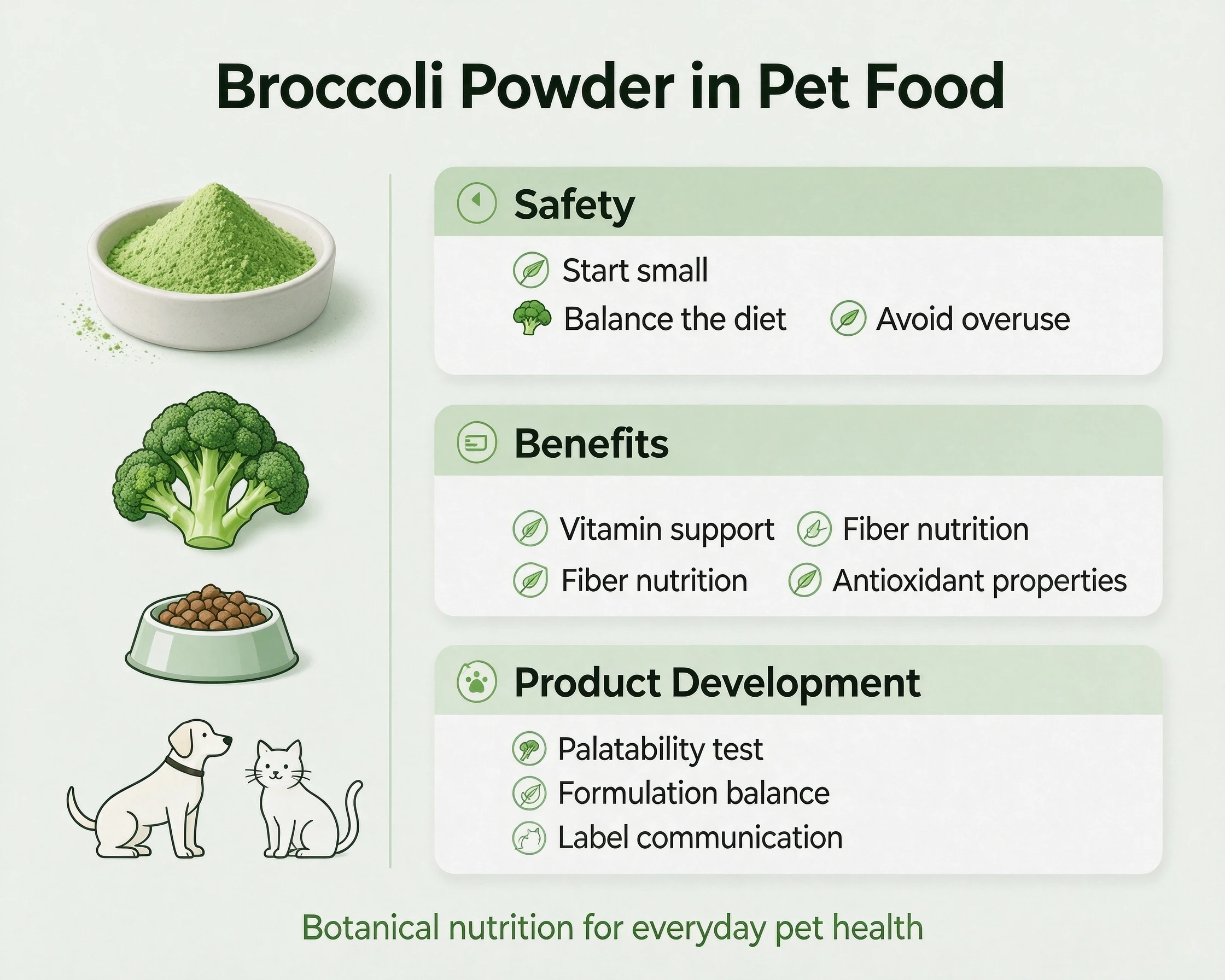


A spoonful of organic broccoli powder can give a soup a pleasant vegetable flavor. Put that same spoonful in a clear drink, and you may see green particles settle before the customer takes a sip. Neither result tells you how much vitamin C or sulforaphane the serving delivers.
When you develop a product for antioxidant support, start with what you need the broccoli to do. Are you buying a recognizable vegetable ingredient, a measured amount of vitamin C, or a source of sulforaphane? Each goal calls for different evidence.
Here's how to choose the right powder, test it in your recipe, and ask a supplier for numbers you can use.
What does organic broccoli powder contribute to antioxidant support?
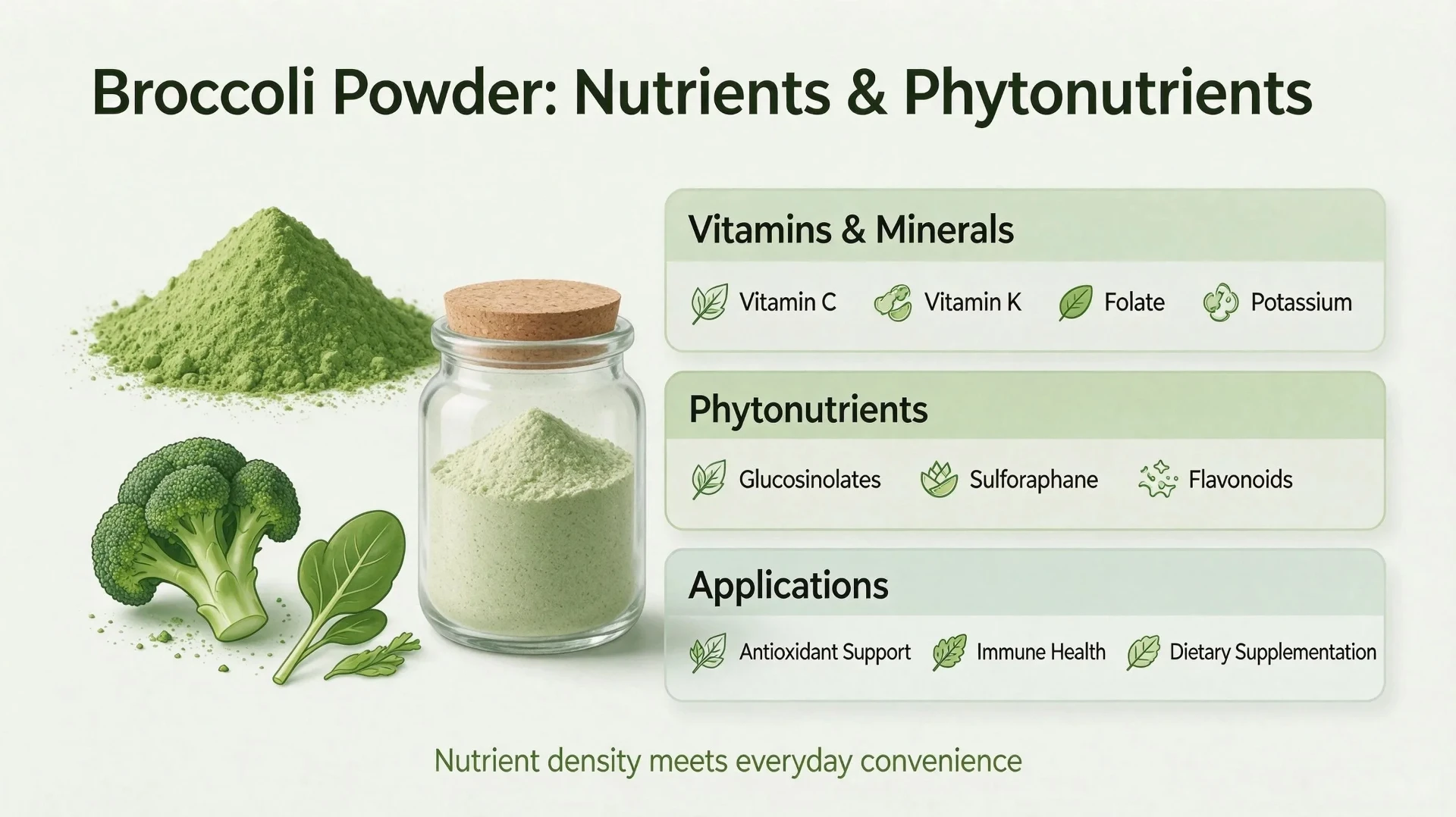
Broccoli contains vitamin C, carotenoids, and a family of plant compounds called glucosinolates. They belong in the same conversation about broccoli, but they do different jobs. Your ingredient specification should name the one that matters to your product.
Vitamin C: measure what reaches one serving
Vitamin C acts as an antioxidant. Raw broccoli contains about 89 milligrams of vitamin C per 100 grams, according to USDA FoodData Central . That figure describes raw broccoli, not your powder.
Drying removes water, which changes the amount of nutrients per gram. Heat, oxygen, and storage can also reduce vitamin C. You cannot take a fresh broccoli value, adjust for water loss, and treat the result as a finished-product measurement.
Consider a simple purchasing calculation. Say a supplier's test finds 50 milligrams of vitamin C per 100 grams of powder. At two grams of powder per serving, your recipe starts with just one milligram of vitamin C from broccoli. That figure comes before mixing, heating, or storage.
This is an illustration, not a Jiuyuan product specification. It shows why a result per 100 grams can sound impressive yet contribute little at your actual serving size.
Glucoraphanin: a precursor, not a sulforaphane guarantee
Glucoraphanin is one of broccoli's glucosinolates. When you cut or crush fresh broccoli, an enzyme called myrosinase can come into contact with glucoraphanin. In the presence of water, that reaction can produce sulforaphane [2, 3].
Researchers study sulforaphane partly because it can activate pathways involved in the body's own protective responses . That differs from the direct antioxidant role of vitamin C. It also means that a glucoraphanin measurement does not establish how much sulforaphane your product delivers.
Ask your supplier to distinguish three results:
- Glucoraphanin content: How much of the starting compound does the powder contain?
- Myrosinase activity: Does the enzyme still work under the test conditions?
- Sulforaphane content or yield: Did the lab measure sulforaphane already present, or did it form during the test?
That last distinction matters for organic broccoli powder in capsules and drink mixes. A lab may hydrate a sample before testing. Your customer may swallow a dry capsule or drink a freshly mixed shake. Those conditions are not interchangeable.
Carotenoids and fiber: useful, but not shortcuts to a claim
Broccoli also contains carotenoids, including beta-carotene, lutein, and zeaxanthin . Whole vegetable powder can contribute fiber as well. Neither its green appearance nor its broccoli aroma gives you a reliable measure of these components.
For a vegetable soup, you may value the flavor and fine solids without making any nutrient claim. That is a sound reason to choose organic broccoli powder. You do not need an antioxidant promise to justify an ingredient that improves the recipe.
How to choose organic broccoli powder for your application
Before comparing prices, decide whether you need mature broccoli, young sprouts, or an extract. The names sound similar on a quote. The materials can behave quite differently in your product.
Whole broccoli powder vs. broccoli sprout powder
Use the job you need the ingredient to perform as your starting point.
|
Ingredient |
When it makes sense |
What to verify |
|
Mature broccoli powder |
You want broccoli flavor, vegetable solids, or green color in food. |
Plant part, flavor, particle size, and any added ingredients. |
|
Broccoli sprout powder |
You want to explore a formula centered on glucoraphanin. |
Sprout identity, glucoraphanin per gram, and relevant enzyme activity. |
|
Standardized broccoli extract |
You need a defined amount of a named compound in a small serving. |
Compound name, guaranteed amount, test method, and shelf-life data. |
Researchers found that young broccoli sprouts can contain much higher concentrations of certain glucosinolates than mature broccoli . The finding helps explain interest in sprouts. It does not give every sprout powder a fixed advantage over every mature broccoli powder.
For instant soup, a stronger broccoli flavor may matter more than a higher glucoraphanin result. For a capsule with a specific compound target, that priority may reverse.
Freeze-dried vs. air-dried broccoli powder
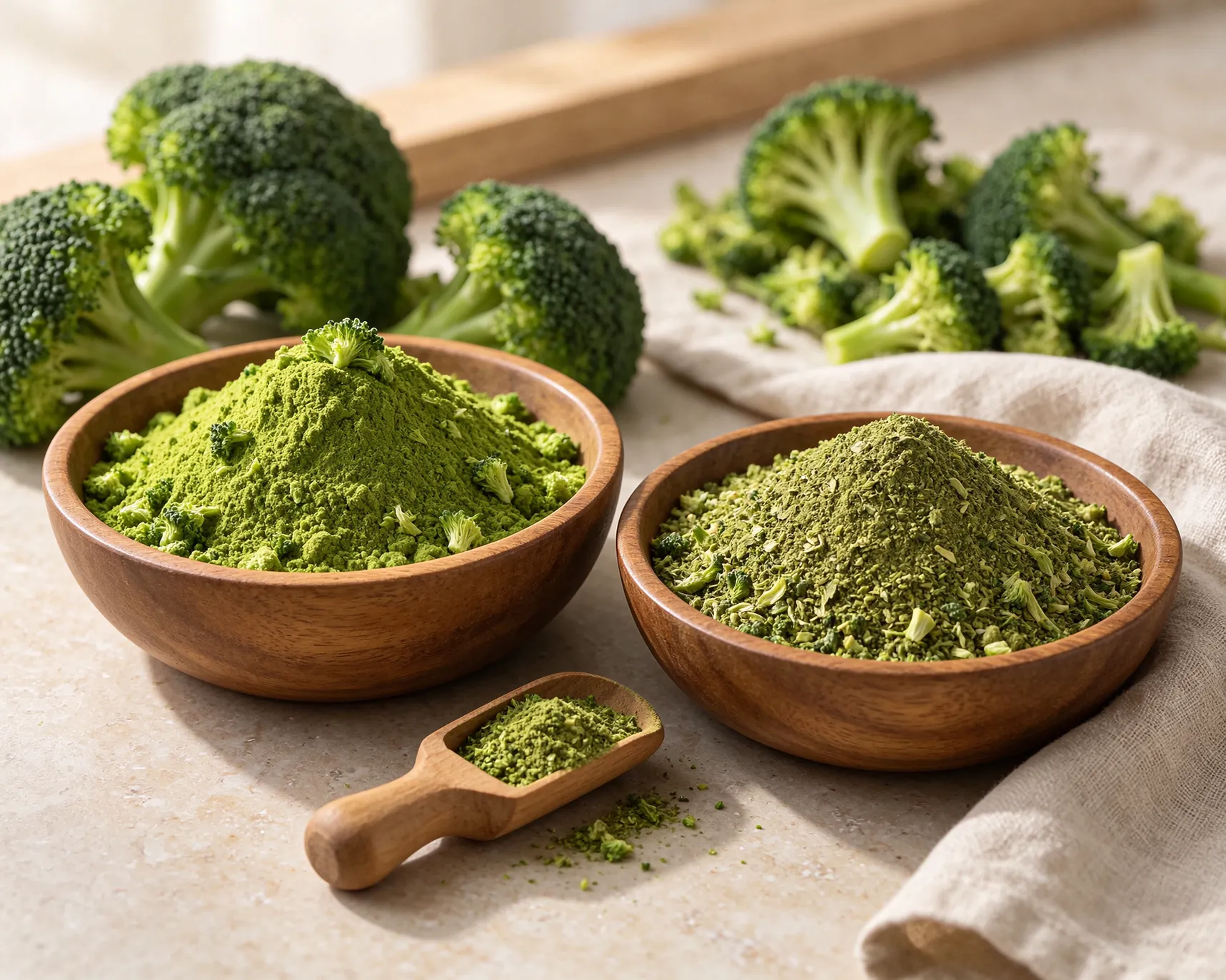
Jiuyuan lists both freeze-dried and low-temperature air-dried options on its organic broccoli powder product page. Ask which process applies to the sample and the commercial lot. Also ask whether the manufacturer blanches the broccoli before drying.
Why ask about an earlier step? A drying method tells you only part of the ingredient's heat history. In one broccoli study, steaming retained more vitamin C and total glucosinolates than several other cooking methods . The study examined cooked vegetables, not commercial powders. Its practical lesson is that how you apply heat matters.
Compare both grades in your finished recipe. A freeze-dried sample may look greener in a clear bag. That difference may disappear in a tomato soup or after baking. Pay for the difference your customer can taste, see, or verify.
Match the pilot test to the way people eat
A useful trial recreates the customer's kitchen, not just your mixing tank. These tests address different buying risks:
|
Application |
What to test |
What you learn |
|
Greens drink or smoothie |
Mix with cold water in the shaker your customer uses. Taste immediately and after ten minutes. |
Whether clumps, sediment, or a lingering broccoli note affect the last sip. |
|
Instant soup or sauce |
Prepare with the stated water volume. Taste again after the normal holding time. |
Whether the vegetable flavor fits the base or grows too strong. |
|
Pasta or crackers |
Cook or bake the finished recipe. Compare it with a batch without broccoli. |
Whether the color survives and the powder changes texture. |
|
Capsules or stick packs |
Run a small filling trial with the final blend. Check fill weight across the run. |
Whether the blend flows well enough to deliver a consistent serving. |
For beverage development, keep dispersion separate from dissolution. Fine particles can spread evenly through a drink without dissolving. If your brief calls for a clear beverage, test clarity before spending time on flavor adjustments.
For savory foods, taste the product at serving temperature. A warm cup of soup gives you a better read on broccoli aroma than a spoonful of cold powder. Keep an untreated control so your team can describe what the ingredient changed.
What to ask a bulk organic broccoli powder supplier
A useful supplier quote connects the powder you tested with the powder you will receive. A price per kilogram cannot tell you whether those materials match.
Request documents that answer specific buying questions
When you contact an organic broccoli powder supplier, request the specification and a recent lot-specific certificate of analysis, or COA. The specification sets the acceptance limits. The COA reports results for an identified lot.
Use this checklist to keep the conversation focused:
- Identity: Request the botanical identity, plant part, country of origin, and full ingredient list. Ask whether the powder contains a carrier.
- Organic status: Request the current certificate and its product list. Check the operator, site, and scope against your destination market.
- Safety: Ask for microbial results, relevant pesticide screens, and individual heavy metal results. A single total can hide differences that matter to your buyer.
- Processing: Confirm the drying method, any blanching step, particle size range, and storage conditions.
- Nutrition: Request the test method, units, and reporting basis for any nutrient or plant compound behind your claim.
- Supply: Confirm the minimum order, pack size, lead time, and notice period for specification changes.
Jiuyuan lists a 20-kilogram carton and identifies US and EU organic certification on its product page. Confirm the current documents for your order. The page also gives different vitamin C figures in its two tables. For label work, request one current result tied to your exact grade rather than choosing either website value.
Compare cost per finished serving
Suppose one organic broccoli powder costs $20 per kilogram and meets your flavor target at two grams per serving. Its ingredient cost is four cents per serving. A second grade at $15 per kilogram costs six cents per serving if you need four grams.
Neither price represents a supplier quote. The exercise shows why it pays to test both samples at the level your formula needs. Include freight and expected production losses before you approve the purchase.
Keep a sealed sample from the approved trial. Record the lot, recipe, mixing steps, and observations. When the next shipment arrives, your team will have something more useful than a note saying "good green color."
Keep antioxidant claims tied to evidence
In the United States, FDA rules set conditions for antioxidant nutrient content claims . A supplier's general antioxidant test does not establish that your food qualifies. Identify the nutrient behind the wording and check the amount in the finished serving.
In the European Union, an authorized vitamin C claim concerns the protection of cells from oxidative stress . The food must meet the applicable conditions of use. Organic certification does not satisfy those conditions or establish a vitamin C level.
Before you print packaging, give your regulatory reviewer the proposed wording, serving size, market, and supporting results. If you need the claim to hold through shelf life, build that requirement into your testing plan.
Organic broccoli powder FAQ
These questions often come up when a product moves from a promising sample to a purchase order.
1. Does organic broccoli powder contain sulforaphane?
It may, but the ingredient name does not establish an amount. Ask whether the lab measured existing sulforaphane or calculated potential yield after hydration. If your label names sulforaphane, a result for glucoraphanin alone does not answer your question .
2.Is freeze-dried organic broccoli powder always better?
No. The better grade meets your product target at an acceptable cost. Compare representative lots in your recipe. Test vitamin C or enzyme activity separately when either one matters. Do not use the drying method as a substitute for those results.
3.How much broccoli powder should you add to a greens blend?
There is no single inclusion rate for every blend. Make three small batches with different amounts and keep your other ingredients constant. Compare aroma, texture, and sediment. Then calculate the nutrient contribution at the level your tasting team accepts.
4.Can you replace fresh broccoli with powder by weight?
Not gram for gram. Fresh broccoli contributes water, bulk, and texture that a powder cannot replace on its own. For soup or sauce, adjust water and vegetable solids separately. For a fresh-equivalent statement, request documented yield data for the specific powder.
5.Does organic certification mean every lot contains more antioxidants?
No. Organic certification addresses production and handling standards. It does not guarantee more vitamin C, higher glucoraphanin, or active myrosinase. Ask for a measured value when any of those factors drives your purchase.
6.What should you send when requesting a sample?
Share your application, destination market, serving size, expected order volume, and most important acceptance criterion. "Low sediment after ten minutes in cold water" gives a supplier a clearer target than "premium beverage grade."
For a sample or quote, contact Jiuyuan Biotech at info@jiuybiotech.com. Mention Organic Broccoli Powder and tell us what your finished product needs to deliver. Request the matching specification, organic documents, and lot-specific results so you can test the right grade before ordering in bulk.
References
- U.S. Department of Agriculture, Agricultural Research Service. FoodData Central: Broccoli, raw. SR Legacy. FDC ID 170379.
- Fahey JW, Zhang Y, Talalay P. Broccoli sprouts: an exceptionally rich source of inducers of enzymes that protect against chemical carcinogens. Proceedings of the National Academy of Sciences USA. 1997;94(19):10367–10372.
- Yagishita Y, Fahey JW, Dinkova-Kostova AT, Kensler TW. Broccoli or Sulforaphane: Is It the Source or Dose That Matters? Molecules. 2019;24(19):3593.
- Yuan GF, Sun B, Yuan J, Wang QM. Effects of different cooking methods on health-promoting compounds of broccoli. Journal of Zhejiang University Science B. 2009;10(8):580–588.
- U.S. Food and Drug Administration. Code of Federal Regulations. Title 21, Section 101.54(g): Nutrient content claims using the term "antioxidant."
- European Commission. Commission Regulation (EU) No 432/2012 of 16 May 2012. Annex: permitted health claims for vitamin C. Official Journal of the European Union. 2012;L136:1–40.