




If you are comparing Black Ginger Extract Powder with regular Ginger Extract, you are not choosing between two versions of the same ingredient. You are choosing between two different botanicals with different active compounds, sensory profiles, applications, and quality markers.
Black ginger comes from Kaempferia parviflora. Regular ginger comes from Zingiber officinale. Both belong to the ginger family, yet they serve different formulation goals. Black ginger extract often fits sports nutrition, men's wellness, energy-positioned formulas, and premium botanical blends. Ginger extract often fits digestive wellness, warming formulas, tea blends, and general wellness products.
For supplement formulators, the key question is not "Which one is better?" The better question is: Which ingredient fits your claim strategy, dosage form, target market, and specification?
This guide breaks down the practical differences so you can select the right extract for capsules, tablets, gummies, beverage powders, and functional nutrition products.
Black Ginger Extract Powder and Ginger Extract Come from Different Plants
The naming can confuse buyers. Black ginger and regular ginger sound closely related. They are botanically different ingredients.
Black Ginger Extract Powder comes from Kaempferia parviflora, a plant native to Southeast Asia. Its rhizome has a dark purple to black inner color. In commercial extracts, black ginger is often valued for polymethoxyflavones, also known as PMFs. Research on Kaempferia parviflora often focuses on PMF-rich extracts and their role in physical performance and energy-related studies.
Regular ginger extract comes from Zingiber officinale. Its rhizome has the familiar yellow color and warm, pungent taste. Ginger extract is usually standardized for gingerols and shogaols. These compounds give ginger its characteristic sensory and technical profile.
This botanical difference affects everything downstream:
- Active markers
- Testing method
- Taste and odor
- Color
- Product positioning
- Dosage strategy
- Regulatory review
- Consumer understanding
- Cost structure
A supplement brand should never treat these two extracts as interchangeable.
Core Active Compounds: PMFs vs Gingerols
The largest technical difference sits in the marker compounds.
Black ginger: polymethoxyflavones and 5,7-dimethoxyflavone
Black ginger is known for polymethoxyflavones, often shortened to PMFs. A common marker compound is 5,7-dimethoxyflavone, also called 5,7-DMF.
Commercial black ginger extract specifications may include:
- 5,7-dimethoxyflavone
- Total polymethoxyflavones
- Extract ratio grades
- Custom active marker levels
Some ingredient suppliers position black ginger extract around 5,7-DMF content for supplement use, especially in capsules, tablets, powdered blends, and botanical formulas.
Regular ginger: gingerols and shogaols
Regular ginger extract is commonly standardized for:
- 6-gingerol
- Total gingerols
- 6-shogaol
- Total pungent compounds
- Extract ratio grades
Gingerols and shogaols create the pungent, warming profile that many consumers associate with ginger. This makes ginger extract useful in digestive, warming, seasonal, and traditional wellness formulas.
Why this matters for formulators
If your product needs a PMF-positioned ingredient, regular ginger extract will not replace black ginger extract.
If your product needs a classic ginger taste or gingerol specification, black ginger extract will not replace regular ginger extract.
They may sit together in one formula, but they do different jobs.
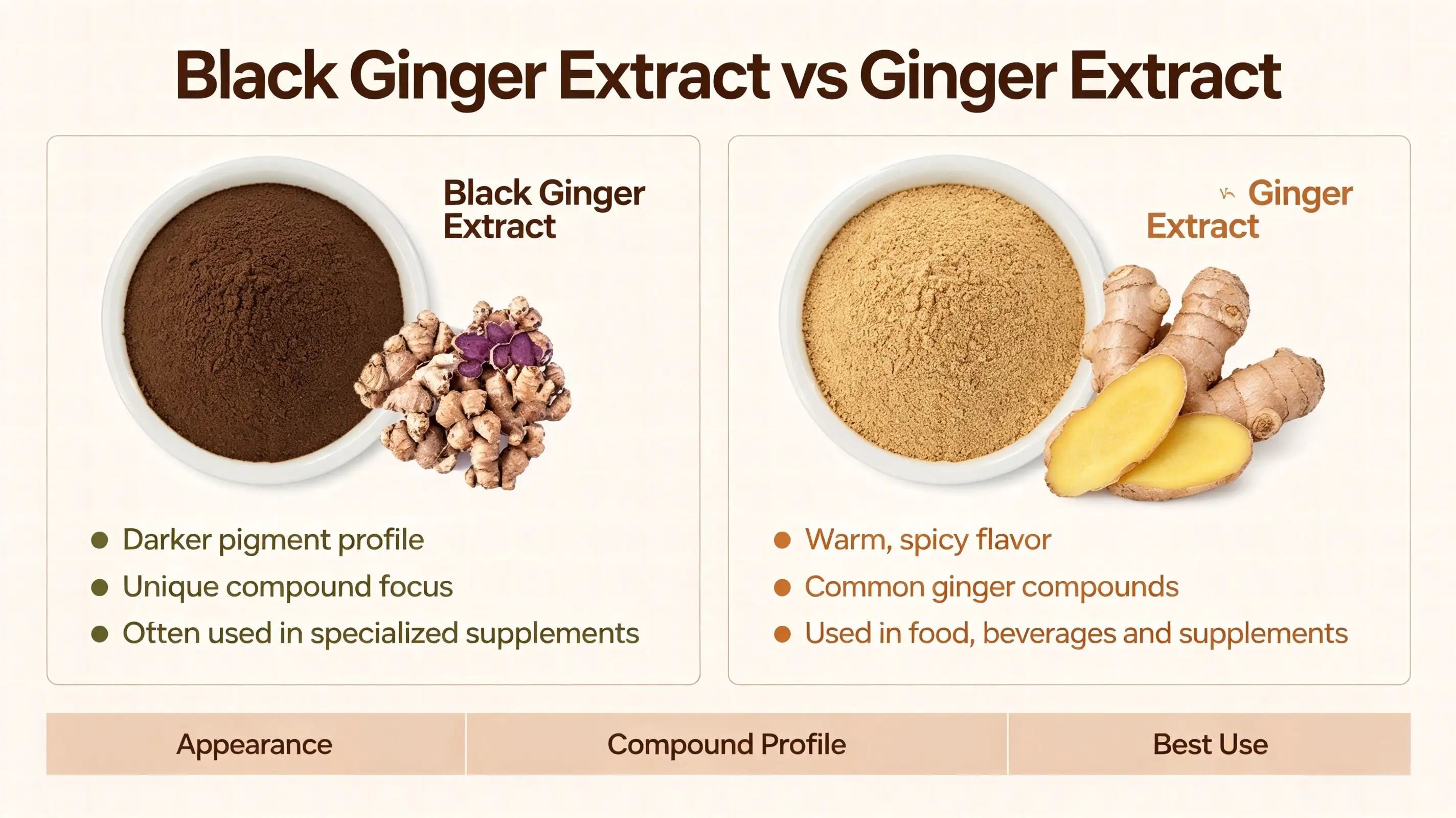
Specification Comparison for B2B Buyers
A clear specification helps your purchasing, R&D, and quality teams speak the same language.
| Item | Black Ginger Extract Powder | Ginger Extract |
|---|---|---|
| Botanical Source | Kaempferia parviflora | Zingiber officinale |
| Plant Part Used | Rhizome | Rhizome |
| Common Marker Compounds | PMFs, 5,7-dimethoxyflavone | Gingerols, shogaols |
| Typical Positioning | Sports nutrition, vitality, energy-positioned formulas | Digestive wellness, warming blends, general wellness |
| Common Test Method | HPLC for 5,7-DMF or PMFs | HPLC for gingerols or shogaols |
| Taste Profile | Mild botanical, less typical ginger heat | Warm, pungent, spicy |
| Color | Brown to dark brown powder | Yellow-brown to brown powder |
| Common Dosage Forms | Capsules, tablets, powder blends | Capsules, tablets, teas, gummies, drinks |
| Key Sourcing Question | What is the PMF or 5,7-DMF level? | What is the gingerol or shogaol level? |
This table gives a practical sourcing view. Your final choice should match the formulation brief.
Formulation Positioning: When to Use Black Ginger Extract Powder
Black Ginger Extract Powder works best when your product needs a more specialized botanical identity.
You may consider it for:
- Sports nutrition formulas
- Men's wellness products
- Active lifestyle supplements
- Energy-positioned capsules
- Performance-focused powder blends
- Premium botanical complexes
- Stimulant-free vitality formulas
- Functional nutrition concepts
Human research has explored black ginger extract in relation to physical fitness performance. One randomized study reported changes in fitness-related measures after black ginger extract use, though formulators still need to treat this as research context, not a disease or guaranteed performance claim.
That distinction matters. A B2B product page or finished supplement label should avoid overpromising. You can discuss black ginger as a studied botanical ingredient. You should not present it as a treatment or guaranteed performance enhancer.
For formulation teams, black ginger's main appeal comes from its unique PMF profile. This gives brands a way to stand apart from common botanical formulas.
Formulation Positioning: When to Use Ginger Extract
Regular ginger extract fits a different set of products.
You may choose ginger extract for:
- Digestive wellness formulas
- Traditional herbal blends
- Warming botanical products
- Seasonal wellness products
- Functional teas
- Gummies and chewables
- Beverage powders
- Daily wellness supplements
Ginger has strong consumer recognition. Many buyers already understand its taste and traditional use. That makes ginger extract easier to explain in mass-market formulas.
It also has a clear sensory role. Ginger brings heat, spice, and warmth. In tea, gummies, and beverage powders, that can become part of the product experience.
Yet that same taste can create formulation limits. High-gingerol extracts may taste too sharp in gummies or drinks. You may need masking flavors or lower inclusion rates.
Black ginger usually does not deliver the same classic ginger heat. That can make it easier for capsule or tablet formulas, but less useful if your product depends on ginger flavor.
Testing Methods: What Should Be on the COA?
A COA should verify what the product claims. It should not create confusion.
For Black Ginger Extract Powder, ask for clear marker testing.
Black ginger extract COA should include:
- Product name
- Botanical source: Kaempferia parviflora
- Part used: rhizome
- Appearance
- Active marker result
- Test method
- Batch number
- Moisture
- Ash
- Particle size
- Heavy metals
- Microbiology
- Pesticide residues, when required
- Residual solvents, when required
The assay section should clearly state whether the test covers:
- 5,7-dimethoxyflavone
- Total polymethoxyflavones
- Extract ratio only
- Custom marker specification
HPLC is commonly used for defined marker compounds, including flavonoid markers. If a supplier claims 5,7-DMF content, ask for HPLC data or another validated method.
For ginger extract, the COA should state gingerols or shogaols and the test method. HPLC is commonly used for gingerol and shogaol analysis.
Black Ginger Extract Powder Is Not a Darker Ginger Extract
Black ginger is not regular ginger that looks darker. It is a separate botanical.
Here is the practical difference:
- Black ginger = Kaempferia parviflora
- Regular ginger = Zingiber officinale
Their marker compounds differ. Their taste differs. Their commercial applications differ.
Sensory and Processing Differences
Formulators often focus on assay values, but sensory performance matters too.
Taste and odor
Regular ginger extract has a strong warming, spicy, pungent taste. That can work well in tea, gummies, and beverages. It can also create challenges in high-dose formulas.
Black ginger extract usually has a milder botanical taste. It may fit capsules and tablets better when taste exposure should stay low.
Color
Black ginger extract often appears brown to dark brown. Ginger extract usually appears yellow-brown to brown.
Color can affect:
- Gummies
- Beverage powders
- Stick packs
- Capsules with clear shells
- Tablets
- Powder blends
Ask for a sample before you confirm bulk production.
Solubility and dispersibility
Both extracts may show limited full solubility depending on the grade. Beverage applications need extra testing.
Ask your supplier about:
- Water dispersibility
- Particle size
- Carrier system
- Spray-drying conditions
- Flowability
- Sedimentation
- Taste impact
Do not assume an extract works in drinks just because it is a powder.
Application Guide for Supplement Formulators
Use your product format to guide ingredient selection.
Capsules
Both extracts can work in capsules.
Choose Black Ginger Extract Powder if your formula targets active lifestyle, vitality, or premium botanical positioning.
Choose ginger extract if your formula targets digestive wellness, warming support, or traditional herbal positioning.
Check:
- Bulk density
- Particle size
- Flowability
- Assay level
- Capsule fill weight
Tablets
Tablets need good compressibility and flow.
Ask about:
- Granulation needs
- Excipients
- Moisture
- Mesh size
- Color variation
- Odor
Black ginger and ginger extracts may need different formulation support.
Gummies
Ginger extract can bring recognizable flavor. It can also bring heat.
Black ginger may need flavor masking, but it usually does not create the same spicy ginger bite.
Check:
- Heat stability
- Taste
- Color
- Assay after processing
- Ingredient interaction
Beverage powders
Ginger extract works well when the formula needs a spicy, warming flavor.
Black ginger can work in beverage powders, but you should test dispersibility and mouthfeel.
For drinks, always request a sample.
Organic, Conventional, and Custom Grades
Not every black ginger extract is organic. Not every ginger extract is organic.
If your product claims organic positioning, the certification scope must match the ingredient and target market.
Ask for:
- USDA Organic certificate, when needed
- EU Organic certificate, when needed
- Certificate holder information
- Product scope
- Valid date
- Transaction certificate, when needed
- Country-specific import requirements
For Black Ginger Extract Powder, custom grades may include:
- Extract ratio grade
- 5,7-DMF standardized grade
- Total PMFs standardized grade
- Water-dispersible grade
- Fine mesh grade
- Custom packaging
- Low heavy metal grade, when required
Ingredient suppliers may offer different black ginger extract grades based on 5,7-DMF or PMF specifications for supplement applications.
A strong supplier should explain what each grade means.
Quality and Safety Standards B2B Buyers Should Review
Active markers are only part of quality. Safety testing matters just as much.
A practical specification should include:
| Quality Item | Why It Matters |
|---|---|
| Botanical identity | Confirms correct plant source |
| Active marker assay | Supports label and formula consistency |
| Moisture | Affects shelf life and powder stability |
| Ash | Helps monitor inorganic residue |
| Particle size | Affects blending and production |
| Heavy metals | Critical for EU and US supplement buyers |
| Microbiology | Supports safety and compliance |
| Pesticide residues | Important for organic and export markets |
| Residual solvents | Needed when ethanol extraction applies |
| Allergen statement | Supports finished product labeling |
For high-quality B2B sourcing, request a current COA for the actual batch. A generic specification can start the discussion, but batch data should support bulk approval.
How to Choose a Black Ginger Extract Powder Supplier
A reliable supplier should offer more than a price.
Ask these sourcing questions:
- What is the botanical source?
- Is the Latin name Kaempferia parviflora?
- What plant part do you use?
- What is the active marker?
- Do you test 5,7-DMF or total PMFs?
- Which method do you use?
- Can you provide a batch COA?
- Can you provide pesticide residue data?
- Do you support custom specifications?
- What is the MOQ?
- What is the lead time?
- Can you supply samples?
- What packaging options are available?
If the supplier cannot answer these questions clearly, keep looking.
For B2B buyers, the best supplier is not always the cheapest one. The best supplier helps reduce your quality risk and development time.
FAQ
1. Is Black Ginger Extract Powder the same as Ginger Extract?
No. Black Ginger Extract Powder comes from Kaempferia parviflora. Ginger extract comes from Zingiber officinale. They have different active compounds and applications.
2. What is the main active marker in black ginger extract?
Common markers include polymethoxyflavones and 5,7-dimethoxyflavone. The exact marker depends on the supplier's specification.
3. What is regular ginger extract standardized for?
Regular ginger extract is commonly standardized for gingerols and shogaols.
4. Can Black Ginger Extract Powder replace Ginger Extract?
Not usually. Black ginger extract and ginger extract serve different formulation goals. Use black ginger for PMF-positioned formulas. Use ginger extract for gingerol-based and warming formulas.
5. What test method should I ask for?
For black ginger extract, ask for HPLC testing for 5,7-DMF or total PMFs when applicable. For ginger extract, ask for HPLC testing for gingerols or shogaols.
6. Is Black Ginger Extract Powder suitable for gummies?
It may be suitable, but you should test taste, color, heat stability, and assay after processing.
7. What documents should a supplier provide?
Ask for COA, specification sheet, MSDS, flow chart, allergen statement, non-GMO statement, heavy metal test, microbiology test, and pesticide residue data when required.
8. What information should I send when requesting a quote?
Send your target specification, quantity, application, destination country, packaging preference, and required documents.
Final Notes for Supplement Formulators
Black Ginger Extract Powder and Ginger Extract can both add value to supplement formulas. Yet they do not play the same role.
Choose Black Ginger Extract Powder when your formula needs Kaempferia parviflora, PMF-focused positioning, and a more specialized botanical profile. Choose Ginger Extract when your formula needs Zingiber officinale, gingerols, shogaols, and classic warming ginger character.
For sourcing, focus on botanical identity, active marker specification, test method, COA quality, safety data, and supplier communication. That approach protects your formula and supports a smoother product launch.
Jiuyuan Bio supplies Black Ginger Extract Powder for supplement, functional food, capsule, tablet, gummy, beverage powder, and botanical blend applications. We support specification discussion, COA requests, samples, and bulk quotation.
For Black Ginger Extract Powder specifications, samples, COA, or bulk supply, contact us at: info@jiuybiotech.com
Website:https://www.jiuyuanbio.com/
References
- Toda, K., et al. "Black Ginger Extract Increases Physical Fitness Performance and Muscular Endurance by Improving Inflammation and Energy Metabolism." Heliyon, 2016.
- Yoshino, S., et al. "Daily Intake of Kaempferia parviflora Extract Decreases Abdominal Fat in Overweight and Preobese Subjects: A Randomized, Double-Blind, Placebo-Controlled Clinical Study." Diabetes, Metabolic Syndrome and Obesity: Targets and Therapy.
- Saokaew, S., et al. "Clinical Effects of Krachaidum, Kaempferia parviflora: A Systematic Review." Journal of Evidence-Based Integrative Medicine.
- Han, A. R., et al. "Flavonoids and Other Constituents from the Rhizomes of Kaempferia parviflora." Phytochemistry.
- Semwal, R. B., et al. "Gingerols and Shogaols: Important Nutraceutical Principles from Ginger." Phytochemistry.
- Chrubasik, S., Pittler, M. H., and Roufogalis, B. D. "Zingiberis Rhizoma: A Comprehensive Review on the Ginger Effect and Efficacy Profiles." Phytomedicine.