

Daily supplementation is a serious commitment - for consumers and for the formulators who design their products. If you're working with broccoli seed extract or evaluating it as a daily-use ingredient, you need more than marketing claims. You need clinical evidence, dosage precision, and a clear picture of what long-term use actually looks like in real populations.
Here's what the science says - and what it means for your formulation decisions.
What Happens Inside the Body When You Take It Daily
Broccoli seed extract delivers glucoraphanin, a stable glucosinolate that converts to sulforaphane in the gut. Sulforaphane is the active compound - an electrophilic isothiocyanate that activates the Nrf2 transcription pathway, triggering a cascade of cytoprotective enzymes including NQO1, HO-1, and glutathione-S-transferase.
When taken daily, this activation doesn't plateau immediately. Research shows that repeated sulforaphane exposure produces a sustained upregulation of Phase II detoxification enzymes - a cumulative benefit that single-dose models don't capture.
Key physiological effects observed with consistent daily intake include:
- Reduced oxidative stress markers - measurable decreases in 8-isoprostane and malondialdehyde
- Lower systemic inflammation - CRP and IL-6 reductions documented in clinical cohorts
- Enhanced glutathione synthesis - a direct downstream effect of Nrf2 activation
- Improved detoxification capacity - accelerated clearance of airborne pollutants and carcinogens
The body doesn't build tolerance to sulforaphane the way it does with stimulants. Daily use maintains the Nrf2 activation cycle without receptor downregulation - which is one reason long-term protocols are both practical and scientifically supported.
What Clinical Trials Say About Long-Term Daily Use
The safety record for daily sulforaphane supplementation is one of the more robust in the phytonutrient space. Multiple human trials have run continuous protocols ranging from 4 weeks to 18 months without serious adverse events.
A landmark open-label study published in Cancer Prevention Research followed participants taking broccoli sprout extract daily for 12 weeks. Researchers observed consistent biomarker improvements with no clinically significant adverse effects reported at doses delivering up to 200 µmol sulforaphane equivalent per day.
A separate randomized controlled trial in Proceedings of the National Academy of Sciences evaluated sulforaphane supplementation in young men with autism spectrum disorder over 18 weeks. The safety profile remained favorable throughout, with only mild, transient gastrointestinal symptoms noted in a small subset of participants.
Additional long-term data points from published research:
- 12-month broccoli sprout extract study - no hepatotoxicity, nephrotoxicity, or hematological abnormalities detected
- Phase I clinical trial (Shapiro et al.) - confirmed safety and tolerability across a broad dose range in healthy adults
- Pediatric and elderly cohort studies - both populations tolerated daily glucoraphanin supplementation without dose-limiting toxicity
The consistent finding across these trials: daily use at therapeutic doses is safe for most healthy adults when sourced from a standardized, verified extract.

The Daily Dose Question: How Much Is Right?
This is where formulation decisions get precise. There's no universal "correct" daily dose - the right amount depends on the application, the target population, and the glucoraphanin concentration of your raw material.
Here's a practical reference framework based on published clinical data and the 2023 Chinese Dietary Reference Intakes, which established a Tolerable Upper Intake Level (TUL) of 30 mg sulforaphane per day - the first regulatory body to set a quantified ceiling for this compound.
|
Use Case |
Daily Sulforaphane Equivalent |
Typical Glucoraphanin Grade |
|
General antioxidant support |
5–10 mg/day |
1%–5% extract |
|
Detox & cellular protection |
10–20 mg/day |
5%–13% extract |
|
Clinical / therapeutic protocols |
20–30 mg/day |
13%+ extract |
|
Functional food / beverage |
2–5 mg/serving |
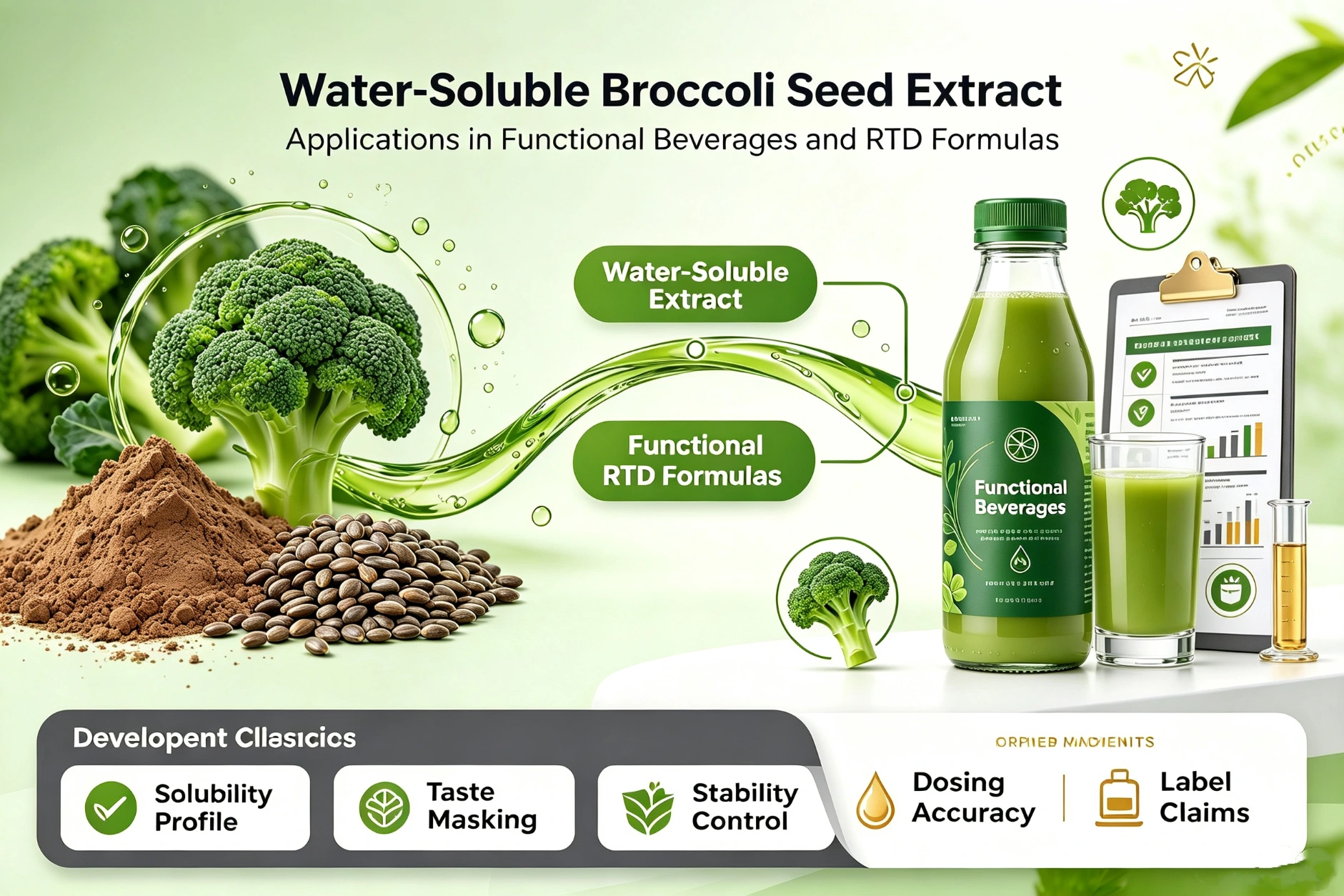
1% water-soluble grade |
Practical formulation notes:
- Doses below 10 mg/day are well-tolerated across virtually all adult populations
- Doses between 10–20 mg/day represent the sweet spot for most supplement applications
- Doses approaching 30 mg/day require clear label guidance and are best reserved for clinical or practitioner-directed products
- Exceeding the 30 mg/day TUL without medical supervision is not recommended
One important variable: bioavailability differs significantly between extract types. A glucoraphanin-dominant extract relies on gut microbiome conversion, which varies between individuals. A co-formulated extract with active myrosinase delivers more predictable sulforaphane yield - but requires tighter manufacturing controls to prevent premature conversion during processing.
Who Should Be Cautious With Daily Use
Daily supplementation with broccoli seed extract is appropriate for most healthy adults. That said, certain populations warrant additional consideration in your product labeling and formulation strategy.
Individuals with thyroid conditions:
Glucosinolates are classified as goitrogens at very high doses. At standard supplement doses, this effect is not clinically significant for euthyroid individuals. For those with hypothyroidism or on thyroid medication, a physician consultation note on the label is a reasonable precaution.
People taking prescription medications:
Sulforaphane modulates CYP1A2 and CYP2E1 enzyme activity. This creates a theoretical interaction risk with:
- Acetaminophen (altered hepatic clearance)
- Certain chemotherapy agents
- Anticoagulant medications
For supplements targeting clinical or pharmacy channels, this interaction profile needs explicit documentation in your technical dossier.
Pregnant and breastfeeding individuals:
Human safety data in these populations is limited. Standard regulatory practice applies: include a "consult your healthcare provider" advisory on the label.
Children:
Pediatric dosing data exists in the ASD research context, but general pediatric supplementation guidelines for sulforaphane are not yet established. Conservative dosing and physician oversight are appropriate.
Why Consistency Matters More Than High Doses
One of the most important insights from long-term sulforaphane research is this: regularity outperforms intensity.
A single high dose produces a sharp Nrf2 activation spike followed by rapid urinary clearance - sulforaphane has a half-life of approximately 1.77 hours in plasma. Daily low-to-moderate dosing maintains a more sustained activation pattern, which better reflects the protective mechanisms observed in population-level cruciferous vegetable consumption studies.
This has direct implications for how you position a daily-use product:
- Emphasize consistency over potency in consumer messaging
- Design for compliance - capsule count, taste, and convenience matter for daily-use formats
- Avoid megadose positioning - it doesn't align with the mechanistic evidence and creates unnecessary regulatory exposure
The most defensible daily-use products are those formulated at 10–20 mg sulforaphane equivalent, with clear serving guidance, and sourced from a standardized extract with batch-verified potency.
What B2B Buyers Need to Confirm Before Sourcing a Daily-Use Ingredient
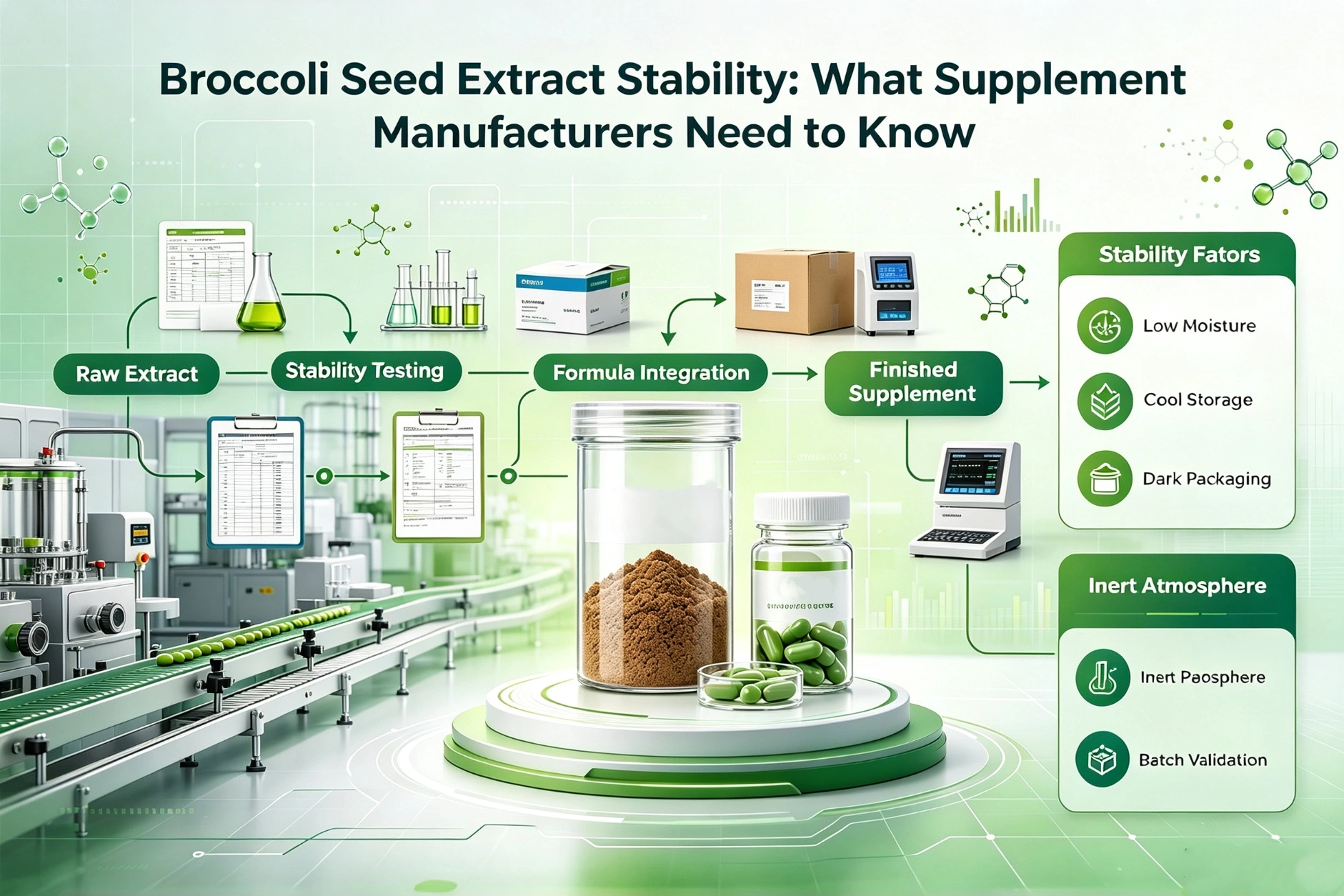
If you're sourcing broccoli seed extract for a daily supplement, the raw material quality standard is higher than for occasional-use products. Here's the non-negotiable checklist:
✅ HPLC-verified glucoraphanin content - per batch, not per lot average
✅ Declared myrosinase activity status - active or inactivated, with implications for conversion rate
✅ Accelerated stability data - minimum 90 days at 37°C/75% RH with documented potency retention
✅ Heavy metals COA - lead, arsenic, cadmium, mercury per batch
✅ Solvent residue declaration - extraction solvent type and residual levels
✅ Microbiology panel - total plate count, yeast, mold, E. coli, Salmonella
✅ Manufacturing certifications - ISO 9001, FSSC 22000, cGMP at minimum
✅ Regulatory compliance documentation - for target markets (US FDA, EU EFSA, etc.)
A supplier who cannot provide all of the above on request is not an appropriate partner for a daily-use supplement launch.
Sourcing Broccoli Seed Extract for Daily-Use Formulations
The answer to "can you take broccoli seed extract every day?" is clearly yes - when the ingredient is properly standardized, dosed within evidence-based parameters, and manufactured under verified quality controls.
At Jiuyuan Biotech, our broccoli seed extract is produced at a 70,000 m² facility with full vertical integration - from cultivar selection through HPLC-verified finished product. We offer three standardized grades:
- SFN-1 - Sulforaphane ≥1% (functional food and beverage applications)
- SFN-5 - Sulforaphane ≥5% (general supplement use)
- GR-13 - Glucoraphanin ≥13% (clinical and high-potency formulations)
All grades include batch-specific COAs, accelerated stability data, and full regulatory documentation for US, EU, Middle East, and Asian market compliance.
Certifications held: ISO 9001, FSSC 22000, HACCP, cGMP, USDA Organic, EU Organic, Halal, and Kosher.
Explore the full product specifications at: 👉 https://www.jiuyuanbio.com/standard-plant-extract-powder/broccoli-seed-extract.html
Ready to request samples, stability data, or a technical consultation? Reach out directly at info@jiuybiotech.com - our technical team responds within one business day.
References
Fahey, J. W., Haristoy, X., Dolan, P. M., Kensler, T. W., Scholtus, I., Stephenson, K. K., Talalay, P., & Lozniewski, A. (2002). Sulforaphane inhibits extracellular, intracellular, and antibiotic-resistant strains of Helicobacter pylori and prevents benzo[a]pyrene-induced stomach tumors. Proceedings of the National Academy of Sciences, 99(11), 7610–7615.
Houghton, C. A. (2019). Sulforaphane: Its "coming of age" as a clinically relevant nutraceutical in the prevention and treatment of chronic disease. Oxidative Medicine and Cellular Longevity, 2019, Article 2716870.
Shapiro, T. A., Fahey, J. W., Dinkova-Kostova, A. T., Holtzclaw, W. D., Stephenson, K. K., Wade, K. L., & Talalay, P. (2006). Safety, tolerance, and metabolism of broccoli sprout glucosinolates and isothiocyanates: A clinical phase I study. Nutrition and Cancer, 55(1), 53–62.
Singh, K., Connors, S. L., Macklin, E. A., Smith, K. D., Fahey, J. W., Talalay, P., & Zimmerman, A. W. (2014). Sulforaphane treatment of autism spectrum disorder (ASD). Proceedings of the National Academy of Sciences, 111(43), 15550–15555.
Vanduchova, A., Anzenbacher, P., & Anzenbacherova, E. (2019). Isothiocyanate from broccoli, sulforaphane, and its properties. Journal of Medicinal Food, 22(2), 121–126.
Bahadoran, Z., Mirmiran, P., Hosseinpanah, F., Rajab, A., Asghari, G., & Azizi, F. (2012). Broccoli sprouts powder could improve serum triglyceride and oxidized LDL/LDL-cholesterol ratio in type 2 diabetic patients: A randomized double-blind placebo-controlled clinical trial. Diabetes Research and Clinical Practice, 96(3), 348–354.