

If you're working with broccoli seed extract in a supplement or functional food formula, you've likely done your homework on the benefits. The Nrf2-activating power of sulforaphane is well-documented across thousands of peer-reviewed studies. But before you finalize your formula and go to market, there's a side of this ingredient that doesn't get nearly enough attention - its side effect profile and the formulation risks that come with it.
This guide breaks down what the science actually says, what your compliance team needs to flag, and what separates a defensible product launch from a liability waiting to happen.
What Makes Broccoli Seed Extract Biologically Active - and Why That Matters for Safety
To understand the side effects, you first need to understand the mechanism. Broccoli seed extract works primarily through its key bioactive compound, glucoraphanin - a stable glucosinolate precursor that converts to sulforaphane in the gut via microbial myrosinase activity.
Sulforaphane is an electrophilic isothiocyanate. It works by reacting with cysteine residues on the Keap1 protein, releasing Nrf2 to activate cytoprotective gene expression. That same reactivity - the property that makes it therapeutically valuable - is also what makes it capable of causing adverse effects at excessive doses.
Key bioactive pathway:
- Glucoraphanin (ingested) → gut microbiome converts → Sulforaphane (active)
- Sulforaphane activates Nrf2 → upregulates Phase II detox enzymes (NQO1, HO-1, GST, GCL)
- Conversion efficiency ranges from 70%–90% urinary dithiocarbamate recovery in clinical models
The biological potency of this pathway is exactly why dosage precision matters so much in formulation.
Documented Side Effects: What the Clinical Data Shows
Clinical trials have generally reported that sulforaphane is well-tolerated at therapeutic doses. A comprehensive review of clinical protocols found that sulforaphane doses ranged from 9.9 to 847 µmol per person per day - a wide range that reflects both the diversity of applications and the importance of dose management.
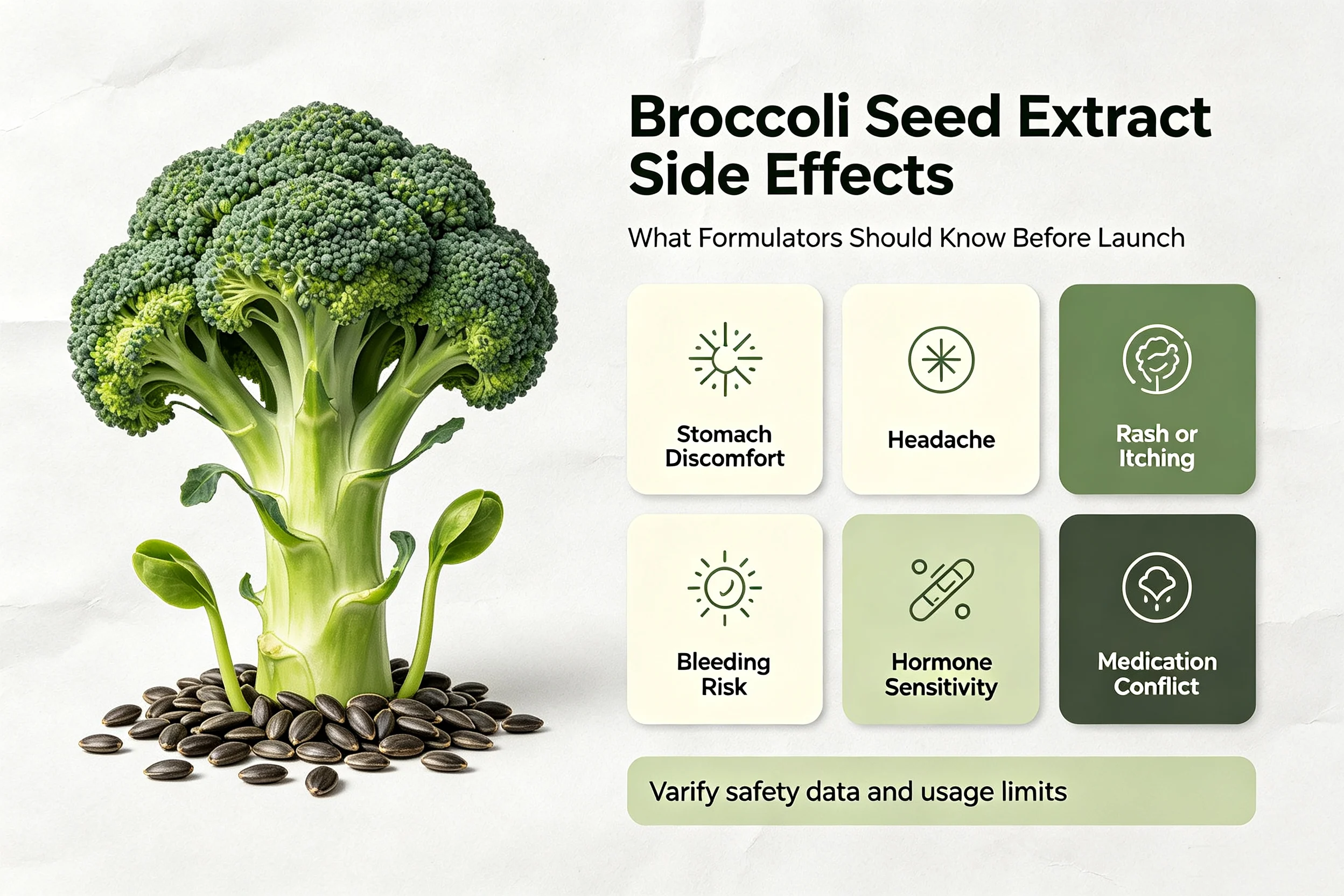
The most commonly reported adverse effects fall into predictable categories:
Gastrointestinal Discomfort
This is the most frequently reported side effect across human trials. Symptoms include:
- Bloating and flatulence - especially at higher doses
- Nausea - more common on an empty stomach
- Loose stools or mild diarrhea - typically transient and dose-dependent
- Stomach cramping - reported in sensitive individuals
These effects are largely attributed to the isothiocyanate load reaching the gut, particularly when gut microbiome composition affects conversion rates unevenly across individuals.
Thyroid Considerations at High Doses
Cruciferous compounds, including glucosinolates, have historically been associated with goitrogenic activity. At standard supplement doses, this is not considered a clinically significant concern for healthy individuals. However, formulators targeting populations with thyroid conditions should note this in product labeling and consult regulatory guidance.
Potential Drug Interactions
Sulforaphane modulates cytochrome P450 enzymes - specifically CYP1A2 and CYP2E1. This creates a theoretical interaction risk with:
- Acetaminophen (paracetamol) - altered hepatic metabolism
- Certain chemotherapy agents - particularly relevant in oncology-adjacent formulations
- Anticoagulants - indirect pathway effects
For B2B formulators developing products for clinical or pharmaceutical channels, this interaction profile requires explicit disclosure in technical documentation.
Neurological and Behavioral Observations
A review of sulforaphane in CNS-related research noted that while neuroprotective effects are well-supported, very high doses in sensitive populations - particularly those with autism spectrum disorder (ASD) - showed minimal adverse effects, with the overall safety profile described as favorable. However, formulators in the neutraceutical space should still build in conservative dosing guidance.

The Tolerable Upper Intake Level: A Critical Formulation Anchor
One of the most significant regulatory developments for formulators working with broccoli seed extract came in 2023. For the first time, China's Dietary Reference Intakes 2023 established a Tolerable Upper Intake Level (TUL) for sulforaphane at 30 mg/day.
This is a landmark figure for several reasons:
- It provides a science-backed ceiling for product dosing
- It enables milligram-level precision in label claims
- It gives formulators a defensible position in regulatory submissions
- It signals growing institutional recognition of sulforaphane as a quantifiable nutrient
For reference, most commercial supplements deliver between 5 mg and 20 mg of sulforaphane equivalent per serving. Products positioned above 20 mg/day should include clear usage guidance and contraindication language.
Formulation Risks That Go Beyond the Consumer Label
Side effects don't only affect end users. As a formulator, you face a second layer of risk: ingredient instability during manufacturing. This is where many product failures actually originate.
Sulforaphane Volatility in Processing
Free sulforaphane is chemically unstable. It degrades rapidly under:
- Heat (standard tablet compression temperatures)
- Moisture (hygroscopic degradation)
- Oxidative conditions (open-air blending)
- Acidic or alkaline pH extremes (liquid formulations)
This instability is why the industry standard has shifted to glucoraphanin-based extracts - the thermally stable precursor that survives processing intact and converts in vivo.
Myrosinase Enzyme Activity
If your extract contains active myrosinase (the enzyme that converts glucoraphanin to sulforaphane), premature conversion can occur during:
- Wet granulation
- Aqueous blending
- High-humidity storage
Premature conversion produces free sulforaphane before encapsulation, leading to potency loss, off-odors, and label claim failures at third-party audit.
What to Verify with Your Supplier
Before you lock in a raw material source, these are the non-negotiable technical checks:
- HPLC-verified potency - not colorimetric assay (colorimetric methods inflate glucosinolate readings)
- Accelerated stability data - minimum 90 days at 37°C/75% RH with documented retention rates
- Myrosinase activity status - active vs. inactivated, clearly declared
- Heavy metals COA - per batch, not generic
- Microbiology panel - total plate count, yeast, mold, pathogens
- Solvent residue testing - especially if ethanol extraction is used
B2B Procurement Red Flags to Watch
When sourcing broccoli seed extract at scale, the side effect risk to your brand isn't just biological - it's also supply chain-related. Here are the warning signs that a supplier may not meet your quality threshold:
- No HPLC certificates - only UV or colorimetric assay data provided
- Generic COAs - not batch-specific
- No stability data - supplier cannot provide accelerated aging results
- Unclear extraction solvent declaration - ethyl alcohol vs. methanol matters for regulatory compliance
- No third-party audit trail - FDA inspection records, ISO, or FSSC 22000 absent
A supplier with genuine vertical integration - from raw material sourcing through extraction, testing, and packaging - eliminates most of these risks structurally, not just documentarily.
Recommended Dosage Ranges by Application Segment
The table below summarizes practical dosing guidance based on published clinical data and regulatory reference points:
|
Application Segment |
Sulforaphane Equivalent |
Glucoraphanin Grade |
Key Consideration |
|
General antioxidant / wellness |
5–10 mg/day |
1%–5% |
Well within TUL; broad consumer safety |
|
Detox & Phase II support |
10–20 mg/day |
10%–13% |
Label contraindications for thyroid conditions |
|
Clinical / oncology-adjacent |
20–30 mg/day |
13%+ custom |
Physician supervision language required |
|
Functional food / beverage |
2–5 mg/serving |
1% water-soluble |
Stability in aqueous matrix is critical |
|
Sports nutrition |
5–15 mg/day |
5%–10% |
Monitor CYP450 interaction disclosures |
Staying at or below the 30 mg/day TUL gives your product a clean regulatory footing across most major markets.
What a Responsible Formulation Strategy Looks Like
Here's the practical checklist for any formulator preparing to launch a product containing broccoli seed extract:
✅ Source glucoraphanin-dominant extract (not free sulforaphane) for processing stability
✅ Confirm HPLC-verified specification - SFN-1, SFN-5, or GR-13 grade
✅ Request batch-specific COA covering assay, heavy metals, solvents, and microbiology
✅ Design dosing at or below 30 mg sulforaphane equivalent per day
✅ Include GI tolerance guidance on the label (take with food)
✅ Add thyroid and drug interaction disclosures for clinical-channel products
✅ Verify accelerated stability data before finalizing your formula
✅ Audit your supplier's manufacturing certifications (ISO 9001, FSSC 22000, cGMP minimum)
Why the Source of Your Broccoli Seed Extract Changes Everything
The side effect profile of a finished product is only as good as the raw material behind it. An extract with inconsistent glucoraphanin content, unverified myrosinase status, or undeclared solvent residues doesn't just create regulatory exposure - it creates unpredictable consumer experiences that damage brand trust.
Jiuyuan Biotech's broccoli seed extract is produced at a 70,000 m² facility at the foot of China's Qinling Mountains, with full vertical integration from cultivar selection through HPLC-verified finished product. The product line covers SFN-1 (sulforaphane ≥1%), SFN-5 (sulforaphane ≥5%), and GR-13 (glucoraphanin ≥13%), with accelerated stability data showing >95% retention after 90 days at 37°C/75% RH.
The facility holds ISO 9001, FSSC 22000, HACCP, cGMP, USDA Organic, EU Organic, Halal, and Kosher certifications - covering compliance requirements across the US, EU, Middle East, and Asian markets in a single supplier relationship.
Learn more about the product specifications at https://www.jiuyuanbio.com/standard-plant-extract-powder/broccoli-seed-extract.html
Ready to request a batch-specific COA, stability data, or a sample? Contact the team directly at info@jiuybiotech.com - technical support is included, not billed separately.
References
- Fahey, J. W., Zhang, Y., & Talalay, P. (1997). Broccoli sprouts: An exceptionally rich source of inducers of enzymes that protect against chemical carcinogens. Proceedings of the National Academy of Sciences, 94(19), 10367–10372.
- Shapiro, T. A., Fahey, J. W., Dinkova-Kostova, A. T., Holtzclaw, W. D., Stephenson, K. K., Wade, K. L., & Talalay, P. (2006). Safety, tolerance, and metabolism of broccoli sprout glucosinolates and isothiocyanates: A clinical phase I study. Nutrition and Cancer, 55(1), 53–62.
- Vanduchova, A., Anzenbacher, P., & Anzenbacherova, E. (2019). Isothiocyanate from broccoli, sulforaphane, and its properties. Journal of Medicinal Food, 22(2), 121–126.
- Singh, K., Connors, S. L., Macklin, E. A., Smith, K. D., Fahey, J. W., Talalay, P., & Zimmerman, A. W. (2014). Sulforaphane treatment of autism spectrum disorder. Proceedings of the National Academy of Sciences, 111(43), 15550–15555.
- Houghton, C. A. (2019). Sulforaphane: Its "coming of age" as a clinically relevant nutraceutical in the prevention and treatment of chronic disease. Oxidative Medicine and Cellular Longevity, 2019, 2716870.
- Chinese Nutrition Society. (2023). Chinese Dietary Reference Intakes 2023. People's Medical Publishing House. [Tolerable Upper Intake Level for sulforaphane established at 30 mg/day.]