If you work in food formulation or supplement sourcing, you have likely seen freeze dried broccoli powder appear on more ingredient lists. I see it show up in clean-label soups, green blends, capsule fills, and even snack seasonings. This ingredient earns its place because freeze-drying locks in color, flavor, and delicate plant compounds that heat drying often damages.
You may wonder whether this powder is simply a convenient substitute for fresh broccoli. It is more than that. The freeze-drying process creates a concentrated ingredient with a long shelf life and a nutrient profile that holds up remarkably well. Let's look at what it is, what the science says, and how buyers like you evaluate it.
What Exactly Is Freeze Dried Broccoli Powder?
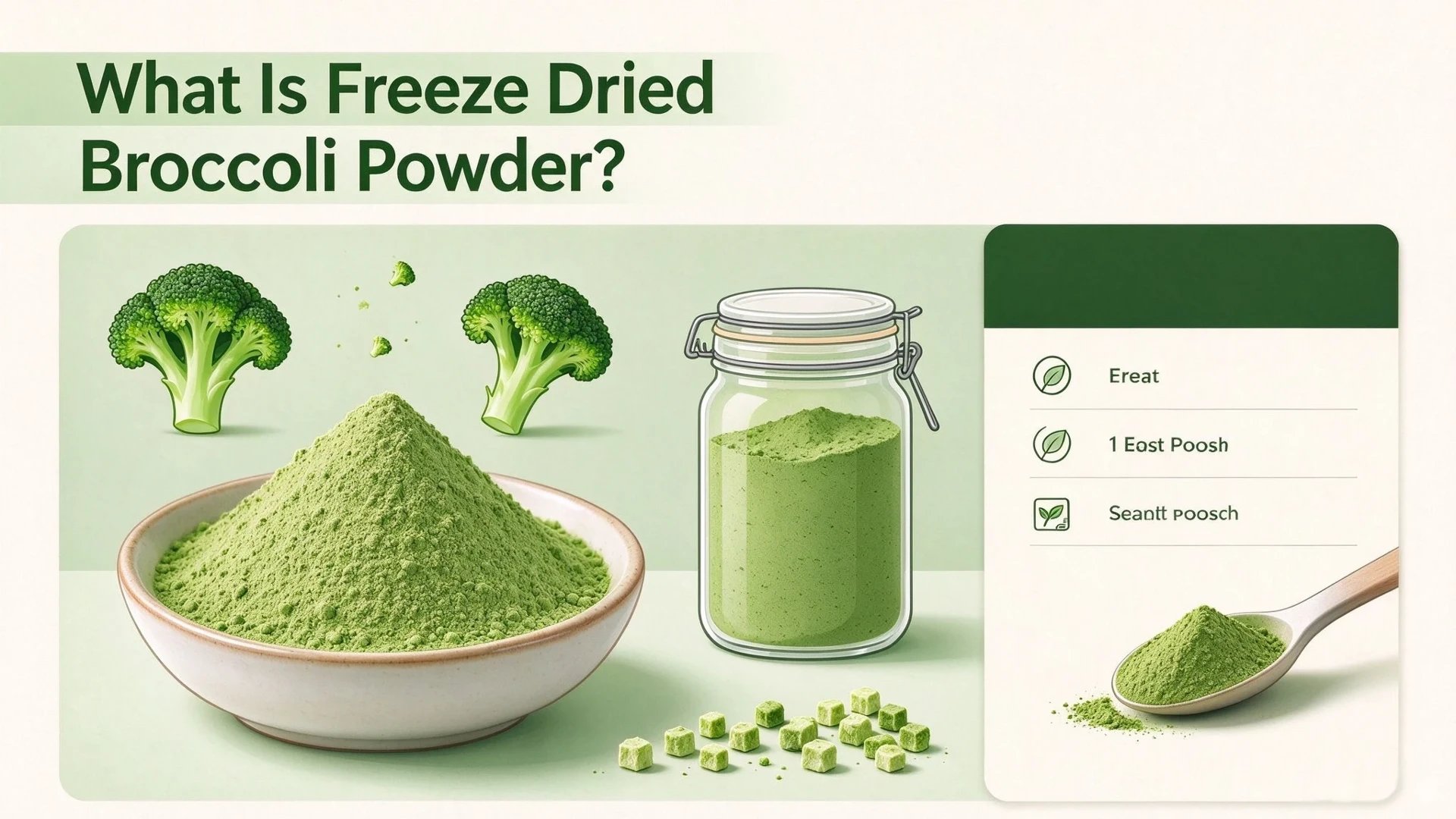
Freeze dried broccoli powder starts with fresh broccoli florets or stalks. The broccoli is washed, cut, and often blanched to protect color and enzymes. It then enters a vacuum freeze-dryer. The material is frozen at very low temperatures and the ice is removed as vapor under low pressure. The dried broccoli becomes brittle and is milled into a fine green powder.
This sequence matters. Water leaves the plant tissue without turning into liquid. Cell walls stay largely intact. Volatile aromas and heat-sensitive vitamins remain closer to their fresh state.
The result is a free-flowing powder with a mild, grassy broccoli taste and a deep green hue. A typical specification shows moisture below 5%, fine particle size through 80 mesh, and a shelf life of up to 24 months in proper storage. Some suppliers offer a concentration ratio near 15:1, meaning 15 kilograms of fresh broccoli yields roughly 1 kilogram of powder.
Why Freeze-Drying Beats Air-Drying for Nutrient Retention
You have options when you buy broccoli powder. Air-drying, hot-air drying, and spray-drying are common. Freeze-drying usually costs more, and the gap in quality explains the price difference.
Studies consistently show that freeze-drying preserves more of what makes broccoli valuable. A comparative drying study found that freeze-drying better retained broccoli nutrients while hot-air drying showed the worst effect. Another investigation reported that freeze-dried broccoli retained the highest vitamin C among the drying methods tested. Freeze-dried broccoli also showed the highest antioxidant activity in DPPH radical scavenging assays.
Color tells a similar story. Air-drying at 40°C retained only about 49% of pigments, while freeze-drying protected far more of the green chlorophyll. For a buyer, color is not cosmetic. Browning or yellowing often signals heat damage and lost bioactivity.
The Nutrition Inside: Sulforaphane, Glucoraphanin, and More
Broccoli's reputation rests on a family of sulfur-containing compounds called glucosinolates. The most studied is glucoraphanin. When broccoli cells are damaged-by chopping, chewing, or milling-an enzyme called myrosinase converts glucoraphanin into sulforaphane. Freeze-drying is particularly effective at preserving both glucoraphanin and myrosinase, so the powder can still generate sulforaphane when consumed.
Sulforaphane interests researchers because it activates the Nrf2 pathway. This pathway switches on the body's own antioxidant and detoxification enzymes. It also helps calm inflammatory signaling and supports liver detoxification pathways.
Beyond sulforaphane precursors, freeze dried broccoli powder contributes:
- Vitamin C, a water-soluble antioxidant that supports immune function.
- Vitamin K, important for blood vessel and bone health.
- Minerals including calcium, copper, and manganese.
- Dietary fiber, which supports gut health and regularity.
- Carotenoids such as lutein and zeaxanthin, plus various phenolic compounds.
Commercial specs vary by supplier. One standard freeze-dried broccoli powder lists glucoraphanin at ≥0.3% by HPLC and retained vitamin C at ≥40 mg per 100 g. Higher-potency or sprout-based ingredients may show much higher glucosinolate figures. Always ask for a batch-specific certificate of analysis rather than relying on a marketing sheet.
Health Benefits You Can Discuss with Confidence
You do not need to make drug claims to explain why formulators choose this ingredient. The evidence supports several credible benefit areas.
Antioxidant support. Freeze-dried broccoli powder delivers a measurable ORAC value and helps neutralize free radicals. The sulforaphane pathway amplifies the body's own antioxidant defenses.
Detoxification and liver support. Sulforaphane enhances both Phase I and Phase II detoxification enzymes. These enzymes help the body process and clear harmful compounds.
Gut and digestive health.The fiber in broccoli powder feeds beneficial bacteria and supports regular bowel movements.
Hormone metabolism support. Broccoli contains indole-3-carbinol (I3C) and its derivative DIM. These compounds influence how estrogen is metabolized in the body.
Convenience without refrigeration. Fresh broccoli has a short shelf life. The powder delivers concentrated broccoli nutrition in a stable format that does not require cold storage before opening.
I keep these points grounded in mechanism and nutrient content. Responsible marketing avoids turning preliminary research into medical promises.
Where Freeze Dried Broccoli Powder Fits in Product Development
Formulators use freeze dried broccoli powder across a wide range of applications. The ingredient behaves well in dry mixes and adds both nutrition and natural color.
Common uses include:
- Soups, sauces, and gravies. The powder disperses smoothly and brings a clean vegetable note without fresh prep.
- Smoothies and beverage blends. It mixes into water, juice, or yogurt with minimal grit when milled fine.
- Dietary supplements and capsule fills. Standardized glucoraphanin specs support dosage-driven formulations.
- Seasoning blends and snack seasonings. It adds green color and a mild brassica flavor.
- Baked goods and functional foods. The powder can boost nutrient density without changing the processing line dramatically.
- Pet and animal nutrition. Broccoli-derived ingredients appear in premium pet formulations for antioxidant support.
The market context supports these uses. The global broccoli powder market was valued at roughly USD 286.5 million in 2025 and is projected to reach USD 586.8 million by 2034. Clean-label and plant-based product trends continue to pull vegetable powders into new categories.
What B2B Buyers Should Verify Before Placing an Order
If you source ingredients for a brand or a manufacturing facility, your evaluation goes beyond the spec sheet. I recommend a structured checklist.
Processing method.Confirm that the supplier uses true vacuum freeze-drying, not hot-air drying labeled as "low-temperature." Freeze-drying protects glucoraphanin and chlorophyll far better than heat drying.
Certificate of Analysis per batch. Request a COA that covers glucoraphanin or sulforaphane potential, vitamin C, moisture, heavy metals, and microbiological counts. A transparent supplier will provide this without friction.
Color and solubility. Deep green color and smooth dispersion are practical quality signals. Yellowing or uneven color can indicate heat damage or adulteration.
Certifications. Depending on your market, look for cGMP, ISO 22000, USDA Organic, EU Organic, Kosher, Halal, or HACCP. These certifications reduce your audit burden and support retail claims.
Supply capacity and lead time. Ask about annual output, minimum order quantity, and shipping terms. Reliable suppliers publish clear delivery windows for express, air, and sea freight.
Traceability. A supplier should know the farm region, harvest window, and processing lot for the material in your sample.
Shaanxi Jiuyuan Biotechnology operates a production facility with a 2,000-square-meter Class 100,000 cleanroom and an annual capacity exceeding 6,000 tons. The company holds cGMP, USDA Organic, ISO9001, and ISO22000 certifications. You can request a free sample and a batch COA by writing to info@jiuybiotech.com.
Storage, Handling, and Formulation Notes
Freeze dried broccoli powder is hygroscopic. It pulls moisture from the air if left open. Keep the powder in its original sealed packaging in a cool, dry place away from strong light and heat. Once a bag is opened, reseal it tightly or transfer the powder to an airtight container.
In formulations, the powder's low bulk density and fine particle size can affect flow. Ultra-fine milling improves solubility and dispersibility, but it also reduces bulk density. Adjust your filler or carrier system accordingly. For dry blends, consider whether the powder needs a flow agent or a granulation step to prevent caking.
Shelf life is typically 24 months under recommended conditions. Stability testing for your specific matrix is still wise. Vitamin C and carotenoids can oxidize over time when exposed to air and light.
Frequently Asked Questions Buyers Ask
- How does freeze-dried broccoli powder compare to fresh broccoli by weight?
The powder is concentrated. One reference point suggests that 100 grams of broccoli powder delivers benefits comparable to about 1 kilogram of fresh broccoli. Exact equivalence depends on the starting material and processing yield.
- Does freeze-drying destroy sulforaphane?
Freeze-drying preserves glucoraphanin and myrosinase, the precursors needed for sulforaphane formation. The conversion happens when the powder is consumed and exposed to moisture.
- Can I use this powder in organic-certified products?
Yes, if you source an organic-certified grade. Look for USDA Organic or EU Organic documentation on the specific lot.
- What is the typical lead time for bulk orders?
Lead time depends on quantity and destination. Suppliers often quote 3–5 days for express shipments under 100 kg and around 30 days for sea freight over 300 kg.
Let's Talk About Your Formulation
Freeze dried broccoli powder gives you a stable, concentrated way to bring broccoli's glucosinolates, vitamin C, fiber, and natural green color into products that fresh broccoli cannot easily reach. The ingredient works best when you verify the processing method, review a batch COA, and confirm certifications that match your market.
If you are comparing suppliers or need a specification to start your formulation, reach out to the Jiuyuan Biotech team at info@jiuybiotech.com. Share your target application and required glucoraphanin range. The team can provide a sample, a current COA, and shipping options for your region.