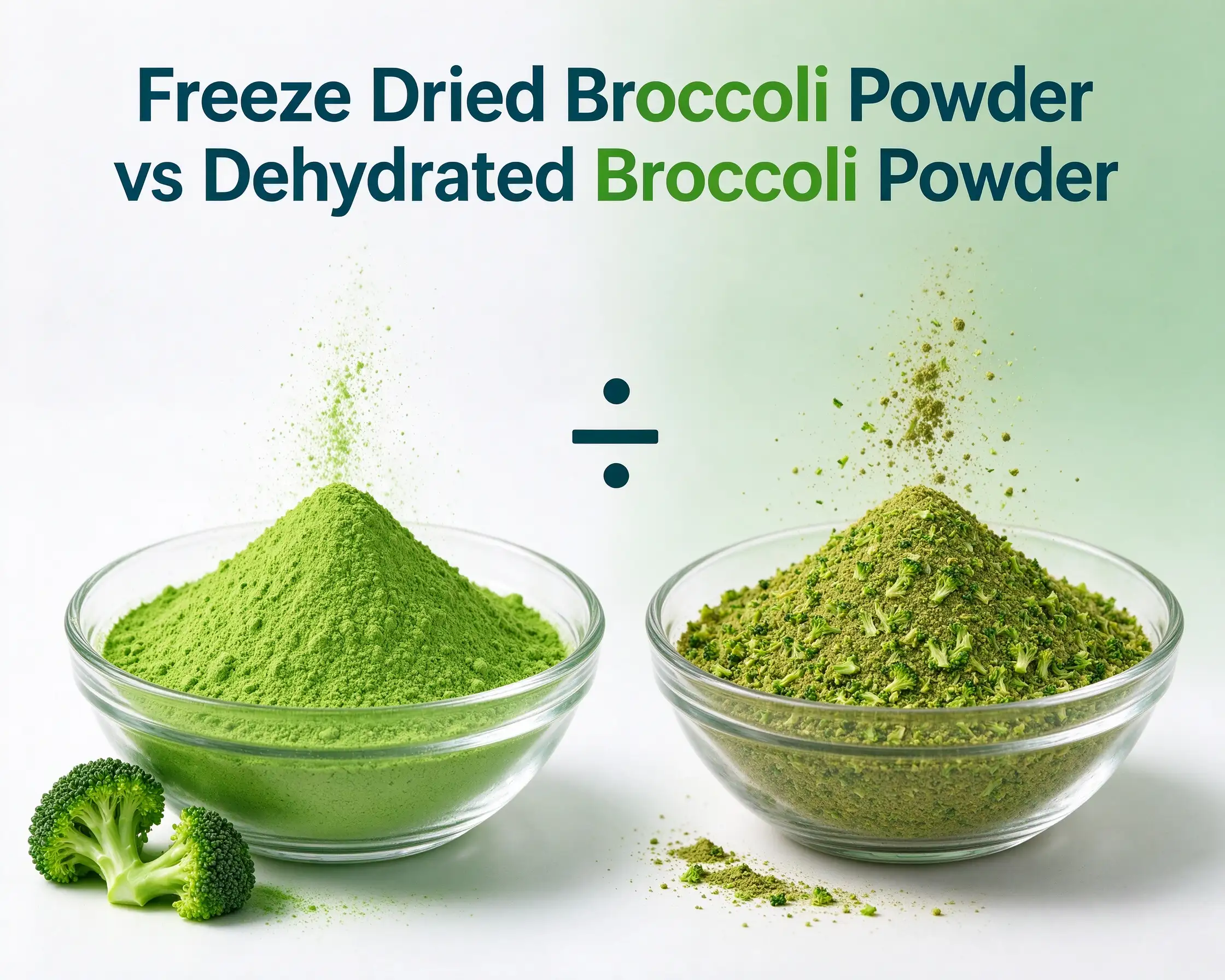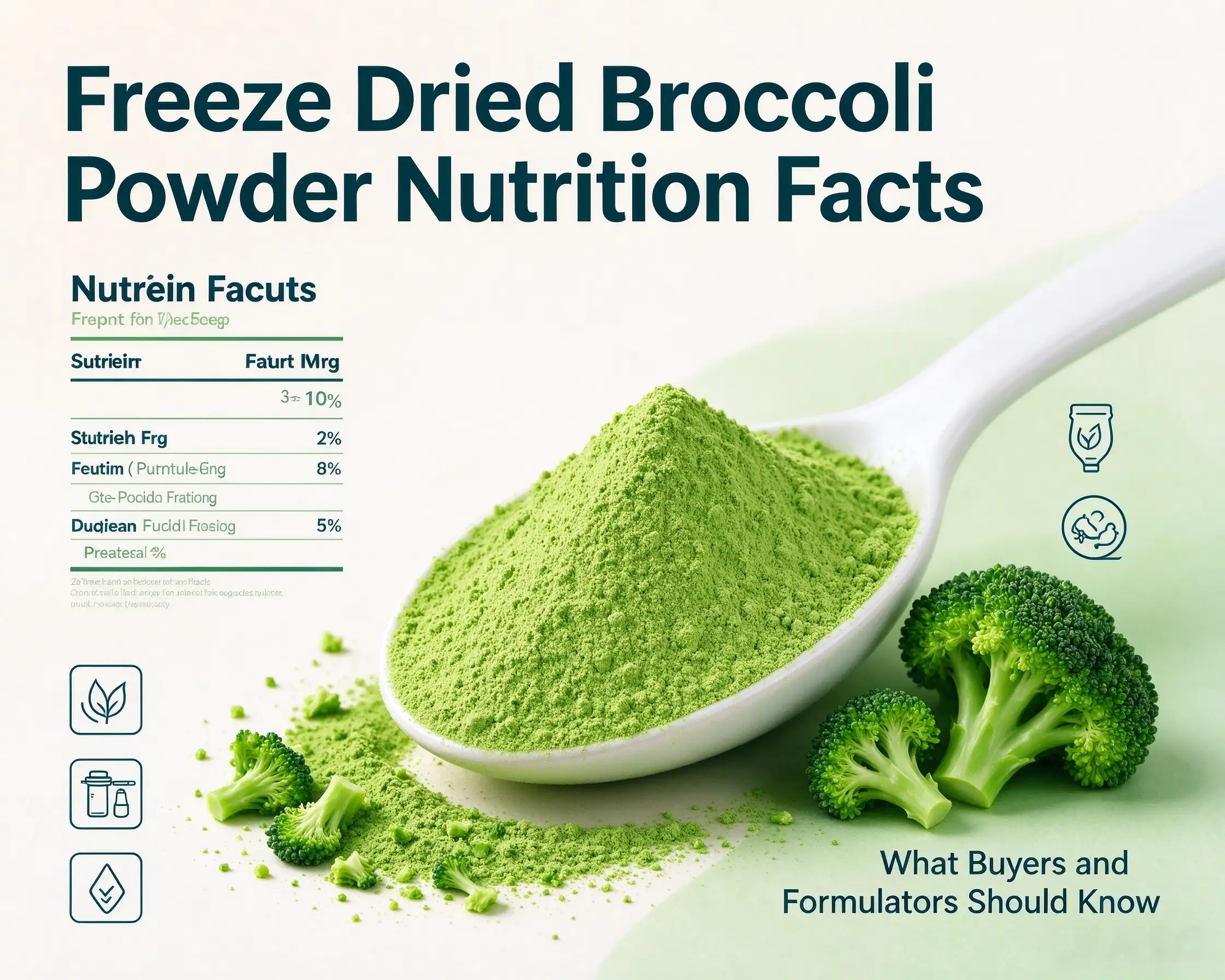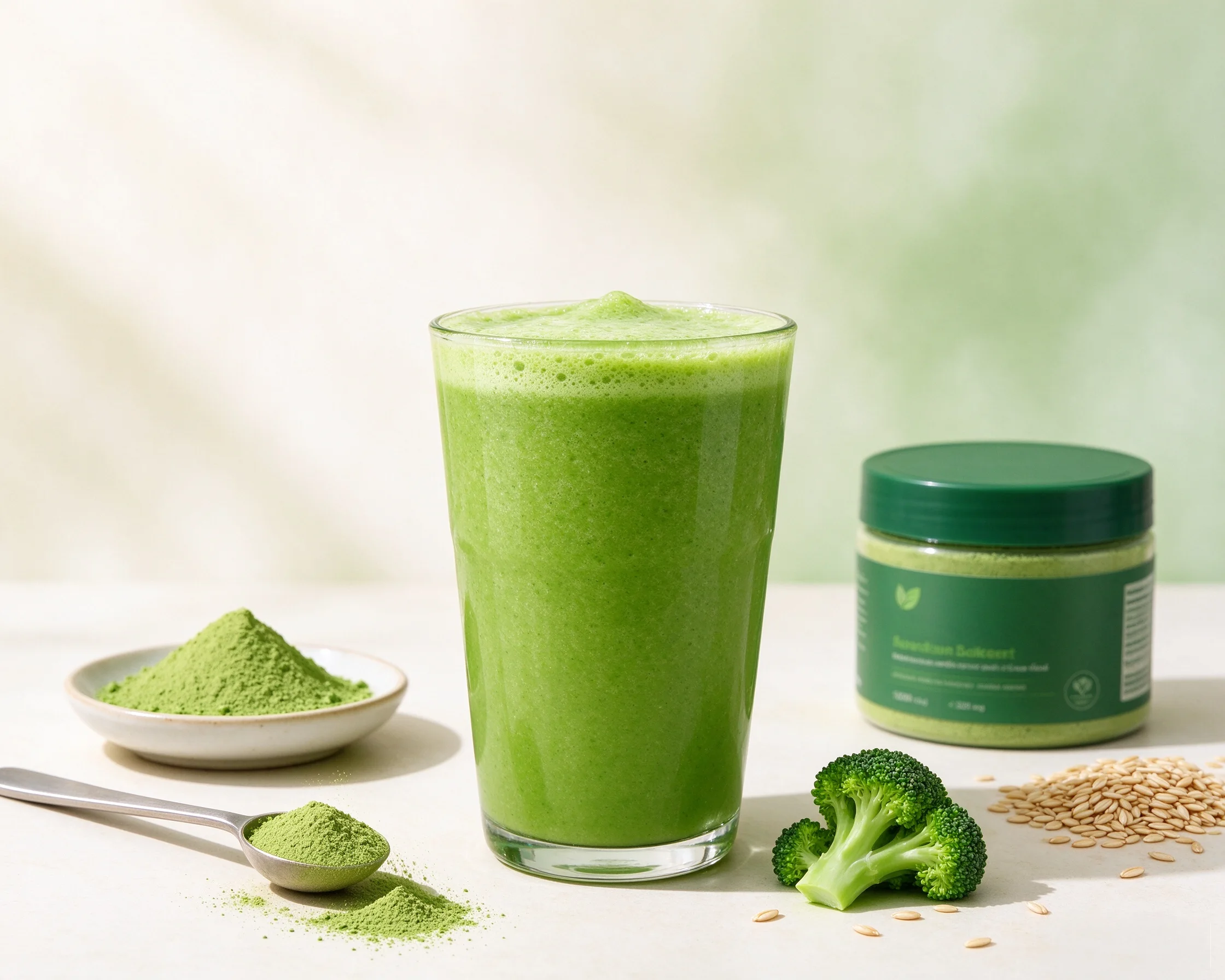
When you're building a supplement, functional food, or nutraceutical product, the ingredient form you choose shapes everything - from label claims to shelf life to customer results. Freeze dried broccoli powder and dehydrated broccoli powder both start with the same vegetable, but they end up as very different ingredients by the time they reach your formulation lab.
This guide walks you through the real differences between the two. It covers nutrition retention, bioactive compound integrity, cost trade-offs, and which format fits which product type - so you can make a confident sourcing decision.
How Each Drying Method Actually Works
Understanding the process helps you predict the outcome. These two methods treat broccoli in fundamentally different ways.
Freeze Drying (Lyophilization)
Freeze drying works in three stages:
- Freezing - Fresh broccoli is rapidly frozen, typically at temperatures below -40°C
- Primary drying - The frozen product enters a vacuum chamber, where ice sublimates directly into vapor (no liquid phase)
- Secondary drying - Residual moisture is removed under continued vacuum
The entire process happens at low temperatures. Heat-sensitive compounds - including vitamin C, glucosinolates, and chlorophyll - stay largely intact.
Dehydration (Hot Air or Drum Drying)
Conventional dehydration uses heat - typically between 50°C and 90°C - to evaporate moisture from broccoli over several hours. It's faster and cheaper than freeze drying, but the sustained heat exposure degrades a measurable portion of the vegetable's bioactive content.
Some manufacturers use spray drying, which atomizes a broccoli slurry into a hot air chamber. This produces a fine powder quickly but subjects the material to even higher temperatures for a short burst.
Nutritional Comparison: The Numbers That Matter
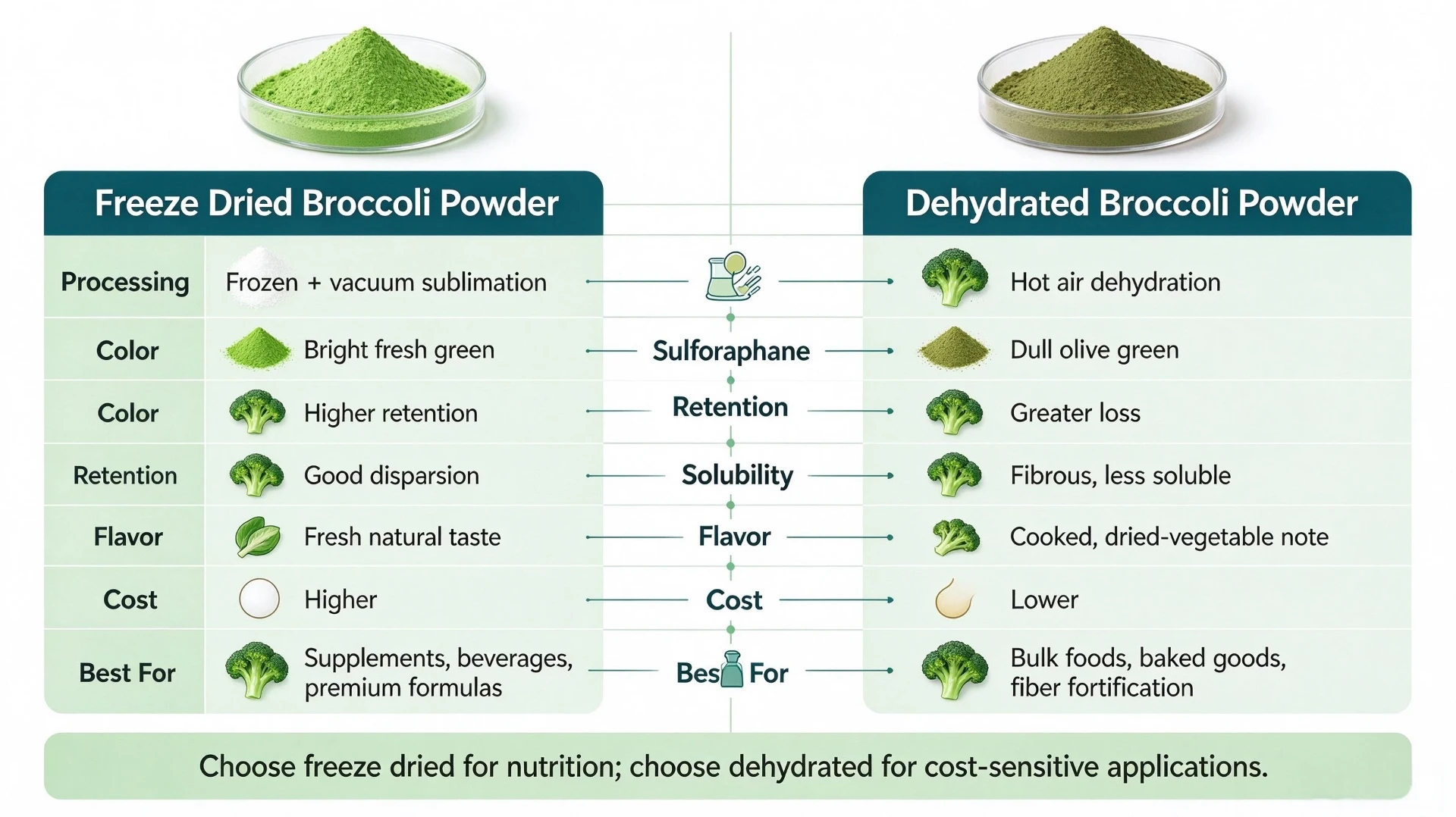
Here's a side-by-side look at how the two methods compare on key nutritional markers. Values are based on published food science research and industry-standard testing data.
|
Nutrient / Compound |
Freeze Dried Broccoli Powder |
Dehydrated Broccoli Powder |
|
Vitamin C Retention |
90–95% of fresh |
30–60% of fresh |
|
Glucosinolate Retention |
80–90% of fresh |
40–65% of fresh |
|
Chlorophyll (Color) |
Bright green, stable |
Olive to yellow-green |
|
Flavor Profile |
Fresh, mild, true-to-vegetable |
Cooked, sometimes bitter |
|
Moisture Content |
1–3% |
5–10% |
|
Shelf Life |
24–36 months |
12–24 months |
|
Particle Density |
Light, porous |
Denser, heavier |
|
Cost per kg |
Higher |
Lower |
Data context: Vitamin C and glucosinolate retention figures draw from peer-reviewed studies in Food Chemistry and Journal of Food Science, which consistently show lyophilization outperforming heat-based drying for heat-labile nutrients.
Vitamin C: The Clearest Difference
Vitamin C degrades rapidly above 60°C. Freeze drying never reaches that threshold. Dehydration almost always does.
For a product where you want to make a vitamin C content claim, freeze dried broccoli powder gives you a far more reliable starting point. You spend less on fortification and your label reflects the actual ingredient - not a compensated value.
Glucosinolates: The Functional Food Argument
Glucoraphanin - the glucosinolate that converts to sulforaphane - is the compound that makes broccoli a functional ingredient rather than just a vegetable. Research from institutions including Johns Hopkins University has documented sulforaphane's role in activating the Nrf2 pathway and supporting antioxidant enzyme activity.
Freeze drying preserves glucoraphanin at significantly higher levels than heat drying. If your formula targets detox support, liver health, or antioxidant positioning, this difference is not cosmetic - it directly affects what your product can deliver.
Sensory and Physical Properties: What Formulators Notice First
Beyond nutrition, the physical characteristics of your powder affect how your product performs in manufacturing.
Color
Freeze dried broccoli powder holds its vivid green color because chlorophyll remains intact. Dehydrated powder often shifts toward olive or brownish-green tones due to chlorophyll degradation during heat exposure.
For finished products where visual appeal matters - smoothie blends, green superfood powders, functional snacks - color consistency is a real differentiator on shelf.
Flavor
Freeze dried powder tastes closer to fresh broccoli. Dehydrated powder often carries a cooked or slightly sulfurous note. In high-inclusion formulas (above 5% by weight), this flavor difference becomes noticeable to end consumers.
Solubility and Texture
Freeze dried powder has a porous, lightweight structure due to the sublimation process. It rehydrates quickly and disperses well in water-based formulas. Dehydrated powder tends to be denser and may require more mixing time or a dispersing agent.
Cost Considerations: Where Each Method Makes Sense
Freeze drying costs more - that's a straightforward fact. The equipment is expensive, the process is slower, and energy consumption is higher. Expect to pay a 20–40% premium for freeze dried broccoli powder over a comparable dehydrated product.
But cost-per-kilogram is not the same as cost-per-outcome.
When freeze dried is worth the premium:
- Your product targets health-conscious consumers who read ingredient labels
- You're making specific nutrient or bioactive claims (vitamin C, glucosinolates, sulforaphane precursors)
- Your brand positioning emphasizes "clean," "whole food," or "minimally processed"
- You're formulating for premium supplement or nutraceutical categories
When dehydrated may be sufficient:
- Your formula uses broccoli powder primarily for flavor, color, or fiber contribution
- Bioactive content is not a primary label claim
- You're working within tight cost constraints on a commodity product
- The powder represents a minor percentage of the total formula
Neither option is universally better. The right choice depends on what your product needs to do.
Regulatory and Label Claim Implications
This is where the sourcing decision gets serious for B2B buyers.
If you plan to make structure/function claims related to antioxidants, detoxification support, or vitamin C content, your ingredient needs to support those claims with documented testing data. Freeze dried broccoli powder gives you a stronger evidentiary foundation.
What to request from any supplier:
- Certificate of Analysis (COA) with third-party verification
- HPLC testing for glucosinolate content (specifically glucoraphanin)
- Vitamin C assay results per batch
- Heavy metals and microbial testing (lead, arsenic, cadmium, E. coli, Salmonella)
- Moisture content and water activity data
A supplier who can't provide these documents on request is a supplier worth reconsidering.
Application Match: Which Powder Fits Which Product?
Here's a practical breakdown by product category to help you match the right format to your formulation goals.
Freeze dried broccoli powder fits best in:
- Green superfood capsules and tablets
- Antioxidant and detox supplement blends
- Premium meal replacement powders
- Functional beverage mixes where color and flavor matter
- Infant and toddler nutrition (where nutrient density is critical)
- Private label products competing on ingredient quality
Dehydrated broccoli powder fits best in:
- Soup and sauce bases (flavor contribution, not bioactives)
- Extruded snack coatings
- Pet food formulations
- Budget-tier vegetable blend powders
- Applications where broccoli is a minor ingredient by weight
What to Ask Your Supplier Before You Commit
Whether you're evaluating freeze dried or dehydrated options, these questions protect your formulation and your brand:
- Is this 100% single-ingredient powder, or a blend?
- What broccoli cultivar is used, and where is it grown?
- What is the glucoraphanin content per gram (HPLC verified)?
- What is the vitamin C content per 100g (verified by third-party lab)?
- What certifications does your facility hold (ISO 22000, HACCP, organic)?
- What is the minimum order quantity for sampling vs. bulk?
- How is the powder packaged to prevent moisture absorption during transit?
These questions separate reliable ingredient partners from commodity brokers.
Why Jiuyuan Bio Is a Trusted Source for Freeze Dried Broccoli Powder
At Jiuyuan Bio, we produce 100% freeze dried broccoli powder with full traceability from raw material to finished batch. Our facility operates under ISO-certified food safety protocols, and every batch ships with a complete COA backed by third-party lab testing.
What sets our product apart:
- Pure freeze dried broccoli - no fillers, no blending with spray-dried material
- Verified glucosinolate content available on request
- Consistent green color and fresh flavor profile across batches
- Flexible MOQ for both sampling and large-scale production runs
- Custom packaging with nitrogen flushing for maximum shelf life
Explore full product specifications here: 👉 Freeze Dried Broccoli Powder – Jiuyuan Bio
Ready to request a sample or discuss your formulation needs? Contact our team at info@jiuybiotech.com. We typically respond within one business day.
References
- Mahn, A., & Reyes, A. (2012). An overview of health-promoting compounds of broccoli (Brassica oleracea var. italica) and the effect of processing. Food Science and Technology International, 18(6), 503–514.
- Oliviero, T., Verkerk, R., & Dekker, M. (2018). Isothiocyanate formation in broccoli as affected by glucosinolate content, myrosinase activity, pH, and temperature. Food Chemistry, 263, 98–103.
- Ratti, C. (2001). Hot air and freeze-drying of high-value foods: A review. Journal of Food Engineering, 49(4), 311–319.
- Fahey, J. W., Zhang, Y., & Talalay, P. (1997). Broccoli sprouts: An exceptionally rich source of inducers of enzymes that protect against chemical carcinogens. Proceedings of the National Academy of Sciences, 94(19), 10367–10372.
- Murador, D. C., Mercadante, A. Z., & de Rosso, V. V. (2016). Cooking techniques improve the levels of bioactive compounds and antioxidant activity in kale and red cabbage. Food Chemistry, 196, 1101–1107.
- Sagar, V. R., & Suresh Kumar, P. (2010). Recent advances in drying and dehydration of fruits and vegetables: A review. Journal of Food Science and Technology, 47(1), 15–26.