

If you work in supplement formulation or ingredient sourcing, broccoli seed extract is a name you've heard a lot lately. And for good reason. This ingredient sits at the center of one of the most well-researched bioactive pathways in modern nutraceutical science. But here's what most product developers and procurement managers don't fully understand: the compound everyone wants - sulforaphane - isn't actually what you're buying in the powder.
What you're buying is its precursor. And the conversion process between the two determines everything about your product's efficacy.
Let's unpack exactly how this works, why it matters for your formulation, and what to look for when sourcing at scale.
What Is Broccoli Seed Extract, Really?
Broccoli seed extract is a concentrated botanical ingredient derived from the seeds of Brassica oleracea var. italica. Seeds are used - rather than florets or sprouts - because they contain significantly higher concentrations of the target bioactive compounds.
The primary active compound in a quality broccoli seed extract is glucoraphanin - a glucosinolate that serves as the stable, storable precursor to sulforaphane.
Here's why this distinction matters:
● Sulforaphane itself is chemically unstable. It degrades rapidly under heat, oxidation, and standard manufacturing conditions.
● Glucoraphanin is thermally stable. It survives extraction, encapsulation, and shelf storage with minimal degradation.
● The conversion happens after ingestion - inside the gut - where microbial and enzymatic activity transforms glucoraphanin into active sulforaphane.
This biochemical design is actually an advantage for manufacturers. You get a stable, standardizable ingredient that delivers bioactive sulforaphane in vivo, where it counts.
The Glucoraphanin-to-Sulforaphane Conversion: Step by Step
Understanding this conversion pathway is non-negotiable for anyone formulating with broccoli seed extract. Here's how it works.
The Role of Myrosinase
Myrosinase is a plant enzyme (β-thioglucosidase) that catalyzes the hydrolysis of glucoraphanin into sulforaphane. In intact plant cells, glucoraphanin and myrosinase are stored in separate cellular compartments. When the cell is disrupted - through chewing, grinding, or processing - the two compounds meet and the reaction begins.
The conversion equation is straightforward:
Glucoraphanin + Myrosinase + Water → Sulforaphane + Glucose + Sulfate
What Happens During Industrial Extraction?
Most commercial extraction processes involve heat and aqueous solvents. This is where a critical trade-off occurs:
● Heat deactivates myrosinase. Standard extraction temperatures (50–80°C) denature the enzyme.
● The result: a glucoraphanin-rich extract with no active myrosinase.
● This is intentional for stability purposes - but it shifts the conversion burden entirely to the consumer's gut microbiome.
Research published in MDPI Nutrients confirmed that gastric acidity significantly affects myrosinase activity when the enzyme is co-delivered with glucoraphanin. This means the gut environment of each individual consumer plays a real role in conversion efficiency.
Gut Microbiome as the Conversion Engine
When myrosinase is absent in the supplement, gut bacteria - particularly Bacteroides and Lactobacillus species - step in as the conversion agents. However, this pathway is less efficient and highly variable between individuals.
Research from PMC showed that mean sulforaphane bioavailability from glucoraphanin-rich preparations lacking active myrosinase was roughly 10% of the administered dose.
This is a critical data point for formulators. It directly informs decisions about:
● Whether to add exogenous myrosinase to your formula
● What glucoraphanin potency level to specify from your supplier
● How to set realistic label claims for sulforaphane equivalents

How Exogenous Myrosinase Changes the Equation
One of the most significant recent developments in broccoli seed extract formulation is the addition of exogenous myrosinase - typically sourced from mustard seed - to glucoraphanin-rich extracts.
A randomized clinical study published in Nature Scientific Reports demonstrated that adding exogenous myrosinase from mustard seed significantly increased sulforaphane bioavailability from a glucoraphanin-rich broccoli seed extract compared to glucoraphanin alone.
Practical implications for formulators:
● Combining a standardized glucoraphanin extract with a myrosinase source creates a more predictable and higher-yield sulforaphane delivery system.
● This approach is now used in several premium supplement SKUs targeting the clinical and functional medicine markets.
● It also allows brands to make stronger, more defensible bioavailability claims on their labels.
If your target market is health-conscious consumers or clinical practitioners, this dual-ingredient strategy is worth serious consideration.
Sulforaphane and the NRF2 Pathway: Why Buyers Care
Once sulforaphane forms in the gut and enters systemic circulation, it activates one of the most important cellular defense mechanisms in human biology: the NRF2 (Nuclear Factor Erythroid 2-Related Factor 2) pathway.
Here's what NRF2 activation actually does:
● Upregulates phase II detoxification enzymes - including glutathione S-transferase and quinone reductase
● Induces antioxidant response element (ARE) genes - boosting the body's endogenous antioxidant capacity
● Reduces oxidative stress markers - documented in multiple human clinical trials
● Modulates inflammatory signaling - through suppression of NF-κB activity
Importantly, sulforaphane does not act as a direct antioxidant in the conventional sense. Research published in PMC clarified that sulforaphane is actually weakly pro-oxidant at the cellular level - and it's precisely this mild oxidative signal that triggers the NRF2 upregulation response.
A clinical trial registered at ClinicalTrials.gov (NCT01315665) confirmed that sulforaphane consumed from broccoli sprouts activated NRF2, reduced oxidative metabolites, and reduced neutrophil counts in the oral mucosa after just 5 days of supplementation.
This mechanism is why broccoli seed extract has attracted serious attention across multiple application categories:
● Liver health formulas - detoxification enzyme support
● Neuroprotection supplements - oxidative stress reduction in neural tissue
● Sports recovery products - cellular defense against exercise-induced oxidative damage
● Longevity and anti-aging lines - NRF2 as a core pathway target
● Autism spectrum disorder research - ongoing clinical investigation at multiple institutions
Broccoli Seed Extract vs. Broccoli Sprout Extract: Key Differences
This is one of the most common questions from procurement managers and formulators. Here's a clear breakdown:
|
Factor |
Broccoli Seed Extract |
Broccoli Sprout Extract |
|
Glucoraphanin concentration |
Very high (seeds are the richest source) |
High (3–5 day sprouts) |
|
Myrosinase activity |
Typically absent (heat-processed) |
Present in fresh/raw preparations |
|
Stability |
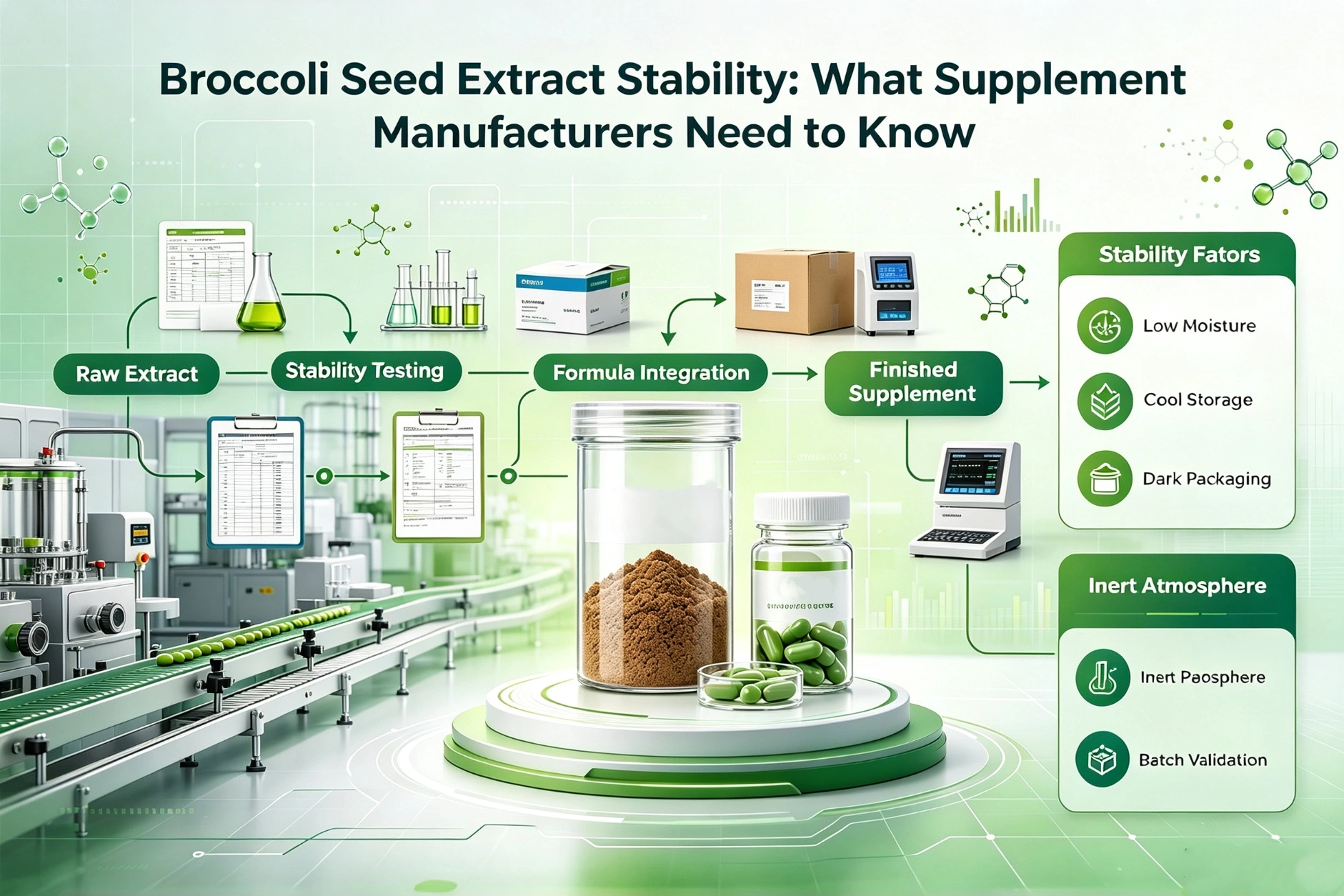
Excellent - 24+ month shelf life |
Lower - enzyme activity degrades |
|
Standardization |
HPLC-verified, batch-consistent |
More variable |
|
Scalability |
High - suitable for large B2B orders |
Moderate |
|
Cost at scale |
More cost-efficient per unit of glucoraphanin |
Higher cost for equivalent potency |
For commercial supplement manufacturing, broccoli seed extract standardized to glucoraphanin offers the most reliable, scalable, and cost-efficient route to a sulforaphane-delivering product.
What Specifications Should You Request from a Supplier?
If you're sourcing bulk broccoli seed extract for commercial production, these are the non-negotiable parameters to verify before placing any order.
Active compound specifications:
● Glucoraphanin content (%) - verified by HPLC, not colorimetric assay
● Sulforaphane equivalent (if claimed) - must be calculation-based from glucoraphanin, not direct measurement of unstable sulforaphane
Physical parameters:
● Moisture content: ≤5%
● Particle size: 80 mesh standard
● Appearance: off-white to light yellow fine powder
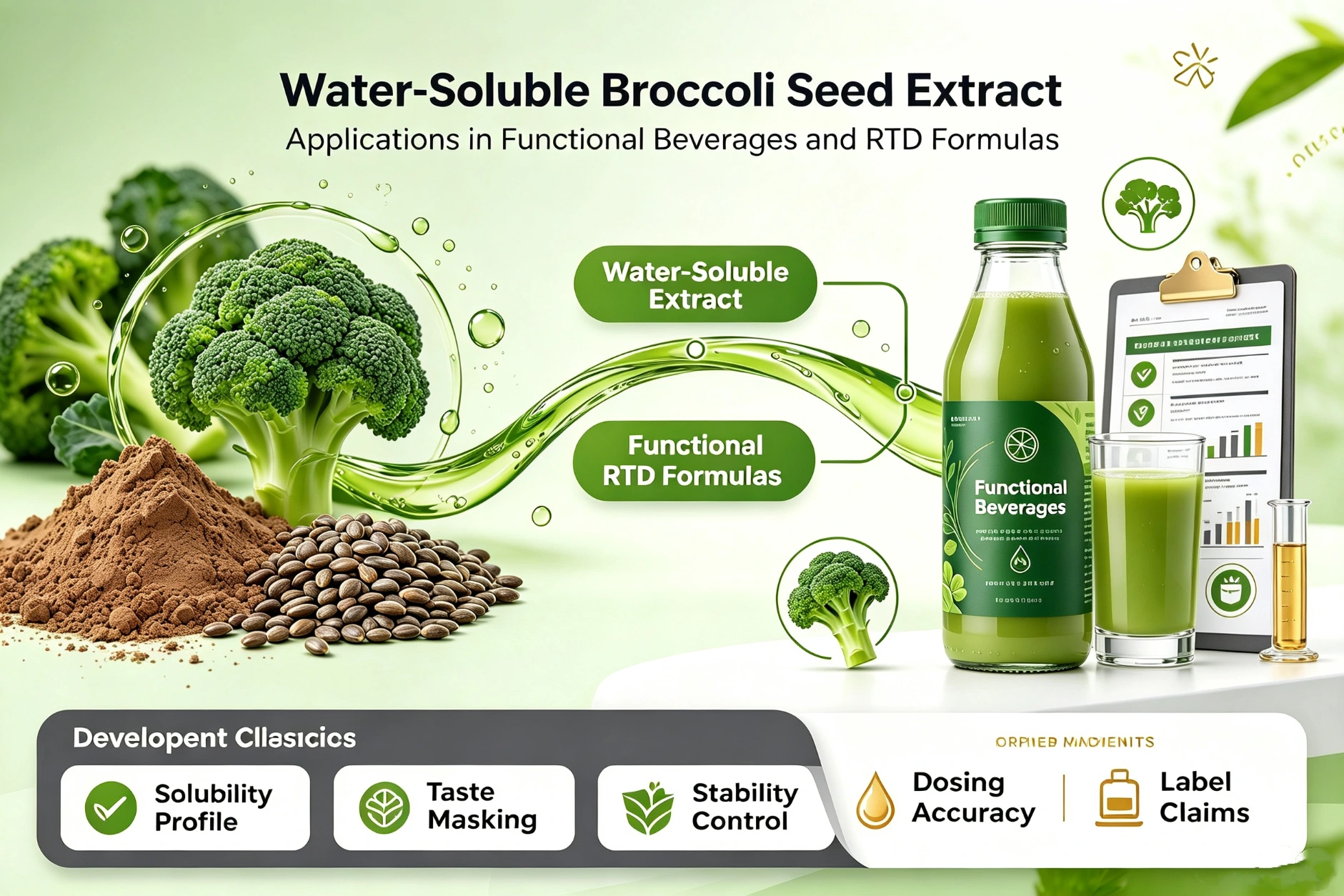
● Solubility: water-soluble grade available for beverage applications
Safety and compliance data:
● Heavy metals (Pb, As, Cd, Hg) - must meet USP/EP limits
● Residual solvents - ethanol ≤5,000 ppm (ICH Q3C Class 3)
● Microbiology - TPC, yeast/mold, Salmonella, E. coli absent
● Pesticide residue - multi-residue screening report
Certifications to request:
● cGMP manufacturing certification
● FSSC 22000 or ISO 22000 food safety
● Halal and Kosher (for global market access)
● USDA/EU Organic (for organic-certified product lines)
● Full batch-specific COA with HPLC chromatograms
Why the Extraction Method Determines Extract Quality
Not all broccoli seed extracts on the market are equal. The extraction process directly determines glucoraphanin yield, purity, and final powder performance.
The standard industrial process for high-quality broccoli seed extract:
1.Seed selection and incoming QC - HPLC verification of glucoraphanin content before processing begins
2.Defatting - Removal of seed oils via supercritical CO₂ or food-grade solvent; skipping this step produces sticky, poorly soluble powder
3.Aqueous-ethanol extraction - Typically 50–70% ethanol at 50–60°C; optimized for glucosinolate yield while protecting compound integrity
4.Filtration and clarification - Membrane filtration removes proteins and pigments; activated carbon treatment improves color and taste
5.Macroporous resin purification - Selective adsorption concentrates glucoraphanin and removes co-extracted impurities
6.Vacuum concentration - Solvent removal at low temperature (40–50°C) preserves bioactive integrity
7.Spray drying or freeze drying - Converts concentrate to stable powder; carrier agents (maltodextrin, silicon dioxide) improve flowability and shelf stability
8.Final QC and batch release - Full COA generated before any shipment leaves the facility
Each step in this sequence has a direct impact on the glucoraphanin content, batch-to-batch consistency, and downstream formulation performance of the finished extract.
Source Bulk Broccoli Seed Extract from a Verified Manufacturer
Understanding the science behind glucoraphanin and sulforaphane conversion gives you a real advantage as a formulator or procurement professional. It helps you ask the right questions, evaluate supplier claims critically, and build products that actually deliver on their label promises.
At Jiuyuan Biotech, we manufacture HPLC-standardized broccoli seed extract across three verified specifications:
● SFN-1: Sulforaphane equivalent ≥1%
● SFN-5: Sulforaphane equivalent ≥5%
● GR-13: Glucoraphanin ≥13%
Custom high-potency grades are available on request. Our facility holds 12 international certifications including ISO 9001, FSSC 22000, cGMP, USDA/EU Organic, Halal, and Kosher.
Every batch ships with a full COA including HPLC chromatograms, heavy metal reports, microbiology results, and residual solvent data.
Explore our broccoli seed extract product line: 👉 https://www.jiuyuanbio.com/standard-plant-extract-powder/broccoli-seed-extract.html
📧 Contact our ingredient specialists directly: info@jiuybiotech.com
We respond within 24 hours with samples, pricing, and full technical documentation.
References
1.Fahey, J. W., Wehage, S. L., Holtzclaw, W. D., Kensler, T. W., Egner, P. A., Shapiro, T. A., & Talalay, P. (2012). Protection of humans by plant glucosinolates: Efficiency of conversion of glucosinolates to isothiocyanates by the gastrointestinal microflora. Cancer Prevention Research, 5(4), 603–611.
2.Dinkova-Kostova, A. T., & Kostov, R. V. (2012). Glucosinolates and isothiocyanates in health and disease. Trends in Molecular Medicine, 18(6), 337–347.
3.Shapiro, T. A., Fahey, J. W., Dinkova-Kostova, A. T., Holtzclaw, W. D., Stephenson, K. K., Wade, K. L., Ye, L., & Talalay, P. (2006). Safety, tolerance, and metabolism of broccoli sprout glucosinolates and isothiocyanates: A clinical phase I study. Nutrition and Cancer, 55(1), 53–62.
4.Kensler, T. W., Egner, P. A., Agyeman, A. S., Visvanathan, K., Groopman, J. D., Chen, J. G., Chen, T. Y., Fahey, J. W., & Talalay, P. (2013). Keap1–Nrf2 signaling: A target for cancer prevention by sulforaphane. Topics in Current Chemistry, 329, 163–177.
5.Vanduchova, A., Anzenbacher, P., & Anzenbacherova, E. (2019). Isothiocyanate from broccoli, sulforaphane, and its properties. Journal of Medicinal Food, 22(2), 121–126.
6.Traka, M. H., & Mithen, R. F. (2011). Plant science and human nutrition: Challenges in assessing health-promoting properties of phytochemicals. The Plant Cell, 23(7), 2483–2497.