If you've ever worked with Yellow Powder Turmeric in a food, supplement, or cosmetic formulation, you already know one thing: that color is powerful. It stains, it signals, and it sells. But what actually makes turmeric so intensely yellow - and why does the color vary so much between suppliers?
The answer lies in curcuminoids - a group of natural polyphenolic pigments that define both the color and the quality of turmeric. Understanding this connection helps you source smarter, formulate better, and avoid costly supply chain mistakes.
Let's break it all down, from the chemistry to the COA.
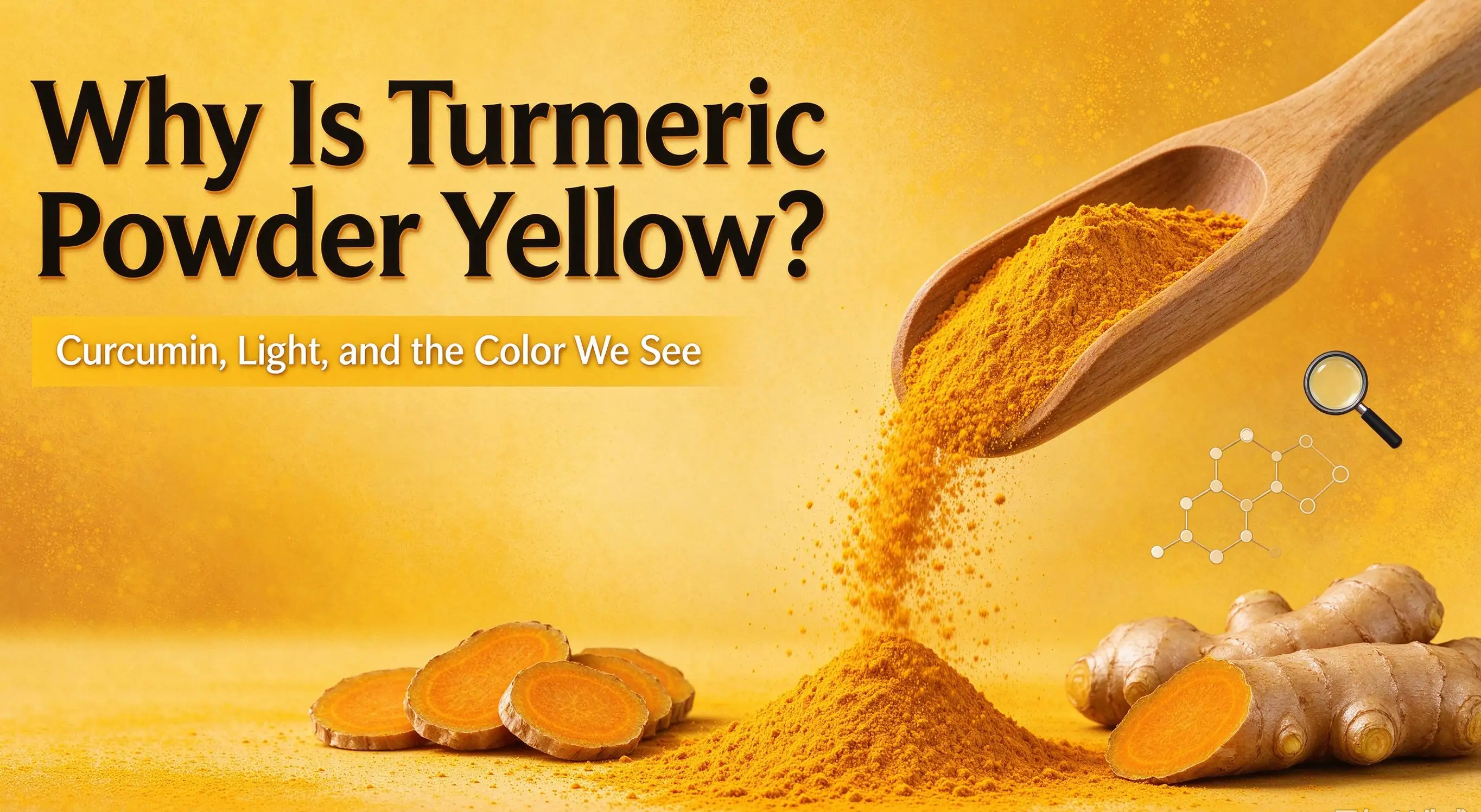
What Gives Turmeric Its Yellow Color?
The golden color of yellow powder turmeric isn't a coincidence of nature. It's the direct result of three specific compounds found in the rhizome (root) of Curcuma longa L.
These compounds are collectively called curcuminoids:
- Curcumin - the dominant pigment, accounting for 60–70% of total curcuminoids
- Demethoxycurcumin - the second most abundant compound
- Bisdemethoxycurcumin - present in smaller concentrations
Curcumin's molecular formula is C₂₁H₂₀O₆. Its structure features two ferulic acid units linked by a methylene bridge. This creates a conjugated π-electron system that absorbs light in the blue-violet range (around 420–430 nm). Your eyes perceive the reflected light as bright yellow and orange.
Here's a key historical fact: curcumin was first isolated from turmeric in 1870. Scientists identified its chemical structure as diferuloylmethane in 1910. Since then, it has become one of the most studied natural pigments in food science, pharmacology, and cosmetics.
How pH Changes Turmeric's Color - And Why That Matters
One of the most practical things to understand about yellow powder turmeric is its pH sensitivity.
- In acidic or neutral conditions → turmeric stays bright yellow
- In alkaline conditions → turmeric shifts to reddish-brown
This isn't a defect. It's basic chemistry. The phenolic hydroxyl groups in curcumin react to changes in pH, causing a visible color shift.
Why does this matter for formulators?
- Adding baking soda to a turmeric-based recipe turns it brownish - that's the pH effect in action
- Beverages, sauces, and supplements with high pH require pH-adjusted formulations to maintain color stability
- During quality testing, pH behavior is used as a quick authenticity check
Storage conditions also matter. Curcuminoids degrade when exposed to:
- Prolonged light (especially UV)
- High heat during processing or storage
- Moisture above 5%
As curcumin degrades, the yellow color fades and colorless breakdown products like vanillin and ferulic acid form. This is why proper packaging and cool, dry storage are non-negotiable for maintaining color quality.
Curcuminoid Content: The Real Driver of Color Quality
Not all yellow powder turmeric looks the same. Some batches are deep orange-yellow. Others appear pale, dull, or uneven. The single biggest factor behind this difference is curcuminoid concentration.
Here's what influences curcuminoid levels:
- Plant variety and cultivar - Different Curcuma longa cultivars naturally produce different curcuminoid profiles. Indian varieties like Alleppey and Madras are known for higher curcumin content.
- Growing region and soil quality - Altitude, rainfall, and mineral content all affect rhizome composition.
- Harvest timing - Rhizomes harvested at full maturity (8–10 months) contain peak curcuminoid levels.
- Processing method - Low-temperature drying preserves curcuminoids. High-heat processing degrades them.
- Extraction and purification - For extract-grade products, the method determines final purity and color intensity.
Standard turmeric spice powder contains roughly 2–9% curcuminoids. A high-purity turmeric extract, like the one Jiuyuan Biotech produces, reaches >95% curcumin by HPLC analysis.
Important note for buyers: Color alone is not a reliable quality indicator. A bright yellow appearance can be faked with artificial dyes or adulterants. Always request a batch-specific Certificate of Analysis (COA) with HPLC assay results.
Turmeric Adulteration: A Real Risk in the Supply Chain
This is a topic many suppliers avoid - but it's critical for B2B buyers to understand.
As demand for yellow powder turmeric and curcumin has grown globally, so has the risk of adulteration. Common adulterants include:
- Metanil yellow (a synthetic azo dye) - used to boost color in low-curcumin batches
- Lead chromate - a toxic yellow pigment historically used to enhance color
- Starch fillers - used to increase weight and reduce cost
- Other botanical powders - mixed in to dilute genuine turmeric
A scoping review of turmeric adulteration data from six continents found that high-quality turmeric is generally defined as having curcumin levels >3% for whole powder. For extract-grade products, the bar is significantly higher.
How to protect your supply chain:
✅ Request HPLC-verified curcumin assay on every batch
✅ Verify heavy metal testing - lead (Pb) should be <2.0 ppm
✅ Confirm the supplier's GC/MS testing for synthetic dye contamination
✅ Choose suppliers with third-party audits and internationally recognized certifications
The Three Extraction Methods That Shape Product Quality
How curcuminoids are extracted from turmeric rhizomes directly affects the final product's color, purity, and safety profile. There are three main commercial methods:
1. Alcohol Extraction ✅ Industry Standard
This method uses ethanol at 70–80% concentration, applied at room or elevated temperatures via immersion or percolation.
- Advantages: High efficiency, simple process, scalable, retains vibrant yellow color
- Best for: Food-grade and supplement-grade applications
- Solvent residue: Must be tested and confirmed within regulatory limits
2. Acid-Base Extraction ⚠️ Limited Use
This method dissolves curcuminoids in sodium hydroxide solution, then precipitates them by adjusting pH with dilute hydrochloric acid.
- Disadvantages: Curcumin degrades under alkaline conditions, lower final yield
- Best for: Certain industrial applications where purity requirements are lower
3. Enzyme-Assisted Extraction 🔬 Emerging Method
Cellulase and pectinase enzymes break down the cell wall of turmeric rhizomes to release more curcuminoids.
- Advantages: Potentially higher extraction rate, no harsh chemicals
- Disadvantages: Difficult to control reaction conditions, hard to scale commercially
For B2B buyers sourcing yellow powder turmeric at scale, alcohol extraction remains the preferred method for consistent color, purity, and regulatory compliance.
Full Technical Specifications: What a Quality COA Looks Like
Transparency in specifications is one of the clearest signals of a trustworthy supplier. Here is the full technical profile of Jiuyuan Biotech's Yellow Powder Turmeric (Batch No. TYJY241203):
|
Parameter |
Specification |
Result |
Method |
|
Latin Name |
Curcuma longa L. |
Confirms |
- |
|
Assay (Curcumin) |
>95% |
Confirms |
HPLC |
|
Appearance |
Fine Powder |
Confirms |
Organoleptic |
|
Color |
Orange Yellow |
Confirms |
Organoleptic |
|
Particle Size |
95% pass 80 mesh |
Confirms |
- |
|
Moisture |
<5.0% |
3.05% |
GB 5009.3 |
|
Ash Content |
<5.0% |
3.02% |
GB 5009.4 |
|
Total Heavy Metals |
<10 ppm |
Confirms |
GB 5009.74 |
|
Lead (Pb) |
<2.0 ppm |
Confirms |
GB 5009.12 |
|
Arsenic (As) |
<2.0 ppm |
Confirms |
GB 5009.11 |
|
Mercury (Hg) |
<0.01 ppm |
Confirms |
GB 5009.17 |
|
Total Plate Count |
NMT 1000 cfu/g |
Confirms |
GB 4789.15 |
|
E. Coli |
Negative |
Negative |
GB 4789.38 |
|
Salmonella |
Negative |
Negative |
GB 4789.31 |
|
Shelf Life |
24 months |
- |
Sealed, cool & dry |
This level of documentation is what separates a professional ingredient supplier from a commodity trader. Every parameter maps directly to a regulatory standard.
Where Yellow Powder Turmeric Is Used in B2B Applications
The commercial applications for yellow powder turmeric span multiple industries. Here's where it delivers the most value:
🍽️ Food & Beverage
- Natural yellow colorant for mustard, curry sauces, snack coatings, dairy products, and beverages
- Replaced expensive saffron in medieval Europe as a cost-effective natural colorant
- Widely used in traditional Indian, Middle Eastern, Persian, and Thai cuisines
💊 Dietary Supplements
- Capsules, tablets, and powders standardized to curcuminoid content
- Growing consumer demand for natural anti-inflammatory and antioxidant ingredients
- Requires >95% curcumin assay for premium supplement formulations
💄 Cosmetics & Skincare
- Antioxidant-rich ingredient for brightening serums, face masks, and anti-aging products
- Natural colorant for lip products and foundations
🏥 Pharmaceutical & Nutraceutical Research
- Research-grade curcumin for clinical studies
- Active area of investigation for anti-inflammatory and antioxidant applications
Certifications That Matter for Global B2B Sourcing
When you source yellow powder turmeric for regulated markets, certifications aren't optional. They're your entry ticket.
Here's what to look for - and why each one matters:
|
Certification |
Why It Matters |
|
ISO 9001 |
Confirms consistent quality management systems |
|
ISO 22000 / HACCP |
Verifies food safety management throughout production |
|
cGMP |
Current Good Manufacturing Practice - required for supplement manufacturing |
|
FDA Registration |
Required for products entering the US market |
|
Halal |
Required for Middle Eastern, Southeast Asian, and Muslim-majority markets |
|
Kosher |
Required for Jewish markets and many mainstream US retailers |
Jiuyuan Biotech's Yellow Powder Turmeric carries all six of these certifications: ISO 9001, ISO 22000, cGMP, HACCP, FDA, and Halal.
How to Evaluate a Turmeric Supplier: A Practical B2B Checklist
Before you place a bulk order for yellow powder turmeric, run through this checklist:
Documentation
- Batch-specific COA with HPLC curcumin assay
- Heavy metals panel (Pb, As, Cd, Hg)
- Microbiology results (E. coli, Salmonella)
- Solvent residue test (for extract-grade products)
Certifications
- ISO 9001 and ISO 22000 certificates (current, not expired)
- cGMP compliance documentation
- FDA facility registration number
- Halal / Kosher certificates if required for your market
Supply Chain
- Country of origin and source farm traceability
- Minimum order quantity (MOQ) and lead time
- Packaging options (double-sealed bags, drum, etc.)
- Sample availability before bulk order
Technical Support
- Formulation guidance available
- Regulatory documentation support for your target market
- Stability data for your application type
Conclusion: The Color Tells a Story - Make Sure You Read It Right
The vivid yellow of yellow powder turmeric is more than a visual cue. It's a window into the product's chemistry, quality, and supply chain integrity. High curcuminoid content produces deep, consistent color. Poor processing, adulteration, or improper storage produces the opposite.
For B2B buyers, the key takeaways are:
✅ Curcuminoids drive color - curcumin, demethoxycurcumin, and bisdemethoxycurcumin work together
✅ pH and storage conditions affect color stability - factor both into your formulation
✅ HPLC assay is the gold standard - never rely on visual inspection alone
✅ Adulteration is a real risk - verify every batch with a full COA
✅ Certifications open global markets - ISO, cGMP, FDA, and Halal are non-negotiable
✅ Alcohol extraction delivers the best results for food-grade and supplement-grade applications
📩 Source Premium Yellow Powder Turmeric from Jiuyuan Biotech
At Jiuyuan Biotech, we supply yellow powder turmeric (CAS No. 458-37-7) derived from carefully selected Curcuma longa rhizomes, standardized to >95% curcumin by HPLC. Every batch ships with a full COA covering assay, heavy metals, microbiology, and physical characteristics.
Our certifications: ISO 9001 · ISO 22000 · cGMP · HACCP · FDA · Halal
Ready to request a sample or get a bulk quote? 📧 Email us at info@jiuybiotech.com 🌐 Visit www.jiuyuanbio.com
References
- Chattopadhyay, I., Biswas, K., Bandyopadhyay, U., & Banerjee, R. K. (2004). Turmeric and curcumin: Biological actions and medicinal applications. Current Science, 87(1), 44–53.
- Priyadarsini, K. I. (2014). The chemistry of curcumin: From extraction to therapeutic agent. Molecules, 19(12), 20091–20112.
- Tayyem, R. F., Heath, D. D., Al-Delaimy, W. K., & Rock, C. L. (2006). Curcumin content of turmeric and curry powders. Nutrition and Cancer, 55(2), 126–131.
- Prasad, S., & Aggarwal, B. B. (2011). Turmeric, the Golden Spice: From Traditional Medicine to Modern Medicine. In Herbal Medicine: Biomolecular and Clinical Aspects (2nd ed.). CRC Press/Taylor & Francis.
- Anand, P., Kunnumakkara, A. B., Newman, R. A., & Aggarwal, B. B. (2007). Bioavailability of curcumin: Problems and promises. Molecular Pharmaceutics, 4(6), 807–818.
- Hewlings, S. J., & Kalman, D. S. (2017). Curcumin: A review of its effects on human health. Foods, 6(10), 92.