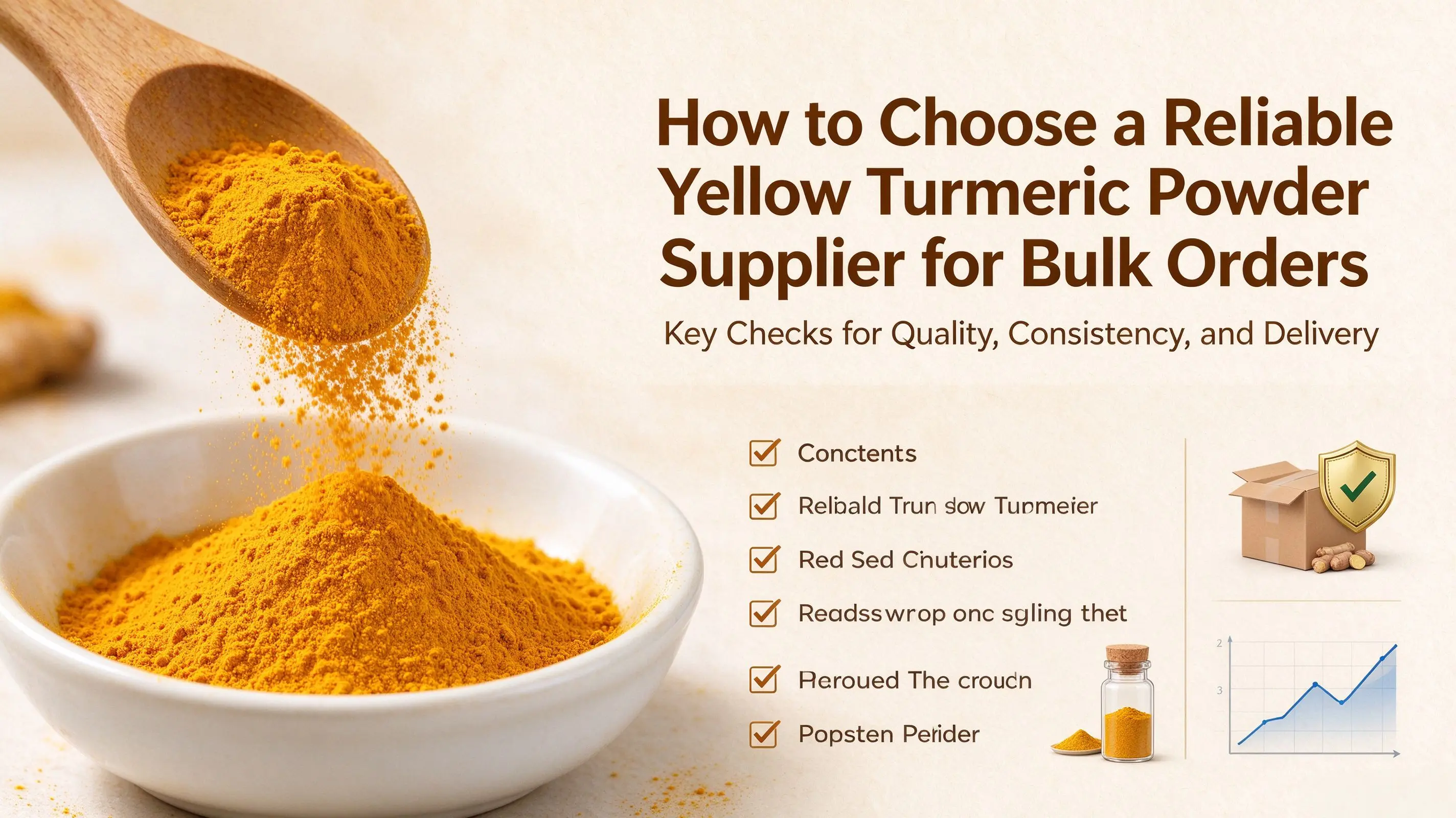
Sourcing yellow powder turmeric in bulk sounds straightforward - until you receive a shipment that fails your quality test, gets flagged at customs, or triggers a product recall. The global turmeric market is growing fast, and so is the number of suppliers cutting corners.
The truth is, not every supplier offering yellow turmeric powder delivers what they promise. Color can be faked. Certifications can be forged. And a low price per kilogram can cost you far more down the line.
This guide gives you a practical, experience-backed framework for evaluating suppliers - so you protect your brand, meet regulatory requirements, and build a supply chain you can actually rely on.
Why Supplier Selection Matters More Than You Think
When you buy yellow powder turmeric for food manufacturing, dietary supplements, or cosmetics, you're not just buying a commodity. You're buying a regulated ingredient that goes into products consumed by real people.
A bad supplier decision can lead to:
- Product recalls due to heavy metal contamination
- Regulatory rejection at US or EU customs
- Brand damage from adulterated or mislabeled ingredients
- Formulation failures from inconsistent curcuminoid content
- Legal liability from undisclosed allergens or synthetic dyes
The global turmeric adulteration problem is well-documented. Common adulterants include metanil yellow (a synthetic azo dye), lead chromate, starch fillers, and other botanical powders mixed in to reduce cost and boost apparent color.
Choosing the right supplier from the start is always cheaper than fixing problems after the fact.
Step 1: Verify Core Certifications Before Anything Else
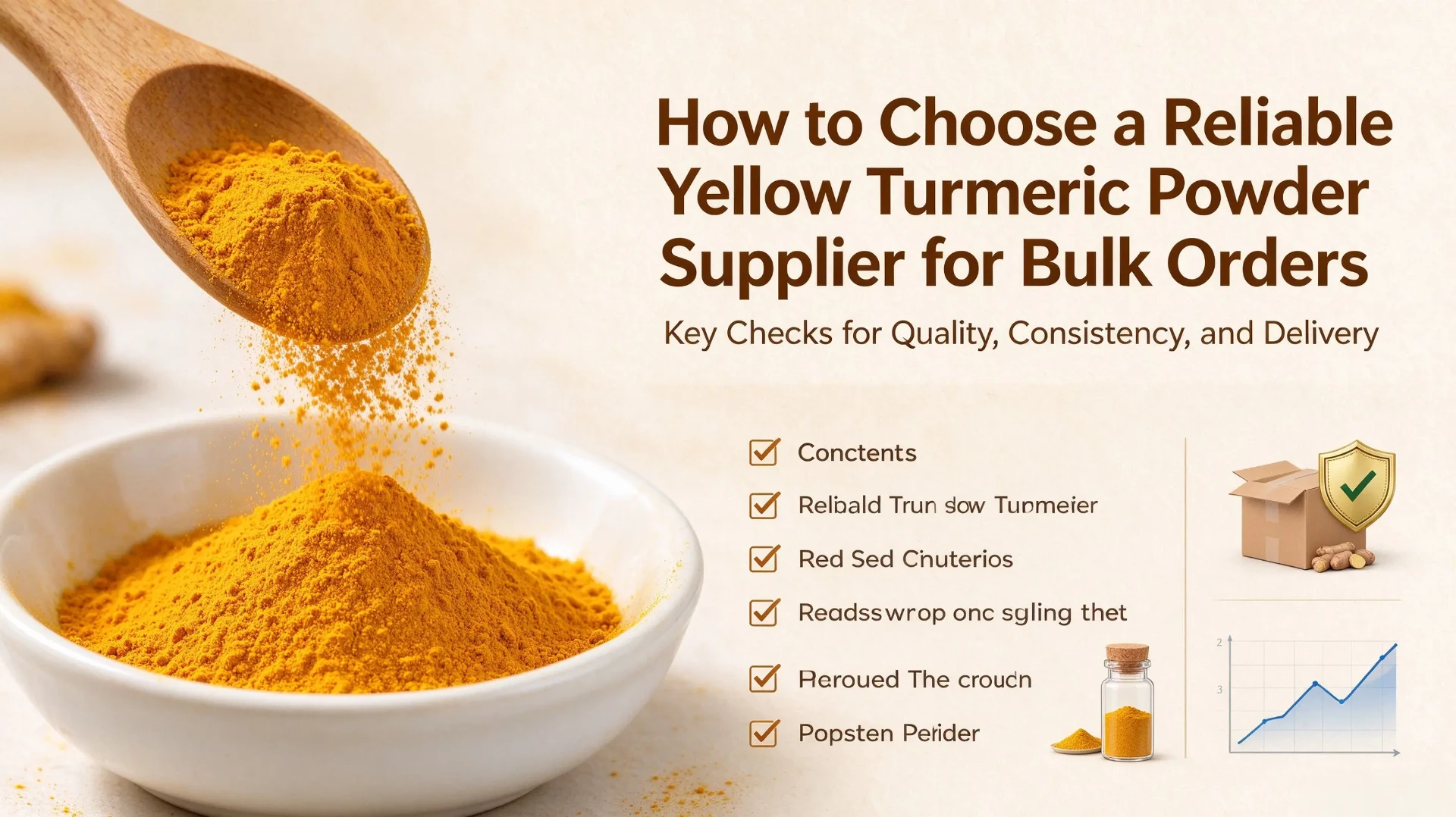
The first filter for any yellow turmeric powder supplier is certifications. These aren't just paperwork - they represent independently audited systems that protect your product and your customers.
Here are the certifications that matter most for bulk B2B sourcing:
|
Certification |
What It Confirms |
Why You Need It |
|
ISO 9001 |
Quality management system |
Consistent production standards |
|
ISO 22000 / HACCP |
Food safety management |
Hazard control throughout production |
|
cGMP |
Current Good Manufacturing Practice |
Required for supplement manufacturing |
|
FDA Registration |
US facility registration |
Mandatory for US market entry |
|
Halal |
Compliance with Islamic dietary law |
Required for Middle East & SE Asia |
|
Kosher |
Compliance with Jewish dietary law |
Required for specific US/EU markets |
Important: Always request the actual certificate documents - not just a logo on a website. Check the issuing body, certificate number, and expiry date. Expired or unverifiable certificates are a serious red flag.
FSSC 22000 and HACCP are widely considered the baseline certifications for functional ingredient procurement. Suppliers without at least these two should be approached with caution.
Step 2: Demand a Batch-Specific Certificate of Analysis
A Certificate of Analysis (COA) is the single most important document in bulk ingredient sourcing. Every serious yellow powder turmeric supplier should provide one for every batch - not a generic template, not a sample COA from six months ago.
A complete COA for yellow powder turmeric should include:
Marker Compounds
- Curcumin assay: >95% by HPLC (for extract-grade products)
- Declared curcuminoid content with analytical method specified
Physical Characteristics
- Appearance: orange-yellow fine powder
- Particle size: 95% pass 80 mesh
- Moisture: <5.0%
- Ash content: <5.0%
Heavy Metals Panel
- Total heavy metals: <10 ppm
- Lead (Pb): <2.0 ppm
- Arsenic (As): <2.0 ppm
- Cadmium (Cd): <1.0 ppm
- Mercury (Hg): <0.01 ppm
Microbiology
- Total plate count: NMT 1,000 cfu/g
- Total yeast & mold: NMT 100 cfu/g
- E. coli: Negative
- Salmonella: Negative
If a supplier hesitates to provide any of these parameters, treat it as a warning sign. Reputable suppliers welcome scrutiny - it's how they prove their value.
Step 3: Understand the Extraction Method and Its Impact on Quality
How a supplier extracts curcuminoids from turmeric rhizomes directly affects the color, purity, and safety of the final yellow powder turmeric product.
There are three main commercial extraction methods:
Alcohol Extraction ✅ Preferred for B2B
Uses ethanol at 70–80% concentration via immersion or percolation methods.
- Pros: High efficiency, scalable, retains vibrant orange-yellow color, widely accepted by regulators
- Best for: Food-grade, supplement-grade, and cosmetic applications
- Key check: Request solvent residue test to confirm ethanol is within regulatory limits
Acid-Base Extraction ⚠️ Limited Applications
Dissolves curcuminoids in sodium hydroxide, then precipitates with dilute hydrochloric acid.
- Cons: Curcumin degrades under alkaline conditions, lower yield, less color stability
- Best for: Certain industrial applications only
Enzyme-Assisted Extraction 🔬 Emerging Technology
Uses cellulase and pectinase enzymes to break down cell walls and release curcuminoids.
- Pros: No harsh chemicals, potentially higher extraction rate
- Cons: Difficult to scale, reaction conditions hard to control commercially
For most bulk yellow powder turmeric applications, alcohol extraction is the industry standard. Ask your supplier directly which method they use - and ask for supporting documentation.
Step 4: Evaluate Supply Chain Transparency and Traceability
A reliable yellow turmeric powder supplier can trace their product from the source farm all the way to your warehouse. This isn't just a nice-to-have - it's increasingly a regulatory requirement in the US, EU, and UK markets.
Ask these traceability questions before committing to a supplier:
- Where is the turmeric grown? Specific region and country of origin matter for regulatory compliance and quality consistency.
- What cultivar is used? High-curcumin varieties like Alleppey or Madras produce more consistent color and potency.
- How is the raw material tested before processing? Pre-processing testing catches contamination early.
- What is the batch numbering system? A clear batch number links every shipment back to a specific production run.
- Can you provide farm-to-COA documentation? Full traceability documentation protects you in the event of a regulatory audit or product recall.
Suppliers who can answer all five questions confidently are operating at a professional level. Those who deflect or give vague answers represent supply chain risk.
Step 5: Watch for These Red Flags in Supplier Communication
Experience in B2B ingredient sourcing teaches you to read between the lines. Here are the warning signs that a yellow powder turmeric supplier may not be reliable:
Documentation Red Flags
❌ Generic COA with no batch number or date
❌ Missing heavy metals or microbiology data
❌ Curcumin content stated as a range with no analytical method
❌ Certifications that are expired or from unrecognized bodies
Product Red Flags
❌ Color that looks unnaturally vivid or uniform (possible synthetic dye)
❌ Price significantly below market rate (often signals adulteration)
❌ No information about extraction method or solvent residue testing
❌ Inability to provide a pre-shipment sample
Business Red Flags
❌ No physical address or verifiable manufacturing facility
❌ Reluctance to allow factory audits or third-party inspections
❌ Pressure to place large orders before documentation is reviewed
❌ Communication that avoids specific technical questions
The supplement and food ingredient industry has seen repeated issues with suppliers using synthetic colorants like metanil yellow to boost the appearance of low-curcumin turmeric. This is both a food safety issue and a regulatory violation in most markets.
Step 6: Assess Technical Support and Long-Term Partnership Potential
The best yellow powder turmeric suppliers don't just ship product - they act as technical partners. This matters especially when you're developing new formulations or entering new markets.
Look for suppliers who offer:
- Formulation guidance - Can they advise on pH stability, solubility, and color performance in your specific application?
- Regulatory documentation support - Can they provide market-specific documentation for US FDA, EU EFSA, or other regulatory bodies?
- Stability data - Do they have shelf-life and stability data for different packaging and storage conditions?
- Custom specifications - Can they adjust particle size, moisture content, or curcuminoid levels to meet your exact needs?
- Responsive communication - Do they answer technical questions quickly and accurately?
A supplier who invests in your success is a supplier worth keeping. One who disappears after the first shipment is a liability.
Step 7: Request Samples and Run Your Own Testing
Never place a bulk order for yellow powder turmeric without first testing a sample in your own facility or through an accredited third-party laboratory.
Your sample evaluation should include:
Visual and Sensory Check
- Color: consistent orange-yellow, no gray or brown patches
- Texture: fine, free-flowing powder with no clumping
- Odor: characteristic earthy turmeric aroma, no off-notes
Laboratory Testing
- HPLC curcumin assay - verify the supplier's declared content
- Heavy metals panel - independent verification of Pb, As, Cd, Hg
- Microbiology screen - E. coli, Salmonella, total plate count
- Moisture content - confirm <5.0%
Application Testing
- Disperse in your target formulation medium (water, oil, capsule matrix)
- Check color stability at your target pH
- Evaluate color retention after heat processing if applicable
Third-party testing adds cost upfront - but it's far cheaper than a failed batch, a regulatory action, or a product recall.
The Supplier Evaluation Checklist: A Quick Reference
Use this checklist when evaluating any new yellow powder turmeric supplier:
✅ Certifications
ISO 9001 (current, verified)
ISO 22000 or FSSC 22000 (current, verified)
cGMP compliance
FDA facility registration
Halal / Kosher (if required for your market)
✅ Documentation
Batch-specific COA with HPLC curcumin assay
Full heavy metals panel
Complete microbiology results
Solvent residue test (for extract-grade)
Country of origin and traceability documentation
✅ Technical
Extraction method confirmed (alcohol extraction preferred)
Particle size and moisture specs match your requirements
Stability data available
Sample provided and independently tested
✅ Business
Physical manufacturing facility verifiable
Factory audit available (on-site or third-party)
Responsive to technical questions
Clear MOQ, lead time, and packaging options stated
Conclusion: The Right Supplier Is a Competitive Advantage
Choosing a reliable yellow powder turmeric supplier for bulk orders isn't just a procurement task. It's a strategic decision that affects your product quality, regulatory standing, and brand reputation.
The suppliers worth working with are the ones who welcome your questions, provide complete documentation, and treat every batch with the same rigor as the first. They hold internationally recognized certifications, use clean extraction methods, and back every shipment with a full, batch-specific COA.
The key principles to remember:
✅ Certifications are your first filter - ISO, cGMP, FDA, and Halal open global markets
✅ Batch-specific COAs are non-negotiable - generic documents protect no one
✅ Alcohol extraction is the industry standard for food and supplement grades
✅ Traceability protects you in audits, recalls, and regulatory reviews
✅ Independent sample testing before bulk orders saves money and risk
✅ Red flags are real - price, color, and vague documentation all tell a story
📩 Partner with Jiuyuan Biotech for Reliable Yellow Powder Turmeric Supply
At Jiuyuan Biotech, we supply premium yellow powder turmeric (CAS No. 458-37-7) derived from carefully selected Curcuma longa rhizomes, standardized to >95% curcumin by HPLC. Every bulk order ships with a complete, batch-specific COA covering assay, heavy metals, microbiology, and physical characteristics.
Our certifications: ISO 9001 · ISO 22000 · cGMP · HACCP · FDA · Halal
We welcome factory audits, third-party inspections, and technical questions - because transparency is how we earn long-term partnerships.
Ready to request a sample or discuss your bulk requirements?
References
- Cocrystal Tech. (2024). Functional ingredient procurement: Key specifications for bulk orders explained. Industry News, CoCrystal Tech.
- Supply Side SJ. (2023). Curcumin market grows, along with adulteration challenges. Supply Side Journal.
- Plantin / Alibaba Buying Guide. (2024). How to choose the best organic turmeric powder: Certifications, curcuminoid content, and supplier evaluation.
- Supply Side SJ. (2022). Advice for selecting a natural products contract manufacturer. Supply Side Journal.
- Tayyem, R. F., Heath, D. D., Al-Delaimy, W. K., & Rock, C. L. (2006). Curcumin content of turmeric and curry powders. Nutrition and Cancer, 55(2), 126–131.
- Hewlings, S. J., & Kalman, D. S. (2017). Curcumin: A review of its effects on human health. Foods, 6(10), 92.