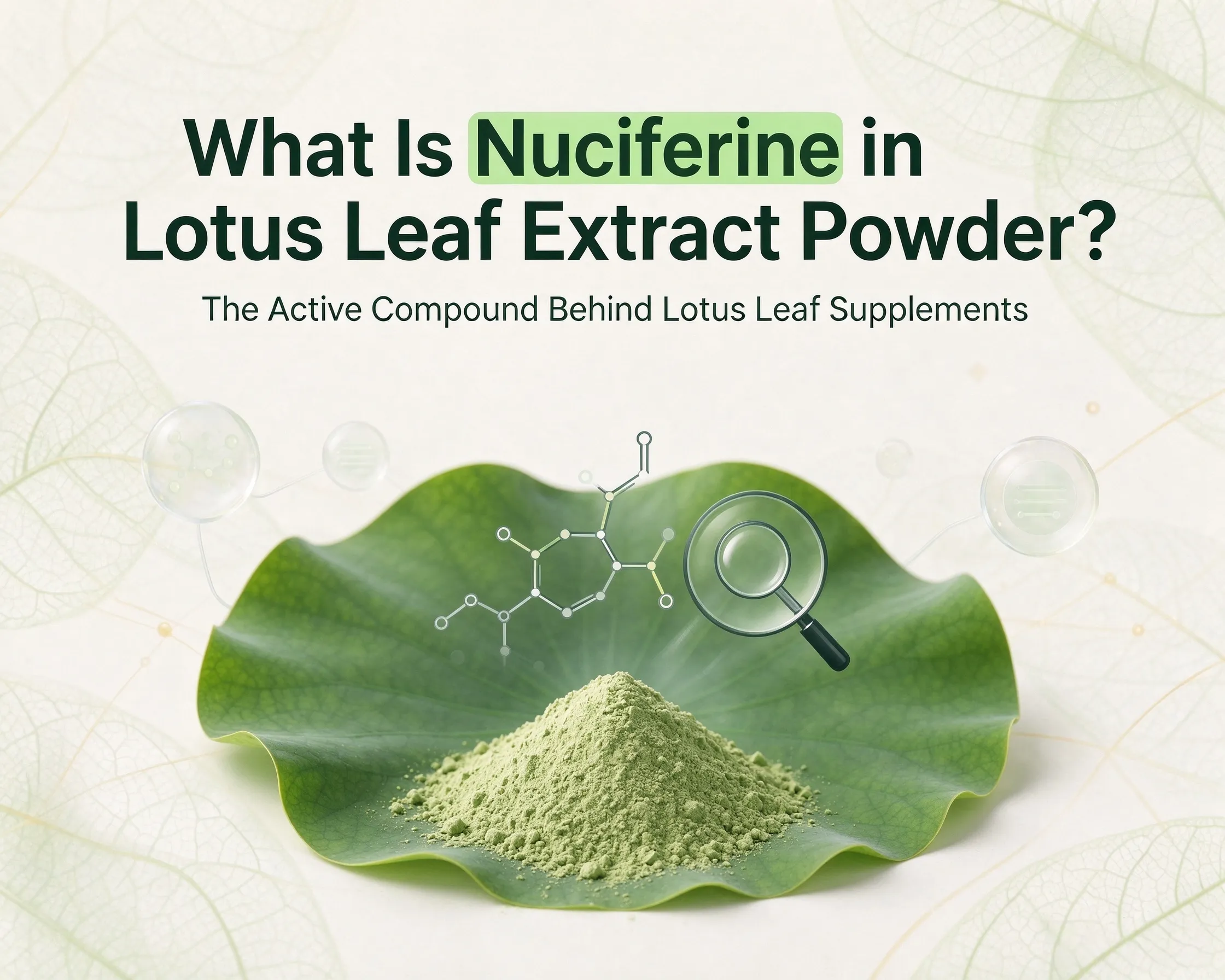



If you are sourcing Lotus Leaf Extract Powder, you will often see one compound appear on specifications and COAs: nuciferine. For many buyers, nuciferine looks like a simple assay number. In real formulation work, it tells you much more. It affects ingredient positioning, testing methods, dosage planning, price comparison, and supplier qualification.
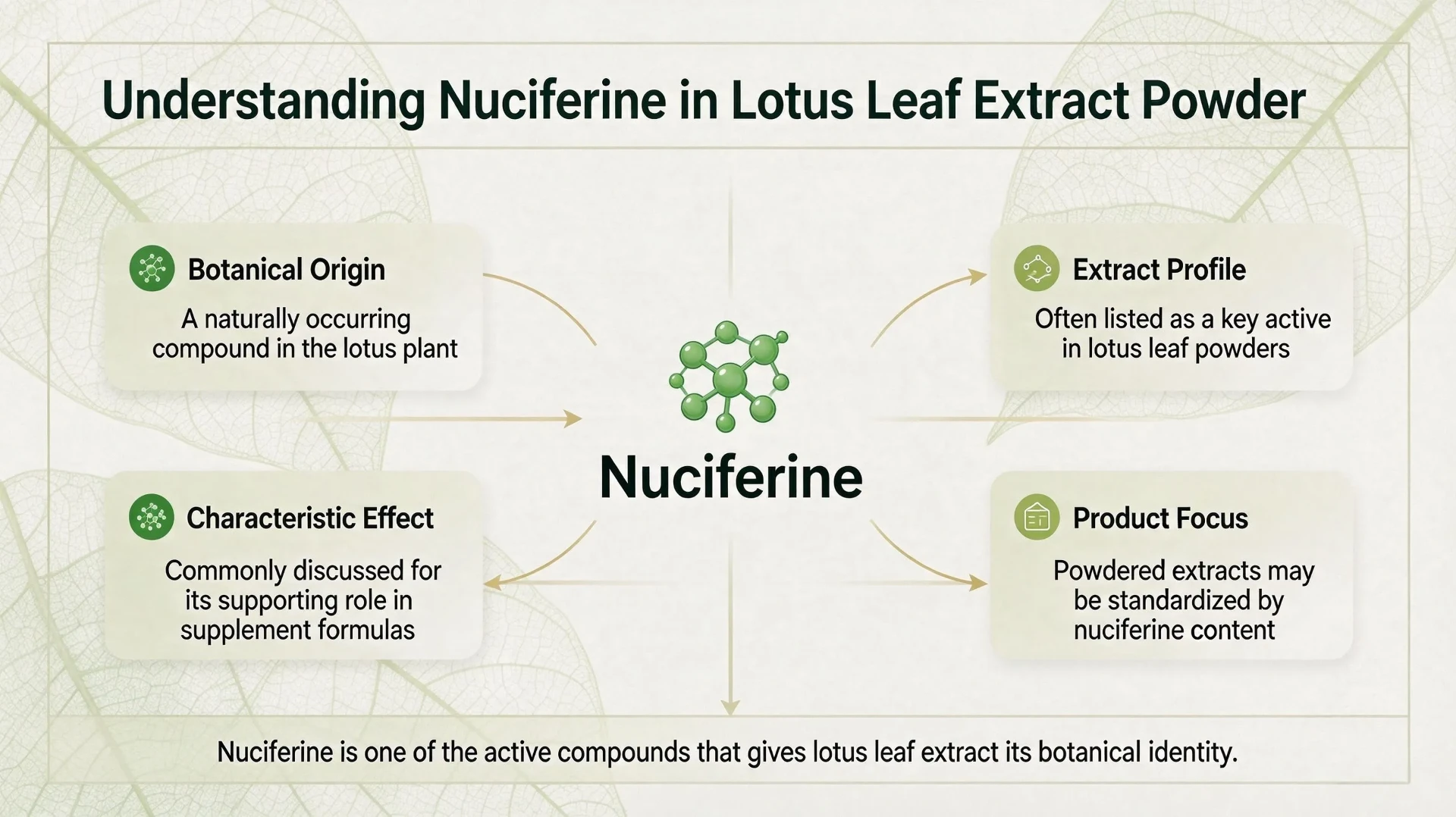
Nuciferine is one of the main alkaloid markers found in lotus leaf, the dried leaf of Nelumbo nucifera Gaertn. In commercial botanical extracts, suppliers often use nuciferine as a quality marker because it can be measured by HPLC and linked to standardized extract grades.
For B2B buyers, the key point is simple: nuciferine is not the same as lotus leaf extract itself. It is one important compound within a larger botanical matrix. Understanding that difference helps you choose the right specification, avoid misleading quotes, and build a cleaner technical file for your finished product.
What Is Nuciferine?
Nuciferine is a naturally occurring aporphine alkaloid found in several parts of the lotus plant, including the leaf. In commercial ingredient sourcing, it is most often discussed in connection with lotus leaf extract.
The botanical source is:
- Botanical name: Nelumbo nucifera Gaertn.
- Plant part: Leaf
- Common ingredient form: Lotus leaf extract powder
- Common active marker: Nuciferine
- Common assay method: HPLC
In a supplier specification, you may see nuciferine listed as:
- Nuciferine 2%
- Nuciferine 5%
- Nuciferine 10%
- Nuciferine 20%
- High-purity nuciferine extract
These percentages refer to the measured nuciferine content in the extract powder, not the extract ratio.
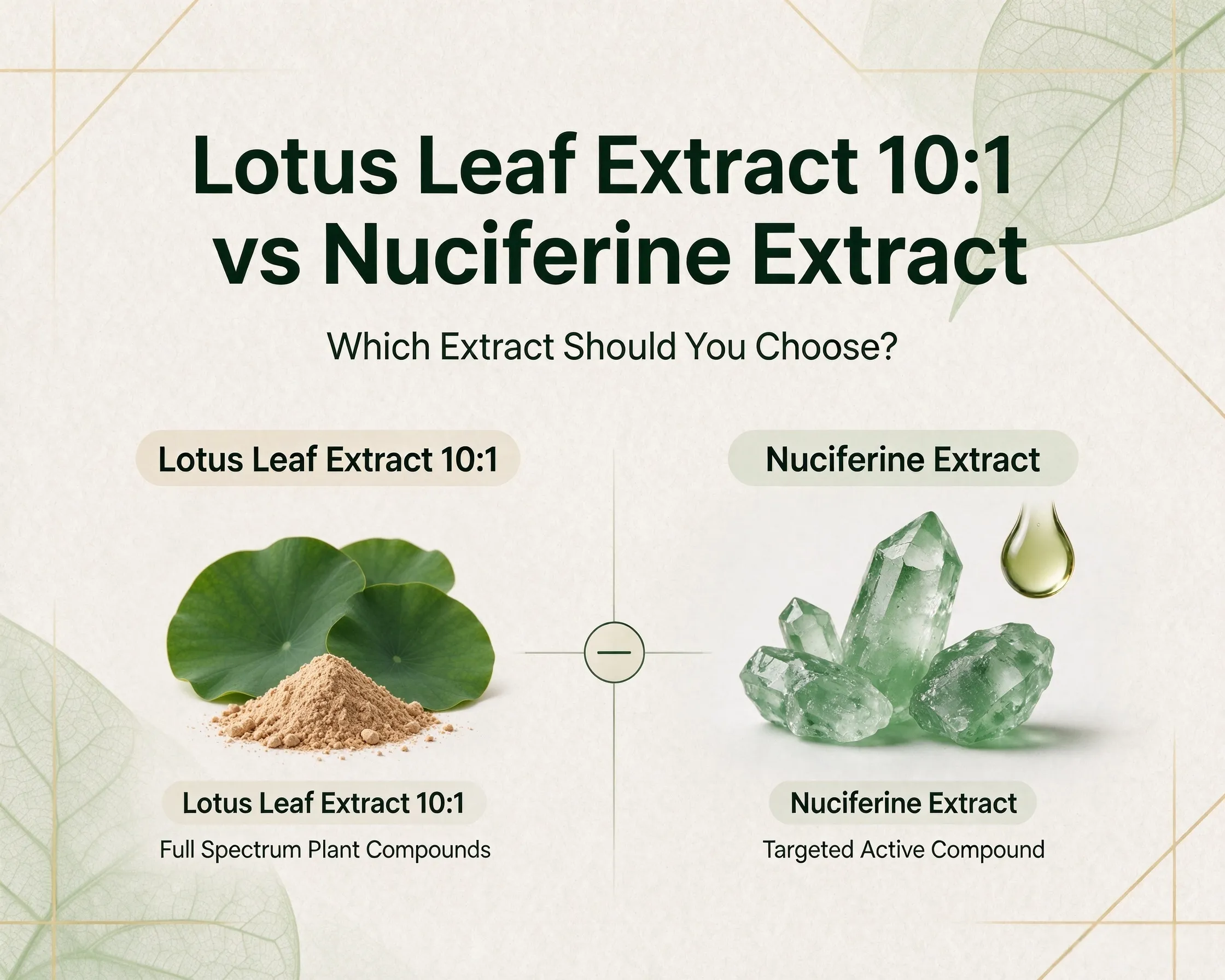
A 10:1 lotus leaf extract and a 10% nuciferine extract do not mean the same thing. This distinction matters when you compare supplier quotes.
Why Nuciferine Matters in Lotus Leaf Extract Powder
Nuciferine matters because it gives buyers a measurable way to evaluate certain lotus leaf extract grades. Without a marker compound, two batches of botanical extract may look similar but perform very differently in formulation and quality review.
For B2B buyers, nuciferine helps with:
- Specification control
- Batch-to-batch consistency
- COA verification
- Formula standardization
- Supplier comparison
- Premium product positioning
- Technical documentation
When a brand wants a marker-based botanical ingredient, nuciferine gives the purchasing and R&D teams a more concrete quality target.
That said, nuciferine should not be the only quality factor. You still need to review plant part, solvent system, heavy metals, pesticide residues, microbiology, carrier status, and residual solvents.
Nuciferine vs Lotus Leaf Extract: What Is the Difference?
Many buyers use the terms loosely, but they are not identical.
| Item | Lotus Leaf Extract Powder | Nuciferine |
|---|---|---|
| Meaning | Botanical extract made from lotus leaves | A specific alkaloid found in lotus leaf |
| Source | Nelumbo nucifera leaf | Naturally present in lotus leaf |
| Role | Finished botanical ingredient | Active marker compound |
| Testing | May include ratio, flavonoids, nuciferine, contaminants | Usually tested by HPLC |
| Use in COA | Product identity and specification | Assay marker |
| Buyer Focus | Overall quality and application fit | Standardization and potency control |
Think of Lotus Leaf Extract Powder as the whole ingredient. Think of nuciferine as one measurable marker inside that ingredient.
How Is Nuciferine Tested?
Most professional suppliers test nuciferine by High Performance Liquid Chromatography, also known as HPLC.
HPLC is widely used for botanical extract quality control because it can separate and quantify target compounds more precisely than broad color-based methods.
When you review a nuciferine specification, ask your supplier for:
- Assay method
- Reference standard
- Batch-specific COA
- HPLC chromatogram, when available
- Sample preparation details
- Third-party report, if required
- Testing lab information
A good supplier should not only state "nuciferine 2%." They should explain how that number was tested.
Why method clarity matters
Different methods can produce different results. A supplier using a weak or unclear method may offer a cheaper quote, but the material may fail your customer's verification test.
For regulated or retailer-controlled markets, method consistency becomes critical.
Common Nuciferine Specifications in the Market
Commercial lotus leaf extract appears in many grades. Jiuyuan Bio's lotus leaf extract product range includes ratio extracts and nuciferine-standardized options.
Common commercial grades include:
| Specification Type | Typical Example | Common Use Case |
|---|---|---|
| Ratio extract | 10:1, 20:1 | General botanical blends, capsules, tablets |
| Standard nuciferine extract | Nuciferine 2% | Weight management and metabolic wellness formulas |
| Higher nuciferine extract | Nuciferine 5%–20% | Premium supplement formulas |
| High-purity nuciferine | Up to high-purity grades | Specialized formulation or research-focused projects |
| Dual-marker extract | Nuciferine + total flavonoids | Premium botanical formulas |
Not every formula needs high nuciferine. In many projects, a moderate standardized grade works better because it balances cost, taste, dosage, and documentation.
Nuciferine and Extract Ratio Are Not the Same
This is one of the most common sourcing mistakes.
A 10:1 lotus leaf extract describes the manufacturing ratio. It means the producer uses about ten parts of raw lotus leaf material to make one part of extract powder.
A nuciferine 10% extract describes the active marker content. It means nuciferine accounts for 10% of the finished extract powder by the agreed test method.
These are different specifications.
Buyer example
You may receive two quotes:
| Quote | What It Means |
|---|---|
| Lotus Leaf Extract 10:1 | Ratio extract; nuciferine may not be standardized |
| Lotus Leaf Extract Nuciferine 10% | Standardized extract with defined nuciferine content |
The second quote will usually cost more because it requires stronger active marker control.
A ratio extract may still contain nuciferine, but the percentage can vary unless the supplier tests and controls it.
What Does Nuciferine Do in Formulation Positioning?
Nuciferine gives formulators a clear marker for lotus leaf extract. This can help when the finished product needs stronger technical positioning.
In commercial supplement development, nuciferine-standardized lotus leaf extract often appears in formulas related to:
- Weight management positioning
- Metabolic wellness blends
- Botanical wellness capsules
- Non-stimulant supplement concepts
- Multi-herb formulas
- Traditional botanical blends
- Functional powder products
Buyers should avoid drug-like claims. A raw material supplier should not claim that lotus leaf extract treats disease. Finished-product claims must follow the rules of the target market.
A safer B2B positioning is:
Lotus leaf extract standardized for nuciferine is used as a botanical ingredient in dietary supplements and functional wellness formulations.
This language supports technical clarity without overpromising.
What Other Compounds Are Found in Lotus Leaf Extract?
Nuciferine is important, but lotus leaf extract contains more than one compound group.
Naturally occurring constituents may include:
- Aporphine alkaloids, including nuciferine
- Flavonoids
- Polyphenolic compounds
- Plant acids
- Other leaf-derived botanical fractions
This broader profile matters when buyers want a whole-leaf extract instead of a single-compound ingredient.
Nuciferine-focused vs full-spectrum positioning
| Formulation Goal | Better Fit |
|---|---|
| Defined active marker | Nuciferine-standardized extract |
| Traditional botanical positioning | 10:1 or 20:1 lotus leaf extract |
| Antioxidant botanical blend | Flavonoid-standardized or dual-marker extract |
| Capsule size reduction | Higher nuciferine grade |
| Cost-sensitive formula | Ratio extract |
| Premium technical file | HPLC-tested nuciferine grade |
The best choice depends on your formula, label, dosage, and customer expectations.
How Nuciferine Affects Price
Nuciferine content can strongly affect price. In most cases, higher active content requires more selective extraction, stronger standardization, and tighter quality control.
Several factors influence cost:
- Raw material quality
- Natural nuciferine level in lotus leaf
- Extraction solvent
- Concentration process
- Purification level
- Assay requirement
- Carrier system
- Testing method
- Batch size
- Third-party testing needs
A low-cost quote for a high nuciferine grade deserves careful review. Ask for a COA, test method, and chromatogram before making a buying decision.
What Buyers Should Check Before Ordering
When you source Lotus Leaf Extract Powder, nuciferine is only one part of the decision. A complete review should cover the full technical and compliance profile.
Key questions for your supplier
Ask these before sampling or bulk ordering:
- Is the product made from Nelumbo nucifera leaf?
- Is the plant part clearly listed as leaf?
- Is it a ratio extract or a standardized extract?
- What is the nuciferine percentage?
- Is nuciferine tested by HPLC?
- Can you provide a batch-specific COA?
- Is a carrier used?
- What extraction solvent is used?
- Are residual solvents controlled?
- Can you provide heavy metal data?
- Can you provide pesticide residue testing?
- What are the microbiological limits?
- Can third-party testing be arranged?
These questions help you avoid comparing unlike materials.
Documentation You Should Request
A reliable B2B supplier should support your technical review with clear documents.
Ask for:
- Certificate of Analysis
- Specification sheet
- Technical data sheet
- Safety data sheet
- Process flow chart
- Allergen statement
- Non-GMO statement
- Country of origin statement
- Heavy metals report
- Microbiology report
- Pesticide residue report, where needed
- Residual solvent statement, where applicable
- HPLC assay report for nuciferine grades
For premium supplement products, a chromatogram can help your technical team confirm the nuciferine assay.
How to Evaluate a Nuciferine Extract Sample
A sample should not be judged only by the nuciferine number. You should test how the material behaves in your real formula.
Sample evaluation checklist
1. Check appearance
Review color, powder uniformity, and visible foreign matter.
2. Confirm odor and taste
Lotus leaf extract may have a herbal, bitter, or earthy profile.
3. Review the COA
Confirm batch number, nuciferine assay, method, and testing date.
4. Test solubility or dispersion
Mix the sample in water or your target formulation.
5.Check flowability
This matters for capsules, sachets, and tablets.
6.Run a compatibility test
Test with proteins, minerals, fibers, sweeteners, acids, and flavors.
7.Evaluate heat exposure
Gummies and granulation processes may stress botanical compounds.
8.Confirm carrier status
Carrier content affects label declaration and assay value.
9. Compare sample and bulk specification
The approved sample should match future commercial batches.
This process helps your team avoid surprises during scale-up.
Which Nuciferine Grade Should You Choose?
The answer depends on your finished product.
| Product Type | Suggested Starting Point | Why |
|---|---|---|
| General botanical capsule | Lotus leaf extract 10:1 or nuciferine 2% | Balanced cost and positioning |
| Premium capsule formula | Nuciferine 5% or higher | Stronger marker control |
| Tablet formula | Nuciferine-standardized grade | Easier active calculation |
| Powder blend | 10:1 or low nuciferine grade | Better cost and sensory balance |
| Gummy formula | Tested sample only | Taste and heat stability matter |
| Functional beverage | Water-compatible grade | Solubility is critical |
| Distributor inventory | Multiple grades | Serves different buyer needs |
A higher nuciferine grade is not always better. It may increase bitterness, price, and formulation complexity.
Why Work With Jiuyuan Bio?
Jiuyuan Bio supplies botanical extract ingredients for supplement, functional food, cosmetic, and pharmaceutical-related markets.
For lotus leaf extract projects, buyers often need a supplier who can support both product quality and documentation. Jiuyuan Bio offers:
- Factory-direct supply
- Specification matching
- Ratio extract and nuciferine-standardized options
- Batch-specific COA
- In-house quality testing support
- Export-ready documents
- Sample support
- Bulk order planning
Jiuyuan Bio was founded in 2012 and operates a 70,000 m² production facility with 10 production lines. The company serves customers across more than 30 countries and holds multiple international certifications, including ISO 9001 and FSSC 22000.
For B2B buyers, this means fewer unknowns during supplier qualification.
FAQ About Nuciferine in Lotus Leaf Extract Powder
1. What is nuciferine?
Nuciferine is a naturally occurring aporphine alkaloid found in lotus leaf. In commercial lotus leaf extract, suppliers often use it as an active marker for standardization.
2.Is nuciferine the same as Lotus Leaf Extract Powder?
No. Lotus Leaf Extract Powder is the full botanical extract. Nuciferine is one compound within the extract.
3. Is lotus leaf extract 10:1 the same as nuciferine 10%?
No. A 10:1 extract describes the raw material to extract ratio. Nuciferine 10% describes the active marker content.
4.How is nuciferine tested?
Professional suppliers usually test nuciferine by HPLC. Buyers should request the assay method, COA, and chromatogram when needed.
5.What nuciferine percentage should I choose?
It depends on your formula. Nuciferine 2% may suit general supplement blends. Higher grades may suit premium formulas with limited capsule space.
6. Can nuciferine extract be used in gummies?
It can, but you should test taste, heat stability, color, moisture behavior, and active retention before scale-up.
7.Does nuciferine extract contain a carrier?
Some grades may contain a carrier. Ask for carrier declaration before sampling or ordering.
8.What documents should I request before buying?
Request COA, specification sheet, SDS, TDS, process flow chart, heavy metals report, microbiology report, pesticide data, and HPLC assay information.
Buyer Takeaway
Nuciferine is a useful quality marker in Lotus Leaf Extract Powder, but it does not define the whole ingredient by itself. A good buying decision should consider the botanical source, plant part, extraction method, assay method, carrier status, contaminant limits, and finished product application.
If your formula needs broad botanical positioning, a 10:1 lotus leaf extract may work well. If your formula needs a defined active marker, nuciferine-standardized extract gives you better control.
Jiuyuan Bio supplies Lotus Leaf Extract Powder for supplement brands, contract manufacturers, importers, distributors, and functional food companies. For samples, specifications, or bulk quotation support, contact info@jiuybiotech.com.
References
- Mukherjee, P. K., et al. "The Sacred Lotus (Nelumbo nucifera)-Phytochemical and Therapeutic Profile." Journal of Pharmacy and Pharmacology, 2009.
- Deng, H., et al. "Study on the Vasodilatory Activity of Lotus Leaf Extract and Its Main Alkaloids." Molecules, 2022.
- Chinese Pharmacopoeia Commission. Pharmacopoeia of the People's Republic of China, Lotus Leaf Monograph.
- International Council for Harmonisation. ICH Q3C Guideline for Residual Solvents.
- United States Pharmacopeia. USP General Chapters on Botanical Extracts and Dietary Supplement Quality Control.
- European Food Safety Authority. Guidance on Safety Assessment of Botanicals and Botanical Preparations Intended for Use in Food Supplements.