

Choosing the right Organic Acai Berry Extract supplier can shape your product quality, label confidence, production cost, and customer trust. Acai is a high-value botanical ingredient, and buyers often face a crowded market with very different grades, origins, carriers, certifications, and testing standards.
If you work in purchasing, R&D, private label, or contract manufacturing, you need more than a low price. You need a supplier who can prove what the ingredient is, how it was processed, how it was tested, and whether the documentation fits your target market.
In this guide, I will walk you through the practical checks I use when evaluating an organic acai extract supplier for capsules, tablets, gummies, beverage powders, beauty blends, and functional food products.
Why Supplier Selection Matters for Organic Acai Berry Extract
Organic Acai Berry Extract is not a simple commodity. It comes from acai berry fruit, usually identified as Euterpe oleracea Mart. The material may be extracted, concentrated, dried, blended, and standardized in different ways.
That means two products with the same name may not perform the same way.
One supplier may offer a concentrated extract with polyphenol testing. Another may offer a spray-dried fruit powder with a carrier. A third supplier may use the phrase "organic acai extract" but provide limited proof of organic certification scope.
This difference affects:
- Label claims
- Organic compliance
- Color strength
- Taste profile
- Solubility
- Active marker level
- Serving size
- Cost per serving
- Import review
- Customer approval
- Repeat order stability
A good supplier reduces uncertainty. A weak supplier creates problems after your formula already moves into production.
Know What You Are Buying: Extract, Powder, or Juice Powder?
Before you compare suppliers, make sure each quote refers to the same ingredient type.
Many buyers ask for Organic Acai Berry Extract and receive quotes for different materials.
Common acai ingredient types
| Ingredient Type | What It Usually Means | Best Fit |
|---|---|---|
| Organic Acai Berry Extract | Concentrated botanical ingredient | Capsules, tablets, gummies, premium blends |
| Organic Acai Powder | Fruit powder from pulp or fruit solids | Smoothies, foods, superfood blends |
| Organic Acai Juice Powder | Spray-dried juice-based powder | Beverages and drink mixes |
| Freeze-Dried Acai Powder | Low-temperature dried fruit powder | Premium whole-food formulas |
| Acai Extract with Carrier | Extract blended with carrier for drying or flow | Gummies, powders, capsules, depending on formula |
The word "extract" should mean a concentrated material. It should not be used loosely for any purple acai powder.
Questions to ask
- Is this a true extract or a fruit powder?
- What is the extract ratio?
- Is the raw material fruit, pulp, juice, or another form?
- Does the material contain a carrier?
- Is the carrier organic-compliant?
- What active marker is tested?
- What is the suggested application?
This step keeps your sourcing comparison fair.
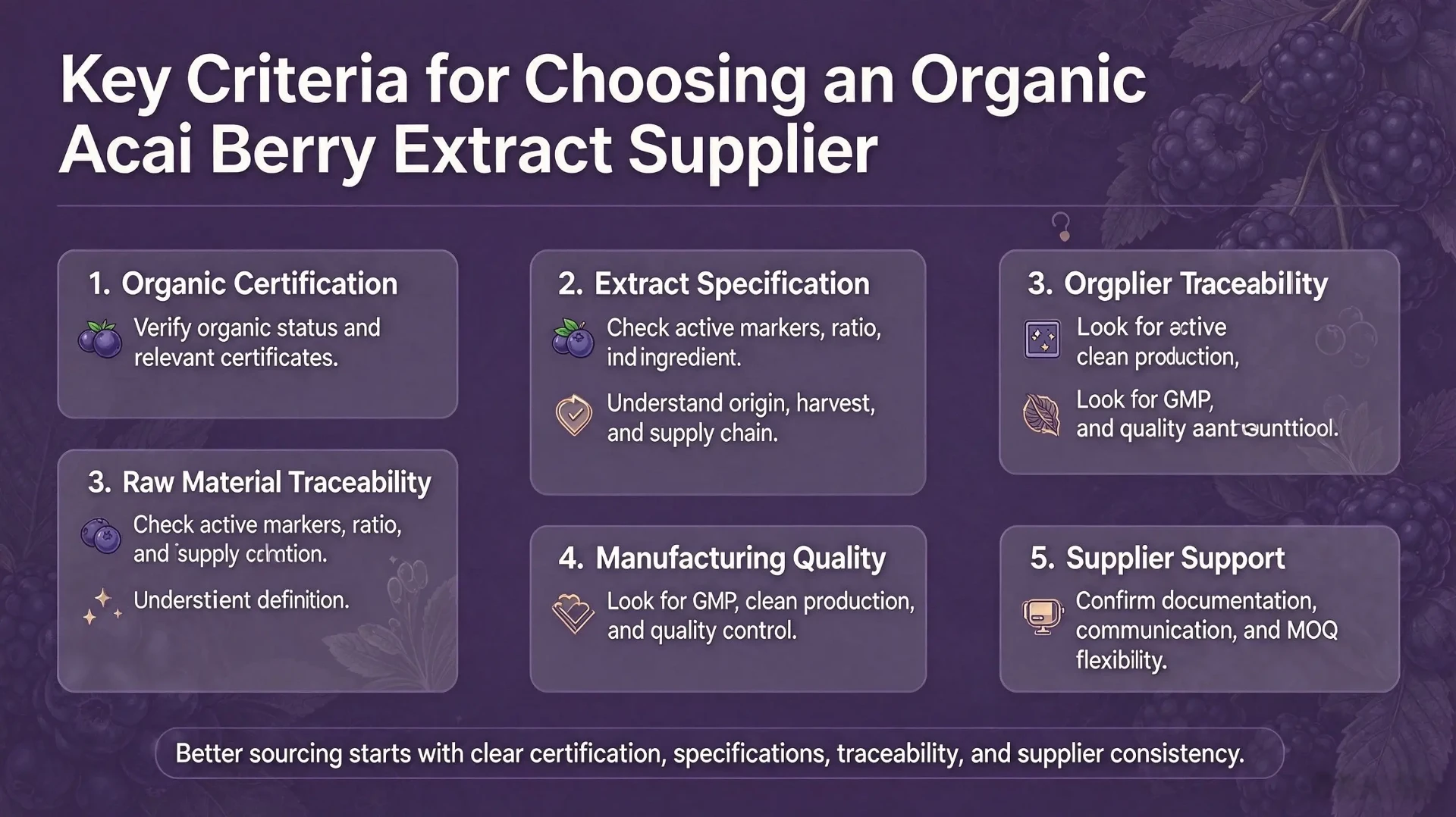
Check the Botanical Source and Plant Identity
A professional Organic Acai Berry Extract supplier should clearly identify the botanical source.
The accepted botanical identity for acai is commonly listed as:
- Botanical name: Euterpe oleracea Mart.
- Plant part: Berry fruit or fruit pulp
- Common name: Acai berry
- Ingredient form: Extract powder
Clear identity matters because buyers use it in specifications, regulatory files, labels, and import documents.
What to verify
Ask the supplier to confirm:
- Full botanical name
- Plant part used
- Country or region of origin
- Processing location
- Raw material traceability
- Lot number system
- Identity control method
If a supplier cannot clearly state the plant part, you should pause the review. Acai fruit extract, seed extract, and juice powder are not the same material.
Review Organic Certification Carefully
Organic status is one of the most important checks. It is also one of the easiest areas to misunderstand.
A supplier may say "organic," but the documents must prove the certification scope. The certificate should match the material, processing route, and market requirement.
Organic documents to request
Ask for:
- Organic certificate
- Certification scope
- Product name listed on certificate
- Certified processing facility information
- Transaction certificate, where required
- Raw material organic documentation
- Carrier organic compliance proof
- Country of origin statement
- Non-GMO statement
- Pesticide residue report, where needed
Organic rules may vary between the United States, European Union, United Kingdom, Canada, Australia, and other markets. A document that works for one buyer may not support another buyer's finished product claim.
Watch carrier compliance
Carriers often create hidden problems.
An organic acai extract may use maltodextrin, gum arabic, tapioca maltodextrin, rice fiber, or another carrier. If your finished product needs organic positioning, the carrier must fit your certification plan.
Ask this direct question:
Is every component in the Organic Acai Berry Extract compliant with my target organic standard?
That answer matters more than the marketing name.
Evaluate Active Markers and Testing Methods
Acai berries naturally contain polyphenols, including anthocyanins and other phenolic compounds. These compounds contribute to the berry's deep purple color and antioxidant profile.
An Organic Acai Berry Extract supplier may offer testing for:
- Total polyphenols
- Anthocyanins
- Moisture
- Ash
- Heavy metals
- Microbiology
- Pesticide residues
- Residual solvents, where applicable
Why active markers matter
Active markers help buyers compare extract grades. They also support internal quality control.
That said, a marker is only useful when the method is clear.
Ask for:
- Test method
- Reference standard
- Batch-specific COA
- Third-party report, where needed
- Sample preparation details
- Method name or standard
- Lab information
Avoid vague claims like "high antioxidant" without supporting test data. That phrase may sound nice, but it does not help your quality team approve the ingredient.
Be careful with ORAC claims
Some older acai marketing materials mention ORAC values. ORAC may appear in historical research, but it should not be used as a stand-alone finished product claim without regulatory review.
For B2B ingredient pages and technical documents, safer wording includes:
- "Naturally contains polyphenols"
- "Anthocyanin-containing berry extract"
- "Used in antioxidant-positioned supplement formulas"
- "Batch testing available upon request"
This language stays more technical and less risky.
Ask About Processing and Extraction
The processing method affects color, taste, active compound retention, solubility, and cost.
For Organic Acai Berry Extract, ask how the material is made.
Key processing questions
- Is the extract water-based?
- Is ethanol used?
- Is the material spray-dried or freeze-dried?
- Is concentration performed before drying?
- What carrier is used during drying?
- Is residual solvent testing available?
- What temperature controls are used?
- Is the final powder milled and sieved?
- Is metal detection included?
- Is the material packed in food-grade packaging?
A stronger supplier can explain the process clearly without giving away confidential details.
Water extraction vs solvent extraction
Water extraction may support clean-label positioning. Ethanol or water-ethanol extraction may help extract certain compounds. The best choice depends on your target marker, application, and compliance needs.
Do not assume one method always wins. Match the process to your finished product.
Confirm Food Safety and Contaminant Controls
Organic does not automatically mean contaminant-free. Acai ingredients still need quality testing.
Botanical and fruit-based powders may carry risks from raw material, water, soil, drying, storage, and transport.
Testing items to review
| Quality Item | Why It Matters |
|---|---|
| Heavy Metals | Supports supplement and food safety review |
| Pesticide Residues | Critical for organic and premium markets |
| Microbiology | Protects powders, gummies, drinks, and capsules |
| Yeast and Mold | Important for fruit-based ingredients |
| E. coli | Indicates sanitation control |
| Salmonella | Required safety check for many buyers |
| Moisture | Affects stability and clumping |
| Ash | Helps monitor raw material and process consistency |
| Residual Solvents | Needed when ethanol or other solvents are used |
| Mycotoxins | May be requested for fruit-based powders |
Your target market may have stricter limits than a supplier's default specification. Share your limits before sample approval.
Compare Cost the Right Way
Many buyers ask for the lowest price per kilogram. That can lead to poor decisions.
For Organic Acai Berry Extract, price per kilogram does not tell the whole story.
You should compare:
- Cost per serving
- Extract ratio
- Active marker level
- Carrier percentage
- Organic certification scope
- Color strength
- Taste impact
- Use level
- Solubility
- Production loss
- Testing cost
- Shipping and packaging
- Repeat batch stability
A cheaper material may require a higher dose. It may also need stronger flavor masking or extra testing.
A higher-priced extract may reduce serving size and improve label positioning. It may also save production time if it flows and blends better.
Better purchasing question
Ask: What is the total cost to achieve my target claim, serving size, color, taste, and compliance standard?
That question gives your team a more useful comparison.
Test Samples in the Final Formula
Never approve an Organic Acai Berry Extract supplier based on documents only.
A COA can look perfect, but the powder still needs to work in your product.
Sample testing checklist
Test the sample for:
- Color
- Odor
- Taste
- Bitterness
- Solubility or dispersibility
- Sedimentation
- Flowability
- Bulk density
- Blend uniformity
- Capsule fill behavior
- Tablet compression behavior
- Gummy heat stability
- Beverage clarity or turbidity
- Moisture behavior
- Packaging stability
Application-specific checks
| Application | What to Test |
|---|---|
| Capsules | Bulk density, flowability, fill weight |
| Tablets | Compression, hardness, disintegration |
| Gummies | Taste, heat stability, color shift |
| Beverages | Solubility, sediment, acidity stability |
| Powder Sticks | Flowability, caking, mouthfeel |
| Smoothie Blends | Color, fruit taste, dispersion |
| Beauty Formulas | Color, flavor pairing, active marker support |
Sample testing helps your team avoid production surprises.
Review Supplier Documents Before Bulk Orders
A reliable supplier should support your qualification process with complete documents.
Core documents to request
- Certificate of Analysis
- Specification sheet
- Technical data sheet
- Safety data sheet
- Organic certificate
- Process flow chart
- Allergen statement
- Non-GMO statement
- Country of origin statement
- Carrier declaration
- Heavy metals report
- Microbiology report
- Pesticide residue report
- Residual solvent statement, where applicable
- Third-party test report, where required
What to check inside the documents
Look for:
- Matching product name
- Batch number
- Production date
- Expiry date or retest date
- Test methods
- Units of measurement
- Limits and results
- Supplier name
- Lab name
- Signature or approval
- Clear storage instructions
Generic documents can slow down customer approval. Batch-specific documents build confidence.
Check Production Capacity and Repeat Supply
A good sample does not guarantee repeat supply.
You need to know whether the supplier can support commercial orders after approval.
Ask about:
- Monthly supply capacity
- Lead time
- MOQ
- Sample-to-bulk matching
- Batch reservation
- Seasonal raw material planning
- Packaging options
- Private-label support
- Export experience
- Long-term price stability
Acai supply can be affected by harvest, logistics, and organic raw material availability. A serious supplier should discuss lead time and batch planning early.
Assess Communication and Technical Support
Supplier communication matters more than many buyers expect.
A good Organic Acai Berry Extract supplier should answer technical questions clearly. They should not only push a quote.
Strong supplier signals
Look for a supplier who can:
- Explain extract vs powder differences
- Confirm carrier status
- Provide sample support
- Discuss dosage form needs
- Share testing options
- Match specifications
- Prepare export documents
- Support third-party testing
- Respond quickly and clearly
- Flag potential formulation risks
A supplier who hides details during sampling may create bigger problems during bulk order.
Red Flags When Choosing an Organic Acai Berry Extract Supplier
Some warning signs should make you slow down.
Watch for:
- No clear botanical name
- No plant part listed
- No organic certificate
- No batch-specific COA
- Unclear carrier status
- Very high active claim without method
- Price far below market level
- Refusal to share test methods
- No heavy metal or microbiology data
- No pesticide testing option
- No residual solvent statement when solvents are used
- Product name mismatch between quote and documents
- Generic COA with no batch number
- Overstated health claims
- Poor English in technical documents
- Slow or vague communication
A low price does not help if the material fails your customer's approval.
Why Jiuyuan Bio Is a Practical Supplier Choice
Jiuyuan Bio supports B2B buyers who need botanical extracts, fruit and vegetable powders, organic ingredients, and technical documentation for global markets.
The company was founded in 2012 near China's Qinling Mountains. Jiuyuan Bio operates a 70,000 m² production facility with 10 production lines and 6,000+ tons of annual capacity. The company serves clients across more than 30 countries in dietary supplements, functional foods, cosmetics, and related ingredient markets.
For Organic Acai Berry Extract projects, Jiuyuan Bio can support:
- Factory-direct ingredient supply
- Organic extract sourcing
- Specification matching
- Sample evaluation
- COA and document review
- Carrier and solubility confirmation
- Custom formulation support
- Bulk order planning
- Export-ready documents
When buyers need more than a quotation, technical support can make the sourcing process much easier.
Practical Supplier Evaluation Scorecard
Use this simple scorecard when comparing suppliers.
| Evaluation Area | What Good Looks Like |
|---|---|
| Product Identity | Clear Euterpe oleracea fruit source |
| Organic Proof | Valid certificate and scope |
| Testing | Batch COA with clear methods |
| Carrier Status | Fully declared and label-ready |
| Safety Data | Heavy metals, microbiology, pesticide data |
| Formulation Fit | Sample works in final application |
| Documentation | Complete technical file |
| Communication | Fast, clear, technical answers |
| Capacity | Stable commercial supply |
| Compliance Support | Export and market documents available |
Suppliers that score well across these areas deserve deeper review.
FAQ About Choosing an Organic Acai Berry Extract Supplier
1.What should I ask an Organic Acai Berry Extract supplier?
Ask about botanical source, plant part, extract ratio, active markers, organic certification, carrier status, testing methods, heavy metals, microbiology, pesticide residues, and available documents.
2. How do I know if the acai extract is really organic?
Request the organic certificate and check the certification scope. Make sure the product name, processing facility, carrier, and target market requirements match your project.
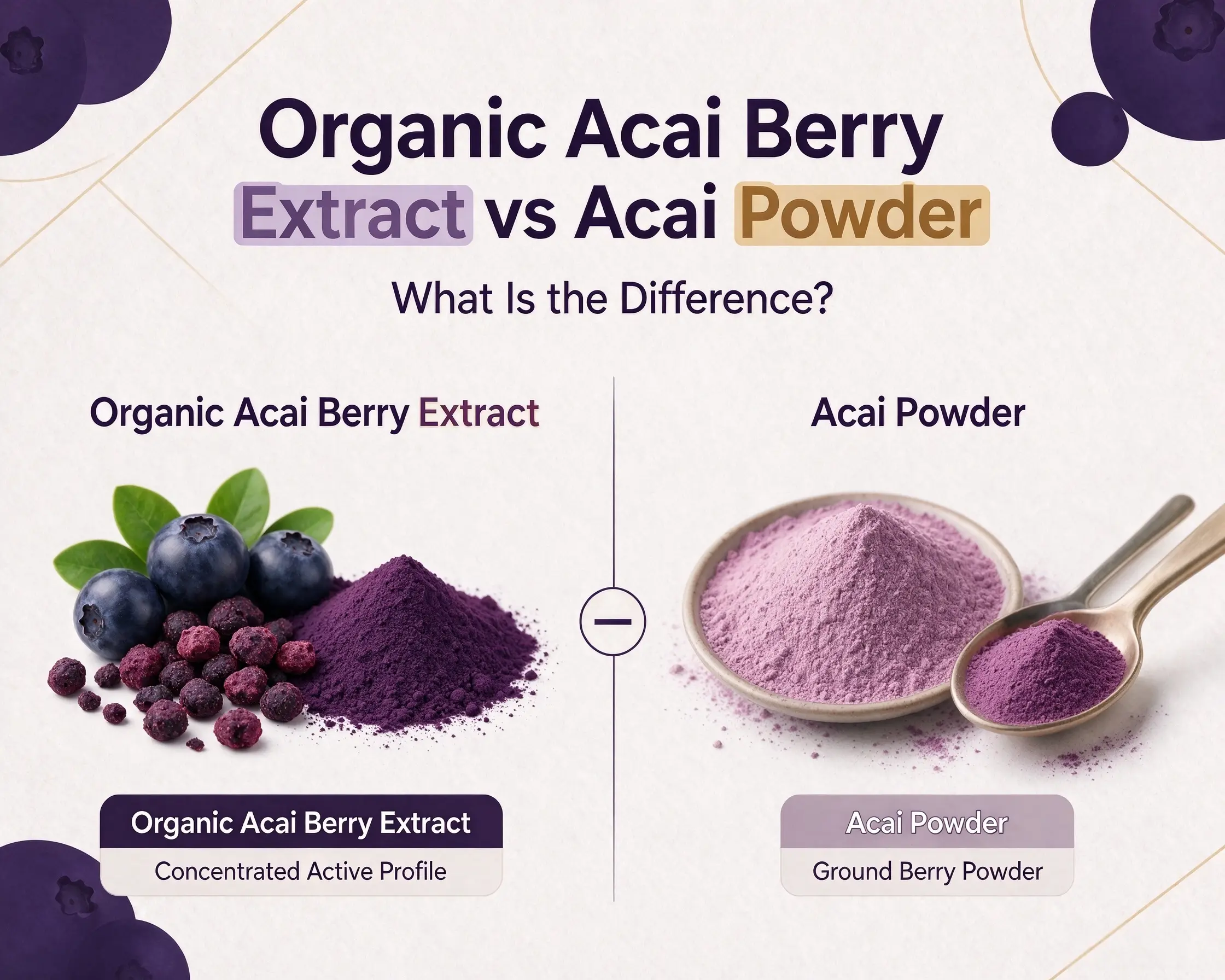
3. Is acai extract the same as acai powder?
No. Acai extract is usually more concentrated. Acai powder is closer to fruit pulp, fruit solids, or juice powder. They serve different formulation goals.
4. Should I choose acai extract or acai powder for capsules?
Organic Acai Berry Extract usually works better for capsules because it offers a lower use level and takes less space.
5. What active markers should I check?
Many buyers check total polyphenols or anthocyanins. The right marker depends on your specification and formula positioning.
6. Can Organic Acai Berry Extract contain a carrier?
Yes. Some extract powders use carriers for drying, stability, or flowability. Always request a carrier declaration.
7. What documents do importers need?
Importers often need COA, specification sheet, SDS, TDS, organic certificate, country of origin statement, allergen statement, non-GMO statement, heavy metals report, microbiology report, and pesticide residue data.
8.How do I compare prices between suppliers?
Compare cost per serving, active marker level, carrier percentage, organic scope, testing quality, formulation behavior, and documentation completeness. Do not compare price per kilogram only.
9. Can acai extract be used in gummies?
Yes. Test taste, color stability, heat exposure, moisture behavior, and active retention before bulk production.
10. What are the biggest red flags?
Unclear organic proof, no batch COA, no carrier declaration, vague active claims, missing contaminant data, and health claims that sound too strong are major warning signs.
Buyer Takeaway
Choosing an Organic Acai Berry Extract supplier is about more than price. You need clear botanical identity, valid organic documents, reliable testing, declared carrier status, clean safety data, real formulation performance, and stable commercial supply.
A strong supplier helps you protect your label, meet customer requirements, and scale from sample to bulk order with fewer risks.
Jiuyuan Bio supplies Organic Acai Berry Extract for supplement brands, functional food companies, importers, distributors, and contract manufacturers. For samples, specifications, technical documents, or bulk quotation support, contact info@jiuybiotech.com.
References
- Schauss, A. G., et al. "Antioxidant Capacity and Other Bioactivities of the Freeze-Dried Amazonian Palm Berry, Euterpe oleracea Mart." Journal of Agricultural and Food Chemistry, 2006.
- Kang, J., et al. "Bioactivities of Acai (Euterpe oleracea Mart.) Fruit Pulp, Superior Antioxidant and Anti-Inflammatory Properties." Journal of Agricultural and Food Chemistry, 2010.
- Pacheco-Palencia, L. A., Mertens-Talcott, S. U., and Talcott, S. T. "Chemical Composition, Antioxidant Properties, and Thermal Stability of a Phytochemical Enriched Oil from Acai." Journal of Agricultural and Food Chemistry, 2008.
- Heinrich, M., Dhanji, T., and Casselman, I. "Acai (Euterpe oleracea Mart.): A Phytochemical and Pharmacological Assessment of the Species' Health Claims." Phytochemistry Letters, 2011.
- United States Department of Agriculture. National Organic Program Handbook: Guidance and Instructions for Accredited Certifying Agents and Certified Operations.
- European Food Safety Authority. Guidance on Safety Assessment of Botanicals and Botanical Preparations Intended for Use in Food Supplements.