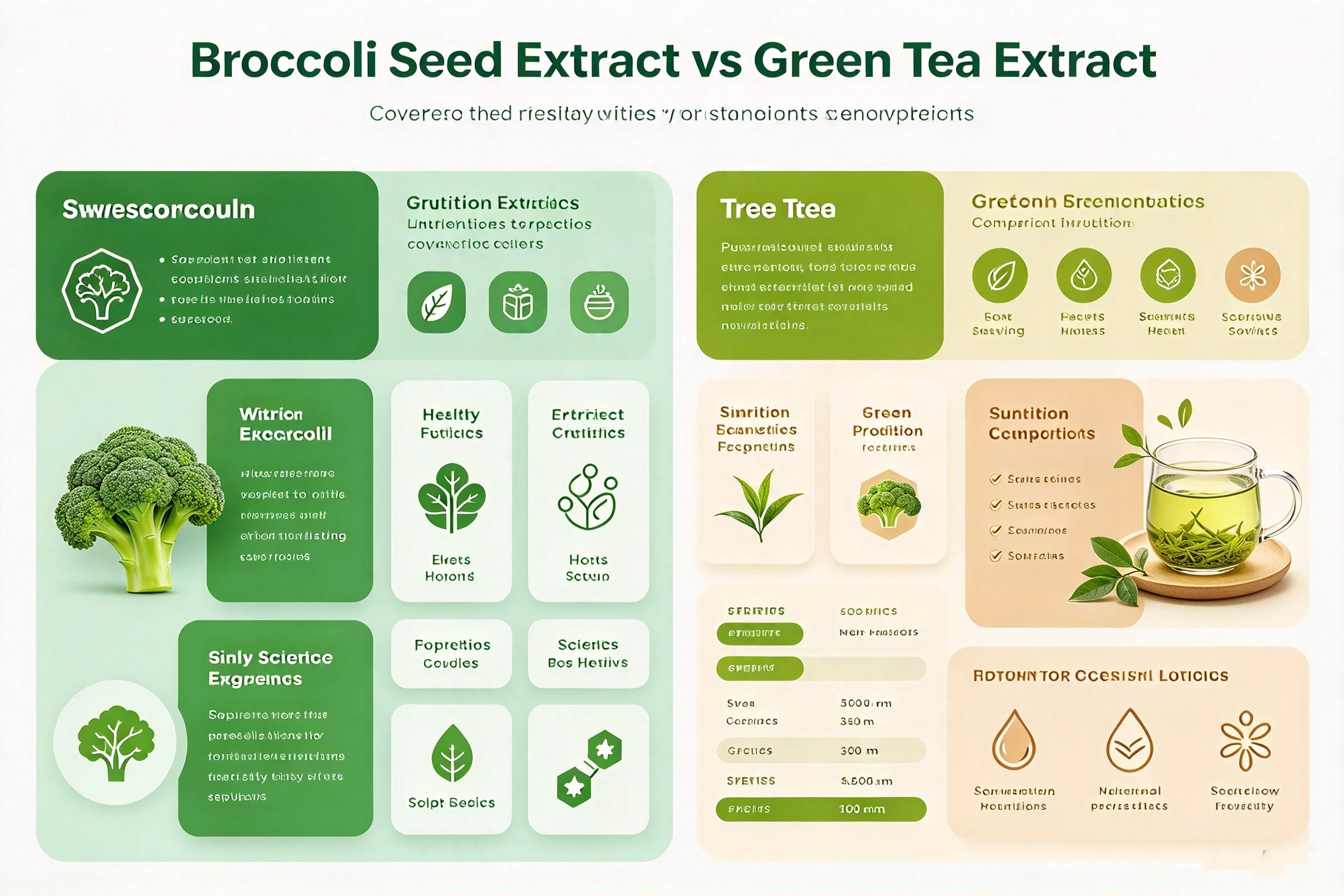
When your formulation team debates which antioxidant ingredient deserves the spotlight, two names keep rising to the top: broccoli seed extract and green tea extract. Both carry serious scientific credentials. Both sell well on supplement shelves. But they work through completely different mechanisms - and that difference matters enormously when you're building a product that needs to perform, pass audits, and win repeat buyers. Here's a clear, evidence-based breakdown of how these two powerhouses stack up.
What Makes Broccoli Seed Extract So Powerful?
Broccoli seed extract gets its reputation from one primary compound: sulforaphane - or more precisely, its stable precursor, glucoraphanin.
Here's why that distinction matters for formulators:
- Sulforaphane itself is chemically reactive and degrades quickly under heat and standard manufacturing conditions.
- Glucoraphanin, on the other hand, is thermally stable. It survives processing intact.
- Once ingested, gut microbiota convert glucoraphanin into active sulforaphane via myrosinase-like enzyme activity.
- Urinary dithiocarbamate recovery rates from oral glucoraphanin doses consistently reach 70%–90% - a remarkably high bioavailability figure for a botanical ingredient.
Sulforaphane's core mechanism centers on Nrf2 pathway activation. Sulforaphane binds to cysteine residues on the Keap1 repressor protein, freeing Nrf2 to migrate to the cell nucleus. Once there, it switches on the antioxidant response element (ARE) - triggering a cascade of cytoprotective enzymes including:
- NQO1 - Phase II detoxification
- HO-1 - Anti-inflammatory and cytoprotective
- GST - Carcinogen conjugation
- GCL - Glutathione biosynthesis
Thioredoxin reductase - Redox homeostasis
This is not a simple free-radical scavenging effect. Sulforaphane essentially trains the cell to defend itself - a mechanism researchers describe as "indirect antioxidant activity." The result is a sustained, amplified antioxidant response that outlasts the compound's presence in the bloodstream.
What Makes Green Tea Extract a Proven Antioxidant?
Green tea extract (GTE) draws its antioxidant power from catechins - a family of polyphenols. The star player is epigallocatechin gallate (EGCG), which typically makes up 50%–80% of the total catechin content in a standardized extract.
EGCG works through a different mechanism than sulforaphane:
- It acts as a direct free-radical scavenger, neutralizing reactive oxygen species (ROS) on contact.
- It also functions as a mild Nrf2 activator and an NF-κB inhibitor, giving it both antioxidant and anti-inflammatory properties.
- Research links EGCG to metabolic health support, neuroprotection, and cardiovascular benefits.
EGCG is one of the most studied polyphenols in nutrition science. Its antioxidant capacity scores consistently high on ORAC and DPPH assay benchmarks.
However, EGCG has a well-documented limitation: poor oral bioavailability. Studies show that only 0.1%–1.6% of ingested EGCG reaches systemic circulation in its intact form. Rapid degradation in the gut, extensive first-pass metabolism, and low intestinal absorption all reduce its effective dose at the cellular level.
Head-to-Head Comparison: Sulforaphane vs EGCG
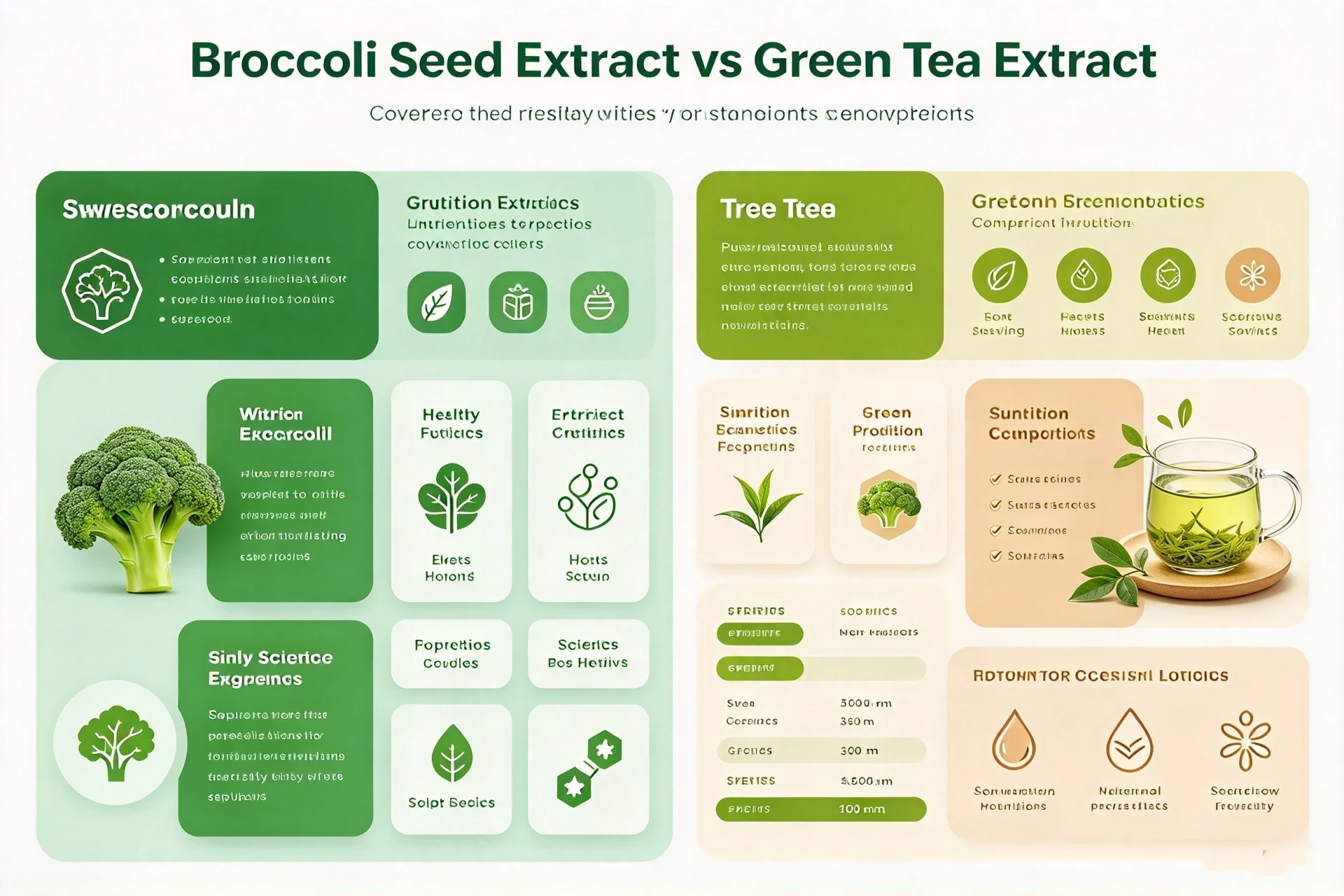
Here's a side-by-side look at the key differences between these two antioxidant ingredients:
|
Factor |
Broccoli Seed Extract (Sulforaphane/Glucoraphanin) |
Green Tea Extract (EGCG) |
|
Primary Compound |
Glucoraphanin → Sulforaphane |
Epigallocatechin gallate (EGCG) |
|
Antioxidant Mechanism |
Indirect - Nrf2/ARE pathway activation |
Direct - free-radical scavenging + mild Nrf2 |
|
Oral Bioavailability |
70%–90% urinary dithiocarbamate recovery |
0.1%–1.6% intact EGCG absorption |
|
Stability in Manufacturing |
High (glucoraphanin form) |
Moderate - EGCG degrades under heat/oxidation |
|
Duration of Effect |
Sustained (enzyme induction lasts 24–72 hrs) |
Shorter (direct scavenging, rapid clearance) |
|
Clinical Trial Volume |
130+ clinical trials, 3,000+ SCI papers |
Extensive - thousands of published studies |
|
Established Daily Limit |
TUL: 30 mg/day sulforaphane (China DRI 2023) |
No universally established upper intake level |
|
Hepatotoxicity Risk |
Low at standard doses |
Documented at high-dose concentrated extracts |
|
Best Application |
Cellular defense, detox, chemoprevention R&D |
Metabolic health, weight management, cognition |
The table tells a clear story: these two ingredients are complementary, not competitive. Each occupies a distinct functional space.
Bioavailability: The Deciding Factor for Formulators
Bioavailability is where the gap between these two ingredients becomes most commercially significant.
Broccoli seed extract (glucoraphanin form):
- Survives gastric acid largely intact
- Reaches the colon where gut microbiota perform the conversion
- Co-administration with exogenous myrosinase sources (e.g., radish powder) further boosts conversion rates
- In vitro conversion rate of 55.8% within 120 minutes of artificial gastric fluid digestion - 5–8× higher than enzyme-free extracts
Green tea extract (EGCG):
- Rapidly oxidized in alkaline intestinal conditions
- Heavily metabolized before reaching systemic circulation
- Bioavailability improves with fasting state and co-administration with vitamin C
- Nanoencapsulation and liposomal delivery formats are increasingly used to address this limitation
For B2B buyers building premium supplement lines, this bioavailability gap directly affects label claims, clinical substantiation, and consumer outcomes. A product with higher delivered bioactivity is easier to market, easier to defend in regulatory review, and more likely to generate repeat purchases.
Clinical Evidence: Who Has the Stronger Research Dossier?
Both ingredients carry substantial clinical backing - but the nature of that evidence differs.
Broccoli seed extract has been used as the intervention ingredient in:
- 130+ published clinical trials
- 3,000+ global SCI papers
- 6 ongoing randomized controlled trials (RCTs)
- Studies conducted at institutions including Johns Hopkins, Imperial College London, and Karolinska Institutet
- Active applications in nutrition, psychiatry, and endocrinology departments across 100+ top-tier hospitals in China
Green tea extract / EGCG research is broader in volume but more variable in quality:
- Thousands of in vitro and animal studies
- Human clinical trials show mixed results, partly due to bioavailability inconsistencies
- High-dose GTE supplementation has been flagged in systematic reviews for potential hepatotoxicity - a regulatory and liability concern for supplement brands
The clinical depth behind broccoli seed extract - particularly the Nrf2 activation mechanism - gives it a stronger position in science-backed, premium-tier formulations.
Which Antioxidant Fits Your Formula?
The right choice depends on your product's positioning and target consumer. Here's a practical guide:
Choose broccoli seed extract when:
- Your formula targets cellular defense, detoxification, or chemoprevention
- You need a stable, high-bioavailability ingredient that survives manufacturing
- Your brand emphasizes clinical credibility and Nrf2 science
- You're formulating for dietary supplements, functional foods, FSMPs, or sports nutrition
- You need a mild-tasting ingredient suitable for beverages (water-soluble grade, clarity ≥98%)
Choose green tea extract when:
- Your formula targets metabolic health, weight management, or cognitive support
- Your consumer base is familiar with green tea and values the brand recognition
- You're building a multi-antioxidant blend where EGCG complements other polyphenols
Consider combining both when:
- You want broad-spectrum antioxidant coverage - direct scavenging (EGCG) plus sustained enzymatic defense (sulforaphane)
- Your product targets aging, inflammation, or comprehensive oxidative stress support
Why Ingredient Quality Changes Everything
Whether you choose broccoli seed extract, green tea extract, or both - the quality of your raw material determines whether the science translates to your finished product.
With broccoli seed extract specifically, two quality issues plague the commodity market:
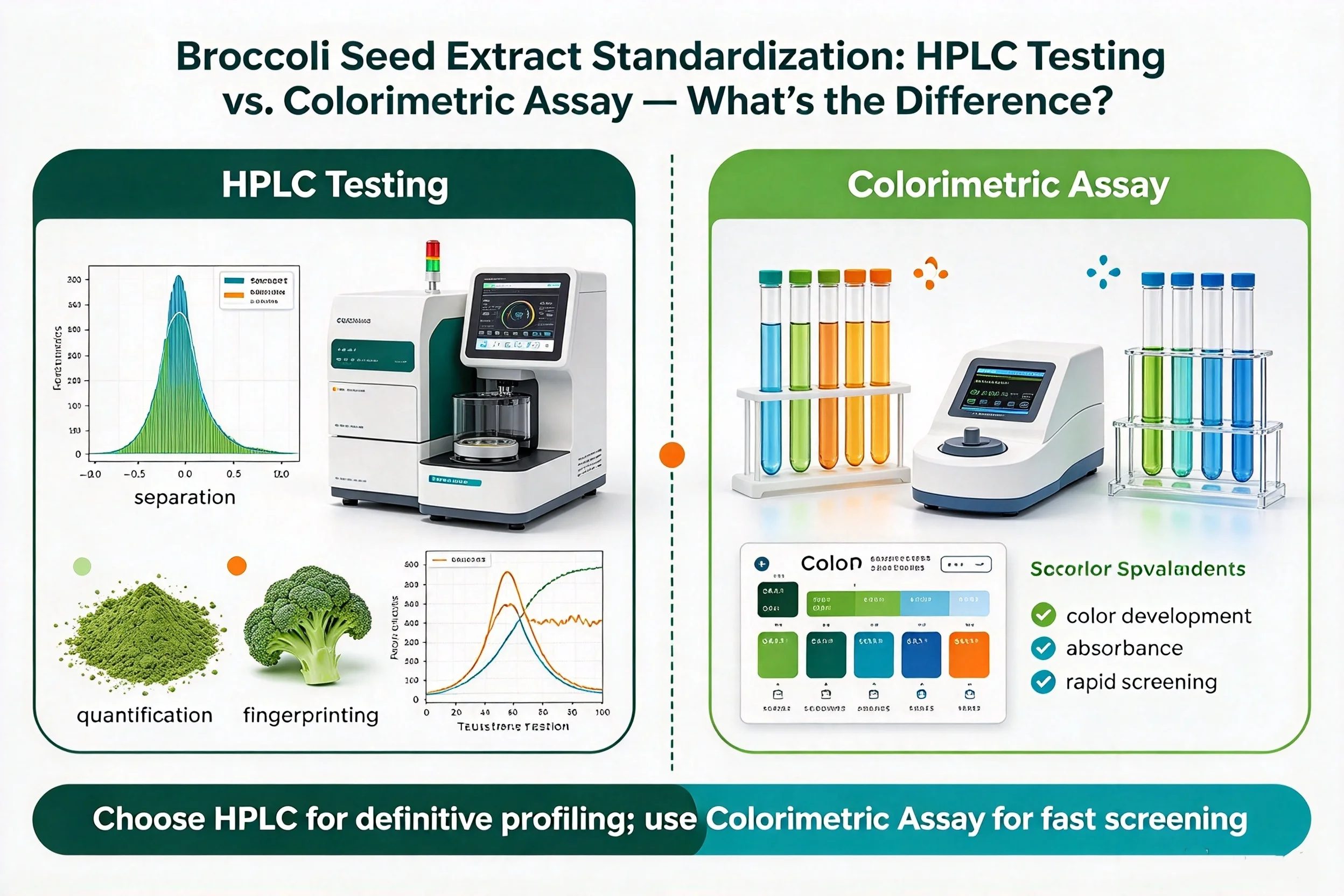
- Non-specific colorimetric assays inflate declared glucosinolate content. Many suppliers report numbers that don't hold up under HPLC verification.
- Enzyme-free extracts deliver far lower in vivo conversion rates - meaning the label claim and the actual consumer benefit are misaligned.
A reliable supplier should provide:
✅ HPLC-verified potency against certified reference standards
✅ Batch-specific COA covering assay, heavy metals, solvents, and microbiology
✅ Accelerated stability data (not just a shelf-life claim)
✅ Recognized certifications: ISO 9001, FSSC 22000, cGMP, Halal, Kosher, USDA/EU Organic
✅ Transparent sourcing with field-to-COA traceability
Source Your Broccoli Seed Extract From a Verified Manufacturer
At Jiuyuan Biotech, we've spent 13 years building a vertically integrated botanical extract operation at the foot of China's Qinling Mountains. Our broccoli seed extract line covers three HPLC-verified specifications:
- SFN-1 - Sulforaphane ≥1%
- SFN-5 - Sulforaphane ≥5%
- GR-13 - Glucoraphanin ≥13%
Ultra-high potency custom grades above 10% available on request
Our proprietary "Myrosinase + Stabilization" dual-patent platform delivers zero activity loss in vitro over 2 years (accelerated stability: 90 days at 37°C/75% RH with >95% retention). Both water-soluble and oil-soluble powder formats ship in packaging from 1 kg foil-lined tins to 25 kg vacuum aluminum buckets.
We hold 12 international certifications - including ISO 9001, FSSC 22000, FDA inspection, cGMP, Halal, Kosher, and USDA/EU Organic. Every batch ships with its own COA. No generic certificates.
Ready to evaluate our broccoli seed extract for your next formulation?
Reach out to our technical team directly: info@jiuybiotech.com
Or explore the full product specifications at: jiuyuanbio.com
References
- Fahey, J. W., Talalay, P., & Kensler, T. W. (2012). Notes from the field: "A decade of clinical trials of sulforaphane in cancer prevention." Molecular Nutrition & Food Research, 56(8), 1220–1230.
- Higdon, J. V., Delage, B., Williams, D. E., & Dashwood, R. H. (2007). "Cruciferous vegetables and human cancer risk: epidemiologic evidence and mechanistic basis." Pharmacological Research, 55(3), 224–236.
- Kensler, T. W., Egner, P. A., Agyeman, A. S., et al. (2013). "Keap1–Nrf2 signaling: A target for cancer prevention by sulforaphane." Topics in Current Chemistry, 329, 163–177.
- Khan, N., & Mukhtar, H. (2013). "Tea and health: Studies in humans." Current Pharmaceutical Design, 19(34), 6141–6147.
- Manach, C., Scalbert, A., Morand, C., Rémésy, C., & Jiménez, L. (2004). "Polyphenols: Food sources and bioavailability." The American Journal of Clinical Nutrition, 79(5), 727–747.
- Singh, K., Connors, S. L., Macklin, E. A., et al. (2014). "Sulforaphane treatment of autism spectrum disorder (ASD)." Proceedings of the National Academy of Sciences, 111(43), 15550–15555.