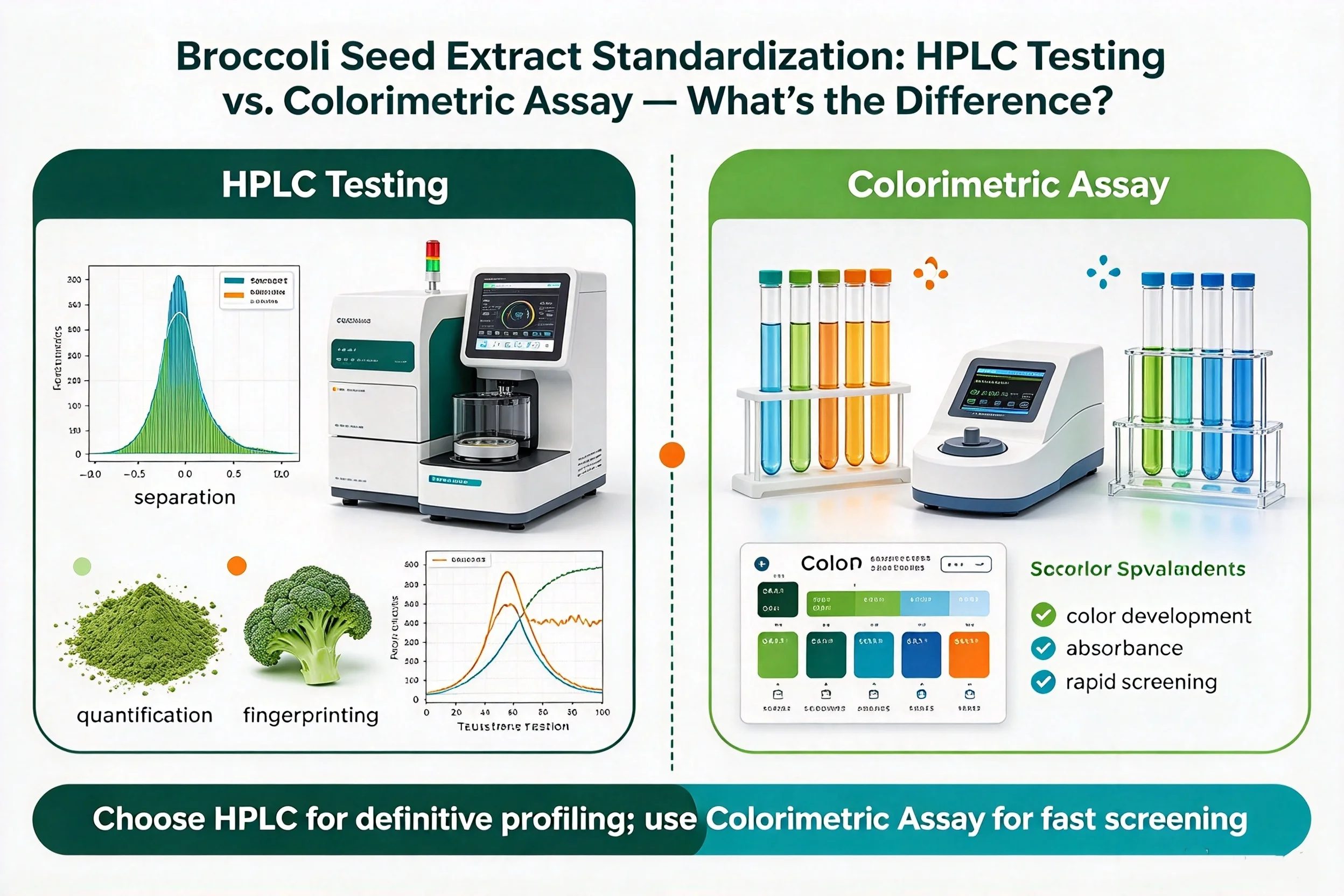
When you source broccoli seed extract for a supplement, functional food, or nutraceutical formulation, the number on the spec sheet only tells part of the story. The other part - the part most buyers never ask about - is how that number was generated. Two suppliers can both claim "10% sulforaphane." But if one uses HPLC and the other uses a colorimetric assay, those two numbers are not the same thing. Not even close.
This distinction matters enormously in B2B ingredient sourcing. The testing method your supplier uses determines whether your label claims hold up under third-party audit, whether your finished product delivers the bioactivity your customers expect, and whether you pass regulatory scrutiny in markets like the US, EU, or Japan.
Here's a clear, practical breakdown of both methods - and what the difference means for your business.
What "Standardization" Actually Means in Botanical Extracts
Standardization is the process of verifying that a botanical extract contains a defined, consistent concentration of one or more active compounds. For broccoli seed extract, the two primary compounds of interest are:
Glucoraphanin - the stable glucosinolate precursor, naturally abundant in broccoli seeds
Sulforaphane - the bioactive isothiocyanate produced when glucoraphanin reacts with the enzyme myrosinase
A standardized extract carries a declared potency - such as "Glucoraphanin ≥13%" or "Sulforaphane ≥1%" - that should be verifiable, reproducible, and defensible under independent analysis.
The problem is that "standardized" does not automatically mean "accurately measured." The analytical method used to generate that declared value is what determines its reliability.
How HPLC Testing Works - and Why It Sets the Benchmark
HPLC (High-Performance Liquid Chromatography) separates individual chemical compounds within a sample by passing them through a stationary phase at high pressure. Each compound elutes at a specific, characteristic retention time. When paired with UV detection or mass spectrometry (LC-MS/MS), HPLC identifies and quantifies compounds with compound-specific precision.
For broccoli seed extract, a validated HPLC method works like this:
- The extract sample is dissolved in a suitable solvent (typically methanol or acetonitrile/water)
- The solution passes through a reverse-phase C18 column under controlled pressure
- Glucoraphanin and sulforaphane elute at distinct, reproducible retention times
- Peak areas are calculated against certified reference standards - pure, authenticated compounds with known concentrations
- The result is a compound-specific, quantified potency value
A peer-reviewed HPLC validation method for sulforaphane quantification - published in Food Chemistry - confirmed that HPLC with UV detection at 254 nm provides linear, accurate, and reproducible results across a wide concentration range. The method showed excellent precision with relative standard deviation (RSD) values below 2%, making it suitable for quality control in commercial extract production.
Key strengths of HPLC for broccoli extract testing:
- Compound-specific - measures glucoraphanin and sulforaphane individually, not a mixed signal
- Validated and peer-reviewed - methods are published and independently reproducible
- Reference standard-anchored - results are tied to certified pure compounds, not assumptions
- Audit-defensible - accepted by FDA, EU regulatory bodies, and third-party labs
- Sensitive - detects potency at low concentrations with high accuracy

How Colorimetric Assays Work - and Where They Fall Short
Colorimetric assays (also called spectrophotometric or UV-Vis assays) measure the intensity of a color reaction between the sample and a chemical reagent. The color depth, measured as absorbance at a specific wavelength, correlates to the estimated concentration of a target compound class.
For glucosinolate analysis, the most widely used colorimetric approach is the palladium chloride method or the Sinigrin equivalent method. The sample reacts with a reagent, and the resulting absorbance is compared to a standard curve - often built from sinigrin, a glucosinolate found in mustard, rather than glucoraphanin itself.
Here is where the accuracy problem begins:
- Non-specific signal - colorimetric reagents react with the entire glucosinolate class, not just glucoraphanin. Degradation products, interfering phenolics, and other plant matrix compounds all contribute to the absorbance reading.
- Wrong reference standard - using sinigrin as a proxy for glucoraphanin introduces a systematic calibration error. Sinigrin and glucoraphanin have different molecular weights and different molar absorptivities.
- Matrix interference - broccoli seed extracts contain chlorophyll derivatives, flavonoids, and other UV-absorbing compounds that inflate absorbance readings.
- No compound separation - unlike HPLC, colorimetric methods cannot distinguish between intact glucoraphanin and its degradation products. A degraded, low-potency extract can produce the same color intensity as a fresh, high-potency one.
The practical consequence is systematic overestimation. A broccoli seed extract declared at "13% glucoraphanin" by colorimetric assay may contain significantly less actual glucoraphanin when re-tested by HPLC. Published comparative studies on glucosinolate analysis have documented that colorimetric methods can overestimate glucosinolate content by 20%–40% relative to chromatographic methods, depending on the matrix complexity.
Side-by-Side Comparison: HPLC vs. Colorimetric Assay
Here is a direct comparison of both methods across the criteria that matter most for B2B ingredient sourcing:
|
Criterion |
HPLC Testing |
Colorimetric Assay |
|
Compound specificity |
Compound-specific (glucoraphanin, sulforaphane individually) |
Class-level (all glucosinolates combined) |
|
Reference standard |
Certified glucoraphanin / sulforaphane standards |
Often sinigrin (proxy standard) |
|
Matrix interference |
Minimal - compounds separated before detection |
High - co-eluting compounds inflate signal |
|
Accuracy |
High - RSD typically <2% |
Variable - overestimation of 20–40% documented |
|
Regulatory acceptance |
FDA, EU, USP recognized |
Not accepted for label claim verification |
|
Cost |
Higher (equipment + skilled operator) |
Lower (simple spectrophotometer) |
|
Audit defensibility |
Strong |
Weak |
|
Suitable for COA |
Yes - batch-specific, compound-specific |
No - unsuitable for commercial label claims |
The cost difference is real - HPLC equipment and skilled operators cost more than a UV spectrophotometer. But that cost difference is exactly why some suppliers choose colorimetric methods. It is a cost-cutting decision that transfers risk directly to you, the buyer.
Why This Matters for Your Label Claims and Regulatory Compliance
If you sell finished products in the United States, your label claims must be substantiated. The FDA's dietary supplement regulations (21 CFR Part 111) require that finished product specifications be verified through appropriate testing. "Appropriate testing" for a declared active compound like sulforaphane or glucoraphanin means compound-specific analytical methods - which means HPLC.
If your raw material COA was generated by colorimetric assay and your declared potency is overstated by 30%, your finished product will fail independent third-party testing. That failure can trigger:
- FDA warning letters for misbranded products
- Retailer delisting - major US and EU retailers require third-party COA verification
- Consumer returns and chargebacks - when products underperform against label claims
- Brand reputation damage - increasingly difficult to recover from in the supplement space
The EU is equally rigorous. The European Food Safety Authority (EFSA) requires that health claim substantiation be based on validated analytical methods. Colorimetric data does not meet that bar for compound-specific claims.
What to Look for in a Supplier's Testing Documentation
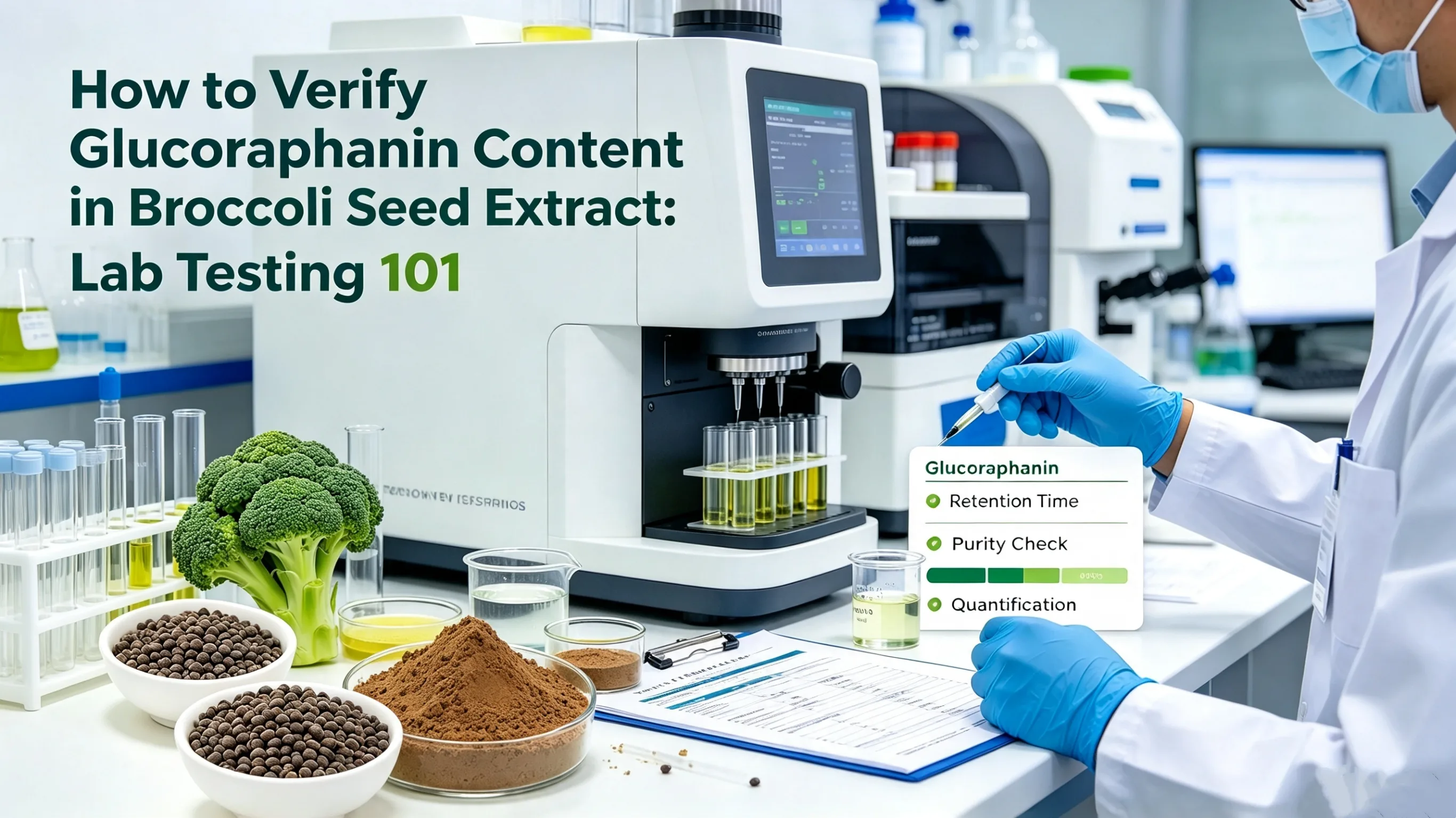
When you review a COA from a broccoli seed extract supplier, these are the specific details that tell you whether HPLC was actually used:
- "Assay method: HPLC" - explicitly stated, not implied
- "Reference standard: Glucoraphanin / Sulforaphane (certified)" - named reference compound, not "sinigrin equivalent"
- "Detection: UV 254 nm" or "DAD" or "MS/MS" - specific detector type listed
- "Column: C18 reverse phase" - column type specified
- Batch-specific lot number - not a generic master COA reused across batches
If the COA says "Assay: Spectrophotometry" or "UV-Vis" without further detail, that is almost certainly a colorimetric method. Ask for clarification before you accept the document.
A supplier with genuine HPLC capability will have no hesitation providing the full analytical method, the reference standard certificate, and the raw chromatogram data on request. That level of transparency is the baseline standard for serious ingredient manufacturers.
The Nrf2 Connection - Why Accurate Potency Data Drives Real Outcomes
Sulforaphane's primary mechanism of action is Nrf2 pathway activation. Nrf2 (Nuclear factor erythroid 2-related factor 2) is a transcription factor that upregulates cytoprotective enzymes - including NQO1, HO-1, GST, and GCL - supporting antioxidant defense and cellular detoxification.
Clinical studies on sulforaphane have used precise, HPLC-verified doses to establish efficacy. When the actual delivered dose differs from the declared dose - because the raw material was overstated by a colorimetric assay - the clinical outcome changes. A product formulated to deliver 10 mg sulforaphane per serving may actually deliver 6–7 mg if the raw material potency was inflated. That gap is the difference between a clinically relevant dose and a sub-therapeutic one.
This is not a theoretical concern. It is a formulation reality that affects product performance, customer outcomes, and repeat purchase rates.
A Quick Decision Framework for Buyers
Before you accept any broccoli seed extract COA, run through this checklist:
- Does the COA explicitly state "HPLC" as the assay method?
- Is the reference standard named (glucoraphanin or sulforaphane - not sinigrin)?
- Is the COA batch-specific with a unique lot number?
- Can the supplier provide the raw chromatogram data?
- Has the method been validated (precision, accuracy, linearity documented)?
- Does the supplier's in-house lab hold ISO 17025 accreditation or equivalent?
If any answer is "no" or "I'm not sure," that is your signal to ask harder questions - or look elsewhere.
Source Your Broccoli Seed Extract With Confidence
At Jiuyuan Biotech, every batch of broccoli seed extract is tested by validated HPLC against certified glucoraphanin and sulforaphane reference standards. Our in-house analytical lab generates batch-specific COAs covering assay, heavy metals, residual solvents, microbiology, and pesticide residues - all available before shipment.
Our broccoli seed extract product line includes:
- Glucoraphanin ≥13% (HPLC verified)
- Sulforaphane ≥1%, ≥5%, ≥10% (HPLC verified)
- Custom potency grades available on request
We hold 12 international certifications including ISO 9001, FSSC 22000, cGMP, USDA/EU Organic, Halal, and Kosher. Our extract has been referenced in 3,000+ SCI-indexed publications and used in 130+ registered clinical trials globally.
If you want to verify our testing methodology, request our analytical method documentation, or discuss your formulation requirements, reach out directly.
📧 Contact us: info@jiuybiotech.com
🌐 Product page: Jiuyuan Biotech Broccoli Seed Extract
References
- Maldini, M., Maksimović, M., Natella, F., Torelli, A., & Scaccini, C. (2012). Development and validation of an HPLC-DAD method for the determination of glucosinolates in Brassica oleracea varieties. Food Chemistry, 132(4), 2121–2128.
- Fahey, J.W., Wade, K.L., Stephenson, K.K., & Chou, F.E. (2003). Separation and purification of glucosinolates from crude plant homogenates by high-speed counter-current chromatography. Journal of Chromatography A, 996(1–2), 85–93.
- Dinkova-Kostova, A.T., & Abramov, A.Y. (2015). The emerging role of Nrf2 in mitochondrial function. Free Radical Biology and Medicine, 88(Part B), 179–188.
- Shapiro, T.A., Fahey, J.W., Wade, K.L., Stephenson, K.K., & Talalay, P. (1998). Human metabolism and excretion of cancer chemoprotective glucosinolates and isothiocyanates of cruciferous vegetables. Cancer Epidemiology, Biomarkers & Prevention, 7(12), 1091–1100.
- Vanduchova, A., Anzenbacher, P., & Anzenbacherova, E. (2019). Isothiocyanate from broccoli, sulforaphane, and its properties. Journal of Medicinal Food, 22(2), 121–126.
- Prestera, T., Holtzclaw, W.D., Zhang, Y., & Talalay, P. (1993). Chemical and molecular regulation of enzymes that detoxify carcinogens. Proceedings of the National Academy of Sciences, 90(7), 2965–2969.