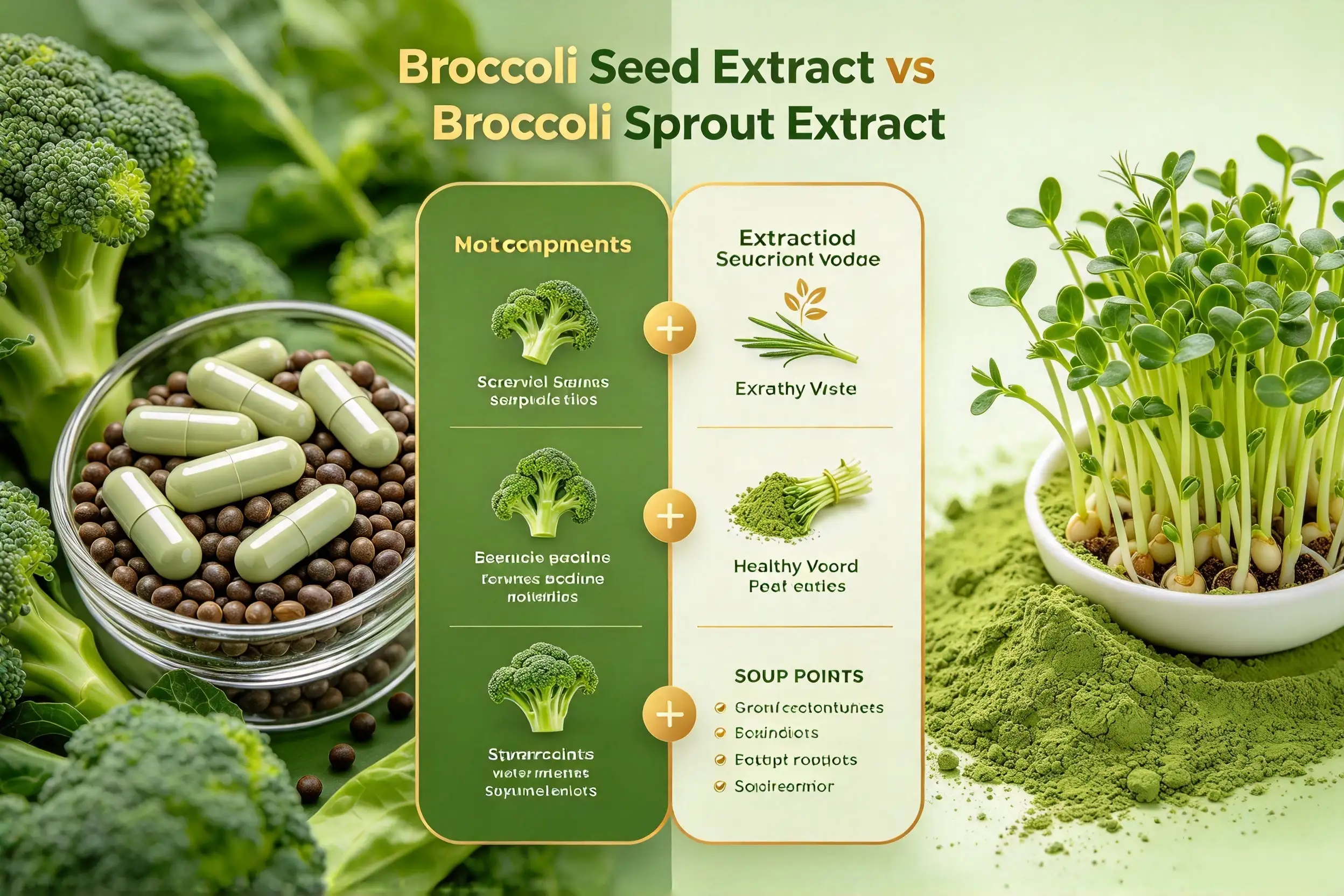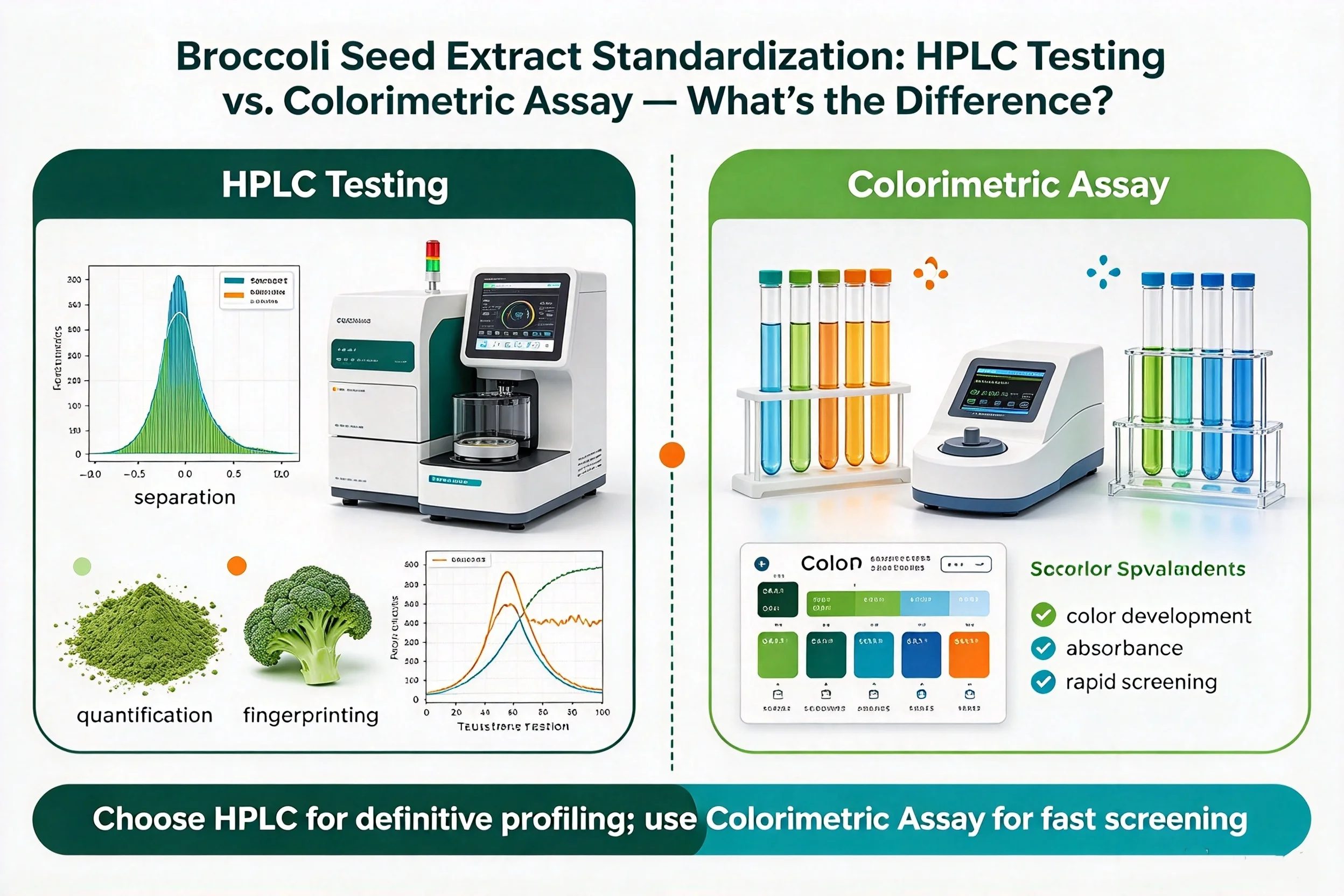
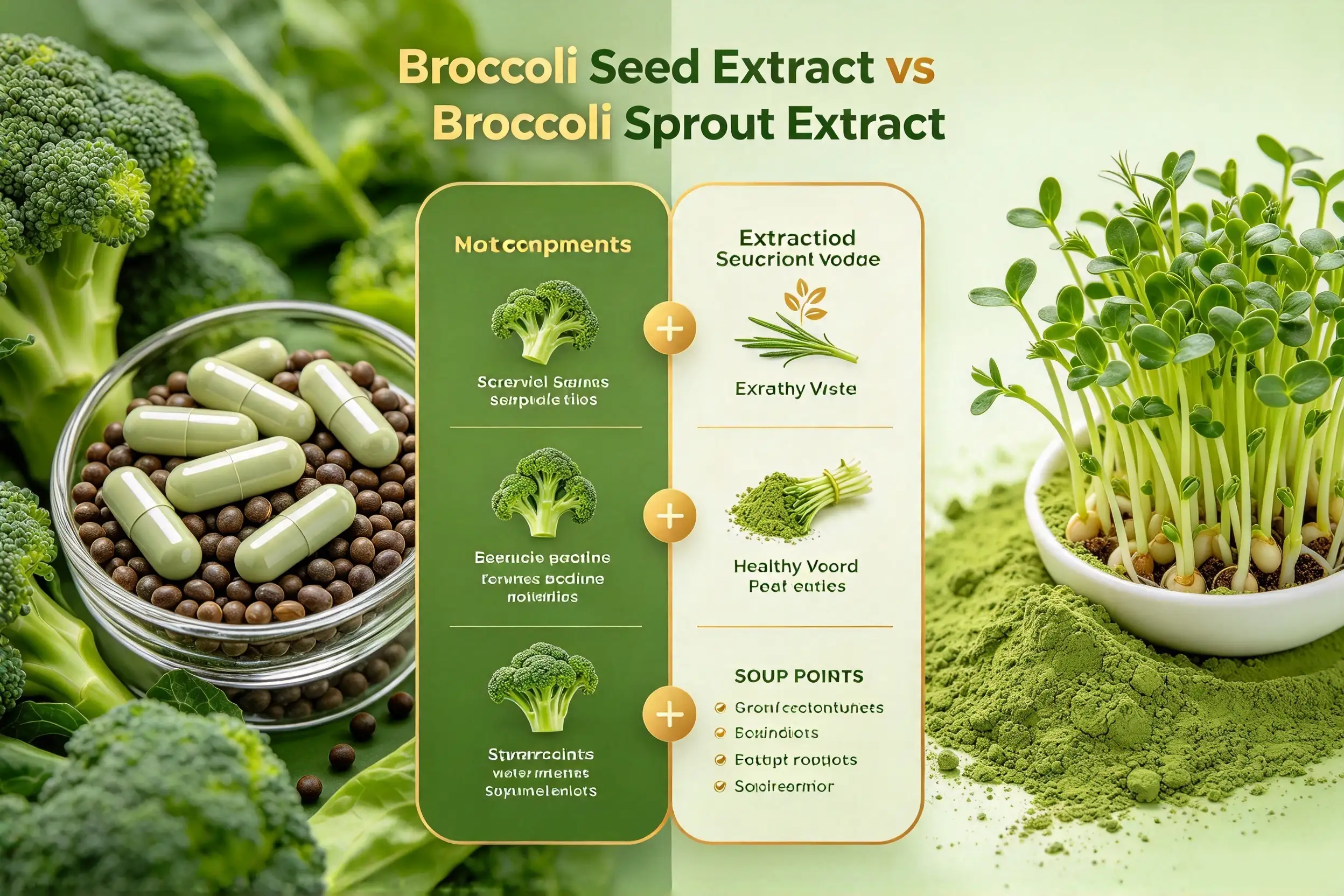
If you're building a sulforaphane-based supplement, you've already hit this fork in the road: broccoli seed extract or broccoli sprout extract? Both originate from Brassica oleracea italica. Both deliver glucoraphanin - the stable precursor that your body converts into active sulforaphane. But the two ingredients behave very differently in a manufacturing environment, on a stability shelf, and inside the human gut. Choosing the wrong one doesn't just affect your cost of goods - it affects your label claims, your regulatory dossier, and ultimately your consumer's results. Here's the full picture.
The Core Difference: Where Each Extract Comes From
Understanding the source material is the foundation of every other comparison.
Broccoli seed extract is derived from the fully mature, dried seeds of Brassica oleracea var. italica. Seeds are the plant's most energy-dense storage organ. They accumulate glucoraphanin at concentrations that no other part of the plant can match - and they do so in a chemically stable, enzyme-free matrix that survives industrial processing.
Broccoli sprout extract comes from 3–5 day old germinated seedlings. The 1997 landmark study by Fahey, Zhang, and Talalay at Johns Hopkins University put sprouts on the map - showing they contain 20–50 times more glucoraphanin than mature broccoli florets. That finding was accurate and important. But it compared sprouts to mature florets, not to seed extracts - a distinction that gets lost in most supplement marketing.
The practical difference between these two source materials shows up in four areas: concentration, enzyme activity, manufacturing behavior, and supply chain reliability.
Glucoraphanin Concentration: Seeds Win on Raw Numbers
Glucoraphanin content is the most important starting metric for any sulforaphane-based formula. Here's how the two sources compare:
|
Plant Part |
Glucoraphanin Content (Dry Weight) |
Notes |
|
Mature broccoli florets |
0.5–2 µmol/g |
Lowest concentration; cooking destroys myrosinase |
|
Broccoli sprouts (fresh, day 3) |
30–60 µmol/g |
Peak at day 3; drops sharply after day 5 |
|
Broccoli sprout extract (dried powder) |
~1.6–3.8% glucoraphanin |
Variable; depends heavily on harvest timing and drying method |
|
Broccoli seed extract (standardized) |
Up to 13%+ glucoraphanin (HPLC-verified) |
Consistent; thermally stable; no enzyme interference |
Seeds contain glucoraphanin at concentrations that are 3–8× higher than dried sprout powder on a weight-for-weight basis.
That gap has direct consequences for your formulation:
- Lower extract weight per serving - a 13% glucoraphanin seed extract needs ~77 mg to deliver 10 mg of glucoraphanin; a 3% sprout powder needs ~333 mg
- More room in your capsule for co-ingredients like myrosinase, vitamin C, or black pepper extract
- Simpler label claims - higher concentration means less rounding error and tighter batch-to-batch variance
- Lower cost per active milligram - even if seed extract costs more per kilogram, the active yield per dollar is significantly better
Myrosinase Activity: The Double-Edged Sword
This is where the two extracts diverge most sharply - and where most formulators get tripped up.
Broccoli sprouts contain active myrosinase enzyme. When sprout cells are damaged - by chewing, cutting, or processing - myrosinase immediately hydrolyzes glucoraphanin into sulforaphane. In a fresh sprout, this is a feature. In a manufacturing environment, it's a liability.
Here's why:
- Active myrosinase begins converting glucoraphanin the moment the plant tissue is disrupted
- Heat inactivates myrosinase - so standard drying and spray-drying processes destroy the enzyme while leaving glucoraphanin intact
- The result: dried sprout extract behaves almost identically to seed extract in the gut - relying on gut microbiota for conversion
- Sulforaphane itself is chemically reactive and degrades rapidly under heat, moisture, and oxidative conditions - so any pre-converted sulforaphane in a sprout extract is already degrading before it reaches the consumer
Broccoli seed extract contains no active myrosinase. This is intentional and advantageous:
- Glucoraphanin remains fully intact through extraction, spray-drying, blending, and encapsulation
- No premature conversion means no sulforaphane degradation during manufacturing or storage
- Myrosinase can be added back as a controlled co-ingredient (e.g., mustard seed powder, radish seed powder) to optimize in vivo conversion at a precise, validated dose
A registered clinical trial (NCT04946526) specifically studied sulforaphane bioavailability from a glucoraphanin-rich broccoli seed supplement with and without added myrosinase from mustard seed powder - confirming that co-enzyme formulation is a viable and scientifically supported strategy for seed-based products.
Bioavailability: A More Honest Comparison
The bioavailability narrative around sprout extract is often oversimplified. Let's unpack what the data actually shows.
Fresh broccoli sprouts do deliver exceptional sulforaphane bioavailability - up to 37% from raw sprouts versus only 3.4% from cooked broccoli. One study found that drinking a broccoli sprout beverage significantly accelerated urinary excretion of airborne pollutants like benzene by 61%. These are real, meaningful numbers.
But those numbers apply to fresh, unprocessed sprouts - not to dried sprout extract in a capsule.
Once sprout extract is dried and encapsulated:
- Myrosinase is inactivated by heat
- Glucoraphanin conversion depends entirely on gut microbiota
- Bioavailability drops to levels comparable to seed extract
- Individual variation in gut microbiome composition creates significant inter-person variability in sulforaphane yield
Broccoli seed extract with co-administered myrosinase closes the gap substantially:
- A clinical comparison found that a 30 mg glucoraphanin dose from broccoli seed extract averaged a 12.8% conversion rate - statistically equivalent to the same dose from broccoli sprouts
- Urinary dithiocarbamate recovery from well-formulated seed extract products consistently reaches 70–90%
- The conversion is more reproducible across individuals because it doesn't depend solely on microbiome composition
The honest conclusion: dried sprout extract and seed extract are bioequivalent in capsule form. The sprout's bioavailability advantage is real - but only in fresh food applications.
Manufacturing Stability: Where Seed Extract Holds a Clear Edge
Stability is the most commercially critical factor that supplement brands underestimate at the sourcing stage.
Broccoli seed extract stability profile:
- Glucoraphanin has no reactive functional groups exposed in its native form
- Survives spray-drying, tablet compression, hard capsule filling, and beverage powder blending
- Accelerated stability testing at 37°C / 75% RH for 90 days shows >95% glucoraphanin retention in properly formulated powders
- Compatible with standard ambient-temperature warehousing and shipping
- Shelf life of 24+ months achievable without cold chain or nitrogen flushing
Broccoli sprout extract stability challenges:
- Residual myrosinase - even partially inactivated - can continue slow glucoraphanin conversion during storage
- Pre-formed sulforaphane in sprout extracts degrades to sulforaphane nitrile and other byproducts under heat and humidity
- Products can lose 20–40% of declared activity within 6 months without specialized microencapsulation or cold chain logistics
- Requires nitrogen-flushed packaging, refrigerated storage, or liposomal delivery systems to maintain potency claims
For procurement managers managing two-year supply contracts across multiple markets and climates, seed extract's ambient stability is a non-negotiable operational advantage.
Scalability and Supply Chain Reliability
This dimension rarely appears in ingredient comparison articles - but it matters enormously for B2B buyers planning large production runs.
Broccoli seed extract:
- Seeds are harvested once per year from field-grown crops
- Dried seeds store for 12–24 months without significant glucoraphanin loss
- Large-scale extraction from seeds is a well-established industrial process
- Global supply is relatively stable and predictable - seeds from multiple growing regions (China, India, Europe) are commercially available
- Standardization to defined glucoraphanin specifications (5%, 10%, 13%) is achievable with consistent raw material
Broccoli sprout extract:
- Sprouts require controlled indoor germination facilities - temperature, humidity, light, and contamination management are all critical
- Harvest window is narrow - day 3 post-germination for peak glucoraphanin
- Year-round production is possible but requires significant infrastructure investment
- Batch-to-batch glucoraphanin variance is higher due to biological variability in germination conditions
- Scaling up requires proportional facility expansion - not simply larger extraction runs
For brands sourcing 500 kg+ per production run, broccoli seed extract offers a fundamentally more scalable and predictable supply model.
Head-to-Head Summary: Seed Extract vs Sprout Extract
Here's the complete side-by-side comparison across every key dimension:
|
Factor |
Broccoli Seed Extract |
Broccoli Sprout Extract |
|
Source Material |
Mature dried seeds |
3–5 day germinated seedlings |
|
Glucoraphanin Concentration |
Up to 13%+ (HPLC-verified) |
~1.6–3.8% (dried powder) |
|
Myrosinase Activity |
Absent - stable precursor form |
Present in fresh; destroyed by drying |
|
Manufacturing Compatibility |
Excellent - survives all standard processes |
Moderate - enzyme inactivation during drying |
|
Shelf Life (Bulk Powder) |
24+ months at ambient temperature |
12–18 months; sensitive to heat and humidity |
|
Bioavailability (Capsule Form) |
Equivalent to sprout extract with co-enzyme |
Equivalent to seed extract when dried |
|
Bioavailability (Fresh Form) |
N/A |
Up to 37% - highest of all broccoli sources |
|
Batch-to-Batch Consistency |
High - standardized extraction |
Variable - dependent on germination conditions |
|
Scalability for B2B |
High - annual harvest, industrial extraction |
Limited - requires controlled indoor facilities |
|
Cost Per Active mg |
Lower - higher raw concentration |
Higher - lower yield, more processing complexity |
|
Best Application |
Capsules, tablets, functional beverages, powders |
Fresh juices, raw blends, whole-food supplements |
|
Regulatory Documentation |
Straightforward - stable, defined composition |
More complex - variable active content |
Which Extract Fits Your Product Strategy?
The right choice depends on your product format, brand positioning, and production scale.
Choose broccoli seed extract when:
- You need HPLC-verified, standardized glucoraphanin specifications for regulatory submissions
- Your product requires 24-month ambient shelf life without cold chain
- You're formulating high-potency capsules, tablets, or functional beverages
- You need scalable, consistent supply for large production runs
- Your clinical substantiation strategy requires reproducible, bioequivalent dosing
- You're targeting clinical-level sulforaphane doses of 30–100 µmol per serving
Choose broccoli sprout extract when:
- Your product is a fresh juice, raw powder blend, or whole-food supplement
- Your brand story centers on "living food," "whole sprout," or "farm-to-capsule" positioning
- You're producing small-batch, premium-tier products where cost-per-serving is secondary
- Your manufacturing process uses low-temperature processing that preserves myrosinase activity
Consider combining both when:
- You want to leverage sprout brand recognition while delivering seed extract's concentration and stability
- Your formula targets broad-spectrum brassica phytonutrient coverage
- Your product development team wants to differentiate with a "full-spectrum broccoli complex" positioning
What Separates a Quality Broccoli Seed Extract From a Commodity One
Not all broccoli seed extracts deliver what their labels claim. Several quality problems are widespread in the commodity supply chain:
- Inflated glucosinolate figures from non-specific colorimetric assays that count all glucosinolates - not just glucoraphanin
- No myrosinase co-factor - delivering glucoraphanin with no conversion support for individuals with low gut microbiome diversity
- Missing accelerated stability data - suppliers quote a 24-month shelf life with no testing documentation to back it up
- Unverified certifications - Halal, Kosher, or Organic claims without current, audit-backed certificates
- Undisclosed solvent residues - extraction solvents not declared or tested in the COA
A qualified broccoli seed extract supplier should provide all of the following without hesitation:
✅ HPLC-verified glucoraphanin content against certified reference standards - not colorimetric assay results
✅ Batch-specific COA covering assay, heavy metals (As, Pb, Cd, Hg), residual solvents, pesticide residues, and full microbiology panel
✅ Accelerated stability data at 37°C/75% RH - not just a stated expiry date
✅ Third-party certifications: ISO 9001, FSSC 22000, cGMP, Halal, Kosher, USDA Organic, EU Organic
✅ Full raw material traceability from seed source to finished extract
✅ Technical support for formulation, dosing, and regulatory submission assistance
Source Verified Broccoli Seed Extract From Jiuyuan Biotech
At Jiuyuan Biotech, we've spent 13 years building a vertically integrated broccoli seed extract program at the foot of China's Qinling Mountains - a clean-air, low-pollution growing region that gives our raw material a quality foundation most suppliers can't replicate.
Our broccoli seed extract portfolio covers every major specification tier:
- SFN-1 - Sulforaphane ≥1% (HPLC)
- SFN-5 - Sulforaphane ≥5% (HPLC)
- GR-13 - Glucoraphanin ≥13% (HPLC)
- Custom high-potency grades above 10% available on request
- Water-soluble and oil-soluble powder formats for capsules, tablets, beverages, and topical applications
- Packaging from 1 kg foil-lined tins to 25 kg vacuum aluminum buckets
Our proprietary dual-patent stabilization platform delivers >95% glucoraphanin retention after 90 days at 37°C/75% RH. Every batch ships with a full, batch-specific COA. We hold 12 international certifications - including ISO 9001, FSSC 22000, FDA, cGMP, Halal, Kosher, and USDA/EU Organic.
Our technical team supports your formulation from ingredient selection through regulatory submission - including dosing guidance, stability protocol design, and co-enzyme pairing recommendations.
Request samples, technical documentation, or a custom quote: 📧 info@jiuybiotech.com
References
- Fahey, J. W., Zhang, Y., & Talalay, P. (1997). Broccoli sprouts: An exceptionally rich source of inducers of enzymes that protect against chemical carcinogens. Proceedings of the National Academy of Sciences, 94(19), 10367–10372.
- Shapiro, T. A., Fahey, J. W., Wade, K. L., Stephenson, K. K., & Talalay, P. (2001). Chemoprotective glucosinolates and isothiocyanates of broccoli sprouts: Metabolism and excretion in humans. Cancer Epidemiology, Biomarkers & Prevention, 10(5), 501–508.
- Vermeulen, M., Klöpping-Ketelaars, I. W., van den Berg, R., & Vaes, W. H. (2008). Bioavailability and kinetics of sulforaphane in humans after consumption of cooked versus raw broccoli. Journal of Agricultural and Food Chemistry, 56(22), 10505–10509.
- Baenas, N., Suárez-Martínez, C., García-Viguera, C., & Moreno, D. A. (2017). Bioavailability and new biomarkers of cruciferous sprouts consumption. Food Research International, 100(1), 497–503.
- Kensler, T. W., Egner, P. A., Agyeman, A. S., Visvanathan, K., Groopman, J. D., & Talalay, P. (2013). Keap1–Nrf2 signaling: A target for cancer prevention by sulforaphane. Topics in Current Chemistry, 329, 163–177.
- Matusheski, N. V., Juvik, J. A., & Jeffery, E. H. (2004). Heating decreases epithiospecifier protein activity and increases sulforaphane formation in broccoli. Phytochemistry, 65(9), 1273–1281.