Choosing the right broccoli seed extract supplier is one of the most consequential decisions you'll make as a formulator or procurement manager. The market is crowded. Dozens of suppliers claim high potency, clean specs, and reliable delivery - but the reality behind those claims varies wildly. One wrong contract can cost you months of reformulation work, failed audits, and damaged customer trust.
Before you put pen to paper, you need to ask the right questions. Not generic supplier questions - specific, technical, commercially grounded questions that separate serious manufacturers from commodity traders. Here are the seven questions that matter most.
1. How Do You Verify Active Compound Potency - and Which Method Do You Use?
This is the single most important technical question you can ask. Potency verification is where many suppliers cut corners, and the consequences for your product can be severe.
There are two main analytical methods used in the industry:
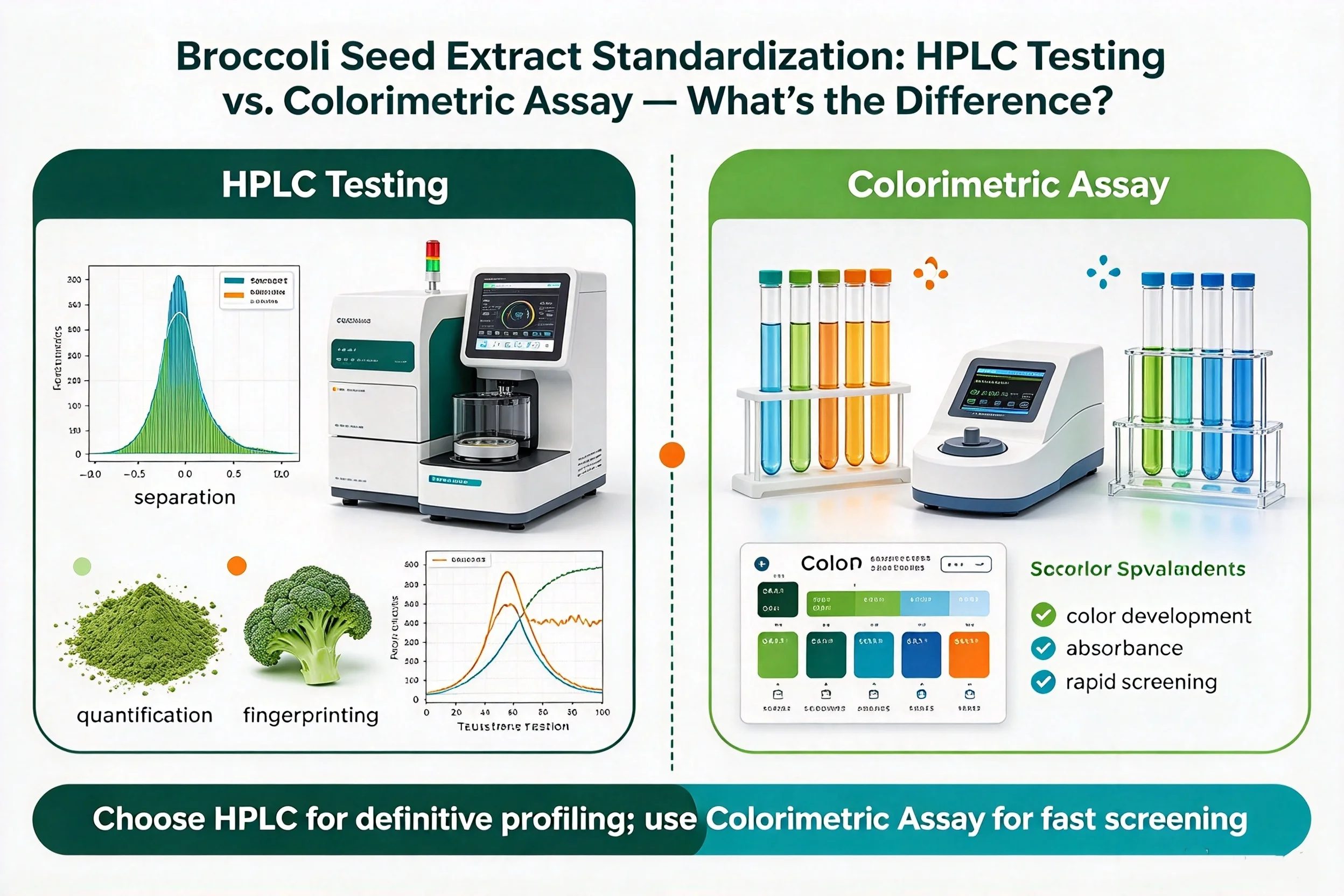
- HPLC (High-Performance Liquid Chromatography) - compound-specific, precise, and defensible in third-party audits
- Colorimetric (UV-Vis) assays - faster and cheaper, but non-specific and prone to overestimating glucosinolate content
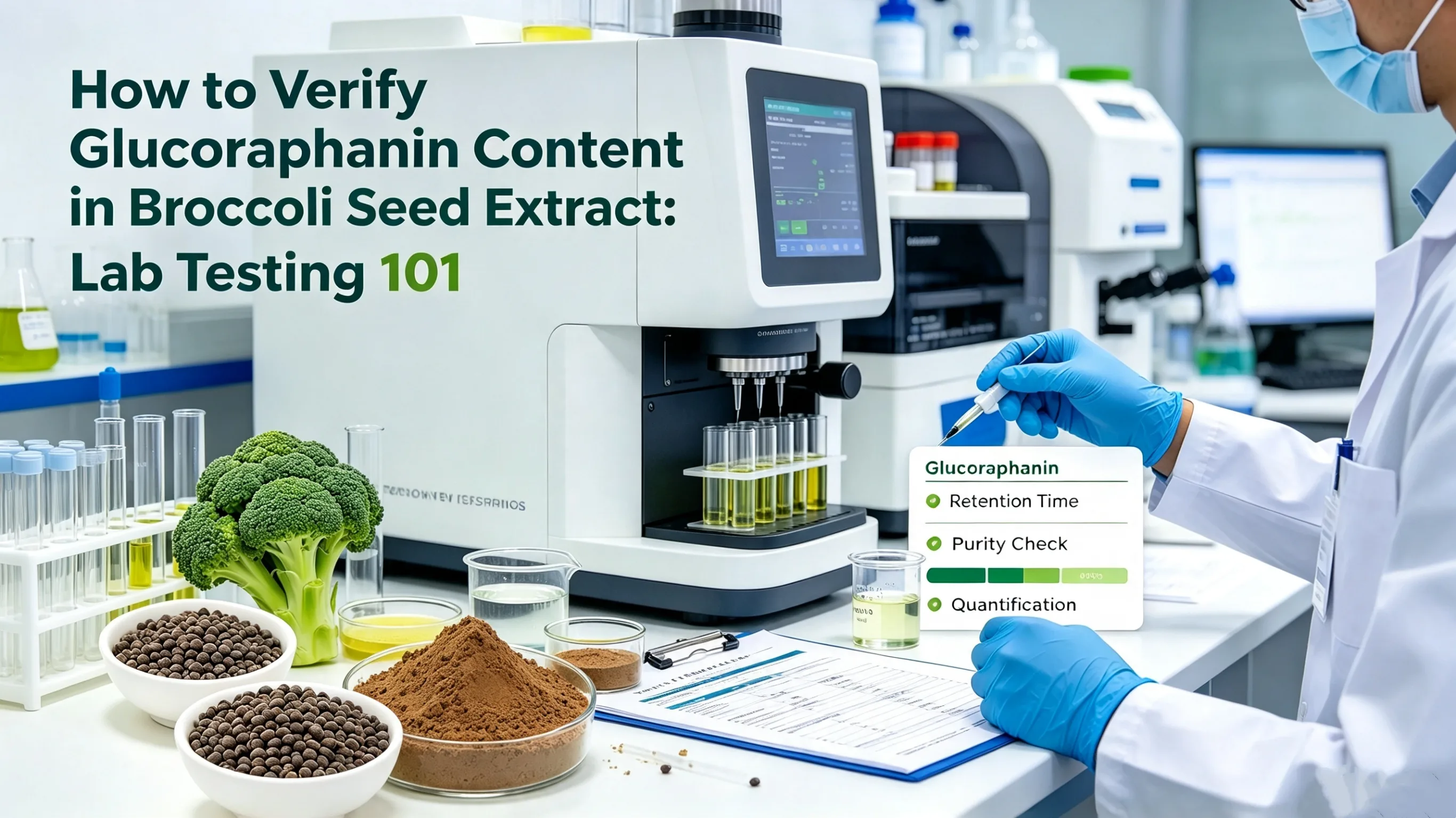
A credible broccoli seed extract supplier will always use HPLC against certified reference standards to verify both glucoraphanin and sulforaphane content. Colorimetric methods can inflate declared values by a significant margin - which means the spec sheet looks great, but the actual bioactivity in your finished product falls short.
Ask for the specific HPLC method, the reference standards used, and whether the lab is in-house or third-party. A validated HPLC method for sulforaphane and glucoraphanin quantification has been well-documented in peer-reviewed literature, making it the industry benchmark for quality verification.
What a strong answer looks like:
"We use HPLC with certified glucoraphanin and sulforaphane reference standards. Our in-house lab runs every batch, and we can provide the full analytical report alongside the COA."
2. What Specifications and Grades Do You Offer - and Can You Customize?
Not all broccoli seed extracts are created equal. The active compound profile, concentration, and form factor vary significantly depending on your application.
A well-equipped supplier should offer at minimum:
- Glucoraphanin grades (e.g., 1%, 10%, 13%–20%) - the thermally stable precursor that converts to sulforaphane in vivo via gut microbial myrosinase
- Sulforaphane grades (e.g., 0.1%, 1%, 5%, 10%) - the bioactive isothiocyanate for direct-activity applications
- Combination specs (e.g., Glucoraphanin 13% + Sulforaphane 1%) - for formulators targeting both stability and immediate bioavailability
- Water-soluble vs. oil-soluble formats - critical for beverage vs. capsule applications
Glucoraphanin is particularly important for finished product stability. Research confirms that sulforaphane itself is volatile and reactive - it degrades under standard manufacturing conditions. Glucoraphanin, by contrast, survives processing intact and delivers a urinary dithiocarbamate recovery rate of 70%–90% in vivo.
If your formula requires a custom potency or a specific solubility profile, ask whether the supplier supports OEM/ODM development. A manufacturer with genuine R&D capability will say yes without hesitation.
3. What Certifications Does Your Facility Hold?
Certifications are not just paperwork. They are your compliance infrastructure - especially when selling into regulated markets like the US, EU, or Middle East.
At minimum, your broccoli seed extract supplier should hold:
|
Certification |
Why It Matters |
|
ISO 9001 |
Quality management system baseline |
|
FSSC 22000 / ISO 22000 |
Food safety management - required for food-grade ingredients |
|
cGMP |
Current Good Manufacturing Practice - mandatory for dietary supplement ingredients sold in the US |
|
USDA NOP / EU Organic |
Required if you're positioning the product as organic |
|
Halal / Kosher |
Necessary for Middle Eastern and Jewish market access |
|
FDA Registration |
Facility-level compliance for US market entry |
Ask to see the actual certificates - not just logos on a website. Verify expiry dates. A supplier who hesitates to share original certification documents is a supplier worth walking away from.

4. Can You Provide Batch-Specific COAs - and What Do They Cover?
A Certificate of Analysis (COA) is your primary quality assurance document. But not all COAs are equal. A generic, reused COA tells you almost nothing about the specific batch you're purchasing.
A batch-specific COA from a credible broccoli seed extract manufacturer should cover:
- Assay - confirmed active compound percentage (glucoraphanin and/or sulforaphane)
- Heavy metals - lead, arsenic, cadmium, mercury (with limits aligned to USP or EU standards)
- Residual solvents - especially relevant since many extracts use ethyl alcohol in extraction
- Microbiology - total plate count, yeast, mold, E. coli, Salmonella
- Pesticide residues - critical for raw material sourced from agricultural crops
- Moisture content and particle size
Ask specifically: "Is this COA generated per batch or is it a master document?" The answer tells you a great deal about the supplier's quality culture.
Suppliers with in-house analytical labs - equipped with HPLC, GC, AAS, and microbiology testing - can generate true batch-specific COAs. Those relying entirely on outsourced testing often have longer turnaround times and less control over data integrity.
5. What Is Your Stability Data - and How Was It Generated?
Stability is a make-or-break factor for broccoli seed extract, particularly for sulforaphane-containing grades. Sulforaphane is chemically reactive. Without proper stabilization technology, potency loss during storage and manufacturing can be substantial.
Ask your supplier directly:
- What is the declared shelf life, and under what storage conditions?
- Do you have accelerated stability testing data? (e.g., 37°C / 75% RH for 90 days)
- What stabilization technology do you use?
Strong suppliers will provide documented accelerated stability data. For reference, a well-stabilized glucoraphanin extract should show greater than 95% potency retention after 90 days under accelerated conditions. Any supplier making shelf-life claims without supporting stability data is asking you to take their word for it - which is not a position you want to be in when your product is on the market.
Also ask about in vivo conversion rate data. The conversion efficiency of glucoraphanin to sulforaphane in the gut varies significantly between products. Published research shows that conversion rates can range from under 10% to over 55% depending on the extraction and stabilization method used.
6. What Are Your MOQ, Lead Time, and Supply Chain Reliability?
Even the best product specification is worthless if your supplier can't deliver consistently. Supply chain disruptions in the botanical extract industry are real - raw material shortages, harvest failures, and logistics delays can all affect your production schedule.
Key questions to ask:
- What is your minimum order quantity (MOQ)? - For broccoli seed extract, typical MOQs range from 1 kg (sample/trial) to 25 kg (commercial). Confirm whether sample quantities are available before committing to a full order.
- What is your standard lead time from order to shipment?
- Do you maintain safety stock for key SKUs?
- Where is your raw material sourced, and do you have direct grower relationships?
Suppliers who own their supply chain from raw material to finished extract - rather than relying on brokers - offer significantly more reliability and traceability. Direct grower relationships also mean better control over glucosinolate accumulation in the raw seed, which directly impacts extract potency.
Ask whether you can visit the facility - in person or via live video tour. A manufacturer with nothing to hide will welcome the request.
7. Do You Have Clinical or Scientific Evidence Supporting Your Product?
This question separates ingredient suppliers from true ingredient partners. In the B2B supplement and functional food space, your customers increasingly demand evidence-backed formulations. The scientific credibility of your ingredient directly affects your marketing claims and your brand's reputation.
Ask your supplier:
- Has your specific extract been used in published clinical trials?
- Are there ongoing registered clinical trials (e.g., NCT-registered, EudraCT) using your product?
- Can you provide SCI-indexed research papers referencing your ingredient?
Broccoli seed extract has one of the strongest scientific profiles in the botanical ingredient category. Sulforaphane's primary mechanism - Nrf2 pathway activation - has been extensively documented. Nrf2 upregulates a battery of cytoprotective enzymes including NQO1, HO-1, GST, and GCL, supporting antioxidant defense, detoxification, and anti-inflammatory pathways.
A supplier whose extract has been used as the intervention ingredient in peer-reviewed clinical trials - particularly at institutions like Johns Hopkins, Imperial College London, or Karolinska Institutet - brings a level of scientific credibility that commodity suppliers simply cannot match.
Also note: the Chinese Dietary Reference Intakes 2023 established a Tolerable Upper Intake Level (TUL) for sulforaphane at 30 mg/day - the first time a regulatory body has set a quantified intake reference for this compound. This milestone enables precise, milligram-level formulation, and your supplier should be aware of it and able to help you align your product accordingly.
Why These 7 Questions Actually Protect Your Business
Asking these questions before signing a contract is not about being difficult. It is about protecting your formulation investment, your regulatory standing, and your customers.
A supplier who answers all seven questions with documented evidence - COAs, stability data, certifications, clinical references, and analytical method details - is a supplier who has built their business around quality rather than around sales volume.
A quick checklist before you sign:
- HPLC-verified potency confirmed
- Batch-specific COA reviewed and verified
- All relevant certifications confirmed and current
- Stability data reviewed (accelerated + real-time)
- MOQ, lead time, and supply continuity confirmed
- Clinical/scientific evidence reviewed
- Facility visit or audit completed (in-person or virtual)
Work With a Supplier Who Can Answer All Seven
At Jiuyuan Biotech, we built our broccoli seed extract program to answer every one of these questions with hard data - not marketing language.
Our extract line covers three HPLC-verified specifications: SFN-1 (sulforaphane ≥1%), SFN-5 (sulforaphane ≥5%), and GR-13 (glucoraphanin ≥13%), with ultra-high potency custom grades available on request. Every batch ships with a full COA covering assay, heavy metals, residual solvents, and microbiology. Our facility holds 12 international certifications including ISO 9001, FSSC 22000, cGMP, USDA/EU Organic, Halal, and Kosher.
Our broccoli seed extract has been used as the intervention ingredient in 130+ published clinical trials and 3,000+ SCI-indexed papers globally - with ongoing RCTs registered at ClinicalTrials.gov.
If you're evaluating suppliers for your next formulation project, we're ready to answer every question on your list.
📧 Contact us: info@jiuybiotech.com
🌐 Product details: Jiuyuan Biotech Broccoli Seed Extract
References
- Fahey, J.W., Zhang, Y., & Talalay, P. (1997). Broccoli sprouts: An exceptionally rich source of inducers of enzymes that protect against chemical carcinogens. Proceedings of the National Academy of Sciences, 94(19), 10367–10372.
- Shapiro, T.A., Fahey, J.W., Wade, K.L., Stephenson, K.K., & Talalay, P. (1998). Human metabolism and excretion of cancer chemoprotective glucosinolates and isothiocyanates of cruciferous vegetables. Cancer Epidemiology, Biomarkers & Prevention, 7(12), 1091–1100.
- Vanduchova, A., Anzenbacher, P., & Anzenbacherova, E. (2019). Isothiocyanate from broccoli, sulforaphane, and its properties. Journal of Medicinal Food, 22(2), 121–126.
- Dinkova-Kostova, A.T., & Abramov, A.Y. (2015). The emerging role of Nrf2 in mitochondrial function. Free Radical Biology and Medicine, 88(Part B), 179–188.
- Traka, M., & Mithen, R. (2009). Glucosinolates, isothiocyanates and human health. Phytochemistry Reviews, 8(1), 269–282.
- Houghton, C.A. (2019). Sulforaphane: Its "coming of age" as a clinically relevant nutraceutical in the prevention and treatment of chronic disease. Oxidative Medicine and Cellular Longevity, 2019, Article 2716870.