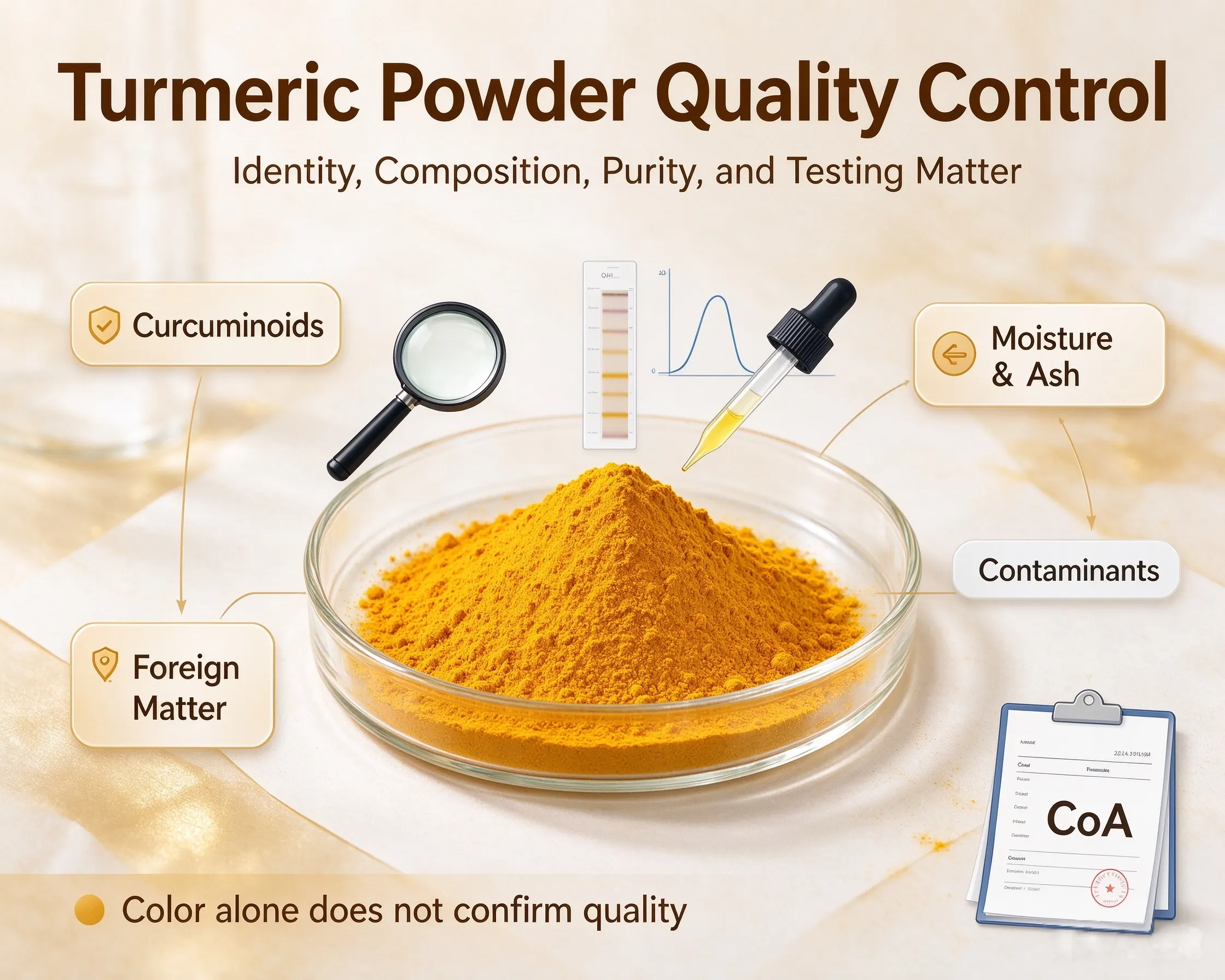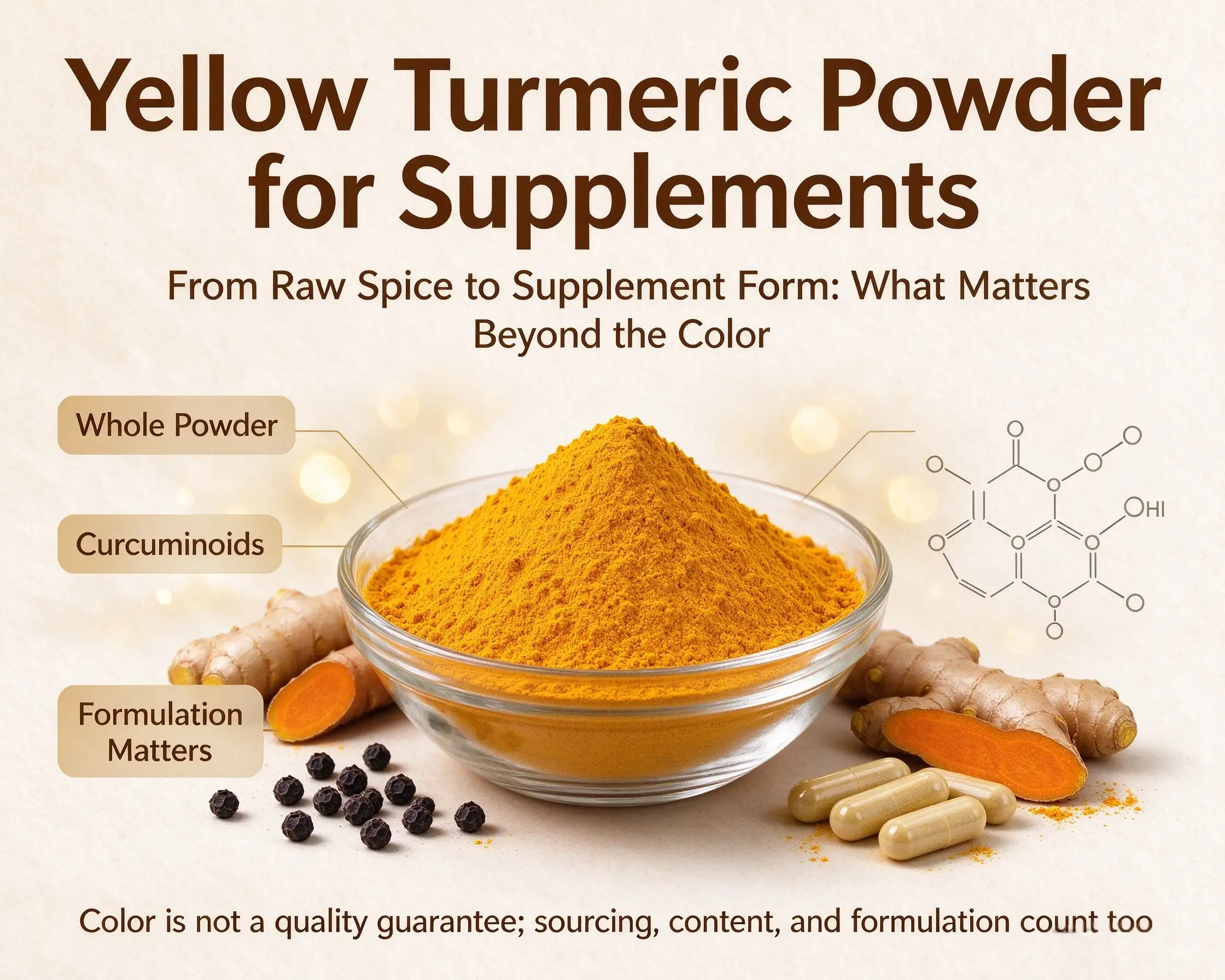
When you source yellow powder turmeric for supplement manufacturing, quality control is not a formality - it is your first line of defense. A single out-of-spec batch can trigger a product recall, a regulatory warning letter, or a lost customer relationship that took years to build. The global turmeric supplement market continues to expand, and with that growth comes a sharper focus on ingredient traceability and batch-level testing.
This guide walks you through the four pillars of turmeric powder quality control - color, particle size, heavy metals, and microbiology - and explains exactly what procurement teams and formulators should verify before approving any supplier.
Why Quality Control Starts Before the Purchase Order
Most quality failures in turmeric supply chains are preventable. They happen when buyers skip supplier qualification, accept COAs without verifying the testing methodology, or assume that a low price reflects equivalent quality.
Here is the reality: turmeric is one of the most frequently adulterated spices in global trade. Adulterants have included synthetic dyes, starch fillers, and lead chromate - a yellow pigment historically used to enhance color that carries serious toxicity risk.
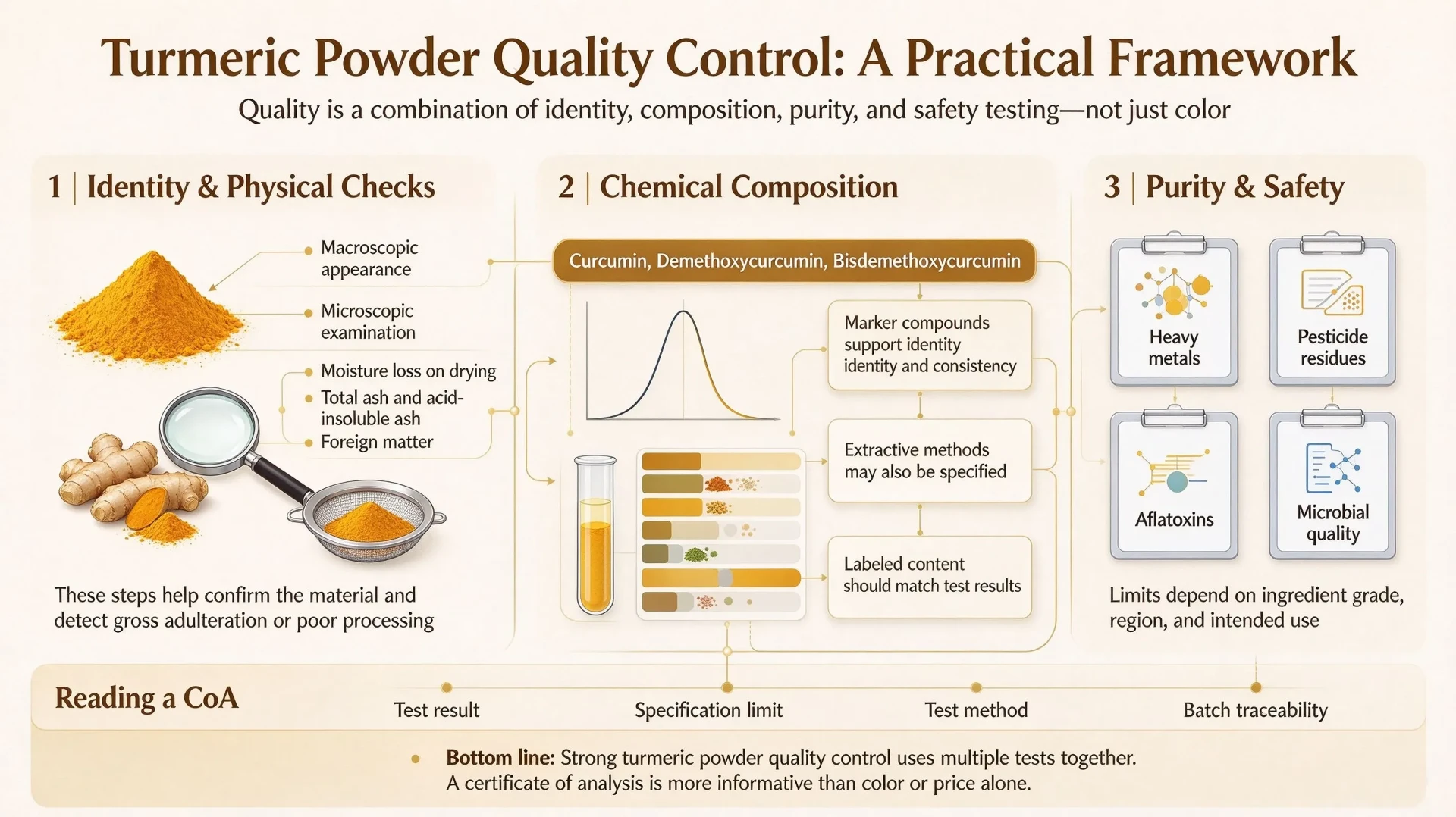
A robust quality control framework protects your brand at every step. It covers:
- Raw material qualification - verifying the supplier's analytical capabilities
- Incoming batch testing - independent verification of each shipment's COA
- In-process monitoring - particle size and moisture checks during milling
- Finished product release - full panel testing before dispatch
Each of the four parameters below maps directly to one of these steps.
Color: The First Quality Signal in Yellow Powder Turmeric
Color is the most visible quality attribute of yellow powder turmeric - and also one of the most misunderstood. A deep orange-yellow hue signals high curcuminoid content to many buyers, but visual assessment alone is not a reliable quality metric.
How Color Gets Measured Properly
Professional-grade color measurement uses two standardized approaches:
- Spectrophotometric absorbance at 425–430 nm wavelength - measures the optical density of a dissolved turmeric sample, reported as "color value" or "E1%"
- CIE L*a*b* colorimetry - quantifies lightness (L*), red-green axis (a*), and yellow-blue axis (b*) using a calibrated colorimeter
For supplement-grade yellow powder turmeric, a color value (E1%, 1cm, 425 nm) of ≥500 in a standardized solvent system is a common benchmark for high-curcuminoid extracts.
What Affects Color Consistency
Several upstream variables shift color batch-to-batch:
- Harvest season and growing region - Indian Alleppey turmeric typically shows higher curcuminoid content than Madras varieties
- Drying method - sun-dried vs. oven-dried rhizomes produce different color profiles
- Milling conditions - heat generated during fine grinding can degrade curcuminoids and shift color toward brown
- Storage conditions - UV light and humidity accelerate curcuminoid degradation
A supplier with in-house colorimetry equipment and documented color specifications per lot gives you the consistency your production line needs.
Particle Size: Why Mesh Matters More Than You Think
Particle size directly affects how yellow powder turmeric behaves in every downstream application - from capsule filling to tablet compression to powder blend homogeneity.
Standard Mesh Specifications
|
Application |
Recommended Mesh Size |
Why It Matters |
|
Hard-shell capsule filling |
80 mesh (≤180 µm) |
Consistent fill weight, no bridging |
|
Tablet compression |
60–80 mesh |
Uniform blend, predictable hardness |
|
Powder blend / stick pack |
80–100 mesh |
Smooth texture, no grittiness |
|
Functional beverage mix |
100–120 mesh |
Better dispersibility in liquid |
A particle size distribution that is too coarse causes segregation in blends - heavier particles settle to the bottom, creating dosing inconsistency. Too fine, and you risk electrostatic clumping and poor flow on high-speed capsule machines.
How to Verify Particle Size
Ask your supplier for a laser diffraction particle size report (D10, D50, D90 values) rather than a simple mesh pass/fail statement. Laser diffraction gives you the full distribution curve - not just whether 95% of particles pass a given sieve. This matters when you are scaling from pilot batches to commercial production runs.
Heavy Metals: The Non-Negotiable Safety Parameter
Heavy metal contamination in turmeric is a documented, well-studied risk - not a theoretical concern. A 2017 study published in Environmental Health Perspectives found that ground turmeric was a significant source of lead exposure in some populations, with lead chromate identified as a likely adulterant used to enhance yellow color.
Regulatory Limits You Need to Know
Different markets set different maximum limits. Here is a practical reference table:
|
Metal |
USP/NF Limit |
EU Regulation (EC) 1881/2006 |
WHO Guideline |
|
Lead (Pb) |
≤2.0 ppm |
≤3.0 ppm |
≤2.0 ppm |
|
Arsenic (As) |
≤1.5 ppm |
≤1.0 ppm |
≤1.0 ppm |
|
Cadmium (Cd) |
≤0.5 ppm |
≤1.0 ppm |
≤0.3 ppm |
|
Mercury (Hg) |
≤0.1 ppm |
≤0.1 ppm |
≤0.05 ppm |
Always confirm which regulatory framework applies to your target market before finalizing specifications with your supplier.
Acceptable Testing Methods
Not all heavy metal tests carry equal weight. The two accepted analytical methods for supplement ingredients are:
- ICP-MS (Inductively Coupled Plasma Mass Spectrometry) - the gold standard; detects metals at sub-ppb levels with high accuracy
- ICP-OES (Inductively Coupled Plasma Optical Emission Spectrometry) - reliable for most metals at ppm-level detection
Reject any COA that reports heavy metals using only colorimetric or titration methods. These older techniques lack the sensitivity and specificity that modern regulatory bodies expect.
Red Flags in Supplier COAs
Watch for these warning signs when reviewing a heavy metals report:
- Results reported as "ND" (not detected) without a stated detection limit
- No mention of the analytical method used
- Third-party lab name absent from the document
- Results that look identical across multiple batches (a sign of copy-paste rather than actual testing)
Microbiology: Protecting the End Consumer
Microbial contamination in botanical powders is a persistent challenge. Turmeric rhizomes grow in soil - they carry a natural microbial load that must be reduced to safe levels before the powder enters a supplement manufacturing facility.
Standard Microbiology Specifications
For supplement-grade yellow powder turmeric, the following limits are widely accepted across the US and EU markets:
- Total Aerobic Plate Count (TAPC): ≤10,000 CFU/g
- Total Yeast and Mold Count (TYMC): ≤1,000 CFU/g
- Enterobacteriaceae: ≤100 CFU/g
- E. coli: Negative / Not detected
- Salmonella spp.: Negative / Not detected in 25g
- Staphylococcus aureus: Negative / Not detected
These limits align with USP <2021> and <2023> microbiology standards for dietary supplements.
How Reputable Suppliers Control Microbial Load
A qualified supplier uses multiple control points to keep microbial counts within spec:
- Spray drying or flash drying at controlled temperatures to reduce surface moisture
- Steam sterilization or ethylene oxide treatment (where permitted by market regulations)
- Clean-room packaging environments with positive air pressure and HEPA filtration
- Validated storage conditions - sealed, moisture-barrier packaging with desiccant
Ask your supplier to share their microbial reduction validation data - not just the finished product test result. Understanding their process gives you confidence that low counts are repeatable, not accidental.
Curcuminoid Assay: The Fifth Parameter Worth Adding
While this article focuses on four core QC parameters, any complete quality framework for yellow powder turmeric must include curcuminoid assay by HPLC.
The USP monograph for powdered turmeric extract specifies HPLC as the reference method for quantifying curcumin, demethoxycurcumin, and bisdemethoxycurcumin. UV spectrophotometry is faster but less specific - it can overreport curcuminoid content by detecting non-curcuminoid chromophores.
- A validated HPLC method with a certified reference standard gives you:
- Accurate potency data for label claims
- Batch-to-batch consistency verification
- Adulteration detection - synthetic curcumin analogs produce a different HPLC fingerprint than natural extract
Building a Supplier Qualification Checklist
Before you approve a yellow powder turmeric supplier for commercial use, run through this checklist:
Documentation:
- Batch-specific COA with all four QC parameters plus curcuminoid assay
- Third-party lab reports (ISO/IEC 17025 accredited lab preferred)
- Allergen statement and cross-contact controls
- Pesticide residue panel (multi-residue screen)
- Solvent residue report (if solvent extraction was used)
Certifications:
- cGMP manufacturing certification
- ISO 9001 / ISO 22000 or FSSC 22000
- FDA facility registration (for US market)
- HALAL / KOSHER (if required by your customer base)
- USDA Organic / EU Organic (if applicable)
Operational:
- In-house analytical lab with HPLC and ICP-MS capability
- Documented batch traceability from raw rhizome to finished powder
- Stability data supporting the stated shelf life (typically 24 months)
- Willingness to accept facility audits
The Cost of Skipping Quality Control
A single contaminated batch of yellow powder turmeric can generate costs that dwarf any savings from choosing a cheaper supplier. Consider:
- Product recall costs - logistics, consumer notification, regulatory reporting
- Regulatory action - FDA warning letters, import alerts, or EU border rejections
- Brand damage - negative press coverage and loss of retailer confidence
- Legal liability - consumer injury claims linked to heavy metal exposure
Quality control is not overhead. It is risk management with a measurable return.
Partner With a Quality-Verified Yellow Powder Turmeric Supplier
At Jiuyuan Biotech, we manufacture supplement-grade yellow powder turmeric standardized to ≥95% curcuminoids by HPLC. Every batch undergoes full QC testing - color value, particle size distribution, ICP-MS heavy metals panel, and complete microbiology screen - before release.
Our facility holds 12 international certifications, including ISO 9001, ISO 22000, FSSC 22000, cGMP, FDA registration, HALAL, KOSHER, and USDA/EU Organic. We work with supplement brands, contract manufacturers, and distributors across 30+ countries.
Request specifications, a sample, or a bulk quote: 📧 info@jiuybiotech.com 🌐 View product details at www.jiuyuanbio.com
References
- Mudge, E. M., Brown, P. N., & Murch, S. J. (2020). "Determination of Curcuminoids in Turmeric Dietary Supplements Using High-Performance Liquid Chromatography." Journal of AOAC International, 103(4), 1045–1052. Published via PubMed Central (PMC8174018).
- Cowell, W., Ireland, T., Vorhees, D., & Heiger-Bernays, W. (2017). "Ground Turmeric as a Source of Lead Exposure in the United States." Environmental Health Perspectives, 125(8), 087008. Published via PubMed Central (PMC5415259).
- United States Pharmacopeia (USP). (2023). USP Monograph: Powdered Turmeric Extract - Curcuminoids Assay by HPLC. USP–NF. United States Pharmacopeial Convention.
- Qimei USA. (2024). Organic Turmeric Extract: Bulk Supplier Guide for Supplements, Beverages, and Functional Foods. Qimei USA Industry Report.
- European Food Safety Authority (EFSA). (2022). Scientific Opinion on the Safety and Efficacy of Curcumin as a Feed Additive. EFSA Journal, 20(3), e07187.
- World Health Organization (WHO). (2011). Safety Evaluation of Certain Food Additives and Contaminants: Curcumin. WHO Food Additives Series No. 63. WHO Press, Geneva.