When you source a standardized broccoli seed extract, the percentage on the spec sheet is not a marketing number. It is a performance promise. A 10% glucoraphanin extract and a 1% glucoraphanin extract are not the same ingredient - they behave differently in your formula, they cost differently per active dose, and they carry very different risks in a third-party audit.
If you are a formulator, brand owner, or procurement manager, this distinction matters more than almost anything else in your ingredient brief. Let me walk you through why.
What "Standardized" Actually Means in Broccoli Seed Extract
The word "standardized" gets used loosely in the botanical extract industry. In the context of broccoli seed extract, it should mean one specific thing: the extract has been tested and verified to contain a declared minimum level of one or more active compounds - typically glucoraphanin, sulforaphane, or both - using a validated analytical method.
The two primary active compounds you will see on spec sheets are:
- Glucoraphanin - the thermally stable precursor glucosinolate found abundantly in broccoli seeds. It survives manufacturing, converts to sulforaphane in the gut via microbial myrosinase activity, and delivers a urinary dithiocarbamate recovery rate of 70%–90% in human studies.
- Sulforaphane - the bioactive isothiocyanate itself. More potent per milligram, but chemically reactive and prone to degradation under heat, moisture, and standard tableting conditions.
A truly standardized extract declares which compound is being measured, at what minimum percentage, and by what method. Anything less is a ratio extract - and ratio extracts tell you nothing reliable about active content.
Why the Percentage on the Label Is a Quality Signal
Here is a practical reality: two products can both say "broccoli seed extract" on the label and have wildly different potencies.
A 10:1 ratio extract simply means 10 kg of raw material was used to produce 1 kg of extract. It says nothing about how much glucoraphanin or sulforaphane is actually present.
A 13% glucoraphanin extract, verified by HPLC, means every gram of powder delivers at least 130 mg of glucoraphanin - a number you can use to calculate a dose, defend in a regulatory submission, and reproduce batch after batch.
The percentage matters for three concrete reasons:
- Dosage accuracy - The 2023 Chinese Dietary Reference Intakes established a Tolerable Upper Intake Level (TUL) for sulforaphane at 30 mg/day. Hitting that target precisely requires a known, verified active content - not an estimated ratio.
- Audit defensibility - Third-party labs test finished products. If your declared glucoraphanin content does not match the certificate of analysis, you have a compliance problem.
- Cost-per-active-dose - A higher-percentage extract often costs more per kilogram but less per milligram of active compound. Buying on price per kilogram without checking the percentage is one of the most common sourcing mistakes in supplement manufacturing.

The Glucoraphanin → Sulforaphane Pathway: Why It Changes Everything
Understanding the biochemistry helps you make smarter sourcing decisions.
Glucoraphanin is the stable, orally deliverable precursor. When you swallow a capsule containing glucoraphanin-rich broccoli seed extract, the compound travels largely intact to the colon. There, gut bacteria with myrosinase-like activity cleave the thioglucose bond and release sulforaphane - an electrophilic isothiocyanate with a well-mapped mechanism of action.
Sulforaphane's primary target is the Nrf2 pathway (Nuclear factor erythroid 2-related factor 2). It reacts with cysteine residues on the Keap1 repressor protein, freeing Nrf2 to migrate to the nucleus and switch on the antioxidant response element (ARE). The downstream result is upregulation of a battery of cytoprotective enzymes:
|
Induced Enzyme |
Function |
|
NQO1 |
Phase II detoxification |
|
HO-1 |
Anti-inflammatory, cytoprotective |
|
GST |
Carcinogen conjugation |
|
GCL |
Glutathione biosynthesis |
|
Thioredoxin reductase |
Redox homeostasis |
This pathway is why broccoli seed extract has attracted over 3,000 published SCI papers and more than 130 completed clinical trials globally. The science is not speculative - it is mechanistically grounded and clinically replicated.
How to Read a Broccoli Seed Extract Spec Sheet as a B2B Buyer
When a supplier sends you a technical data sheet, here is what you should look for - and what should raise a flag.
Green flags:
- Declared active compound with a minimum percentage (e.g., Glucoraphanin ≥13%, Sulforaphane ≥1%)
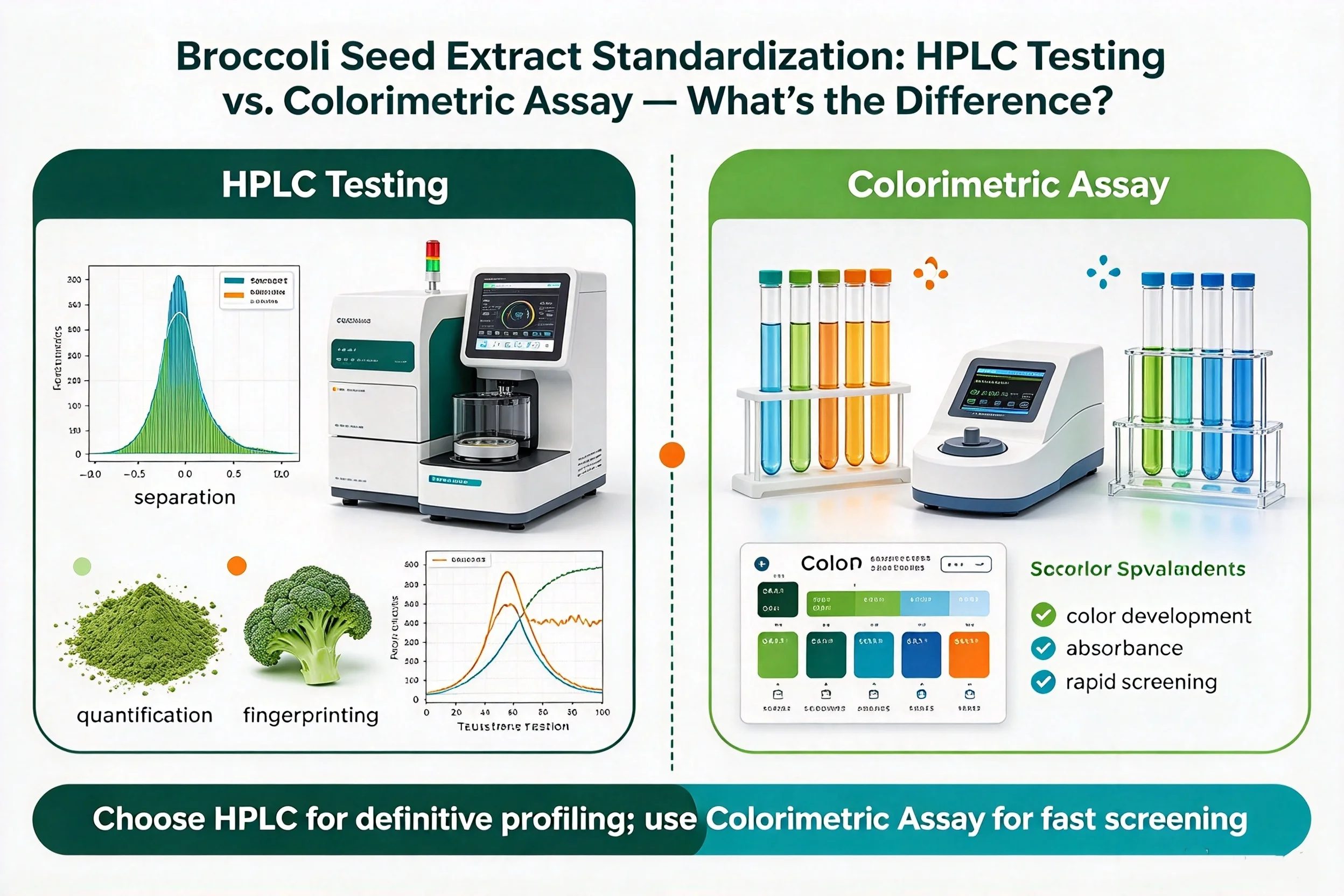
- HPLC as the analytical method - not UV or colorimetric assay
- Batch-specific COA covering assay, heavy metals, residual solvents, and microbiology
- Reference to certified reference standards used for calibration
- Accelerated stability data (e.g., 90 days at 37°C/75% RH)
Red flags:
- Only a ratio extract specification (e.g., "10:1") with no declared active content
- Colorimetric assay used to quantify glucosinolates - these are non-specific and can inflate declared content
- No batch-specific COA - only a generic certificate
- Vague origin statement with no raw material traceability
Colorimetric assays are a known weak point in commodity broccoli extract supply chains. They measure a broader class of compounds rather than glucoraphanin specifically, which allows suppliers to declare higher numbers than HPLC would support.
Common Broccoli Seed Extract Specifications and When to Use Each
Different formulation targets call for different grades. Here is a practical breakdown:
Glucoraphanin-standardized grades:
- Glucoraphanin 1% / 10% - Entry-level and mid-range grades. Suitable for general wellness positioning, food applications, and cost-sensitive formulas.
- Glucoraphanin 13% - The benchmark specification used in the majority of published clinical research. Ideal for science-backed supplement brands, clinical nutrition, and premium SKUs.
- Glucoraphanin 20%+ - Ultra-high potency. Used in research substrates, FSMPs (foods for special medical purposes), and high-dose therapeutic formulations.
Sulforaphane-standardized grades:
- Sulforaphane 0.1%–1% - Lower-potency grades for broad consumer supplement use.
- Sulforaphane 5%–10% - High-potency grades for targeted formulations where direct sulforaphane delivery is preferred over precursor conversion.
Combination grades:
- Glucoraphanin 13% + Sulforaphane 1% - Dual-active specification. Provides both the stable precursor for sustained conversion and immediate sulforaphane activity. Increasingly popular in premium antioxidant and detox formulas.
The right grade depends on your target dose, your manufacturing process (heat-sensitive sulforaphane needs cold processing), and your regulatory environment.
What Separates a Quality Manufacturer from a Commodity Supplier
The broccoli seed extract market has grown significantly. The global broccoli extract market, driven by demand for standardized sulforaphane content, has been growing at an estimated 9.2% annually since 2022. That growth has attracted a wave of commodity suppliers offering low-cost material with questionable standardization.
Here is what a quality manufacturer actually does differently:
- Raw material selection - Premium cultivars selected for peak glucosinolate accumulation, not just any broccoli seed. Soil fertility, irrigation, and harvest timing all affect glucoraphanin content.
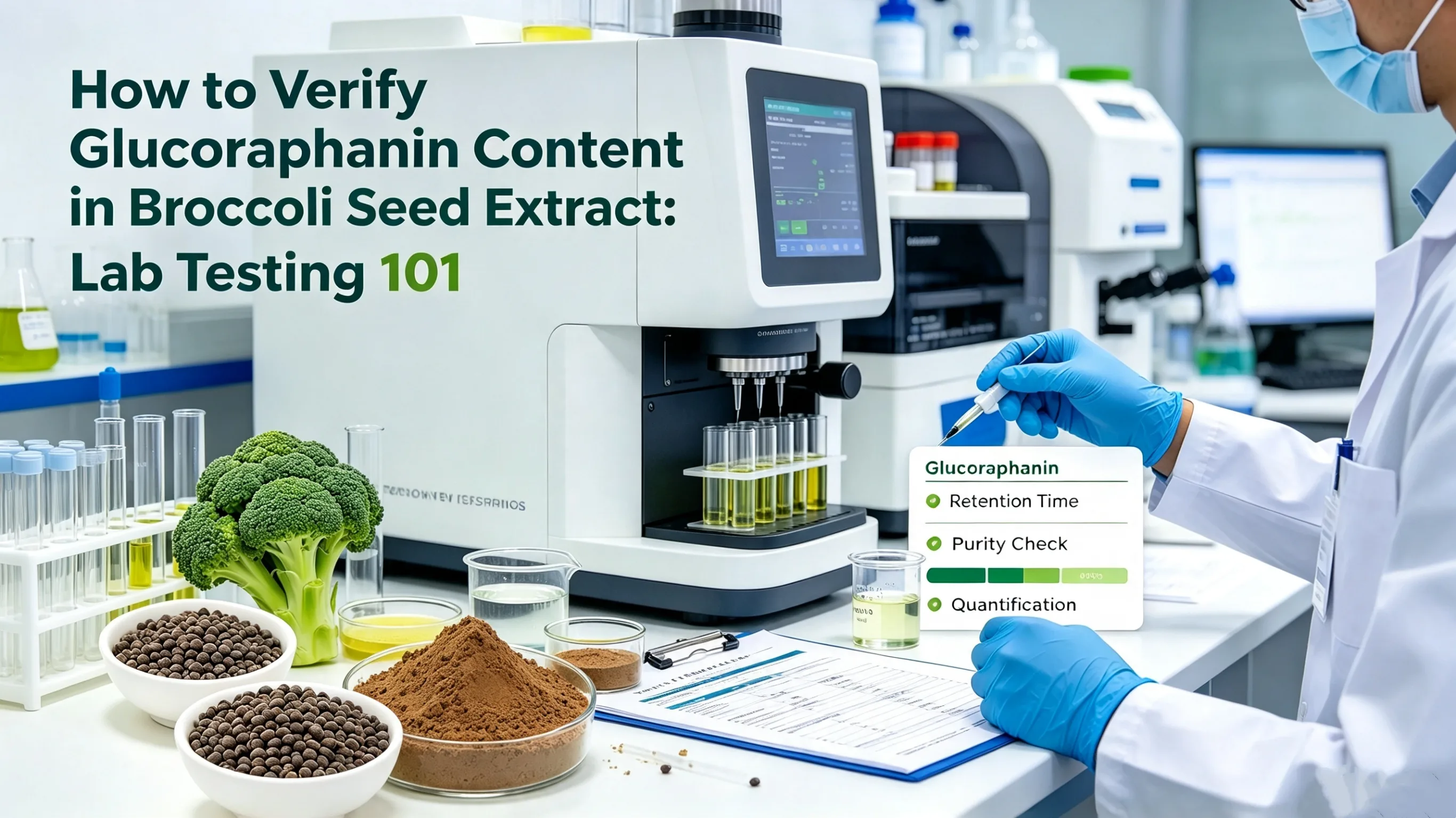
- In-house HPLC testing - Every batch verified against certified reference standards before it ships. Not outsourced. Not assumed.
- Stability validation - Accelerated stability testing to confirm active retention over shelf life. A 13% glucoraphanin extract that degrades to 8% by month six is not a 13% extract.
- Full traceability - Field-to-COA documentation. You should be able to trace any batch back to the source lot of raw material.
- Regulatory certifications - For global distribution, look for FDA inspection records, cGMP compliance, FSSC 22000, ISO 9001, and organic certifications (USDA NOP / EU Organic) where applicable.
These are not nice-to-have features. They are the baseline for any ingredient going into a product that will be sold in the US, EU, or Japanese market.
Bioavailability Considerations for Formulators
One detail that often gets overlooked at the sourcing stage: glucoraphanin conversion to sulforaphane is gut-microbiome dependent. Individuals with robust populations of myrosinase-expressing bacteria - notably Bacteroides and Lactobacillus species - convert more efficiently.
This has two practical implications for your formula:
- Co-administration with exogenous myrosinase (e.g., a small amount of fresh broccoli sprout powder or radish powder) significantly boosts sulforaphane yield. This is a formulation strategy backed by published research and worth considering for premium products.
- Choosing a dual-active extract (glucoraphanin + sulforaphane) hedges against individual variation in gut microbiome composition. Consumers with lower microbial myrosinase activity still receive direct sulforaphane from the extract itself.
These are the kinds of technical nuances that separate a well-designed formula from one that just lists a trendy ingredient on the label.
Application Formats: Where Standardized Broccoli Seed Extract Fits
A high-quality, standardized extract is versatile. Depending on the grade and format (water-soluble vs. oil-soluble powder), it integrates cleanly into:
- Capsules and tablets - The most common format. Glucoraphanin grades are thermally stable and process well.
- Powder blends and sachets - Water-soluble grades with ≥98% clarity work in transparent beverage applications without off-flavor.
- Functional gummies - Requires careful temperature management during manufacturing; glucoraphanin grades preferred over sulforaphane grades.
- Infant and maternal nutrition / FSMPs - Requires the highest purity grades with full documentation.
- Sports nutrition - Positioned around cellular defense and recovery, leveraging the Nrf2/antioxidant mechanism.
- Pet nutrition - An emerging application with growing interest from premium pet supplement brands.
The mild taste profile - no pungent cruciferous aftertaste - makes standardized broccoli seed extract significantly easier to work with than raw broccoli powder in finished product development.
The Bottom Line: Percentage Is Not a Detail - It Is the Product
When you buy a standardized broccoli seed extract, you are not buying a plant. You are buying a defined, reproducible dose of a specific active compound. The percentage is what defines that dose. It is what you put in your formula brief, what your regulatory team defends, and what your customers are paying for.
Sourcing on price per kilogram without verifying the percentage, the analytical method, and the batch-specific COA is a risk that shows up - reliably - in third-party audits, customer complaints, and reformulation costs.
Work with a manufacturer who can show you the data, not just quote you a price.
Ready to Source a Verified Standardized Broccoli Seed Extract?
At Jiuyuan Biotech, we produce HPLC-verified standardized broccoli seed extract across multiple grades - from Glucoraphanin 1% to 20%+ and Sulforaphane 0.1% to 10% - with full batch-specific COAs, accelerated stability data, and field-to-COA raw material traceability.
Our facility holds 12 international certifications including ISO 9001, FSSC 22000, cGMP, Halal, Kosher, and USDA/EU Organic. We serve clients across 30+ countries in the dietary supplement, functional food, cosmetic, and pharmaceutical industries.
👉 View full product specifications: Broccoli Seed Extract – Jiuyuan Biotech
📩 Request a sample or technical data sheet: info@jiuybiotech.com
References
1. Fahey, J. W., Wehage, S. L., Holtzclaw, W. D., Kensler, T. W., Egner, P. A., Shapiro, T. A., & Talalay, P. (2012). Protection of humans by plant glucosinolates: Efficiency of conversion of glucosinolates to isothiocyanates by the gastrointestinal microflora. *Cancer Prevention Research*, 5(4), 603–611.
2. Vanduchova, A., Anzenbacher, P., & Anzenbacherova, E. (2019). Isothiocyanate from broccoli, sulforaphane, and its properties. *Journal of Medicinal Food*, 22(2), 121–126.
3. Shapiro, T. A., Fahey, J. W., Dinkova-Kostova, A. T., Holtzclaw, W. D., Stephenson, K. K., Wade, K. L., Ye, L., & Talalay, P. (2006). Safety, tolerance, and metabolism of broccoli sprout glucosinolates and isothiocyanates: A clinical phase I study. *Nutrition and Cancer*, 55(1), 53–62.
4. Cramer, J. M., Teran-Garcia, M., & Bhagwat, S. (2017). Sulforaphane bioavailability from glucoraphanin-rich broccoli: Control by active endogenous myrosinase. *PLOS ONE*, 12(11), e0140963.
5. Kensler, T. W., Egner, P. A., Agyeman, A. S., Visvanathan, K., Groopman, J. D., Chen, J. G., Chen, T. Y., Fahey, J. W., & Talalay, P. (2013). Keap1–Nrf2 signaling: A target for cancer prevention by sulforaphane. *Topics in Current Chemistry*, 329, 163–177.
6. Dinkova-Kostova, A. T., & Fahey, J. W. (2012). Glucosinolate hydrolysis products as cancer chemopreventive agents: Sulforaphane and related isothiocyanates. *Nutrition and Cancer*, 64(7), 973–993.