You've sourced a batch of broccoli seed extract. The supplier's COA says 13% glucoraphanin. The price looks right. The documentation looks clean. But here's the question that separates experienced formulators from costly mistakes: do you actually know how to verify that number?
Glucoraphanin content is the single most important quality marker in broccoli seed extract. It determines bioavailability, clinical relevance, and label claim defensibility. Yet the analytical methods used to measure it vary enormously - and not all of them give you the same answer.
This guide walks you through exactly what you need to know: which testing methods are reliable, which are not, what the numbers mean, and how to use lab data to qualify or disqualify a supplier.
Why Glucoraphanin Verification Matters More Than You Think
Glucoraphanin is the stable glucosinolate precursor that converts to sulforaphane - the active Nrf2-pathway activator - in the body. Without verified glucoraphanin content, you cannot predict sulforaphane yield, cannot substantiate your label claims, and cannot defend your product in a third-party audit.
The problem is real and widespread. A 2020 independent analysis of commercial sulforaphane and broccoli extract supplements found that many products delivered significantly less sulforaphane than their labels claimed. The root cause in most cases traced back to inadequate glucoraphanin verification at the raw ingredient stage.
Here is what inaccurate glucoraphanin data costs you:
- Under-dosed finished products that fail third-party testing
- Label claim liability in regulated markets (FDA, EU Cosmetics, Health Canada)
- Customer complaints and return rates that erode brand equity
- Regulatory action risk in markets with mandatory ingredient substantiation
The good news: glucoraphanin is one of the most analytically tractable botanical actives in the supplement industry. Validated, reproducible testing methods exist. You just need to know which ones to trust.
The Gold Standard: HPLC-Based Glucosinolate Analysis
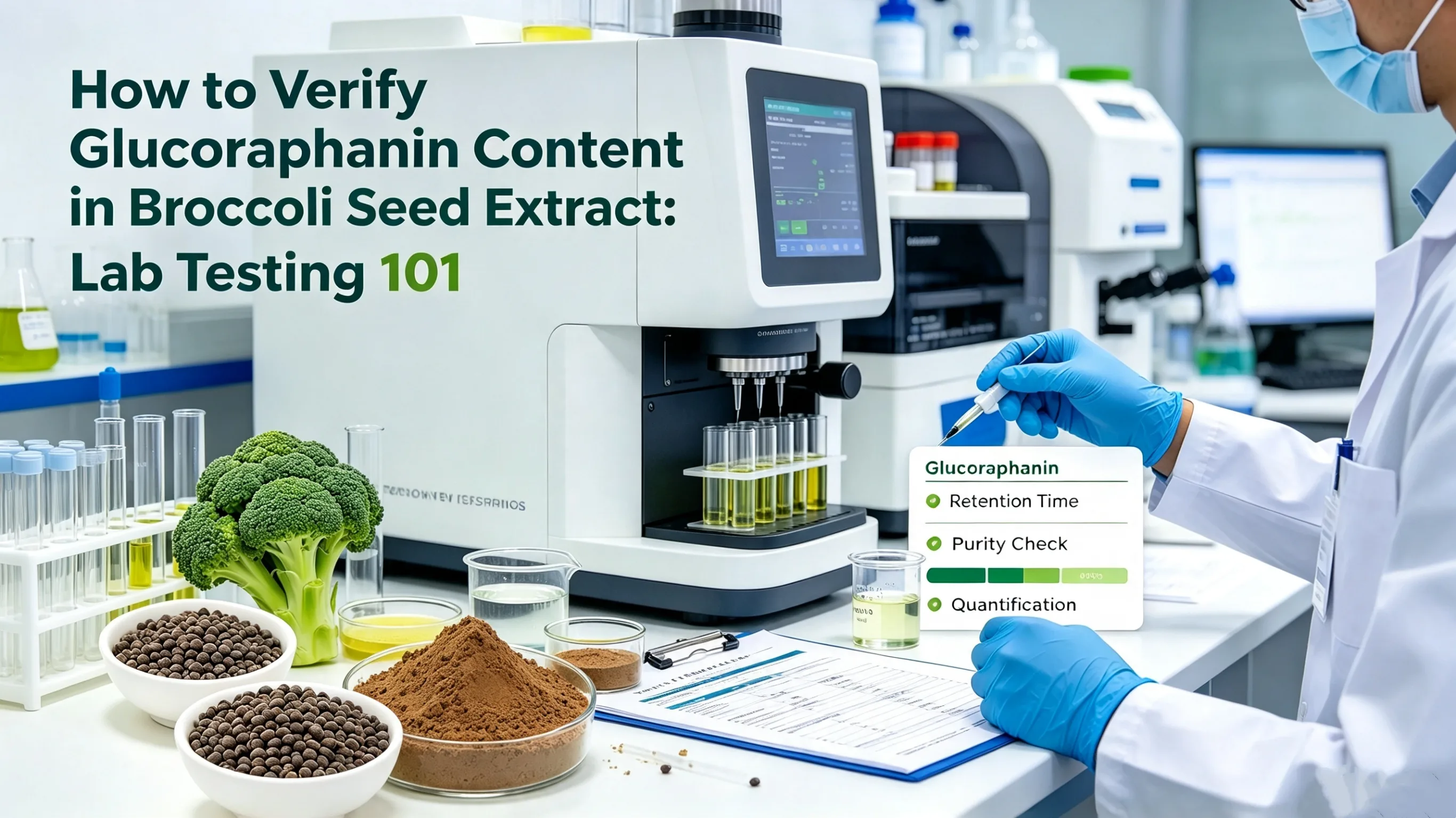
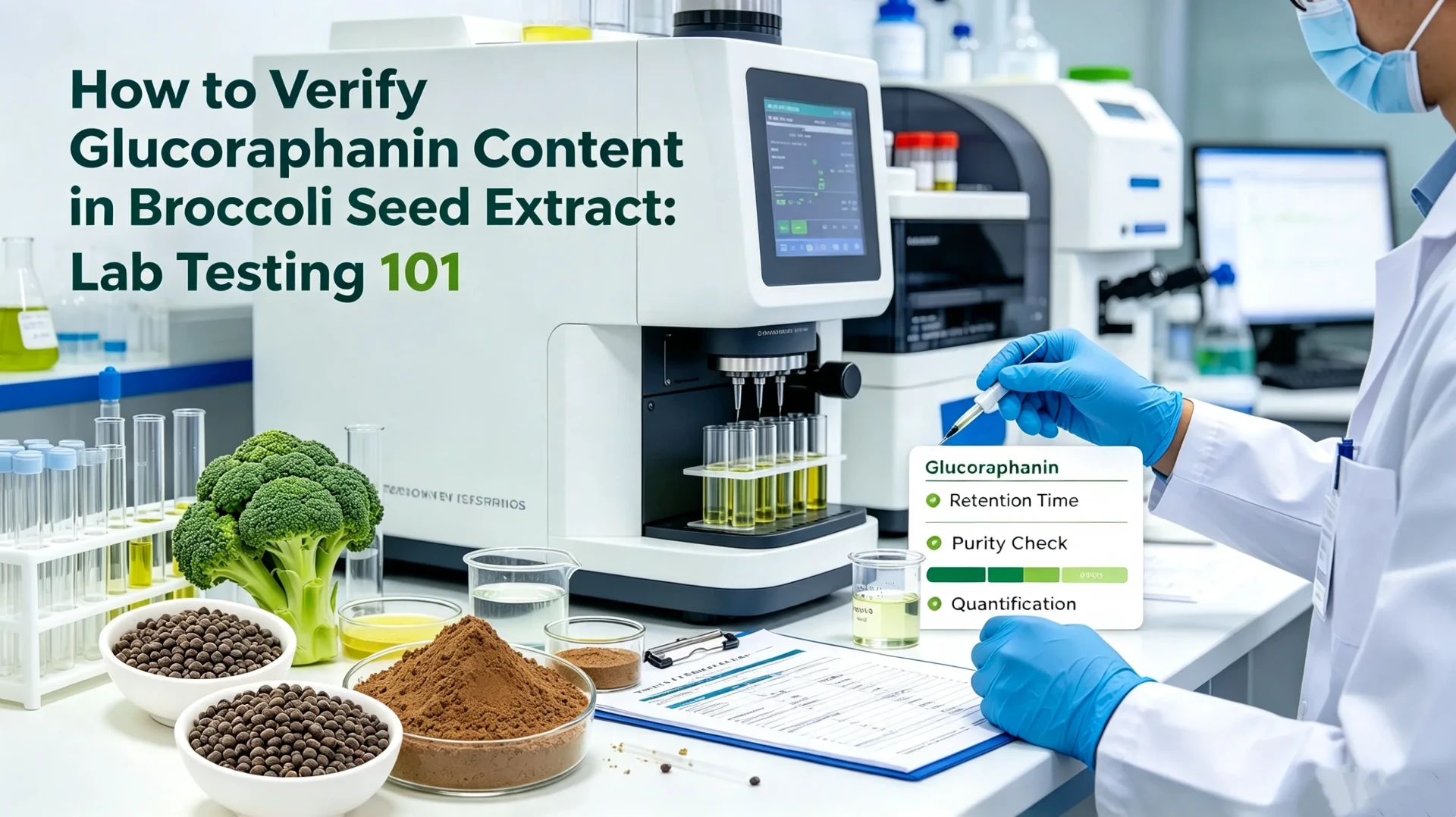
High-Performance Liquid Chromatography (HPLC) is the definitive analytical method for glucoraphanin quantification in broccoli seed extract. It is the method referenced in ISO 9167-1 for glucosinolate analysis in Brassica crops - and it is the only method that gives you compound-specific, quantitatively defensible data.
How the HPLC Method Works
The validated HPLC procedure for glucoraphanin follows a defined sequence:
Step 1 - Extraction Glucosinolates are extracted from the dried extract powder using hot water or methanol-water solvent systems. Published research confirms that hot water extraction at 70–80°C for 10–20 minutes achieves consistent glucoraphanin recovery from broccoli seed material.
Step 2 - Desulfation (for intact glucosinolate analysis) Crude extracts are passed through DEAE-Sephadex ion exchange columns to isolate intact glucosinolates. An enzymatic desulfation step using sulfatase converts intact glucosinolates to their desulfo forms - which are more UV-detectable and better separated on reverse-phase HPLC columns.
Step 3 - Chromatographic Separation Desulfo-glucosinolates are separated on a C18 reverse-phase column using a gradient mobile phase (typically acetonitrile/water). Glucoraphanin elutes at a characteristic retention time that distinguishes it from other glucosinolates including sinigrin, gluconapin, and glucobrassicin.
Step 4 - Detection and Quantification UV detection at 229 nm provides the absorption signal for desulfo-glucosinolates. Glucoraphanin content is quantified against a certified reference standard - either sinigrin (as an internal standard) or purified glucoraphanin reference material.
What a reliable HPLC report should show you:
- Chromatogram with clearly resolved glucoraphanin peak
- Retention time matching certified reference standard (±0.1 min)
- Peak area and calculated concentration in mg/g or % w/w
- Identification of co-eluting glucosinolates (sinigrin, gluconapin, etc.)
- Reference standard lot number and certification date
- Method validation parameters (linearity, precision, recovery)
Why Colorimetric Assays Are Not Enough
Many suppliers report glucosinolate content using colorimetric assays - particularly the Kore method or glucose-release assays based on enzymatic hydrolysis. These methods are faster and cheaper than HPLC. They are also fundamentally inadequate for glucoraphanin-specific quantification.
Here is the core problem:
- Colorimetric glucosinolate assays measure total glucosinolates - not glucoraphanin specifically
- Broccoli seed extract contains multiple glucosinolates beyond glucoraphanin
- A high total glucosinolate reading can mask low glucoraphanin content if other glucosinolates predominate
- Colorimetric methods cannot distinguish glucoraphanin from sinigrin, gluconapin, or glucobrassicin
A practical scenario: A supplier reports 15% total glucosinolates by colorimetric assay. If only 40% of that fraction is glucoraphanin, the actual glucoraphanin content is 6% - less than half the implied value. Without HPLC, you cannot know the difference.
Published validation research confirms that HPLC with desulfation provides significantly better specificity and accuracy for individual glucosinolate quantification than colorimetric approaches.
The bottom line: Accept colorimetric data as a screening tool only. Require HPLC quantification for any glucoraphanin specification claim on a COA.
Alternative and Complementary Testing Methods
HPLC is the primary standard - but several complementary methods add value in specific contexts:
LC-MS/MS (Liquid Chromatography - Tandem Mass Spectrometry)
LC-MS/MS provides the highest specificity of any glucoraphanin testing method. It combines chromatographic separation with mass-based molecular identification - eliminating any ambiguity about peak identity. It is particularly valuable for:
- Detecting adulteration with synthetic glucoraphanin
- Quantifying trace-level glucosinolate impurities
- Confirming glucoraphanin identity in novel or complex extract matrices
LC-MS/MS is more expensive than standard HPLC and requires specialized instrumentation. It is the method of choice for high-value pharmaceutical-grade applications and dispute resolution testing.
Micellar Electrokinetic Capillary Chromatography (MECC)
Research published on ResearchGate validated a MECC method for glucoraphanin determination in broccoli seeds and florets using solid-phase extraction. MECC offers good resolution for glucosinolate separation and is used in some specialized research laboratory settings. It is less common in commercial QC environments than HPLC.
Near-Infrared Spectroscopy (NIR)
NIR is a rapid, non-destructive screening method used for incoming material inspection. It can detect gross adulteration or batch-to-batch inconsistency in extract composition quickly and without sample preparation. However, NIR cannot replace HPLC for quantitative glucoraphanin specification - it requires calibration against HPLC-verified reference samples and loses accuracy for low-concentration analytes.
In Vitro Conversion Assay (Myrosinase Hydrolysis)
This functional test measures how much sulforaphane your extract actually generates under simulated digestion conditions. The procedure:
- Incubates extract with myrosinase enzyme at physiological pH and temperature
- Measures sulforaphane yield by HPLC after defined hydrolysis periods
- Expresses results as sulforaphane equivalent per gram of extract
A well-characterized glucoraphanin extract with active myrosinase should achieve 55–70% molar conversion to sulforaphane under optimized in vitro conditions. This data is more predictive of in vivo bioavailability than glucoraphanin content alone - and it is the data that sophisticated formulators increasingly request alongside standard COA documentation.
Reading a COA: What the Numbers Actually Mean
A Certificate of Analysis is only as useful as your ability to interpret it critically. Here is what to look for - and what to question:
Glucoraphanin specification - the key parameters:
|
Parameter |
What to Look For |
Red Flag |
|
Assay method |
HPLC (desulfo method) |
Colorimetric only |
|
Specification |
% w/w glucoraphanin |
"Total glucosinolates" without GR breakdown |
|
Reference standard |
Named, certified standard with lot number |
No reference standard cited |
|
Retention time |
Documented in chromatogram |
No chromatogram provided |
|
Related substances |
Other glucosinolates identified and quantified |
No impurity profile |
|
Moisture correction |
Assay reported on dry weight basis |
Wet weight only |
|
Batch traceability |
Batch number links to specific production run |
Generic or undated COA |
Specific numbers to benchmark against:
- High-quality broccoli seed extract: 10%–20% glucoraphanin by HPLC (dry weight basis)
- Published research reports glucoraphanin concentrations up to 274.1 µmol/g dry weight in elite broccoli genotypes
- Sulforaphane-standardized grades: typically 0.1%–10% sulforaphane by HPLC
- Myrosinase-active grades: conversion rate ≥55% under standard in vitro conditions
The Epithiospecifier Protein (ESP) Problem - What Most COAs Miss
Here is a quality parameter that most COAs do not address - and that can silently undermine your formulation's efficacy.
Epithiospecifier protein (ESP) is an enzyme naturally present in broccoli seed material. When active, ESP diverts glucoraphanin hydrolysis away from sulforaphane toward sulforaphane nitrile - a compound with no documented Nrf2 activity.
The consequence: an extract with high glucoraphanin content but active ESP can deliver dramatically lower sulforaphane yield than its specification implies.
How to detect ESP interference:
- Request in vitro conversion assay data comparing sulforaphane yield with and without added myrosinase
- A large discrepancy between theoretical sulforaphane yield (from glucoraphanin content) and actual measured yield signals ESP activity
- Some suppliers specifically document ESP inactivation in their manufacturing process - this is a meaningful quality differentiator
Ask your supplier directly: "Has ESP activity been characterized and controlled in this extract?" A supplier who cannot answer this question is not operating at pharmaceutical-grade quality standards.
Third-Party Lab Verification - Your Non-Negotiable Safety Net
Even with a clean COA from your supplier, independent third-party verification is essential for any commercial supplement launch.
When to use third-party testing:
- Before committing to a large purchase order (pre-shipment verification)
- When switching suppliers or receiving a new production batch
- When your in-house stability testing shows unexpected potency decline
- When preparing for regulatory submission or retail buyer audits
Accredited labs for glucosinolate testing:
Look for ISO/IEC 17025-accredited laboratories with documented experience in glucosinolate analysis. Key labs with published glucosinolate methodology include Eurofins, SGS, and NSF International. Request that the lab uses the ISO 9167-1 adapted HPLC method or an equivalent validated procedure - not a proprietary colorimetric screen.
What to send for third-party testing:
- Representative sample from the production batch (minimum 50 g)
- Your supplier's COA for the same batch
- Specification sheet with target glucoraphanin range
- Request for full glucosinolate profile - not just glucoraphanin
Acceptable variance between supplier COA and third-party results:
Industry practice accepts ±5% relative variance for HPLC-based glucoraphanin quantification between laboratories using the same validated method. Variance exceeding ±10% warrants investigation and supplier dialogue.
Supplier Qualification Checklist for Broccoli Seed Extract
Analytical verification does not happen in isolation - it is part of a broader supplier qualification process. Here is the complete checklist:
Documentation requirements:
✅ COA with HPLC glucoraphanin assay and full chromatogram
✅ Method validation report (linearity, precision, accuracy, LOD/LOQ)
✅ In vitro conversion assay data (sulforaphane yield under simulated digestion)
✅ ESP activity characterization or inactivation documentation
✅ Pesticide residue report (GC/LC-MS, EU 396/2005 or equivalent)
✅ Heavy metals panel (ICP-MS)
✅ Residual solvent report (ICH Q3C compliant)
✅ Microbial enumeration and pathogen absence
✅ Accelerated stability data (glucoraphanin retention at 37°C/75% RH, 90 days)
Certification requirements:
✅ GMP certificate (FDA-equivalent or EU GMP)
✅ ISO 9001:2015
✅ HACCP
✅ Non-GMO declaration
✅ Allergen statement
Experience indicators:
Published clinical trial use of the specific extract material
Peer-reviewed analytical method citations
Long-term supply history with named nutraceutical brand customers
Putting It All Together - A Practical Verification Protocol
Here is a step-by-step verification protocol you can implement immediately for any incoming broccoli seed extract batch:
On receipt of COA from supplier:
- Confirm assay method is HPLC - not colorimetric
- Verify glucoraphanin is reported specifically - not as total glucosinolates
- Check that a chromatogram is attached with labeled glucoraphanin peak
- Confirm reference standard is named and certified
- Note moisture content - verify assay is on dry weight basis
Before purchase order commitment:
- Request in vitro conversion assay data
- Ask specifically about ESP characterization
- Request accelerated stability data for the specific batch grade
- Confirm pesticide residue and heavy metals reports are available
After receipt of bulk material:
- Send representative sample to ISO 17025-accredited third-party lab
- Request full glucosinolate profile - not just glucoraphanin
- Compare third-party results against supplier COA (acceptable variance ±5%)
- Document results in your incoming material QC records
This protocol takes less time than reformulating a failed product. It costs a fraction of a regulatory action. And it is the difference between a supplement that delivers on its claims and one that quietly disappoints.
Source Broccoli Seed Extract with Full Analytical Transparency
Jiuyuan Bio supplies HPLC-verified Broccoli Seed Extract in multiple specifications - including Glucoraphanin 10%–20%, Sulforaphane 0.1%–10%, and myrosinase-active combination grades - with full analytical documentation per batch.
Every batch ships with:
- HPLC chromatogram with glucoraphanin peak identification
- In vitro conversion assay data
- Full glucosinolate profile
- Pesticide residue and heavy metals reports
- Accelerated stability data on request
👉 View full product specifications: https://www.jiuyuanbio.com/standard-plant-extract-powder/broccoli-seed-extract.html
📧 Contact our technical team for samples and analytical documentation: info@jiuybiotech.com
We work with supplement formulators, contract manufacturers, and procurement teams across North America, Europe, and Asia-Pacific who need analytically verified broccoli seed extract they can trust.
References
- Berhow, M. A., Polat, U., Glinski, J. A., Glinski, V., Vaughn, S. F., & Isbell, T. (2013). Quantitative determination and chemometric analysis of glucosinolates in seeds of Brassica species. Phytochemical Analysis, 24(5), 495–503.
- Fahey, J. W., Zalcmann, A. T., & Talalay, P. (2001). The chemical diversity and distribution of glucosinolates and isothiocyanates among plants. Phytochemistry, 56(1), 5–51.
- Velasco, P., Soengas, P., Vilar, M., Cartea, M. E., & del Rio, M. (2008). Comparison of glucosinolate profiles in leaf and seed tissues of different Brassica napus crops. Journal of the American Society for Horticultural Science, 133(4), 551–558.
- Grosser, K., & van Dam, N. M. (2017). A straightforward method for glucosinolate extraction and analysis with high-pressure liquid chromatography (HPLC). Journal of Visualized Experiments, (121), e55425.
- Dinkova-Kostova, A. T., & Kostov, R. V. (2012). Glucosinolates and isothiocyanates in health and disease. Trends in Molecular Medicine, 18(6), 337–347.
- Hanschen, F. S., Lamy, E., Schreiner, M., & Rohn, S. (2014). Reactivity and stability of glucosinolates and their breakdown products in foods. Angewandte Chemie International Edition, 53(43), 11430–11450.