

If you're developing a supplement line with broccoli seed extract, you already know the market opportunity is real. Sulforaphane - the star bioactive compound in broccoli seed extract - has been featured in 130+ clinical trials and over 3,000 SCI-indexed papers. Consumer demand for Nrf2-activating ingredients is growing fast.
But here's the problem most brands run into: not all broccoli seed extract is created equal. The gap between a high-performing, clinically relevant ingredient and a cheap commodity powder can be enormous - and it's not always visible on a spec sheet.
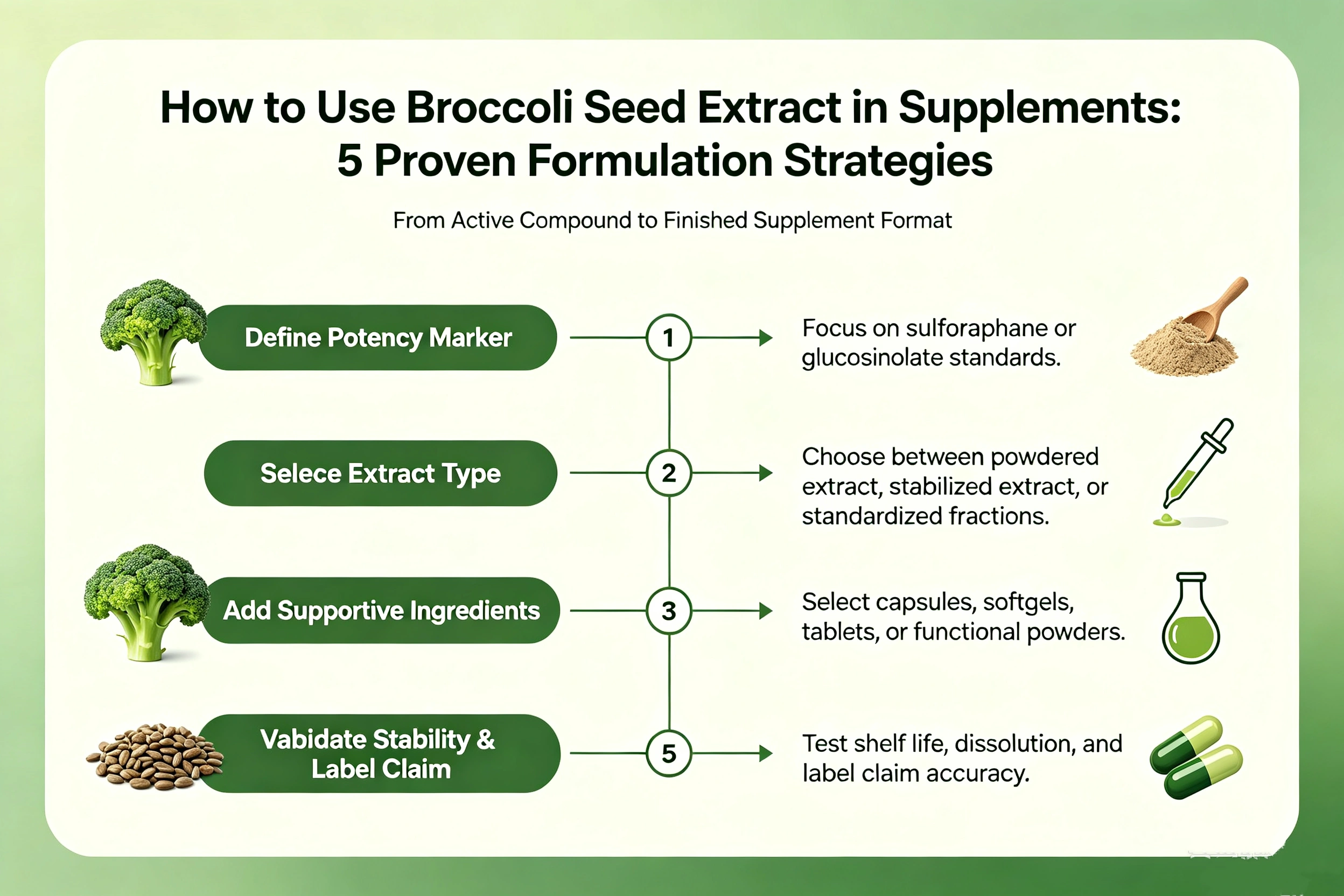
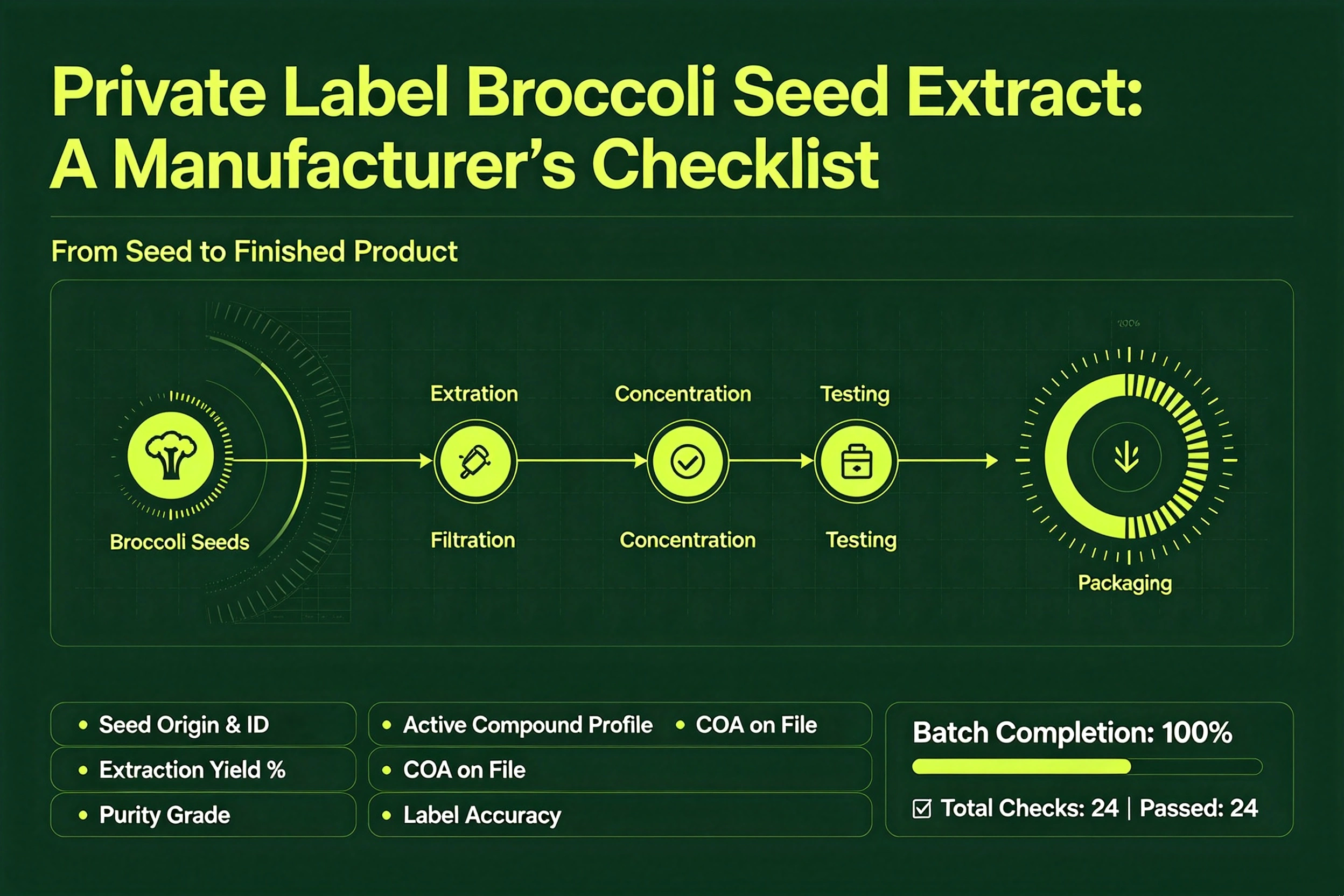
This checklist walks you through 5 proven formulation strategies and the key manufacturer criteria you need to evaluate before placing a private label order. Whether you're a supplement brand, contract manufacturer, or procurement manager, this guide gives you a practical framework to make the right call.
1. Understand the Glucoraphanin vs. Sulforaphane Decision First
Before you even talk to a supplier, you need to resolve one fundamental formulation question: do you want glucoraphanin or sulforaphane as your active marker?
This choice shapes everything - stability, dosing, shelf life, and label claims.
Here's a quick breakdown:
- Sulforaphane (SFN) is the bioactive isothiocyanate. It's potent, but highly reactive and volatile. It degrades under heat, humidity, and standard manufacturing conditions.
- Glucoraphanin (GR) is the thermally stable precursor. It survives processing intact and converts to sulforaphane in vivo via gut microbial myrosinase activity. Urinary dithiocarbamate recovery rates of 70%–90% have been consistently documented.
The industry consensus has largely shifted toward glucoraphanin-based formulations for finished supplements - precisely because of stability advantages. A glucoraphanin-rich extract that survives a 24-month shelf life is far more commercially viable than a sulforaphane extract that degrades within months.
What to ask your manufacturer:
- What is the HPLC-verified glucoraphanin or sulforaphane content per gram?
- Is potency verified against certified reference standards - or colorimetric assays?
- What accelerated stability data (e.g., 37°C/75% RH for 90 days) can they provide?
⚠️ Red flag: Any supplier quoting glucosinolate content via non-specific colorimetric assays is likely inflating numbers. Demand HPLC data.
2. Strategy #1 - Add Exogenous Myrosinase to Boost Bioavailability
One of the most impactful formulation strategies for glucoraphanin-based supplements is co-formulating with an exogenous myrosinase source.
Here's why this matters:
- Glucoraphanin requires myrosinase enzyme activity to convert to sulforaphane in the gut.
- Gut microbiome myrosinase activity varies widely between individuals - meaning conversion efficiency is inconsistent.
- Adding a small amount of mustard seed powder, radish powder, or fresh broccoli sprout powder provides exogenous myrosinase, dramatically improving conversion rates.
A published randomized study confirmed that exogenous myrosinase from mustard seed significantly increases sulforaphane bioavailability from a glucoraphanin-rich broccoli seed extract.
Practical formulation tip:
- Include 5–10 mg of mustard seed powder per serving alongside your glucoraphanin dose.
- Ensure the myrosinase source is heat-inactivated separately during processing to preserve enzyme activity.
- Label this combination as "Enhanced Bioavailability Formula" - it's a genuine differentiator.
3. Strategy #2 - Choose the Right Specification for Your Product Category
Broccoli seed extract isn't a one-size-fits-all ingredient. Different product categories demand different potency grades. Here's how to match specification to application:
|
Product Category |
Recommended Specification |
Functional Positioning |
|
General antioxidant / wellness |
Glucoraphanin 10%–13% |
Nrf2 activation, cellular defense |
|
Detox & Phase II enzyme support |
Glucoraphanin 13% + Sulforaphane 1% |
GST/NQO1 upregulation |
|
Clinical / research-grade formulas |
Sulforaphane ≥5%–10% |
High-potency intervention |
|
Functional beverages (clear) |
Water-soluble grade, clarity ≥98% |
Transparent liquid application |
|
Sports nutrition / daily wellness |
Sulforaphane ≥0.1%–1% |
Broad-spectrum antioxidant |
Key takeaway: The Chinese Dietary Reference Intakes 2023 established a Tolerable Upper Intake Level (TUL) of 30 mg/day for sulforaphane - the first time a regulatory body has set a precise upper limit. This enables milligram-level, defensible dosing on your label.
4. Strategy #3 - Prioritize Stability-Tested, Encapsulation-Ready Formats
Sulforaphane's instability is well-documented in the scientific literature. This makes encapsulation format and excipient selection critical formulation decisions.
Best practices for stable broccoli seed extract supplements:
- Capsules (HPMC or gelatin): Preferred for glucoraphanin-based formulas. Protects from moisture and oxygen exposure.
- Enteric-coated tablets: Useful when targeting colon delivery for microbiome-dependent conversion.
- Powder blends: Require nitrogen-flushed, moisture-barrier packaging. Avoid open-air blending environments.
- Functional gummies: Use only water-soluble, heat-stable glucoraphanin grades. Confirm stability under gummy processing temperatures (typically 70–80°C).
What to verify with your manufacturer:
- Accelerated stability data at 37°C/75% RH (minimum 90 days)
- Real-time stability data at 25°C/60% RH (24-month projection)
- Compatibility testing with common excipients (magnesium stearate, silica, etc.)
A quality manufacturer should provide batch-specific COA data covering assay, heavy metals, residual solvents, and microbiology - not generic certificates.
5. Strategy #4 - Validate Your Supplier's Raw Material Traceability
For B2B buyers, raw material sourcing transparency is non-negotiable. Here's why:
- Glucosinolate content in broccoli seeds varies significantly by cultivar, growing conditions, soil fertility, and harvest timing.
- A supplier without field-to-COA traceability cannot guarantee batch-to-batch consistency.
- Regulatory scrutiny on botanical ingredient sourcing is increasing in both the US and EU markets.
Checklist for evaluating raw material traceability:
✅ Does the manufacturer source from verified, dedicated cultivars - not commodity agricultural byproducts?
✅ Can they provide field-level documentation (growing region, soil testing, harvest records)?
✅ Is every incoming raw material lot tested before extraction begins?
✅ Do they operate their own extraction facility - or outsource to third-party processors?
A vertically integrated manufacturer - one that controls sourcing, extraction, and testing under one roof - dramatically reduces your supply chain risk and simplifies your own quality audits.
6. Strategy #5 - Confirm Certifications That Match Your Target Markets
This is the step many brands skip until it's too late. Certifications are market access documents - not just quality badges.
Here's a quick reference for the certifications that matter most by market:
|
Market |
Required / Strongly Recommended Certifications |
|
United States |
FDA-registered facility, cGMP, FSSC 22000 |
|
European Union |
ISO 22000, EU Organic (if organic claims), HACCP |
|
Middle East |
Halal certification |
|
Global Jewish markets |
Kosher certification |
|
Organic supplement lines |
USDA NOP Organic + EU Organic |
Why this matters for private label buyers:
- If your manufacturer isn't FDA-inspected and cGMP-certified, your US distribution is at risk.
- EU buyers increasingly require FSSC 22000 as a baseline food safety standard.
- Halal and Kosher certifications open significant market segments in the Middle East and specialty retail.
Questions to ask before signing a private label agreement:
- Are certifications current and available for review?
- Can the manufacturer support your regulatory documentation needs (e.g., GRAS notifications, novel food dossiers)?
- Do they have experience with FDA inspections and third-party audits?
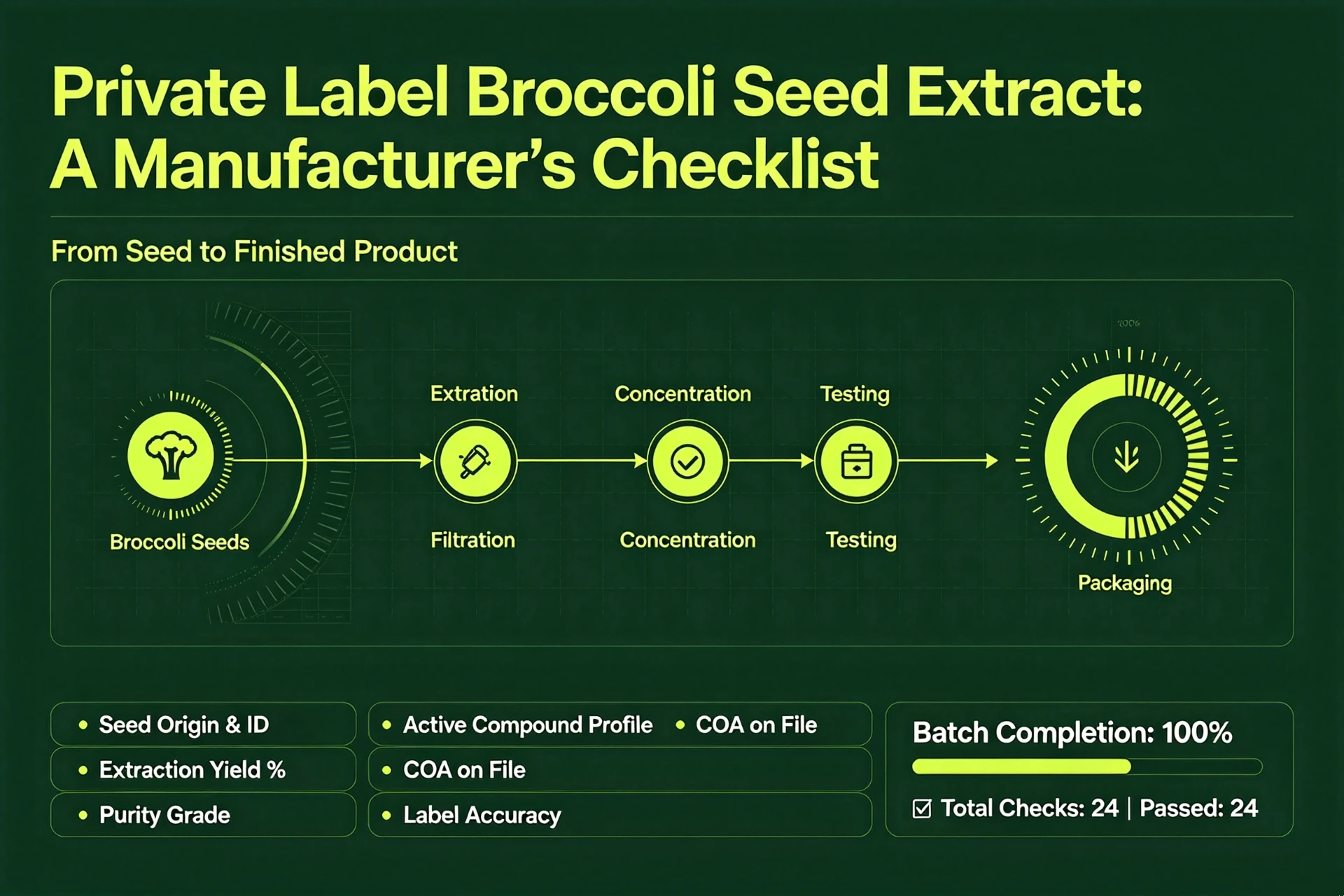
7. The Private Label Manufacturer Checklist: A Summary
Here's your consolidated checklist before committing to a broccoli seed extract private label partner:
Product Quality
- HPLC-verified potency (glucoraphanin and/or sulforaphane)
- Accelerated and real-time stability data available
- Batch-specific COA covering assay, heavy metals, solvents, microbiology
- Multiple specifications available (0.1% to 13%+ glucoraphanin/sulforaphane)
Raw Material Integrity
- Dedicated cultivar sourcing with field traceability
- Pre-extraction lot testing protocol
- Vertically integrated (no third-party extraction outsourcing)
Manufacturing Capability
- Multiple dosage form support (capsules, tablets, powders, gummies, liquids)
- OEM/ODM customization available
- Minimum order quantities that match your launch scale
Certifications
- cGMP + FDA-registered
- ISO 9001 / ISO 22000 / FSSC 22000
- Halal + Kosher (if applicable)
- USDA/EU Organic (if applicable)
Technical Support
- Formulation development assistance available
- Myrosinase co-formulation expertise
- After-sales technical support included
Final Thoughts: Get the Formulation Right From the Start
Using broccoli seed extract in supplements is one of the most scientifically credible moves you can make in today's nutraceutical market. The research behind sulforaphane and Nrf2 activation is robust, growing, and increasingly mainstream.
But the difference between a supplement that delivers results and one that disappoints customers comes down to formulation strategy and supplier selection. The five strategies outlined here - myrosinase co-formulation, specification matching, stability-tested formats, raw material traceability, and certification alignment - give you a concrete framework to evaluate any private label broccoli seed extract manufacturer.
Ready to source a private label broccoli seed extract that checks every box?
At Jiuyuan Biotech, we've been producing HPLC-verified broccoli seed extract since 2012. Our facility at the foot of China's Qinling Mountains covers 70,000 m², runs 10 production lines, and holds 12 international certifications - including cGMP, FSSC 22000, ISO 9001, Halal, and Kosher. We offer glucoraphanin specifications from 1% to 13%+, sulforaphane grades from 0.1% to 10%+, and full OEM/ODM support across capsules, tablets, powders, and functional beverages.
📧 Contact our formulation team today: info@jiuybiotech.com
🌐 Explore our broccoli seed extract product page: jiuyuanbio.com
References
- Fahey, J. W., Wehage, S. L., Holtzclaw, W. D., Kensler, T. W., Egner, P. A., Shapiro, T. A., & Talalay, P. (2012). Protection of humans by plant glucosinolates: Efficiency of conversion of glucosinolates to isothiocyanates by the gastrointestinal microflora. Cancer Prevention Research, 5(4), 603–611.
- Shapiro, T. A., Fahey, J. W., Dinkova-Kostova, A. T., Holtzclaw, W. D., Stephenson, K. K., Wade, K. L., Ye, L., & Talalay, P. (2006). Safety, tolerance, and metabolism of broccoli sprout glucosinolates and isothiocyanates: A clinical phase I study. Nutrition and Cancer, 55(1), 53–62.
- Vanduchova, A., Anzenbacher, P., & Anzenbacherova, E. (2019). Isothiocyanate from broccoli, sulforaphane, and its properties. Journal of Medicinal Food, 22(2), 121–126.
- Dinkova-Kostova, A. T., & Fahey, J. W. (2012). Glucosinolate hydrolysis products as cancer chemopreventive agents: Insights into their mechanisms of action. Current Drug Targets, 13(14), 1799–1810.
- Traka, M. H. (2016). Health benefits of glucosinolates. Advances in Botanical Research, 80, 247–279. Academic Press.
- Houghton, C. A. (2019). Sulforaphane: Its "coming of age" as a clinically relevant nutraceutical in the prevention and treatment of chronic disease. Oxidative Medicine and Cellular Longevity, 2019, Article 2716870.