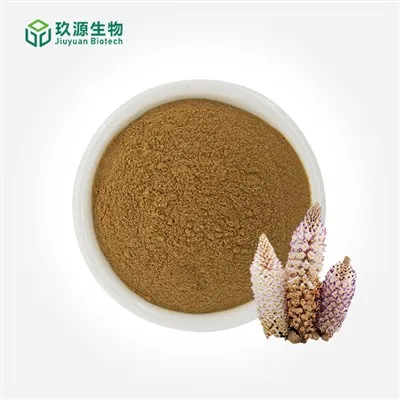
Chrysanthemum Flower Extract (Standardized & Ratio Extract)
Our Chrysanthemum Extract, derived from the dried flower heads of the Chrysanthemum morifolium plant, is a natural botanical essence obtained through advanced extraction techniques. This product presents as a fine powder with the characteristic delicate fragrance of chrysanthemum. Rich in various bioactive compounds, it is widely applied in the health, beauty, and food industries. We offer a high-quality extract produced under stringent quality control to meet the demanding needs of our business partners.
Chrysanthemum Flower Extract is a standardized botanical ingredient manufactured from selected Chrysanthemum morifolium flower heads. Using controlled extraction and concentration processes, the product delivers consistent levels of naturally occurring flavonoids and phenolic acids, making it suitable for nutraceutical, cosmetic, functional food, and pharmaceutical raw material applications.
This product is supplied in both standardized content extracts and ratio extracts, allowing formulators to balance regulatory compliance, efficacy positioning, and cost efficiency across different markets.
Typical Quality Parameters
- Particle Size: ≥95% pass 80 mesh
- Loss on Drying: ≤6.0%
- Ash: ≤10.0%
- Total Heavy Metals: ≤10 ppm
- Lead (Pb): ≤1.0 ppm
- Arsenic (As): ≤0.5 ppm
- Total Plate Count: ≤10,000 cfu/g
- Yeast & Mold: ≤200 cfu/g
- E. coli / Salmonella: Negative
A detailed COA is available for each production batch.
Available Specifications
1. Standardized Content Extracts (Most Common for Supplements & Cosmetics)
| Specification | Active Marker | Content | Test Method |
|---|---|---|---|
| Chrysanthemum Extract 10% | Total Flavonoids | ≥10% | UV |
| Chrysanthemum Extract 20% | Total Flavonoids | ≥20% | UV |
| Chrysanthemum Extract 1% | Luteolin | ≥1% | HPLC |
| Chrysanthemum Extract 2% | Luteolin | ≥2% | HPLC |
| Chrysanthemum Extract 5% | Chlorogenic Acid | ≥5% | HPLC |
Notes: Marker compounds and assay methods are aligned with international raw material procurement practices.
2. Ratio Extracts (Cost-Effective & Traditional Applications)
| Ratio | Raw Material Equivalent | Typical Use |
| 5:1 | 5 kg flowers: 1 kg extract | Functional foods, beverages |
| 10:1 | 10 kg flowers: 1 kg extract | Health supplements |
| 20:1 | 20 kg flowers: 1 kg extract | TCM & herbal formulations |
| 30:1 | 30 kg flowers: 1 kg extract | Concentrated herbal use |
Active Compounds & Mechanisms
Chrysanthemum morifolium produces a phytochemically rich secondary metabolite profile. The following table maps the primary constituent classes to their documented pharmacological mechanisms:
|
Compound Class |
Key Representatives |
Primary Bioactivity |
|
Flavones |
Luteolin, apigenin, acacetin |
Anti-inflammatory, antioxidant, neuroprotective, antitumor (preclinical) |
|
Flavone Glycosides |
Luteolin-7-glucoside, linarin, acacetin-7-O-glucoside |
Anti-inflammatory, antispasmodic, antioxidant |
|
Phenolic Acids |
Chlorogenic acid, 3,5-di-O-caffeoylquinic acid |
Antioxidant, hepatoprotective, antiviral, anti-obesity |
|
Sesquiterpene Lactones |
Artabsin-related compounds |
Anti-inflammatory, antimicrobial |
|
Volatile Terpenoids |
Camphor, borneol, chrysanthenone |
Antimicrobial, anti-inflammatory |
|
Carotenoids |
Lutein, β-carotene |
Ocular antioxidant, photoprotection |
|
Polysaccharides |
Chrysanthemum polysaccharides |
Immunomodulatory, antioxidant |
|
Adenosine |
Adenosine |
Cardiovascular, anti-inflammatory |
Key Mechanistic Pathways:
- Ocular Anti-inflammatory Activity: Recent peer-reviewed research confirms that chrysanthemum essential oil and extract components inhibit NF-κB-mediated inflammatory pathways specifically in ocular tissue - providing direct molecular-level substantiation for dry eye and ocular inflammation applications. This mechanism is the most clinically relevant for eye health formulation positioning.
- Hepatoprotective Antioxidant Activity: Published research demonstrates that chrysanthemum extract significantly inhibits oxidative stress in hepatocytes in a dose-dependent manner, with DPPH and ABTS radical scavenging activity attributable primarily to the chlorogenic acid and luteolin fraction.
- Broad-Spectrum Anti-inflammatory: Luteolin and apigenin suppress NF-κB activation, reduce pro-inflammatory cytokine production (TNF-α, IL-1β, IL-6), and inhibit COX-2 expression - mechanisms documented across multiple in vitro and animal model studies.
- Antiviral Activity: Chlorogenic acid and flavone glycosides demonstrate inhibitory activity against multiple viral pathogens in preclinical models, consistent with chrysanthemum's traditional use in respiratory and febrile conditions.
- Neuroprotective Effects: Luteolin and apigenin modulate neuroinflammatory pathways and demonstrate neuroprotective activity in preclinical models - an emerging area of research interest for cognitive health formulations.
- Formulator's note: The combination of carotenoids (lutein, β-carotene) and flavonoids (luteolin, apigenin) in chrysanthemum extract creates a naturally synergistic ocular antioxidant matrix - allowing formulators to position it as a complementary ingredient alongside lutein and zeaxanthin in comprehensive eye health formulas, rather than a standalone replacement.
Application Areas
|
Application Category |
Target Claim |
Recommended Grade |
Format |
|
Eye Health |
Supports ocular comfort, reduces digital eye strain, dry eye support |
10:1 / Luteolin ≥1% |
Capsule, tablet, softgel |
|
Antioxidant / Anti-aging |
Free radical scavenging, cellular protection |
4:1, 10:1 |
Capsule, antioxidant blend |
|
Liver Support |
Hepatoprotective, oxidative stress reduction |
10:1 / Chlorogenic Acid ≥1% |
Capsule, liver health blend |
|
Anti-inflammatory Support |
Supports healthy inflammatory response |
4:1, 10:1 |
Capsule, herbal complex |
|
Immune Health |
Antiviral support, immune modulation |
4:1, 10:1 |
Capsule, immune blend |
|
Cardiovascular Wellness |
Antioxidant cardiovascular support |
4:1 / Total Flavonoids ≥5% |
Capsule, softgel |
|
Cognitive / Neuroprotective |
Neuroinflammation support, cognitive wellness |
10:1 / Luteolin ≥1% |
Capsule, nootropic blend |
|
Traditional Herbal Products |
Chinese Pharmacopoeia-compliant TCM ingredient |
4:1, 10:1 |
Capsule, granule, tea blend |
|
Functional Food & Beverage |
Clean-label botanical fortification, herbal tea |
Food-grade 4:1 |
Instant powder, RTD beverage, herbal tea |
|
Cosmetic / Topical |
Anti-inflammatory, antioxidant skin actives |
4:1, 10:1 |
Serum, cream, eye cream |
Chrysanthemum Flower Extract's food homology classification in China - combined with its long history of safe consumption as a beverage tea - provides a strong safety dossier for functional food and beverage applications in international markets, where novel botanical ingredients face increasingly stringent regulatory scrutiny.
Production Process (Overview)
- Raw material sourcing from contracted chrysanthemum farms
- Cleaning, drying, and milling
- Controlled solvent extraction
- Filtration and vacuum concentration
- Spray drying/vacuum drying
- Milling, sieving, and blending
- Final quality inspection and packaging

Comparison: Chrysanthemum Flower Extract vs. Competing Eye Health & Antioxidant Botanicals
Formulators developing eye health, antioxidant, or liver support products frequently evaluate chrysanthemum against bilberry, eyebright, and green tea extract. Here is a specification-level comparison:
|
Parameter |
Chrysanthemum Flower Extract |
Bilberry Extract |
Eyebright Extract |
Green Tea Extract |
|
Primary Active Class |
Flavones + phenolic acids (luteolin, chlorogenic acid) |
Anthocyanins |
Iridoids, flavonoids |
Catechins (EGCG) |
|
Ocular Anti-inflammatory |
✅ NF-κB mechanism confirmed |
✅ Retinal circulation |
Moderate |
Moderate |
|
Dry Eye Support |
✅ Documented (NF-κB / ocular tissue) |
Limited |
Moderate |
Limited |
|
Hepatoprotective |
✅ Dose-dependent (published) |
Limited |
Limited |
✅ Strong |
|
Antioxidant Activity |
✅ Strong (multi-compound) |
✅ Strong (anthocyanins) |
Moderate |
✅ Strong (EGCG) |
|
Anti-inflammatory |
✅ Strong (luteolin/NF-κB) |
Moderate |
Moderate |
✅ Strong |
|
Food Homology Status |
✅ Yes (China) |
Limited |
Limited |
✅ Yes (China) |
|
Consumer Recognition |
High (Asian markets); Growing (West) |
✅ High (global) |
Moderate |
✅ High (global) |
|
Functional Food Compatibility |
✅ Excellent |
Good |
Moderate |
✅ Good |
|
Regulatory Simplicity |
✅ High (food homology) |
✅ High |
Moderate |
✅ High |
|
Differentiation Potential |
✅ High (underutilized in West) |
Low (saturated) |
Moderate |
Low (saturated) |
Chrysanthemum Flower Extract's most compelling competitive advantage for Western formulators is its differentiation potential - bilberry and green tea are saturated categories, while chrysanthemum offers genuine first-mover positioning in the Western eye health and antioxidant markets, backed by a growing body of peer-reviewed science and millennia of safe-use history.
Why Choose Jiuyuan Biotech?
Founded in 2012, Shaanxi Jiuyuan Biotechnology Co., Ltd. is based at the northern foot of the Qinling Mountains in Huyi District, Xi'an City.
Long-Term Manufacturing Experience
We have been manufacturing Chrysanthemum Flower Extract for over 8 years, with stable production processes and continuous specification optimization for export markets.
Core & Advantage Product Category
Chrysanthemum extract is one of our long-term core botanical extracts, supplied in multiple standardized and ratio forms for nutraceutical and cosmetic clients.
Proven Commercial Supply
-
Long-term cooperative customers in Asia, Europe, and North America
-
A typical customer procurement volume: 2 full containers per quarter
-
Stable repeat orders for standardized flavonoid and luteolin specifications
Customization Capability
We support flexible customization based on buyer requirements:
- Active content (% flavonoids, luteolin, chlorogenic acid)
- Extraction solvent (water/ethanol)
- Ratio or standardized extract format
- Particle size and bulk density
- Application-oriented specifications (supplement/cosmetic / food grade)

Certifications & Compliance
- cGMP
- ISO 9001 / ISO 22000
- HACCP / FSSC 22000
- Organic (USDA / EU)
- HALAL / KOSHER
All products are manufactured under a documented quality management system suitable for international markets.

Packaging, Storage & Logistics
- Packaging: 25 kg fiber drum with double PE liner
- Storage: Cool, dry place, protected from light and moisture
- Lead Time: 7 working days after order confirmation
- Shipping: Express / Air / Sea (based on order volume)
 |
 |
 |
|
Express Under 100kg, 3-5Days Door-to-door service easy to pick up the goods |
By Sea Over300kg, Around 30 Days Port-to-port service professional clearance broker needed |
By Air 100kg-1000kg, 5-7Days Airport-to-airport service professional clearance broker needed |
We offer three standard packaging formats, each designed around a specific order volume and transit risk profile:
|
Format |
Net Weight |
Inner Barrier |
Outer Container |
Nitrogen Flush |
Best For |
|
Sample Pack |
100 g / 500 g |
Double-sealed foil pouch |
Cardboard box with desiccant |
✅ Yes |
R&D evaluation, pilot trials |
|
Standard Unit |
1 kg |
Foil-laminated PE bag |
Fiber drum (UN-certified) |
✅ Yes |
Small-batch production runs |
|
Bulk Commercial |
5 kg / 25 kg |
Double-layer PE liner + foil outer |
UN-certified fiber drum or aluminum canister |
✅ Yes |
Full-scale manufacturing |

Buyer Guide
Sourcing a Daodi botanical extract like chrysanthemum for regulated supplement markets involves considerations that go beyond standard commodity procurement. These are the checkpoints that protect your formulation investment:
1. Specify Your Quality Markers Before Requesting Quotes Total flavonoids, luteolin, chlorogenic acid, and apigenin are distinct quality markers with different analytical methods and price implications. For eye health applications, luteolin content is the most pharmacologically relevant marker. For liver support applications, chlorogenic acid is equally important. Define your primary marker and minimum specification before requesting quotes - "chrysanthemum extract" without specification is commercially ambiguous.
2. Insist on Daodi Origin Documentation Chrysanthemum morifolium grown outside recognized Daodi regions can have substantially lower flavonoid content than pharmacopoeial-grade material. Ask your supplier to document the cultivation region for each lot. Anhui Huangshan (Huiju), Zhejiang Tongxiang (Hangju), and Henan Jiaozuo (Huaiju) are the three primary Daodi varieties recognized by the Chinese Pharmacopoeia - each with a distinct flavonoid profile.
3. Demand Species Authentication Documentation Chrysanthemum genus adulteration with ornamental or wild species is a real supply chain risk. Request HPLC flavonoid fingerprint data confirming C. morifolium identity - macroscopic examination alone is insufficient for authenticated supply chain management.
4. Pesticide Residue Documentation Is Non-Negotiable Chrysanthemum is a cultivated flower crop with documented pesticide use. For EU and US market products, a comprehensive pesticide residue report covering EU MRL-regulated compounds is mandatory - not optional. This is a frequent import rejection trigger for botanical ingredients from China. Our pesticide screening panel covers 500+ compounds per EU Regulation 396/2005.
5. Understand Regulatory Pathways for Your Target Market
USA: Dietary supplement use under DSHEA; structure/function claims for eye health and antioxidant support are well-established categories. Chrysanthemum's food homology status supports GRAS-adjacent positioning for functional food applications.
EU: Food homology history supports Traditional Food status applications; Novel Food assessment may be required for high-concentration extract grades in supplement formats. Verify with your regulatory counsel.
Canada: NHP pathway; chrysanthemum has traditional use documentation supporting NHP license applications.
Australia: TGA Listed Medicine pathway; confirm ingredient listing status before product development.
6. Consider the Functional Food Opportunity Chrysanthemum tea is one of the most consumed herbal beverages in East Asia - a consumer familiarity that translates directly into functional food and beverage positioning in Asian diaspora markets and increasingly in mainstream Western wellness channels. The food-grade extract opens a product development pathway that most competing eye health botanicals cannot access.
7. Request Samples with Full Analytical Package We provide analytical samples (100–500 g) for qualified buyers, shipped with COA, HPLC chromatogram, TDS, MSDS, and pesticide residue report.
FAQ
Q1: What is the difference between Chrysanthemum morifolium and Chrysanthemum indicum?
Both species are used in Traditional Chinese Medicine and share overlapping phytochemical profiles, but they are distinct botanical entities with different pharmacopoeial applications. C. morifolium (Ju Hua, 菊花) is the primary cultivated species used for food, beverage, and supplement applications - it is listed in the Chinese Pharmacopoeia as a food homology herb and is the source of our Chrysanthemum Flower Extract. C. indicum (Ye Ju Hua, 野菊花) is a wild species with a more intensely bitter flavor profile and higher sesquiterpene lactone content, used primarily for anti-inflammatory and antibacterial applications. The two should not be used interchangeably in formulation without verifying the species identity of your raw material.
Q2: What are the primary applications of Chrysanthemum Flower Extract in supplement formulations?
The most substantiated supplement applications are: (1) eye health - NF-κB-mediated anti-inflammatory activity in ocular tissue, dry eye support, digital eye strain relief; (2) antioxidant formulations - multi-compound free radical scavenging from the flavonoid and phenolic acid matrix; (3) liver support - hepatoprotective and antioxidant effects documented in published hepatocyte studies; (4) anti-inflammatory blends - luteolin and apigenin-mediated NF-κB suppression; and (5) immune and antiviral support - consistent with traditional use for respiratory and febrile conditions.
Q3: Is Chrysanthemum Flower Extract safe for long-term supplement use?
Chrysanthemum morifolium has a documented history of safe consumption spanning millennia as both a food and medicinal herb in East Asian cultures. Its food homology classification in China reflects this established safety record. Published pharmacological reviews confirm a favorable tolerability profile with no significant adverse effects reported at dietary and supplemental doses. Individuals with known allergies to plants in the Asteraceae (daisy) family should exercise caution, as cross-reactivity is possible - appropriate allergen labeling is advisable for finished products.
Q4: What is the significance of Daodi origin for Chrysanthemum Flower Extract quality?
Daodi (道地) is a concept in Chinese Pharmacopoeia that designates specific geographic regions where a botanical ingredient reaches its optimal quality - defined by a combination of soil composition, climate, altitude, and centuries of cultivation practice. For C. morifolium, the three primary Daodi varieties - Huiju (Anhui), Hangju (Zhejiang), and Huaiju (Henan) - each have distinct flavonoid profiles and are recognized as producing pharmacopoeial-grade material. Non-Daodi chrysanthemum can have significantly lower luteolin and chlorogenic acid content, leading to under-specification of finished extract. Jiuyuan Bio sources exclusively from authenticated Daodi cultivation bases with documented origin records per lot.
Q5: Can Chrysanthemum Flower Extract be used in functional beverage formulations?
Yes - and this is one of its most commercially compelling applications. Chrysanthemum tea is one of the most widely consumed herbal beverages in East Asia, giving the ingredient exceptional consumer familiarity for functional beverage positioning. Our water-soluble instant grade is specifically designed for beverage applications. Key formulation considerations: flavonoids are mildly pH-sensitive (optimal stability at pH 4–6); color development may occur over time in alkaline conditions; the characteristic floral aroma is an asset for beverage positioning. For extended shelf-life RTD applications, encapsulated grades are available.
Q6: How does Chrysanthemum Flower Extract support eye health specifically?
The eye health mechanism operates through two complementary pathways. First, the flavonoid fraction - particularly luteolin and apigenin - inhibits NF-κB-mediated inflammatory signaling in ocular tissue, reducing inflammatory mediator production relevant to dry eye disease and ocular surface inflammation. Second, the carotenoid fraction (lutein, β-carotene) provides direct antioxidant protection against photooxidative damage in retinal tissue. Published research has specifically validated the NF-κB inhibition mechanism in ocular tissue models, providing molecular-level substantiation beyond traditional use claims.
Q7: What pesticide residue testing does Jiuyuan Bio perform on Chrysanthemum Flower Extract?
We perform comprehensive pesticide residue screening covering 500+ compounds per EU Regulation 396/2005 using GC/LC-MS methodology. This includes organophosphates, pyrethroids, neonicotinoids, fungicides, and herbicides - the compound classes most commonly detected in chrysanthemum cultivation. The full pesticide residue test report is available per batch and is provided as standard documentation for EU-destined shipments. For US buyers, we can provide testing against specific FDA import alert compound lists upon request.
Q8: How does Jiuyuan Bio ensure batch-to-batch consistency for Chrysanthemum Flower Extract?
Consistency is maintained through five mechanisms: (1) contracted Daodi cultivation bases with standardized agronomic and harvest timing protocols; (2) HPLC pre-screening of incoming raw flower material for luteolin and chlorogenic acid content, with rejection of below-specification lots; (3) in-process HPLC monitoring at extraction and purification stages; (4) finished product HPLC assay against validated luteolin and chlorogenic acid reference standards before batch release; and (5) color and appearance monitoring as a rapid in-process indicator of flavonoid integrity. Long-term supply agreement customers receive additional batch consistency guarantees in their supply contracts.
Request a Sample or Commercial Quote
Jiuyuan Biotech supplies chrysanthemum extract to food manufacturers, supplement brands, and contract formulators across North America, Europe, and the Asia-Pacific region. Our technical team - not a generic sales inbox - handles every inquiry.
Email: info@jiuyuanbio.com
Website: www.jiuyuanbio.com
Request: Sample| Bulk Quote | CoA & Spec Sheet | Custom Carrier Ratio
Standard response time: within 1 business day. Please include your target application and annual volume estimate for the most relevant technical recommendation.
Hot Tags: chrysanthemum flower extract, China chrysanthemum flower extract manufacturers, suppliers, factory