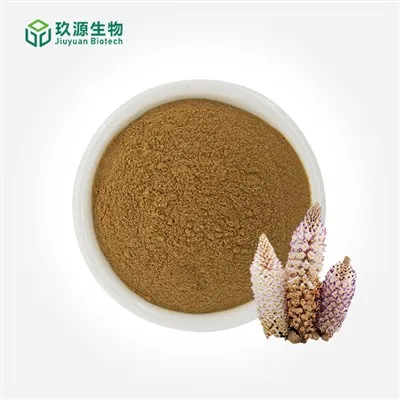
Products Description
Echinacea purpurea extract powder is the most clinically studied species in the Echinacea genus - with a documented bioactive profile anchored by cichoric acid, polyphenols, and alkylamides that work through complementary immunomodulatory mechanisms. The aerial parts of E. purpurea are particularly rich in cichoric acid - a caffeic acid derivative with documented macrophage activation and antioxidant activity - while the root fraction contributes alkylamides that interact directly with cannabinoid receptor type 2 (CB2) to modulate innate immune signaling.
Our echinacea purpurea extract powder is HPLC-verified against certified reference standards, manufactured under cGMP conditions, and available in multiple specifications to match your product's positioning - from ratio extracts for cost-sensitive formulas to high-potency standardized grades for premium immune support lines.
If you're building an immune health product that needs to perform on the shelf and survive a third-party audit - this is where the evaluation starts.
Technical Specifications
|
Test Parameter |
Method |
Specification |
|
Polyphenols |
UV spectrophotometry |
≥4.0% |
|
Cichoric Acid |
HPLC |
≥2.0% |
|
Echinacoside |
HPLC |
≥0.5% (root-containing grades) |
|
Alkylamides (total) |
HPLC |
Reported per batch |
|
Extract Ratio |
Gravimetric |
4:1, 10:1 (available) |
|
Loss on Drying |
USP <731> |
≤5.0% |
|
Ash Content |
USP <281> |
≤10.0% |
|
Bulk Density |
- |
0.30–0.55 g/mL |
|
Particle Size |
USP <786> |
100% through 80 mesh |
|
Heavy Metals (Total) |
ICP-MS |
≤10 ppm |
|
Lead (Pb) |
ICP-MS |
≤1.0 ppm |
|
Arsenic (As) |
ICP-MS |
≤1.0 ppm |
|
Mercury (Hg) |
ICP-MS |
≤0.1 ppm |
|
Cadmium (Cd) |
ICP-MS |
≤0.5 ppm |
|
Residual Solvents |
GC |
USP Class 2 compliant |
|
Pesticide Residues |
GC-MS/MS |
EU MRL compliant |
|
Total Plate Count |
USP <2021> |
≤10,000 cfu/g |
|
Yeast & Mold |
USP <2021> |
≤1,000 cfu/g |
|
E. coli |
USP <2022> |
Negative/10 g |
|
Salmonella spp. |
USP <2022> |
Negative/25 g |
All cichoric acid and polyphenol values are quantified by HPLC against certified reference standards. UV-only polyphenol data is available on request for cost-sensitive applications but is clearly distinguished from HPLC-verified figures on all COAs.
Why Standardization Matters in Echinacea Extracts
Unlike single-compound synthetic ingredients, Echinacea purpurea is a multi-component botanical, containing phenolic acids, alkylamides, polysaccharides, and minor constituents that coexist in a dynamic matrix.
Expert Judgment
In professional Echinacea extract manufacturing, reliance on a single marker such as chicoric acid alone does not reflect the true quality or functional consistency of the extract; balanced multi-marker control is essential.
As a result, standardization must focus on:
- Marker relevance, not marketing numbers
- Batch-to-batch reproducibility, not peak values
- Application compatibility, not laboratory optimization alone
In standardized botanical extracts, batch-to-batch consistency is often more critical than achieving the highest possible active marker content.
Core Active Markers Used in Echinacea Purpurea
Chicoric Acid
Chicoric acid is widely recognized as a signature phenolic marker for Echinacea purpurea.
Commonly used for identity and quality benchmarking
Sensitive to excessive heat and aggressive solvent systems
Not interchangeable with echinacoside (which dominates other Echinacea species)
Expert Judgment
Higher chicoric acid content does not necessarily indicate superior extract quality if achieved at the expense of component balance or stability.
Total Polyphenols
Total polyphenols represent a group parameter, rather than a single compound.
- Typically measured by UV–Vis methods
- Useful for internal consistency monitoring
- Should not be interpreted as a precise compositional fingerprint
Alkylamides
Alkylamides are lipophilic constituents contributing to formulation behavior, particularly in oral and topical systems.
- Extraction efficiency strongly depends on ethanol proportion
- Excessively polar extraction systems may under-represent this fraction
Polysaccharides
Polysaccharides are high-molecular-weight fractions with structural and formulation relevance.
- Sensitive to enzymatic and thermal processing
- Often evaluated as supportive, rather than primary, quality markers
Analytical Methods: What the Numbers Actually Mean
Different analytical techniques serve different technical purposes. No single method is universally "better".
TLC (Thin Layer Chromatography)
- Commonly used for botanical identity verification
- Accepted in multiple pharmacopeial systems
- Effective for routine quality confirmation
HPLC
- Used for the quantitative determination of specific markers
- High precision, but method parameters significantly affect results
- Requires proper reference standards and method validation
UV–Vis Spectrophotometry
- Suitable for total polyphenol estimation
- Group-based measurement, not compound-specific
Expert Judgment
The analytical method selection (TLC, HPLC, or UV) should be aligned with the specification intent and regulatory acceptance, rather than being used solely as a marketing differentiation tool.
Certificates & Documents
All certifications are current and available for review upon request:
✅ ISO 9001:2015 - Quality Management System
✅ ISO 22000:2018 - Food Safety Management System
✅ FSSC 22000 - Food Safety System Certification
✅ cGMP - Current Good Manufacturing Practice
✅ FDA-Registered Facility - US dietary supplement compliance
✅ Halal Certified - Gulf and Southeast Asian markets
✅ Kosher Certified - Specialty retail and Jewish markets
✅ USDA NOP Organic - Available for organic-grade material
✅ EU Organic - Available for EU-market organic claims
✅ Non-GMO Verified - Documented non-GMO sourcing
Standard documents per commercial shipment:
- Batch-specific Certificate of Analysis (COA)
- Material Safety Data Sheet (MSDS)
- Certificate of Origin (COO)
- Allergen Declaration
- BSE/TSE-Free Statement
- Heavy Metal Report (ICP-MS)
- Pesticide Residue Report (GC-MS/MS)
- HPLC Fingerprint Chromatogram (species identity)
- Phytosanitary Certificate (on request)

Application Matrix
|
Market Segment |
Recommended Specification |
Primary Benefit Claims |
Typical Dose Range |
|
Immune Support Supplements |
Polyphenols 4% + Cichoric Acid 2% |
Immune modulation, upper respiratory support |
300–500 mg extract/day |
|
Cold & Flu Season Products |
Polyphenols 4% or 10:1 ratio |
Reduce duration/severity of cold symptoms |
500–900 mg extract/day |
|
Premium Immune Formulas |
Cichoric Acid 2% (HPLC-verified) |
High-potency immune activation |
300–500 mg/day |
|
Functional Beverages |
Water-soluble 4:1 ratio |
Clean-label botanical immune support |
100–300 mg/serving |
|
Combination Immune Blends |
4:1 or 10:1 ratio |
Cost-effective immune stack ingredient |
100–250 mg/serving |
|
Pediatric Immune Products |
Low-potency 4:1 ratio |
Age-appropriate immune support |
Per pediatric protocol |
|
Topical / Cosmeceutical |
Polyphenols 4% cosmetic grade |
Antioxidant, skin-soothing, barrier support |
0.5%–2.0% in formulation |
|
Veterinary Supplements |
Feed-grade ratio extract |
Immune support in companion animals |
Per species protocol |
JIUYUAN BIOTECH: Your Reliable Partner for Premium Plant Extract Prodcuts
Our expansive 70,000-square-meter facility houses 6 production workshops and 10 production lines, enabling an annual output of over 6,000 tons. We also operate a 1,000-square-meter, 100,000-grade clean workshop, equipped with advanced production lines for health food extract and fruit and vegetable powder, along with automated equipment. This large-scale production capability guarantees both volume and consistent quality for our Organic Plant Extract.
|
|
|
|
|
|
|
|
|
|
|


Product Comparison
The echinacea extract market has three persistent quality problems: species ambiguity, assay method inflation, and part-of-plant inconsistency. Here's how to read the landscape:
|
Parameter |
Commodity Grade |
Standard Grade |
Jiuyuan Biotech Grade |
|
Species Verification |
Label claim only |
TLC identity |
TLC + HPLC fingerprint (species-specific) |
|
Polyphenol Assay |
UV only |
UV |
UV + HPLC cichoric acid confirmation |
|
Cichoric Acid |
Not reported |
HPLC ≥1% |
HPLC ≥2% vs. certified reference standard |
|
Alkylamide Data |
Not reported |
Not reported |
Reported per batch (HPLC) |
|
Plant Part Transparency |
Not disclosed |
Aerial parts stated |
Aerial parts / root / whole plant - clearly specified |
|
Heavy Metal Testing |
Total metals, periodic |
Pb + As per batch |
Pb, As, Hg, Cd (ICP-MS, every batch) |
|
Pesticide Testing |
Not standard |
Basic screen |
GC-MS/MS, EU MRL compliant |
|
Stability Data |
Not available |
Accelerated only |
Accelerated + real-time + cichoric acid retention |
|
Certifications |
ISO 9001 |
ISO + cGMP |
ISO + cGMP + FSSC + Halal + Kosher |
|
Regulatory Support |
None |
Basic COA |
Full dossier support, EU botanical guidance |
The species fingerprint gap: Many suppliers list "echinacea extract" without specifying which species, which plant part, or which assay method was used to verify potency. For a brand selling in the US or EU, this ambiguity creates regulatory exposure. HPLC fingerprinting that distinguishes E. purpurea from congeners is the minimum standard for defensible species identity.
Packaging Configuration
We offer three standard packaging formats, each designed around a specific order volume and transit risk profile:
|
Format |
Net Weight |
Inner Barrier |
Outer Container |
Nitrogen Flush |
Best For |
|
Sample Pack |
100 g / 500 g |
Double-sealed foil pouch |
Cardboard box with desiccant |
✅ Yes |
R&D evaluation, pilot trials |
|
Standard Unit |
1 kg |
Foil-laminated PE bag |
Fiber drum (UN-certified) |
✅ Yes |
Small-batch production runs |
|
Bulk Commercial |
5 kg / 25 kg |
Double-layer PE liner + foil outer |
UN-certified fiber drum or aluminum canister |
✅ Yes |
Full-scale manufacturing |

FAQ
Q1: What is the difference between echinacea purpurea extract and echinacea angustifolia extract?
The three commercially used Echinacea species - E. purpurea, E. angustifolia, and E. pallida - have distinct phytochemical profiles. E. purpurea aerial parts are the richest source of cichoric acid and polysaccharides. E. angustifolia root is the primary source of echinacoside and has a higher alkylamide concentration than E. purpurea root. E. pallida root is characterized by ketoalkynes and ketoalkenes rather than alkylamides. These differences have regulatory implications: the European Medicines Agency (EMA) has issued separate monographs for each species and plant part combination. They are not interchangeable in formulations making specific health claims.
Q2: How is cichoric acid different from echinacoside - and why does it matter for my formula?
Both are caffeic acid derivatives, but they come from different parts of different species. Cichoric acid (dicaffeoyl-tartaric acid) is the dominant marker in E. purpurea aerial parts. Echinacoside is more abundant in E. angustifolia and E. pallida roots. Functionally, both have antioxidant and immunostimulatory activity, but their pharmacokinetic profiles differ. For a product standardized to E. purpurea aerial parts, cichoric acid is the appropriate primary marker - and HPLC verification against a certified cichoric acid reference standard is the only defensible way to quantify it.
Q3: Can echinacea purpurea extract be used continuously, or only during acute illness?
This is an active area of debate in the clinical literature. Traditional use and many clinical protocols position echinacea as a short-term immune support ingredient - typically 7–14 days during acute upper respiratory illness. Some researchers have raised theoretical concerns about immune tolerance with prolonged continuous use, though clinical evidence for this effect is limited. As a B2B ingredient supplier, we recommend that our customers consult regulatory counsel for their specific market and intended use before finalizing label directions.
Q4: Is echinacea purpurea extract safe for autoimmune conditions?
This is a contraindication that appears in traditional use guidelines and some regulatory monographs. The theoretical concern is that echinacea's immunostimulatory activity could exacerbate autoimmune conditions. However, the clinical evidence base for this specific risk is limited. The EMA's Community Herbal Monograph on E. purpurea lists autoimmune diseases as a precautionary contraindication. We recommend including appropriate label precautions and consulting regulatory counsel for your target market.
Q5: What specifications are most appropriate for a premium immune support capsule?
For a premium immune support capsule targeting the US or EU market, we recommend our Polyphenols ≥4% + Cichoric Acid ≥2% standardized grade - verified by HPLC against certified reference standards. This specification gives you a defensible, audit-ready potency claim with both a broad phenolic marker (polyphenols) and a species-specific marker (cichoric acid). Typical dose: 300–500 mg extract per capsule, 1–2 capsules per day. For a cost-sensitive formula where HPLC verification is less critical, our 10:1 ratio extract provides a concentrated whole-plant profile at a lower cost per serving.
Q6: Does echinacea purpurea extract interact with immunosuppressive medications?
Theoretically, echinacea's immunostimulatory activity could reduce the efficacy of immunosuppressive drugs - a concern relevant for transplant patients and individuals on immunosuppressive therapy for autoimmune conditions. This interaction has been flagged in pharmacological reviews but has limited direct clinical evidence. We recommend including appropriate label precautions and directing consumers to consult their healthcare provider if they are taking immunosuppressive medications.
Q7: Can echinacea purpurea extract be used in functional beverages?
Yes, with formulation considerations. Our water-soluble ratio extract grades (4:1, 10:1) disperse readily in aqueous systems. The characteristic brown color may require masking in light-colored beverages. Cichoric acid is relatively stable at beverage pH ranges (3.5–5.0) but degrades more rapidly at neutral to alkaline pH. For hot-fill applications, we recommend a bench-scale stability trial at your target processing temperature and pH before finalizing the formula. Flavor is mildly bitter and herbal - compatible with elderberry, citrus, and ginger flavor systems commonly used in immune beverage formulations.
Q8: What is your position on the ongoing EU botanical ingredient regulatory review?
The EU's re-evaluation of botanical ingredients under the food supplement framework has created uncertainty for several high-volume botanicals. Echinacea purpurea aerial parts have a well-established history of safe use in the EU and are covered by EMA Community Herbal Monographs - which provides a stronger regulatory foundation than botanicals without monograph status. We monitor EU regulatory developments continuously and can provide updated regulatory guidance documentation to support our customers' compliance reviews.
Request a Sample or Technical Dossier
We supply echinacea purpurea extract powder in HPLC-verified specifications - Polyphenols ≥4%, Cichoric Acid ≥2%, and ratio extracts (4:1, 10:1) - with full species identity documentation, batch-specific ICP-MS heavy metal data, and GC-MS/MS pesticide residue reports for every commercial shipment.
Whether you're launching a new immune health line, reformulating an existing echinacea product with better documentation, or evaluating clean-label botanical options for a functional beverage - our technical team is ready to support your sourcing decision.
📧 Contact us: info@jiuybiotech.com 🌐 Visit our website: www.jiuyuanbio.com
Hot Tags: echinacea purpurea extract powder, China echinacea purpurea extract powder manufacturers, suppliers, factory