









Product Overview
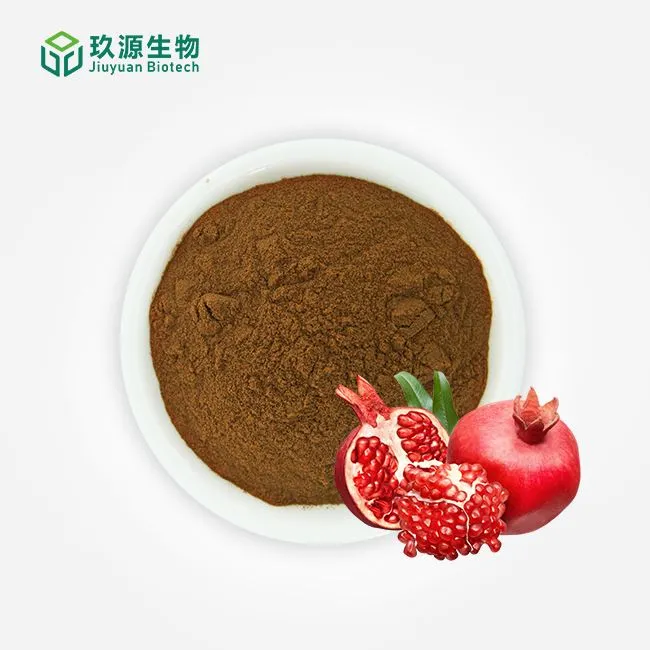
Most botanical extracts on the market are commodity powders - undifferentiated, loosely specified, and sourced through layers of intermediaries. Pomegranate Peel Extract Powder is different. The peel of Punica granatum L. - long discarded as agricultural byproduct - is now recognized as one of the most polyphenol-dense matrices in the plant kingdom, containing a class of hydrolyzable tannins found in virtually no other commercial ingredient.
The key distinction lies in what the peel concentrates: punicalagins, the high-molecular-weight ellagitannins unique to pomegranate, alongside ellagic acid, punicalin, and gallic acid. Together, these compounds deliver antioxidant, anti-inflammatory, and antimicrobial activity that has been substantiated across peer-reviewed literature - not just marketing copy.
At Jiuyuan Biotech, our Pomegranate Peel Extract Powder is manufactured from sun-ripened pomegranate peels sourced from traceable farms, processed through a validated extraction and spray-drying protocol, and standardized by HPLC to guaranteed active content. Whether you're formulating a premium antioxidant capsule, a skin-brightening cosmetic serum, or a functional food ingredient, this is the grade that holds up to scrutiny - from your R&D bench to your finished-product label claim.
Key Components
● Ellagic Acid: A primary active component with potent antioxidant and anti-inflammatory properties, available in 40% and 90% specifications.
● Polyphenols: Rich in flavonoids and phenolic acids, offering antioxidant, antimicrobial, and antitumor activities, available in 20%, 40%, and 60% specifications.
● Punicalagin: Known for its antimicrobial and anti-inflammatory effects, available in 30%, 35%, and 40% specifications.
● Other Active Ingredients: Including pectin, organic acids, and alkaloids, contributing to the extract's broad pharmacological actions.
Technical Specification
Standard Grades Available
|
Specification |
Grade A |
Grade B |
Grade C |
|
Ellagic Acid |
40% (HPLC) |
90% (HPLC) |
- |
|
Punicalagin |
- |
- |
≥ 70% (HPLC) |
|
Extract Ratio |
10:1 |
20:1 |
- |
|
Moisture |
≤ 5.0% |
≤ 5.0% |
≤ 5.0% |
|
Ash |
≤ 5.0% |
≤ 5.0% |
≤ 5.0% |
|
Heavy Metals (Total) |
≤ 10 ppm |
≤ 10 ppm |
≤ 10 ppm |
|
Lead (Pb) |
≤ 2 ppm |
≤ 2 ppm |
≤ 2 ppm |
|
Arsenic (As) |
≤ 1 ppm |
≤ 1 ppm |
≤ 1 ppm |
|
Mercury (Hg) |
≤ 0.1 ppm |
≤ 0.1 ppm |
≤ 0.1 ppm |
|
Residual Solvents |
Meets USP <467> |
Meets USP <467> |
Meets USP <467> |
|
Total Plate Count |
≤ 1,000 CFU/g |
≤ 1,000 CFU/g |
≤ 1,000 CFU/g |
|
Yeast & Mold |
≤ 100 CFU/g |
≤ 100 CFU/g |
≤ 100 CFU/g |
|
E. coli |
Negative |
Negative |
Negative |
|
Salmonella |
Negative |
Negative |
Negative |
|
Pesticide Residues |
Meets EU Reg. 396/2005 |
Meets EU Reg. 396/2005 |
Meets EU Reg. 396/2005 |
Note: Custom specifications - including specific polyphenol ratios, carrier-free grades, or water-soluble formulations - are available upon request. Contact our technical team with your target COA.

Active Compounds
Pomegranate peel's bioactivity is not attributable to a single molecule - it emerges from a structurally diverse polyphenolic matrix. Understanding each compound helps formulators make informed decisions about which specification to select.
Punicalagins (α and β isomers)
The flagship compounds of pomegranate peel. Punicalagins are large ellagitannin molecules (MW ~1,084 Da) found at significant concentrations almost exclusively in pomegranate. They are the primary contributors to the peel's exceptional antioxidant capacity and can be hydrolyzed in vivo to release punicalin and ellagic acid. In comparative antioxidant studies, punicalagin demonstrated superior superoxide anion scavenging capacity compared to ellagic acid alone.
Ellagic Acid
A polyphenol dibenzopyranone formed by hydrolysis of ellagitannins. Ellagic acid is the most studied compound in this matrix, with documented antioxidant, anti-inflammatory, and antiproliferative properties across multiple in vitro and in vivo models. In animal studies, ellagic acid treatment significantly increased total antioxidant capacity (T-AOC) in plasma, liver, and intestinal tissue, and reduced malondialdehyde (MDA) - a marker of lipid peroxidation - across all three compartments (P < 0.05).
Punicalin
An intermediate hydrolysis product of punicalagin. Punicalin exhibits meaningful antioxidant activity in its own right - particularly in superoxide scavenging and intestinal antioxidant enzyme activation (SOD, GSH-Px).
Gallic Acid
A phenolic acid present in the peel matrix. Gallic acid contributes to the overall polyphenol profile and has well-documented antimicrobial and antioxidant properties.
Galloyl Glucose Derivatives & Other Phenolics
The peel also contains p-coumaric acid, caffeic acid, syringic acid, protocatechuic acid, and benzoic acid derivatives - compounds that contribute to the extract's broad-spectrum bioactivity profile.
Proximate Composition Reference (Pomegranate Peel Powder, per 100 g)
|
Component |
Range |
|
Moisture |
8.43 – 13.80 g |
|
Crude Fiber |
17.43 – 35.19 g |
|
Carbohydrates |
59.52 – 61.34 g |
|
Protein |
3.24 – 3.46 g |
|
Fat |
0.55 – 3.36 g |
|
Ash |
3.35 – 6.07 g |
|
Vitamin C |
12.90 – 13.26 mg |
|
Vitamin E |
3.99 – 4.13 mg |
|
Calcium |
338.50 – 342.00 mg |
|
Iron |
5.93 – 10.25 mg |
Source: Singh et al., ACS Omega, 2023
Extraction Process
● Raw Peel Selection
High-quality pomegranate peels from traceable origins.
● Cleaning & Drying
Low-temperature drying to preserve active components.
● Grinding & Pre-Treatment
Peels are ground to a uniform size for efficient extraction.
● Aqueous/Ethanol Extraction
Extraction optimized for punicalagin & polyphenols.
● Filtration
Removal of impurities & plant fibers.
● Concentration
Evaporation under low temperature to protect actives.
● Spray Drying
Converted to fine powder while maintaining polyphenol content.
● Sieving & Inspection
80-mesh standardization; quality assurance checks.
● Packaging & Final QC
COA, microbial tests, heavy metal tests completed before shipment.

Process Advantages & Characteristics
● High Punicalagin Content - Up to 60%, much higher antioxidant potency than seed extracts.
● Strong Anti-Oxidation & Anti-Aging Profile - Ideal for beauty-from-within supplements & skincare.
● 100% Natural Plant-Based Polyphenols - Clean-label and free from artificial additives.
● Low Heavy Metal & Pesticide Residues - Strict EU & US market compliance.
● Consistent Supply & Custom Specs - Custom polyphenol levels, mesh sizes, packaging, and OEM options.
Application Matrix
|
Industry Segment |
Typical Application |
Recommended Spec |
Suggested Use Level |
|
Dietary Supplements |
Antioxidant capsules/tablets |
40% Ellagic Acid |
200–500 mg/serving |
|
Dietary Supplements |
Polyphenol complex formulas |
70% Punicalagin |
100–300 mg/serving |
|
Functional Food & Beverage |
Antioxidant drink blends, bars |
10:1 Extract |
0.5–2.0% w/w |
|
Cosmetics & Personal Care |
Anti-aging serums, skin-brightening creams |
40% Ellagic Acid |
0.1–1.0% w/w |
|
Pharmaceutical Intermediates |
Standardized botanical APIs |
90% Ellagic Acid |
Per formulation |
|
Animal Nutrition |
Antioxidant feed additive |
10:1 Extract |
Per veterinary guidance |
|
Food Preservation |
Natural antimicrobial / shelf-life extension |
10:1 Extract |
Per regulatory limit |
The antimicrobial properties of pomegranate peel - attributed largely to punicalagins and ellagic acid - have been demonstrated against a range of foodborne pathogens, making it a viable candidate for clean-label preservation applications.
ABOUT JIUYUAN BIOTECHNOLOGY
company overview
Shaanxi Jiuyuan Biotechnology Co., Ltd., established in 2012, is located in Huyi District, Xi'an City, Shaanxi Province, China. This area is not only a transportation hub in Xi'an but also a significant agricultural product processing base in Shaanxi Province. We own over 2,000 acres of organic pomegranate tree planting base in Lintong District, providing a high-quality raw material foundation for our pomegranate extract.
|
|
|


Mission And Vision
Our mission is "To safeguard human health with the power of natural plants," committed to providing global customers with high-quality natural plant extracts through advanced plant extraction technology. Our vision is to become a leading enterprise in the field of plant extracts, promoting the widespread application of natural plant ingredients in global health, beauty, and food industries.
Main Business Areas
We specialize in the research, development, production, and sales of plant extracts, with products widely used in health foods, cosmetics, pharmaceuticals, and food additives. Our core products include pomegranate extract, green tea extract, turmeric extract, and others, meeting the needs of various customers.
Production Scale
● Factory Area: Our factory covers an area of 70,000 square meters, located in the industrial park of Huyi District, Xi'an City, equipped with modern production facilities and a comprehensive logistics system.
● Annual Production Capacity: Our annual production capacity reaches 6,000 tons, capable of meeting global market demands. We ensure a stable product supply through efficient production management and advanced equipment.
● Production Equipment and Technology: We are equipped with internationally advanced production equipment, including multi-functional extraction tanks, vacuum concentration equipment, spray dryers, and more. These facilities not only improve production efficiency but also ensure high product quality and consistency.
Certificates & Documents
|
Certification |
Scope |
Status |
|
ISO 9001:2015 |
Quality Management System |
Active |
|
FSSC 22000 |
Food Safety Management |
Active |
|
cGMP |
Manufacturing Practice |
FDA-Inspected |
|
NOP Organic |
USDA National Organic Program |
Active |
|
EU Organic |
EC 834/2007 |
Active |
|
Halal |
IFANCA / equivalent body |
Active |
|
Kosher |
Certified |
Active |
|
Non-GMO |
Self-declared + third-party verified |
Active |
Full certificate copies and audit reports are available to qualified buyers under NDA. Contact our compliance team to initiate the documentation review process.

Comparison: Why Specification Grade Matters
One of the most persistent pain points for supplement formulators is receiving extract powders with inconsistent or unverified active content. Here is how our standardized grades compare to typical market offerings:
|
Parameter |
Generic Market Powder |
Jiuyuan 40% Ellagic Acid |
Jiuyuan 70% Punicalagin |
|
Active Content Verification |
UV only (often inflated) |
HPLC, ref. standard confirmed |
HPLC, ref. standard confirmed |
|
Punicalagin Presence |
Unquantified |
Present (not standardized) |
Standardized ≥ 70% |
|
Batch-to-Batch Consistency |
Variable (±15–30%) |
Controlled (±5%) |
Controlled (±5%) |
|
Heavy Metal Testing |
Often absent |
Full panel, every batch |
Full panel, every batch |
|
Solvent Residue Data |
Rarely provided |
USP <467> compliant |
USP <467> compliant |
|
Traceability |
Broker-sourced, opaque |
Farm-to-COA documented |
Farm-to-COA documented |
|
Regulatory Support |
Minimal |
Full documentation package |
Full documentation package |
The distinction between a 40% ellagic acid grade and a punicalagin-standardized grade is not merely academic. Punicalagins are the native, intact tannin structures - they are what the peel actually contains. Ellagic acid is the hydrolysis product. For formulators targeting the full-spectrum bioactivity of pomegranate peel, a punicalagin-standardized extract preserves the original molecular architecture. For those requiring a well-characterized, single-marker ingredient with established regulatory precedent, ellagic acid standardization is the pragmatic choice.
Delivery Methods for Your References
● Shipping Methods: We offer a variety of shipping methods, including air freight, sea freight, and express delivery. We select the most suitable shipping method based on customer requirements and urgency.
● Delivery Time: Domestic orders typically deliver within 3-5 business days, while international orders typically deliver within 7-15 business days, depending on the shipping method and destination.
● Shipping Costs: Shipping costs are calculated based on order weight and destination. We provide detailed cost breakdowns and can offer shipping insurance services upon customer request.
|
|
|
|
|
By Air 100kg-1000kg, 5-7Days Airport-to-airport service professional clearance broker needed |
By Sea Over 300kg, Around 30 Days Port-to-port service professional clearance broker needed |
Express Under 100kg, 3-5Days Door-to-door service easy to pick up the goods |


Packages and Payments
Storage: Keep in a cool, dry, and clean place, protect from moisture and direct light.
Bulk Package: 25kg/drum.
Lead Time: 7 days after your order.
Shelf Life: 2 years.
Remark: Customized specifications also can be achieved.

Buyer Guide
Who Should Be Reading This Page
This product is designed for procurement managers, R&D formulators, and technical buyers at dietary supplement brands, contract manufacturers, cosmetic ingredient distributors, and functional food companies. If you are evaluating pomegranate peel extract for the first time - or re-evaluating your current supplier - here is what to verify before placing an order.
Five Questions to Ask Any Pomegranate Peel Extract Supplier
1. Is the COA batch-specific or generic? A COA issued per batch, with a unique lot number traceable to production records, is the baseline standard. Generic certificates covering an entire product line are not meaningful quality documentation.
2. What analytical method was used for the assay? HPLC with a certified reference standard is the only method that reliably quantifies punicalagin and ellagic acid. UV-based total polyphenol assays (Folin-Ciocalteu) measure everything that absorbs at 765 nm - including non-target compounds - and routinely overstate active content.
3. Can you provide residual solvent data? Ethanol-extracted products should carry solvent residue data meeting USP <467> or ICH Q3C guidelines. This is non-negotiable for finished-product manufacturers selling into the US or EU markets.
4. What is the actual punicalagin content, even in ellagic acid-standardized grades? Punicalagins are the precursor compounds and the primary bioactive fraction of the intact peel. A supplier who cannot tell you the punicalagin content of their ellagic acid extract does not fully understand their own product.
5. Is the facility auditable? Third-party audits (NSF, Eurofins, SGS facility audits) or customer on-site visits are the gold standard. A supplier who resists audit requests warrants scrutiny.
Pricing & Lead Time
|
Order Volume |
Lead Time |
Notes |
|
Sample (100–500 g) |
3–5 business days |
Free sample available for qualified buyers |
|
Small batch (25–100 kg) |
7–10 business days |
Standard stock grades |
|
Commercial (100–500 kg) |
10–15 business days |
|
|
Large volume (500 kg+) |
15–25 business days |
Custom spec available |
Pricing is volume-dependent and subject to raw material market conditions. Request a formal quotation with your target specification, volume, and destination port.
FAQ
Q1: What is the difference between Pomegranate Peel Extract Powder and pomegranate seed extract?
These are two distinct ingredients from the same fruit. Pomegranate peel extract is standardized to hydrolyzable tannins - primarily punicalagins and ellagic acid - and is the dominant commercial source of these compounds. Pomegranate seed extract is typically standardized to punicic acid (a conjugated fatty acid), which has a completely different bioactivity profile and application space. They are not interchangeable in formulation.
Q2: Is your pomegranate peel extract water-soluble?
Standard spray-dried grades have limited water solubility due to the hydrophobic character of ellagic acid at higher concentrations. Our 10:1 ratio extract and punicalagin-standardized grades disperse well in aqueous systems. For beverage or liquid supplement applications requiring full solubility, we offer a water-dispersible grade using a food-grade carrier matrix. Contact our technical team for solubility data specific to your application.
Q3: How do punicalagins and ellagic acid relate to each other in the extract?
Punicalagins are the native ellagitannin structures in the peel. Under acidic conditions or enzymatic hydrolysis (including gastrointestinal digestion), punicalagins break down to punicalin and subsequently to ellagic acid. In vitro, ellagic acid shows the highest DPPH radical scavenging capacity, while punicalagin outperforms ellagic acid in superoxide anion scavenging. This means the two compounds have complementary, not redundant, antioxidant mechanisms.
Q4: What is the recommended storage condition to maintain active content stability?
Store in sealed original packaging below 25°C, away from direct light and moisture. Ellagic acid is relatively stable under these conditions. Punicalagins are more susceptible to hydrolytic degradation in the presence of moisture and heat; nitrogen-flushed packaging is recommended for long-term storage of punicalagin-standardized grades. Stability data (accelerated and real-time) is available upon request.
Q5: Can you produce a custom specification - for example, a combined punicalagin + ellagic acid standardized grade?
Yes. Our R&D team routinely develops custom specifications for clients who require defined ratios of multiple marker compounds. A minimum order quantity applies for custom development batches. Please submit your target COA and intended application to our technical team to initiate a feasibility assessment.
Q6: Is this ingredient compliant for sale in the EU and the United States?
Pomegranate peel extract is widely used as a dietary supplement ingredient in both markets. In the US, it is marketed under DSHEA as a botanical ingredient. In the EU, it is used as a food supplement ingredient; novel food status should be confirmed for your specific formulation and market. Our regulatory affairs team can provide a market-specific compliance summary upon request.
Q7: Do you offer third-party testing or can we arrange independent verification?
Yes. We welcome third-party testing by accredited laboratories of your choice. We can also arrange split-sample testing at the time of shipment - one portion retained by us, one sent to your designated lab - to ensure testing is conducted on the same material. This is standard practice for our key accounts.
Q8: What is the minimum order for a free sample?
Samples of 100–500 g are available at no charge for qualified B2B buyers who provide a business name, intended application, and target specification. Courier costs may apply depending on destination. Reach out via our inquiry form or directly at our listed contact number.
Request a Sample or Commercial Quote
Jiuyuan Biotech supplies Pomegranate Peel Extract Powder to food manufacturers, supplement brands, and contract formulators across North America, Europe, and the Asia-Pacific region. Our technical team - not a generic sales inbox - handles every inquiry.
Email: info@jiuyuanbio.com
Website: www.jiuyuanbio.com
Request: Sample (500g–1kg) | Bulk Quote | CoA & Spec Sheet | Custom Carrier Ratio
Standard response time: within 1 business day. Please include your target application and annual volume estimate for the most relevant technical recommendation.
Hot Tags: pomegranate peel extract powder, China pomegranate peel extract powder manufacturers, suppliers, factory


