


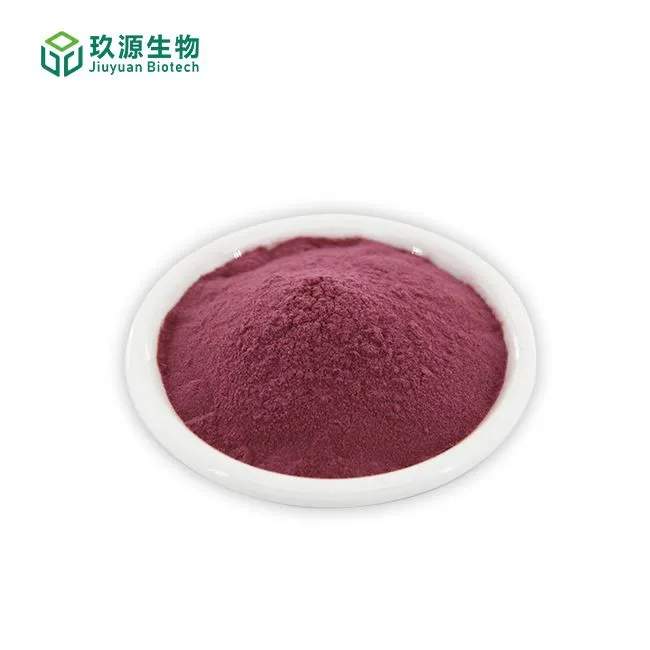
Product Overview
Here's the problem that most formulators and procurement managers run into: the elderberry ingredient market is deeply inconsistent. "Elderberry powder" listed at a dozen different price points with almost no standardization transparency. Some products declare polyphenol content by a colorimetric method that measures everything - including non-anthocyanin compounds that contribute nothing to the ingredient's core bioactivity. Others omit anthocyanin data entirely. The result is that two products with identical label claims can differ by an order of magnitude in actual potency.
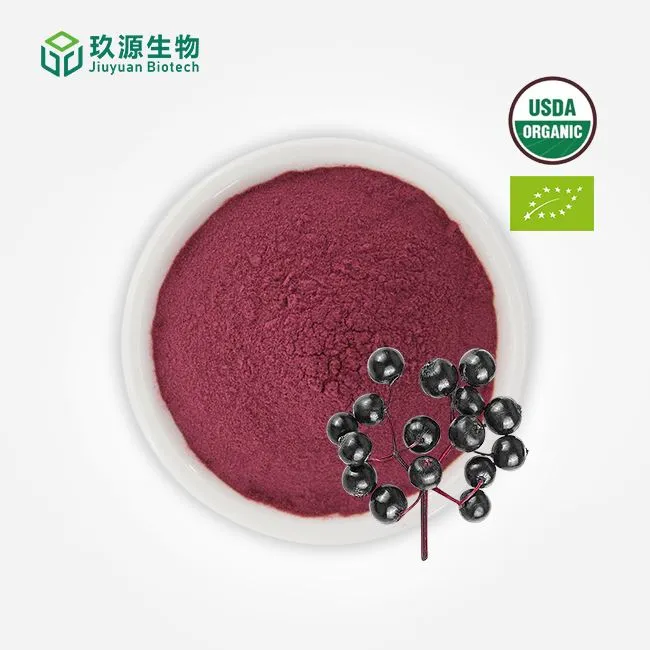
Organic Elderberry Powder from JiuYuan Biotech is built around a different premise: that the only number that matters on a elderberry ingredient specification is the HPLC-verified anthocyanin content, because anthocyanins - specifically cyanidin-3-glucoside and cyanidin-3-sambubioside - are the primary bioactive drivers behind elderberry's immune-modulating, antioxidant, and anti-inflammatory activity. Our standard grade is standardized to a minimum of 1.5% anthocyanins (HPLC), and our concentrated grade to 3.0%, with full chromatographic data available for every production batch.
Certificate of Analysis
|
Item |
Specification |
Result |
Method |
|
Basic Product Information |
|||
| Botanical Source | Sambucus L. |
Conforms |
/ |
|
Part of the Plant |
Fruit |
Conforms |
/ |
|
Marker Compounds |
|||
|
Assay |
>90% |
Conforms |
TLC |
|
Organoleptic Data |
|||
|
Appearance |
Fine Powder |
Conforms |
Sensory |
|
Color |
Purple |
Conforms |
Sensory |
|
Odor |
Characteristic |
Conforms |
Sensory |
|
Process Data |
|||
|
Method of Processing |
Extraction and concentration |
/ |
/ |
|
Drying Method |
Spraying drying |
/ |
/ |
|
Physical Characteristics |
|||
|
Particle Size |
100% pass 80 mesh |
100% pass |
AOAC973.03 |
|
Moisture |
≤5.0% |
3.4% |
GB/T5009.3 |
|
Ash Content |
≤7.0% |
6.1% |
CP2010 |
|
Heavy Metals |
|||
|
Total Heavy Metals |
<10ppm Max. |
Conforms |
GB 5009.74 |
|
As |
≤0.5 ppm |
0. 11ppm |
GB/T5009. 11 |
|
Pb |
≤1.0 ppm |
0.31ppm |
GB/T5009. 12 |
|
Cd |
≤0.2 ppm |
0. 12ppm |
GB/T5009. 15 |
|
Hg |
≤0.05 ppm |
0.012ppm |
GB/T5009. 17 |
|
Microbiology |
|||
|
Total Plate Count |
≤10000 cfu/g |
1800cfu/g |
GB/T4789.2 |
|
Total Yeast & Mold |
≤200 cfu/g |
40cfu/g |
GB/T4789. 15 |
|
E.Coli |
Negative/ 10g |
Negative/ 10g |
SN0169 |
|
Salmonella |
Negative/ 10g |
Negative/ 10g |
GB/T4789.4 |
|
Shelf Life |
24 months under the conditions above and in its original packaging. |
||
|
Storage |
Store in a cool & dry place, keep away from strong light and heat. |
||

Production Process
High-quality organic elderberry powder typically follows a stringent process to ensure the concentration and stability of the active ingredients:
1. Pre-treatment of Raw Materials
● Selection and Cleaning: Organic elderberry raw material (fruit or flower) undergoes strict selection to remove impurities. It is then cleaned to ensure hygiene and organic compliance.
● Grinding/Crushing: The cleaned raw material is preliminarily pulverized or crushed to increase the surface area, facilitating subsequent extraction.
2. Extraction
● Extraction: This crucial step uses water, ethanol (alcohol), or a mixture of both as the solvent to extract the active compounds (such as anthocyanins and polyphenols) from the elderberry. Extraction is typically carried out under controlled temperature and time.
● Filtration: The resulting liquid is separated from the elderberry residue to obtain a clear extract solution.
3. Concentration
● Concentration: Since the active ingredient content in the extract solution is low, most of the solvent (water or ethanol) needs to be evaporated using methods like vacuum concentration at low temperatures, turning the extract into a thick paste (a high-concentration viscous liquid).
4. Spray Drying
● Addition of Carrier (Optional but Common): Before spray drying, a suitable amount of a carrier (such as organic-certified maltodextrin, gum arabic, etc.) is often added to the thick paste. The carrier serves to: protect the active ingredients (especially heat-sensitive ones); prevent the concentrate from sticking to the dryer walls; and improve the final powder's flowability.
● Spray Drying: This is the core step. The concentrated liquid or paste is pumped into a spray dryer tower. It is atomized into extremely fine droplets by an atomizer (such as a centrifugal disc or pressure nozzle). These droplets come into contact with hot air inside the tower, causing the moisture to evaporate rapidly and instantaneously drying them into powder.
Note: To maximize the retention of the elderberry's biological activity and organic integrity, the temperature and time of the spray drying process must be precisely controlled.
5. Post-processing and Packaging
● Collection and Cooling: The dried powder is collected from the bottom of the tower or cyclone separator and rapidly cooled.
● Grinding/Sifting: The crude powder may require further grinding and sifting to achieve a uniform fineness (mesh size) that meets requirements.
● Mixing: After passing quality inspection, the powder may be mixed with other excipients if necessary.
● Packaging: Finally, the finished powder is hermetically sealed in packaging materials that are typically light- and moisture-proof, labeled with organic certification, and then ready for storage and sale.

Active Compounds & Phytochemical Profile
The bioactivity of Sambucus nigra fruit is not the work of a single compound - it emerges from a structurally diverse phytochemical matrix in which anthocyanins play the lead role but are meaningfully supported by flavonols, phenolic acids, and triterpenes.
The Anthocyanin Core
Anthocyanins constitute approximately 80% of the total polyphenol content in elderberry fruit - an unusually high proportion that distinguishes elderberry from most other anthocyanin-containing botanicals. The two dominant species are:
● Cyanidin-3-sambubioside - the most abundant anthocyanin in S. nigra, contributing the characteristic deep violet pigmentation and exhibiting potent free-radical scavenging activity
● Cyanidin-3-glucoside - extensively studied for its capacity to inhibit influenza virus hemagglutinin binding to host cell sialic acid receptors, a mechanism that has attracted significant pharmaceutical research interest
Minor anthocyanins including cyanidin-3-rutinoside and cyanidin-3-sambubioside-5-glucoside are also present and contribute to the overall bioactive profile.
Supporting Phytochemicals
|
Compound Class |
Key Constituents |
Documented Bioactivity |
|
Flavonols |
Quercetin, Rutin, Isorhamnetin |
Anti-inflammatory, antioxidant, capillary-protective |
|
Phenolic Acids |
Chlorogenic acid, Neochlorogenic acid, Caffeic acid |
Antioxidant, hepatoprotective, antiviral |
|
Triterpenes |
α-Amyrin, β-Amyrin, Ursolic acid, Oleanolic acid |
Anti-inflammatory, antiviral |
|
Lectins |
Sambucus nigra agglutinin (SNA) |
Hemagglutinin-binding, immune signaling |
|
Vitamins |
Ascorbic acid (Vitamin C), Provitamin A |
Immune cofactors, antioxidant synergy |
|
Minerals |
Potassium, Iron, Phosphorus, Calcium |
Nutritional contribution |
Immune-Modulating Mechanisms
Research has identified several distinct mechanisms through which elderberry bioactives interact with immune function:
1. Cytokine induction: Elderberry preparations have been shown to stimulate production of pro-inflammatory cytokines (TNF-α, IL-1β, IL-6, IL-8) in monocytes at low concentrations, suggesting an immunostimulatory effect relevant to innate immune activation
2. Viral adhesion inhibition: Cyanidin glycosides can bind to influenza virus surface proteins, physically impeding viral attachment to host epithelial cells
3. Phagocyte activation: Elderberry polyphenols have demonstrated the capacity to activate and mobilize phagocytic immune cells, enhancing pathogen clearance
4. Antioxidant defense: The high anthocyanin load contributes to measurable reduction in oxidative stress markers, relevant to both immune function and broader cellular health
Application Matrix
The formulation versatility of elderberry powder extends well beyond the immune supplement aisle. Here's how leading brands are deploying this ingredient across categories.
|
Application Sector |
Product Format |
Recommended Grade |
Functional Claim Angle |
|
Immune Health Supplements |
Capsules, tablets, softgels |
Concentrated (3.0%) |
Standardized anthocyanin dose per serving |
|
Gummy Supplements |
Pectin or gelatin gummies |
Standard (1.5%) |
Natural color + flavor contribution |
|
Functional Beverages |
RTD drinks, effervescent tablets, powdered drink mixes |
Standard (1.5%) |
Water dispersibility, natural violet color |
|
Children's Immune Formulas |
Liquid syrups, chewable tablets |
Standard (1.5%) |
Familiar taste, clean-label organic |
|
Functional Foods |
Granola bars, yogurt coatings, baked goods |
Standard (1.5%) |
Organic certification, antioxidant positioning |
|
Healthy Aging / Longevity |
Capsules, powder blends |
Concentrated (3.0%) |
Antioxidant + anti-inflammatory stack |
|
Neuroprotective Formulas |
Nootropic capsules, powder blends |
Concentrated (3.0%) |
Emerging neuroprotective evidence |
|
Cosmeceuticals |
Antioxidant serums, facial masks |
Concentrated (3.0%) |
High-polyphenol topical antioxidant |
|
Pet Supplements |
Immune chews, soft treats |
Standard (1.5%) |
Natural, recognizable botanical |
Quality Control
Our QC architecture for organic elderberry powder is built around three non-negotiable commitments: organic chain-of-custody integrity, phytochemical accuracy, and microbiological safety. These are not aspirational standards - they are operationalized through documented procedures at every production stage.
Incoming Material Controls
● Botanical identity: macroscopic examination, microscopy, and HPLC fingerprint against reference standard
● Pesticide multi-residue screen: GC-MS/MS covering >500 compounds, benchmarked against EU Regulation 396/2005 MRLs
● Mycotoxin panel: Aflatoxins B1/B2/G1/G2 and Ochratoxin A by HPLC-MS/MS
● Heavy metals: ICP-MS (Pb, As, Cd, Hg)
● Organic certification chain-of-custody document verification
In-Process Monitoring
● Juice Brix and pH at concentration stage
● Inlet/outlet temperature logging and deviation alerts during spray drying
● Intermediate anthocyanin spot-check by UV-Vis before drying commitment
● Moisture check post-drying before blending
Finished Product Release Testing
Every batch is held for release pending completion of the full analytical panel:
● Anthocyanin content: HPLC (primary potency specification)
● Total polyphenols: Folin-Ciocalteu colorimetric method
● Sambunigrin: HPLC safety screen (must be ND)
● Microbiological: TPC, Y&M, E. coli, Salmonella, S. aureus
● Pesticide residues: GC-MS/MS
● Heavy metals: ICP-MS
● Moisture: Karl Fischer titration
Full CoA, HPLC chromatogram, and third-party verification reports are available for every released batch.

Comparison: JiuYuan Biotech vs. Market Alternatives
The elderberry ingredient market spans a wide quality spectrum. Understanding where different supplier categories sit helps procurement teams make defensible sourcing decisions.
|
Evaluation Criterion |
JiuYuan Bio |
Generic Asian Commodity |
Premium European Brand |
|
Anthocyanin Verification |
HPLC, per batch, chromatogram available |
Often colorimetric estimate only |
HPLC, per batch |
|
Organic Certification Scope |
USDA + EU (dual, full chain) |
Rarely certified |
EU Organic typically |
|
Sambunigrin Safety Testing |
Yes - every batch |
Rarely disclosed |
Yes |
|
Mycotoxin Testing |
Full panel per batch |
Inconsistent |
Yes |
|
Carrier Agent Transparency |
Declared (organic tapioca maltodextrin) |
Often undisclosed |
Declared |
|
Pesticide Standard |
EU Reg. 396/2005 |
Variable |
EU standard |
|
MOQ |
1 kg |
5–25 kg |
10–25 kg |
|
Price Positioning |
Competitive mid-range |
Low (quality variable) |
Premium |
|
Technical Formulation Support |
Dedicated R&D team |
Sales team only |
Available |
|
Custom Purity / Mesh |
Yes |
Rarely |
Limited |
|
Lead Time |
7–14 business days |
14–30 days |
14–21 days |
The most consequential difference between JiuYuan Bio and generic commodity suppliers is not price - it's analytical transparency. The most consequential difference versus premium European brands is cost efficiency and MOQ flexibility, with no compromise on certification depth or testing rigor.
Why Choose jiuyuan Biotech?
● Founded: 2012, based in Xi'an at the northern foot of the Qinling Mountains.
● Business Scope: A high-tech enterprise specializing in the R&D, production, and sales of plant extracts and fruit and vegetable powders.
● Mission: Committed to providing high-quality products and services to the health food, food, and cosmetics industries, to lead China's plant extract sector.
● R&D and Quality Control:
Equipped with advanced testing equipment, including HPLC and UV spectrometers, for precise analysis of active ingredient content and purity.
A professional testing team provides detailed product analysis reports to ensure quality and safety.
● Supply Chain Management:
Maintains long-term, stable partnerships with local farmers.
Utilizes a contract farming and procurement model to guarantee a consistent supply of high-quality raw materials.
● Production and Warehousing:
Boasts comprehensive production facilities with advanced equipment and automated lines to meet large-volume demands.
Our robust warehousing system ensures optimal storage conditions, maintaining product quality and stability.

Delivery Methods, Packages And Storage
 |
 |
 |
|
Express Under 100kg, 3-5Days Door-to-door service easy to pick up the goods |
By Sea Over300kg, Around 30 Days Port-to-port service professional clearance broker needed |
By Air 100kg-1000kg, 5-7Days Airport-to-airport service professional clearance broker needed |
FAQ
Q1: How is anthocyanin content in elderberry powder measured, and why does the method matter?
Anthocyanin content can be measured by several methods, and the choice of method significantly affects the reported value. The pH differential method (spectrophotometric) is simpler and faster but measures total monomeric anthocyanins without distinguishing individual species - it can overestimate potency if degradation products are present. HPLC with UV-Vis or DAD detection against certified reference standards (cyanidin-3-glucoside chloride) is the gold standard: it identifies and quantifies individual anthocyanin species separately, providing a defensible, reproducible potency figure. JiuYuan Bio uses HPLC as the primary release specification for all elderberry batches.
Q2: What distinguishes cyanidin-3-sambubioside from cyanidin-3-glucoside, and does it matter for formulation?
Both are cyanidin-based anthocyanins, but they differ in the sugar moiety attached to the cyanidin aglycone: sambubioside carries a disaccharide (sambubiose), while glucoside carries a monosaccharide (glucose). Cyanidin-3-sambubioside is the dominant anthocyanin in Sambucus nigra by concentration. Cyanidin-3-glucoside has attracted more antiviral research attention due to its hemagglutinin-binding properties. For most commercial formulation purposes, the distinction is less important than the total anthocyanin concentration - but for pharmaceutical research applications requiring specific compound isolation, the relative ratio matters and should be confirmed by HPLC.
Q3: Is elderberry powder safe for use in children's supplement formulations?
Properly processed elderberry powder from ripe Sambucus nigra fruit - with stems, leaves, and unripe berries excluded - has a well-documented safety profile and is widely used in pediatric immune formulations globally. The primary safety consideration is ensuring the absence of sambunigrin, a cyanogenic glycoside concentrated in non-fruit plant parts. JiuYuan Bio screens every batch for sambunigrin by HPLC. For specific pediatric dosing recommendations, formulators should reference current clinical literature and applicable regulatory guidelines in their target market.
Q4: How does elderberry powder perform in gummy formulations?
Elderberry powder is one of the more gummy-friendly botanical ingredients due to its natural deep violet color, tart flavor profile, and water dispersibility. Key formulation considerations include: (1) pH - gummy matrices are typically acidic (pH 3.5–4.5), which is favorable for anthocyanin stability; (2) processing temperature - gummy manufacturing involves heat exposure, so an accelerated stability study at processing temperatures is advisable; (3) light stability - finished gummies should use opaque or UV-blocking packaging to retard anthocyanin photodegradation. The natural color contribution of elderberry powder can reduce or eliminate the need for synthetic colorants, which is a meaningful clean-label advantage.
Q5: What is the recommended use level in immune support capsule formulations?
Published clinical investigations on elderberry immune support have used preparations delivering the equivalent of approximately 500 mg to 1,500 mg of elderberry fruit equivalent per day, typically in divided doses. For JiuYuan Bio's standard 1.5% anthocyanin grade, a 500 mg capsule delivers approximately 7.5 mg of anthocyanins per serving - a dosage consistent with commercially established elderberry supplement products. Formulators targeting a higher anthocyanin dose per capsule should consider the concentrated 3.0% grade to reduce fill weight. Always align dosing with your specific product claim and target market regulatory requirements.
Q6: What is the current regulatory status of elderberry in the EU Novel Food framework?
Sambucus nigra fruit and preparations derived from it have a documented history of consumption in the EU predating May 1997 - the reference date for Novel Food classification under Regulation (EU) 2015/2283. Elderberry is therefore not classified as a Novel Food in the EU and does not require pre-market authorization under the Novel Food framework. It is covered by an EMA HMPC community herbal monograph for traditional use. Buyers should note that specific health claims require authorization under Regulation (EC) 1924/2006 and should consult their regulatory affairs team for claim substantiation strategy.
Q7: Can elderberry powder be combined with zinc and vitamin C in a combination immune formula?
Yes - this is one of the most commercially established combination formats in the immune supplement category. Vitamin C (ascorbic acid) provides antioxidant synergy and can act as a co-stabilizer for anthocyanins in acidic matrices. Zinc contributes complementary immune-supporting mechanisms (T-cell function, barrier integrity) that are mechanistically distinct from elderberry's cytokine-modulating and antiviral activity. The three ingredients are considered compatible from both a formulation chemistry and a regulatory claim perspective in most major markets. Stability testing of the combination in your specific matrix is still recommended, as zinc ions can catalyze oxidation of polyphenols under certain conditions.
Q8: Does JiuYuan Bio offer OEM/ODM finished product services in addition to bulk raw material supply?
Yes. Beyond bulk ingredient supply, JiuYuan Bio operates an OEM/ODM division capable of producing finished elderberry supplement products in capsule, tablet, softgel, gummy, and powder sachet formats. Our in-house R&D team can assist with formulation development, stability protocol design, label compliance review, and packaging specification. MOQ and lead times vary by format and order volume - contact our commercial team with your product brief for a detailed proposal.
Request a Sample or Commercial Quote
Jiuyuan Biotech supplies Organic Elderberry Powder to food manufacturers, supplement brands, and contract formulators across North America, Europe, and the Asia-Pacific region. Our technical team - not a generic sales inbox - handles every inquiry.
Email: info@jiuyuanbio.com
Website: www.jiuyuanbio.com
Request: Sample (500g–1kg) | Bulk Quote | CoA & Spec Sheet | Custom Carrier Ratio
Standard response time: within 1 business day. Please include your target application and annual volume estimate for the most relevant technical recommendation.
Hot Tags: organic elderberry powder, China organic elderberry powder manufacturers, suppliers, factory


