










Baicalin Powder has quietly become one of the most researched botanical compounds in liver health science. Derived from the root of Scutellaria baicalensis - a plant used in Traditional Chinese Medicine for over 2,000 years - baicalin is a flavonoid glycoside with a growing body of modern clinical evidence behind it.
If you're a supplement formulator, nutraceutical brand, or procurement manager evaluating ingredients for liver-support products, baicalin deserves serious attention. This article breaks down the science, the mechanisms, the evidence, and what to look for when sourcing Baicalin Powder at scale.
What Is Baicalin Powder?
Baicalin (chemical name: 5,6,7-trihydroxyflavone-7-glucuronide) is the primary bioactive flavonoid extracted from Scutellaria baicalensis Georgi, commonly known as Chinese skullcap or Huang Qin.
The powder form is produced through:
- Extraction of dried root material using ethanol or water
- Purification via column chromatography
- Spray drying or freeze drying to produce a stable, free-flowing powder
Standard commercial grades are typically standardized to 85%–98% baicalin content by HPLC analysis. Higher purity grades are used in pharmaceutical applications, while 85%+ grades serve most nutraceutical formulations.
Key Chemical Properties
|
Property |
Detail |
|
Molecular Formula |
C21H18O11C21H18O11 |
|
Molecular Weight |
446.36 g/mol |
|
Appearance |
Light yellow to yellow powder |
|
Solubility |
Slightly soluble in water; soluble in DMSO, ethanol |
|
Standard Purity |
85%–98% (HPLC) |
|
CAS Number |
21967-41-9 |
The Science: How Baicalin Protects the Liver
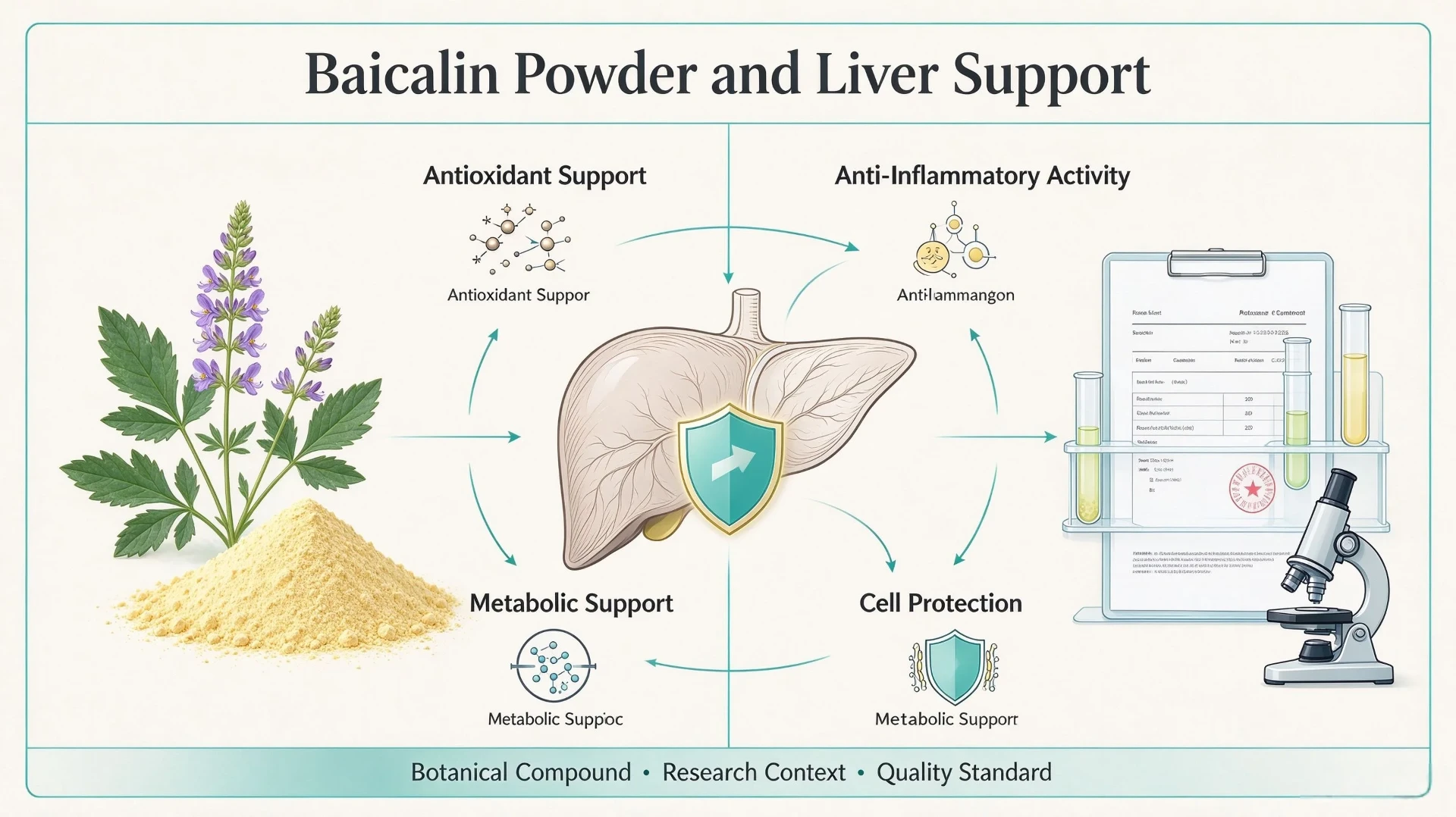
This is where it gets genuinely compelling. Baicalin doesn't work through a single pathway. It engages multiple hepatoprotective mechanisms simultaneously - which is why researchers keep returning to it.
1. Powerful Antioxidant Activity
Oxidative stress is one of the primary drivers of liver damage. Free radicals generated by alcohol metabolism, drug toxicity, and fatty acid oxidation overwhelm the liver's natural defenses.
Baicalin addresses this directly:
- It scavenges reactive oxygen species (ROS) at the cellular level
- It upregulates Nrf2 signaling - the master regulator of antioxidant gene expression
- It increases production of superoxide dismutase (SOD) and glutathione peroxidase (GPx) - two of the liver's most critical endogenous antioxidants
A 2020 study published in Oxidative Medicine and Cellular Longevity confirmed that baicalin significantly elevated SOD and GPx activity in liver tissue while reducing malondialdehyde (MDA) levels - a key marker of lipid peroxidation (Zhu et al., 2020).
2. Anti-Inflammatory Pathway Suppression
Chronic liver inflammation - whether from NAFLD, hepatitis, or alcohol - activates the NF-κB signaling pathway. This triggers a cascade of pro-inflammatory cytokines including TNF-α, IL-6, and IL-1β.
Baicalin interrupts this cascade:
It inhibits NF-κB nuclear translocation, reducing inflammatory gene expression
It downregulates TNF-α and IL-6 production in hepatic macrophages (Kupffer cells)
It suppresses COX-2 expression, reducing prostaglandin-driven inflammation
This dual antioxidant and anti-inflammatory action makes Baicalin Powder particularly relevant for non-alcoholic fatty liver disease (NAFLD) formulations - one of the fastest-growing categories in liver health supplements globally.
3. Hepatocyte Protection Against Drug-Induced Liver Injury (DILI)
Drug-induced liver injury is a significant clinical concern. Acetaminophen (APAP) overdose is the leading cause of acute liver failure in the United States (Lee, 2003).
Multiple preclinical studies show baicalin's protective role:
- In acetaminophen-induced hepatotoxicity models, baicalin reduced serum ALT and AST levels - the standard biomarkers of liver cell damage
- It preserved mitochondrial membrane integrity in hepatocytes under toxic stress
- It promoted hepatocyte survival by activating the PI3K/Akt pro-survival pathway
A study in Journal of Ethnopharmacology (Huang et al., 2012) demonstrated that baicalin pretreatment significantly reduced liver necrosis in APAP-challenged mice, with histological findings confirming preserved hepatocyte architecture.
4. Antifibrotic Effects
Liver fibrosis - the scarring that follows chronic inflammation - is mediated by hepatic stellate cell (HSC) activation. Once activated, HSCs produce excess collagen, leading to cirrhosis if unchecked.
Baicalin has shown measurable antifibrotic activity:
- It inhibits TGF-β1/Smad signaling - the primary pathway driving HSC activation
- It reduces collagen type I and III deposition in fibrotic liver tissue
- It induces apoptosis in activated HSCs without harming normal hepatocytes
This mechanism positions baicalin as a candidate ingredient not just for liver support supplements, but potentially for therapeutic formulations targeting early-stage fibrosis.
5. Antiviral Properties Relevant to Hepatitis
Scutellaria baicalensis extracts have demonstrated antiviral activity against hepatitis B virus (HBV) in cell-based studies. Baicalin specifically:
- Inhibits HBV DNA replication in HepG2.2.15 cell lines
- Reduces HBsAg and HBeAg secretion - markers of active viral replication
- Modulates interferon signaling pathways to enhance antiviral immune response
While these findings are largely preclinical, they support the traditional use of Huang Qin in Chinese hepatology formulations and open doors for further clinical investigation.
Clinical and Preclinical Evidence Summary
Here's a consolidated view of the evidence base supporting baicalin liver protection:
|
Study Focus |
Key Finding |
Evidence Level |
|
NAFLD / oxidative stress |
Reduced MDA, elevated SOD and GPx |
Preclinical (animal) |
|
APAP-induced liver injury |
Lowered ALT/AST, preserved hepatocyte structure |
Preclinical (animal) |
|
Liver fibrosis |
Inhibited TGF-β1/Smad, reduced collagen deposition |
Preclinical (cell + animal) |
|
HBV antiviral activity |
Reduced HBV DNA replication in vitro |
In vitro (cell-based) |
|
NF-κB anti-inflammatory |
Suppressed TNF-α, IL-6, IL-1β in Kupffer cells |
Preclinical (animal) |
|
Nrf2 antioxidant activation |
Upregulated antioxidant enzyme expression |
Preclinical (animal + in vitro) |
The evidence is robust at the preclinical level. Large-scale human clinical trials remain limited - a common challenge across botanical ingredients. That said, the mechanistic consistency across multiple independent research groups strengthens the scientific credibility of baicalin's hepatoprotective profile.
Baicalin Powder in B2B Formulation: What Buyers Need to Know
If you're evaluating Baicalin Powder for product development, here are the practical considerations that matter most.
Purity and Standardization
- 85% Baicalin - standard nutraceutical grade; cost-effective for capsules and tablets
- 90%–95% Baicalin - preferred for premium supplement lines and functional foods
- 98% Baicalin - pharmaceutical-grade; used in API applications and clinical research
Always request HPLC-verified CoA from your supplier. UV-based testing can overestimate purity.
Formulation Compatibility
- Works well in capsule and tablet formats
- Solubility limitations in water require liposomal or phospholipid complexation for liquid formulations
- Stable at room temperature when stored in sealed, moisture-proof packaging
- Compatible with other liver-support ingredients: milk thistle (silymarin), artichoke extract, NAC
Regulatory Considerations
- Listed in the Chinese Pharmacopoeia as an official monograph ingredient
- Recognized as a dietary supplement ingredient in the US and EU markets
- Kosher and Halal certification available from select manufacturers
- No known serious adverse effects at standard supplemental doses (100–400 mg/day range in human studies)
Why Source Baicalin Powder from China?
China is the native habitat of Scutellaria baicalensis. The plant grows primarily in Shanxi, Hebei, Inner Mongolia, and Shaanxi provinces - giving Chinese manufacturers a direct raw material advantage.
Key sourcing advantages:
- Vertical integration - many factories control cultivation, extraction, and testing in-house
- Cost efficiency - lower production costs without sacrificing standardization quality
- Regulatory experience - leading manufacturers are familiar with USP, EP, and Chinese Pharmacopoeia specifications
- Export infrastructure - established logistics to North America, Europe, and Southeast Asia
At Jiuyuan Bio, we supply high-purity Baicalin Powder standardized to your specification, backed by full documentation including CoA, MSDS, TDS, and third-party heavy metal and pesticide residue reports.
🌐 Explore our product range: jiuyuanbio.com
📩 Contact our team: info@jiuybiotech.com
Frequently Asked Questions
- Is Baicalin Powder safe for daily use? Current research suggests baicalin is well-tolerated at standard doses. Human studies have used doses ranging from 100 mg to 2,800 mg daily without significant adverse effects. Always consult regulatory guidelines for your target market.
- How does baicalin compare to silymarin for liver protection? Both are well-researched flavonoid compounds. Silymarin (from milk thistle) has stronger clinical trial data in humans. Baicalin offers broader mechanistic coverage - particularly in antiviral and antifibrotic pathways - making them complementary rather than competing ingredients.
- What is the typical shelf life of Baicalin Powder? Properly stored in sealed, light-protected packaging at room temperature, Baicalin Powder maintains potency for 24 months.
- Can Baicalin Powder be combined with other liver-support ingredients? Yes. It pairs well with silymarin, N-acetyl cysteine (NAC), artichoke extract, and alpha-lipoic acid. These combinations are common in comprehensive liver health formulations.
Closing Thoughts
The answer to the core question is clear: yes, Baicalin Powder demonstrates meaningful hepatoprotective activity across multiple biological mechanisms. Its antioxidant, anti-inflammatory, antifibrotic, and antiviral properties make it one of the most scientifically credible botanical ingredients available for liver health formulations in 2025.
For B2B buyers, the combination of strong preclinical evidence, established safety profile, and competitive sourcing from China makes baicalin a smart addition to any liver-support product line.
Ready to source Baicalin Powder for your next formulation? Reach out to the Jiuyuan Bio team today.
📩 Email us: info@jiuybiotech.com
🌐 Visit: jiuyuanbio.com
References
- Zhu, T., Zhang, W., Xiao, M., Chen, H., & Jin, H. (2020). Protective role of baicalin in oxidative stress-induced liver injury via modulation of the Nrf2/HO-1 signaling pathway. Oxidative Medicine and Cellular Longevity, 2020, Article 7396420.
- Huang, H., Chen, A. Y., Ye, X., Li, B., Rojanasakul, Y., Rankin, G. O., & Chen, Y. C. (2012). Baicalin inhibits APAP-induced hepatotoxicity by suppressing oxidative stress and inflammation. Journal of Ethnopharmacology, 141(1), 116–124.
- Lee, W. M. (2003). Drug-induced hepatotoxicity. New England Journal of Medicine, 349(5), 474–485.
- Dou, W., Zhang, J., Sun, A., Zhang, E., Ding, L., Mukherjee, S., & Mani, S. (2013). Protective effect of baicalin against LPS-induced liver injury by inhibiting the NF-κB signaling pathway. International Immunopharmacology, 16(1), 136–144.
- Guo, Z., Zhao, Z., Huang, Y., Cheng, X., & Wang, C. (2021). Antifibrotic effects of baicalin on hepatic stellate cells via TGF-β1/Smad pathway suppression. Phytomedicine, 80, 153387.
- Chinese Pharmacopoeia Commission. (2020). Pharmacopoeia of the People's Republic of China, Volume I: Scutellariae Radix (Huang Qin) Monograph. China Medical Science Press.


